
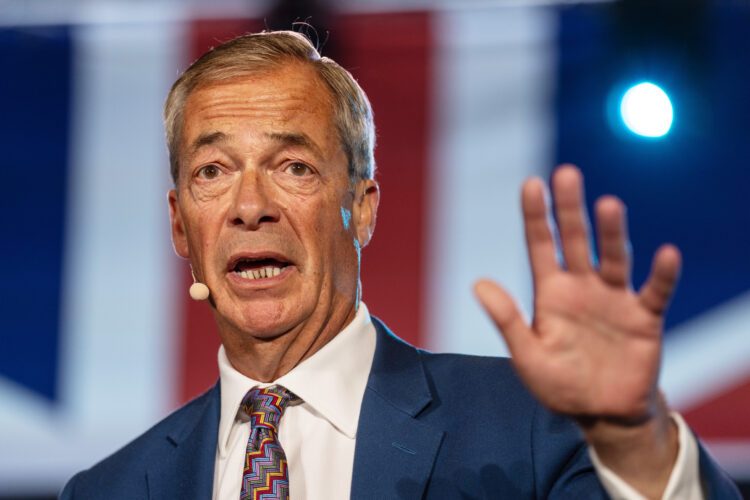
Well, this is something. Nigel Farage, the firebrand who has spent his career ripping into immigrants and fraternising with some of the most polarising figures in world politics, now looks like he is attempting to put the genie back in the bottle – following comments he made to The Telegraph this weekend.
After years of fanning the flames, Nigel Farage is now ‘worried’ about the far-right
The Reform leader has been unapologetic in expressing his conservative viewpoints over the years. But critics argue he has gone much further than that, pointing to accusations of racism and antisemitism during his days as a student, and the mistruths he peddled in order to deliver Brexit.
Farage is also someone who has previously been happy to be judged by the company he keeps. A close confidante of Donald Trump – at least up until the president tired of him – has also expressed his support for controversial right-wing figures such as Javier Milei, Marine Le Pen, and Elon Musk.
Whatever his associations, the ‘far-right’ tag attached to Mr. Farage has largely been acquired through his own actions. The 61-year-old has done more than most to stir-up anti-immigration sentiment since the turn of the century – but he now feels there are others who are taking it too far.
Reform leader thrown by his ‘intelligent friends’ entertaining pro-Nazi narratives
Referring to recent comments made by Tucker Carlson, the Clacton MP said he was ‘astonished’ to hear the prominent US broadcaster question if winning World War II was ‘good for the UK’. He believes there’s now a growing trend of people on the right somewhat sympathising with Hitler and the Nazis.
Whether a bout of self-awareness follows remains to be seen. But Farage directly stated that the far-right are now ‘a cause for concern’. Go figure…
Without a Hint of Irony, Nigel Farage Says He Is Now ‘Worried About the Far-Right’
Nigel Farage has sparked a fresh political debate after declaring that he is increasingly worried about the far-right, both in Britain and the United States. The Reform UK leader made the comments in an interview with The Telegraph, expressing concern about the growing popularity of extreme political narratives and the apparent willingness of some conservative commentators to question Britain’s role in defeating Nazi Germany during the Second World War.
His remarks have attracted attention because of his long political career campaigning against immigration, his associations with controversial right-wing political figures and his position as one of Britain’s most prominent populist politicians.
Farage specifically criticised American broadcaster Tucker Carlson, whom he described as someone he had previously regarded as a friend. He said he was astonished by Carlson’s recent remarks questioning whether Britain should have fought against Adolf Hitler.
“We know about the extreme left, but I’m also worried about the far-right, both here and in America,” Farage said.
The comments represent an interesting development in Britain’s political debate. For years, Farage has been associated with a political movement that has challenged immigration policies, criticised multiculturalism and promoted a more nationalist approach to British politics.
Now, he is publicly warning that the political right itself could be moving in a dangerous direction.
The intervention has prompted questions about where Farage believes the boundaries of acceptable political conservatism should lie and whether his comments represent a broader attempt to distance himself and Reform UK from extremist movements.
Tucker Carlson’s Controversial Comments About Hitler
At the centre of the controversy are comments attributed to Tucker Carlson, the influential American conservative broadcaster and political commentator.
Farage expressed particular concern about Carlson and other conservative commentators questioning whether the Allied decision to fight Nazi Germany was justified.
For British audiences, such arguments are especially sensitive because the Second World War occupies a central place in the country’s national history.
Britain’s involvement in the war, the sacrifices made by its armed forces and civilians, and the eventual defeat of Nazi Germany remain fundamental elements of national remembrance.
Farage said he was astonished that someone he had considered a friend could entertain such arguments.
His criticism is significant because Carlson has been an influential figure within American conservative media and has attracted considerable attention through his interviews with controversial political personalities.
The disagreement illustrates a growing division within international right-wing politics.
While some conservative movements focus on immigration, national sovereignty and opposition to progressive politics, others have increasingly embraced historical revisionism and narratives that challenge established interpretations of the Second World War.
Farage appears to be drawing a distinction between the political conservatism he supports and the more extreme ideological positions he now considers dangerous.
However, the precise boundaries of that distinction remain open to debate.
Farage’s Political Past Comes Under Renewed Scrutiny
Farage’s warning has inevitably attracted criticism because of his own political history.
Throughout his career, he has built a political identity around opposition to immigration, criticism of the European Union and demands for tighter national borders.
As leader of UKIP, the Brexit Party and now Reform UK, he has repeatedly challenged Britain’s established political consensus.
His supporters argue that he has raised legitimate concerns about immigration, national identity and democratic accountability that mainstream politicians have often ignored.
However, critics have accused him of contributing to an increasingly hostile political environment towards immigrants and minority communities.
Farage has also faced allegations concerning racist and antisemitic comments allegedly made during his school years. He has consistently denied these allegations.
His political associations have also attracted scrutiny. He has maintained relationships with prominent figures including Donald Trump, Elon Musk, Marine Le Pen and Argentina’s Javier Milei.
These connections have contributed to questions about the ideological direction of Reform UK and its relationship with international populist movements.
Consequently, when Farage suddenly declares that he is worried about the far-right, critics are asking whether he is recognising a genuine political danger or attempting to establish clearer boundaries around his own political movement.
The distinction matters because opposition to immigration or support for national sovereignty is not automatically equivalent to far-right extremism. Equally, explicitly antisemitic, racist or pro-Nazi narratives cannot simply be dismissed as ordinary conservative political opinions.
A Growing Problem for the International Right
Farage’s comments also highlight a broader disagreement within conservative politics on both sides of the Atlantic.
In recent years, right-wing political movements have become increasingly diverse. Traditional conservatives, nationalist politicians, anti-establishment campaigners and more extreme ideological groups have sometimes found common ground in their opposition to progressive political movements.
However, this cooperation can become complicated when controversial historical or ideological positions emerge.
The controversy surrounding Carlson demonstrates this difficulty.
For politicians such as Farage, maintaining relationships with influential American conservative figures can provide international visibility and political opportunities. Yet those relationships can also become uncomfortable when prominent allies express views that are difficult to defend within Britain’s political environment.
Farage’s criticism suggests that he does not want his political movement associated with arguments that question the legitimacy of Britain’s fight against Nazi Germany.
His intervention also raises an important question: how should mainstream conservative politicians respond when influential figures within their wider political networks begin promoting extremist narratives?
This is particularly relevant for Reform UK, which has been attempting to establish itself as a serious political alternative rather than simply an anti-establishment protest movement.
Reform UK and the Controversy Over Extremism
Farage’s remarks come amid continued scrutiny of Reform UK’s candidates, representatives and internal political culture.
In October 2026, an ITV investigation raised allegations about racist, Islamophobic and misogynistic comments made by some individuals associated with the party.
The investigation also included footage of internal disagreements concerning the handling of controversial candidates.
Reform representatives have disputed aspects of the criticism, while Farage has faced questions about the party’s approach to candidate selection and disciplinary procedures.
The controversy has placed additional attention on the distinction between the party’s official political programme and the views expressed by individual supporters and representatives.
For any political organisation seeking national influence, candidate vetting and internal accountability are important considerations.
Farage’s latest comments could therefore be understood as an attempt to establish a clearer public distinction between Reform UK’s political objectives and openly extremist ideologies.
However, whether that distinction is consistently reflected in the party’s organisation and candidate-selection practices is a separate question.
Robert Jenrick, who joined Reform UK after leaving the Conservatives, previously defended Farage against accusations that the party was accommodating extremist views. He argued that Farage had done considerable work opposing racism and the far right.
Nevertheless, the allegations surrounding individual candidates and activists have continued to generate political debate.
Why Remembrance Day Matters to Farage
Farage made his comments in the context of the approaching Remembrance Day commemorations.
Every November, Britain remembers the members of its armed forces who died in conflicts, particularly the two world wars.
The remembrance of the Second World War has particular significance because Britain played a central role in the Allied struggle against Nazi Germany.
Millions of people lost their lives during the conflict, including soldiers, civilians and victims of Nazi persecution and genocide.
Farage argued that remembering these sacrifices is essential to defending the freedoms enjoyed by British citizens today.
His comments therefore connected the contemporary debate about extremism with the historical responsibility to remember the consequences of fascism.
He suggested that the growing willingness of certain commentators to question the decision to fight Hitler made Remembrance Day even more important.
This message is likely to resonate with many people across the British political spectrum, regardless of their views on Farage or Reform UK.
Opposition to Nazism and remembrance of those who fought against it remain important elements of Britain’s national identity.
Is Farage Trying to Distance Himself from the Far-Right?
One of the most interesting aspects of this controversy is the political timing of Farage’s intervention.
Reform UK has faced increasing scrutiny over its political associations, candidate controversies and internal organisation.
At the same time, Farage has been attempting to present himself as a credible national political leader capable of attracting voters beyond the party’s traditional support base.
His comments about the far-right could therefore serve two purposes.
First, they establish opposition to openly pro-Nazi narratives and historical revisionism.
Second, they allow Farage to argue that his political movement should not be automatically associated with every extreme ideology expressed by individuals on the wider political right.
There is an important distinction between criticising immigration policy, supporting stricter border controls and endorsing extremist ideologies.
However, critics argue that politicians must also consider the consequences of their own rhetoric and the political environments they help create.
Simply condemning extreme views when they become controversial does not necessarily answer wider questions about political responsibility.
Ultimately, Farage’s position will be judged not only by his statements but also by how consistently Reform UK responds to racism, antisemitism and extremist behaviour within its own ranks.
Conclusion: A New Line in Britain’s Political Debate
Nigel Farage’s declaration that he is now worried about the far-right has created an unusual moment in British politics.
The Reform UK leader, who has spent decades challenging immigration policies and criticising Britain’s political establishment, is now warning that extremist ideas are becoming increasingly concerning within right-wing political circles.
His criticism of Tucker Carlson is particularly significant because of their previous association and the influence of American conservative media on international populist movements.
Farage’s comments also raise important questions about Reform UK’s identity, its political relationships and its approach to extremist views among supporters and representatives.
There is nothing inherently contradictory about a politician supporting stricter immigration controls while opposing fascism and Nazism. These are distinct political questions.
Nevertheless, politicians who warn against extremism must also be prepared to answer questions about their own language, political alliances and organisational responsibilities.
For Farage, the challenge is to demonstrate that his opposition to the far-right represents a consistent political principle rather than simply a response to an uncomfortable controversy.
The central question is no longer simply whether Nigel Farage is worried about the far-right. It is how he intends to translate that warning into action within his own political movement.