
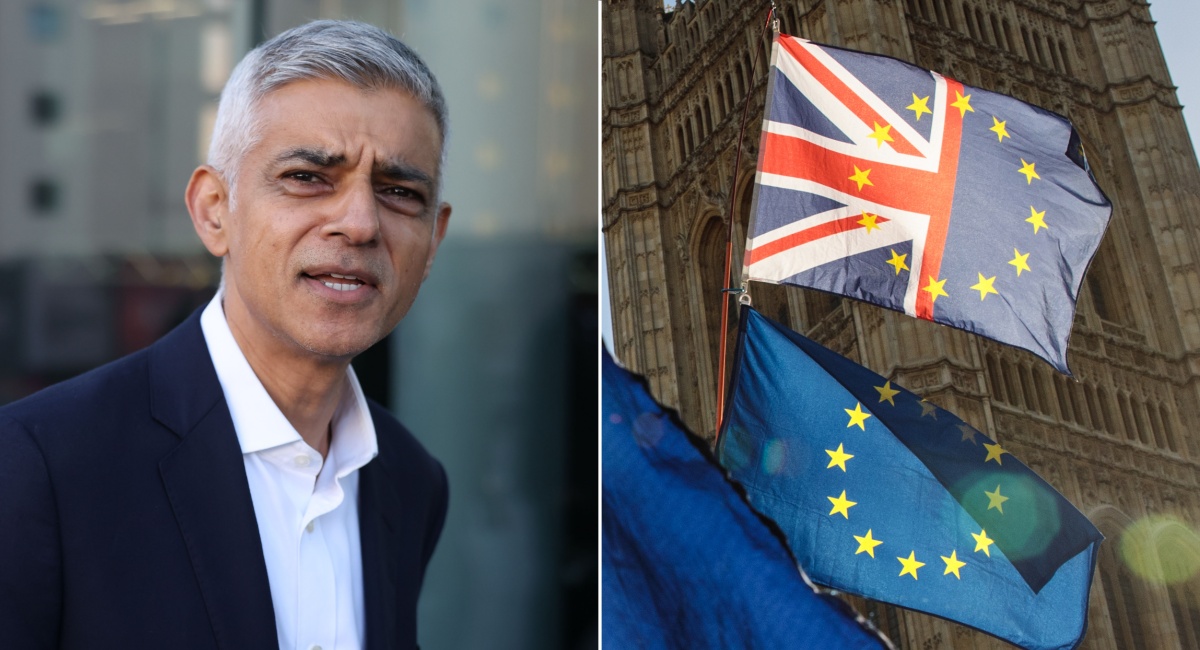
Sadiq Khan is becoming one of the most prominent voices in the ‘Reverse Brexit’ movement, and once again, he has taken the opportunity this week to challenge the government to go further and faster in resetting the UK’s relations with the EU.
Sadiq Khan renews calls to essentially reverse Brexit
An ardent supporter of the Remain campaign, the London Mayor has passionately campaigned against Brexit over the last decade. With Andy Burnham this week acknowledging the need to align closer to the European Union, Khan has reiterated his calls to ‘undo the damage’ caused by the referendum result.
Writing in The Guardian, he took an almighty swipe at Jacob Rees-Mogg, who famously promised that voting for Brexit would lead us towards ‘sunlit uplands’ – a comment Khan has branded ‘total fiction’, juxtaposing this claim with the number of jobs lost as a consequence of the vote.
He also set his stall out for next month’s UK-EU summit, stating that he would publicly encourage the Labour Government to bring Britain back into both the customs union and the single market before the next General Election date in 2029.
“Ten years after the referendum, the sunlit uplands promised by the Brexiters have proven to be a total fiction. Instead, Britain finds itself battling an economic and geopolitical storm. There were nearly two million fewer jobs overall in the UK as a result of us leaving.”
“The EU is our biggest trading partner and our most reliable ally. That’s why, at the UK-EU summit in November, I will call on the government to lay the groundwork for Britain’s swift return to both the customs union and the single market – a move that should happen within this parliament.” | Sadiq Khan
Who is running in the London Mayoral Elections for 2028?
Sadiq Khan may also face a huge test of public opinion himself in 2028, when the next London Mayoral Elections are due to be held. The incumbent has yet to declare if he’ll seek a fourth term, and would be going up against Laila Cunningham of Reform, and James Cleverly of the Conservatives.
Whether he runs or not, Khan will be unwavering in his opposition to Brexit – an act he has labelled as the ‘biggest of of self-harm’ in British history:
“The brutal truth is that leaving the EU was the biggest act of economic and geopolitical self-harm in our country’s history. Rejoining is the only viable path to long-term prosperity and security. Anything less will fail to undo the severe damage that’s been done.”
“For far too long, Labour’s debate about Europe has been constrained by ‘red lines’ that make rebuilding our relationship with the EU impossible. But Burnham has now recognised that these lines were drawn up for a different world. Reversing Brexit is our best chance of getting back on track.” | Sadiq Khan
‘The Sunlit Uplands Were Total Fiction’ – Sadiq Khan Calls to Reverse Brexit by 2029
London Mayor Sadiq Khan has reignited Britain’s increasingly heated Brexit debate after demanding that Labour make reversing Brexit a central commitment at the next general election in 2029.
In a strongly worded intervention, Khan accused Brexit supporters of making promises that had failed to materialise, describing the famous vision of Britain’s post-Brexit future as a land of economic opportunity as “total fiction”.
The Labour politician argued that leaving the European Union had damaged Britain’s economy, weakened its international influence and created unnecessary barriers to trade.
He is now calling on Andy Burnham’s government to begin preparing Britain for a return to the EU’s customs union and single market within the current parliamentary term.
His intervention represents a significant challenge to the government’s existing Brexit policy and could reopen one of the most divisive political arguments in modern British history.
With the next general election expected in 2029, Khan believes Labour should give voters a clear choice on Britain’s future relationship with Europe.
However, his proposal has already created disagreements within British politics, with Nigel Farage and Conservative politicians strongly opposed to reversing Brexit.
Sadiq Khan Launches Fresh Attack on Brexit
Writing in The Guardian on 1 October 2026, Khan argued that the promises made by Brexit campaigners had failed to deliver the prosperous future they had advertised.
He wrote:
“Ten years after the referendum, the sunlit uplands promised by the Brexiters have proven to be a total fiction.”
Khan argued that Britain had instead found itself facing significant economic and geopolitical challenges.
He pointed to research suggesting that Brexit had contributed to a substantial reduction in employment and economic output.
The London Mayor also argued that leaving the EU had weakened Britain’s relationship with its closest European neighbours at a time when international cooperation had become increasingly important.
His criticism was not limited to the economic consequences.
Khan believes Brexit has also damaged Britain’s cultural connections, international influence and ability to respond effectively to shared security challenges.
He described leaving the European Union as one of the most damaging decisions in modern British history.
His conclusion was straightforward: Britain should begin preparing to reverse the decision.
Khan Wants Britain Back in the Customs Union and Single Market
Khan’s immediate proposal is for the government to establish a route towards returning to both the European customs union and the single market.
He wants progress to be made before the next general election.
Writing about the forthcoming UK-EU summit in November, he said:
“At the UK-EU summit in November, I will call on the government to lay the groundwork for Britain’s swift return to both the customs union and the single market.”
The customs union would reduce many trade barriers between Britain and the EU by aligning external tariffs and removing the need for customs duties on qualifying internal trade.
The single market goes further, providing a framework for the free movement of goods, services, capital and people, subject to its rules.
Supporters argue that closer integration would reduce bureaucracy, improve trade and make it easier for British businesses to operate across Europe.
However, critics warn that membership would involve accepting common rules and restrictions on Britain’s ability to negotiate completely independent trade arrangements.
These disagreements mean that Khan’s proposal would require considerable political and diplomatic negotiation.
Nevertheless, he believes the economic and geopolitical circumstances have changed sufficiently to justify reconsidering Britain’s relationship with Brussels.
Labour Is Being Urged to Make Rejoining an Election Promise
Perhaps the most politically significant part of Khan’s intervention concerns the next general election.
He wants Labour to begin making the case for full EU membership rather than limiting its ambitions to smaller agreements with Brussels.
Khan argued:
“Our party must immediately start making the case for rejoining the EU, so we can fight and win a general election with EU membership effectively on the ballot paper in 2029.”
This would represent a substantial change from Labour’s 2024 general election manifesto.
Under its previous commitments, Labour ruled out rejoining the customs union, single market and introducing a return to freedom of movement.
The government instead promised to improve the existing relationship with the EU through negotiations on trade, security and cooperation.
Khan believes that approach is no longer sufficiently ambitious.
He argues that Britain needs a much closer relationship with its European neighbours to address the economic and security challenges facing the country.
His intervention also puts pressure on Labour’s leadership to explain exactly how far it is prepared to go in rebuilding relations with Brussels.
Andy Burnham Has Already Opened the Brexit Debate
Khan’s comments come after Andy Burnham indicated that Britain should have a more open discussion about its future relationship with the European Union.
At Labour’s conference, Burnham acknowledged that leaving the EU had done more harm than good.
He also suggested that the country should examine different options for closer cooperation with Europe.
These could include maintaining the current arrangements, joining the customs union, participating in the single market or eventually pursuing full EU membership.
Burnham’s comments attracted considerable attention because they suggested that Labour’s previous Brexit red lines could be reconsidered.
However, he has also emphasised that he does not intend to move ahead of public opinion.
His position leaves room for further debate without committing the government to an immediate return to the EU.
For Khan, however, the opportunity is clear.
He believes Labour should stop treating rejoining as an issue that cannot be discussed and instead make it part of the party’s long-term political programme.
Nigel Farage Accuses Labour of Betraying Brexit Voters
Unsurprisingly, Khan’s proposals have attracted strong criticism from Nigel Farage.
The Reform UK leader has consistently opposed Britain’s return to the European Union and has warned against any attempt to reverse Brexit through closer integration.
Farage argued that Burnham’s comments represented a betrayal of voters who supported leaving the EU in 2016.
He also warned that returning to the single market or customs union would undermine the independence Britain gained after Brexit.
For Reform, the issue represents an important political opportunity.
Farage can position his party as the strongest defender of the referendum result while challenging Labour’s willingness to reconsider Britain’s relationship with Europe.
The political argument is likely to become increasingly important as the next general election approaches.
Reform will seek to attract voters who remain committed to Brexit, while Labour faces pressure from politicians who believe the country should move towards renewed European integration.
The Conservatives Also Reject the Proposal
Conservative leader Kemi Badenoch has also criticised the growing discussion about reversing Brexit.
She argued that political leaders should be more specific about what closer cooperation with the EU would actually involve.
Badenoch questioned whether proposals for deeper integration would require Britain to contribute additional money or accept European rules over which British voters would have limited influence.
Her position reflects a broader Conservative argument that the UK should maintain its ability to negotiate independent trade agreements and establish its own regulatory policies.
However, supporters of closer European integration argue that these freedoms must be weighed against the economic costs of additional barriers to trade.
The disagreement demonstrates that Brexit remains a politically divisive issue even a decade after the referendum.
What Could Britain Gain From Rejoining?
Supporters of Khan’s proposals believe that closer integration with Europe could bring several economic advantages.
The European Union remains one of Britain’s most important trading partners.
Rejoining the single market could reduce regulatory barriers and make it easier for British businesses to sell goods and services across European markets.
A customs union could also simplify certain aspects of international trade by reducing the need for separate customs arrangements.
There could also be advantages in areas such as scientific research, energy cooperation, defence and environmental policy.
However, rejoining would not automatically resolve Britain’s economic problems.
It would require negotiations with the EU, agreement on membership conditions and a political process capable of securing sufficient public support.
Critics also argue that membership could restrict Britain’s freedom to establish certain independent trade policies.
The economic consequences would therefore depend on the precise arrangements negotiated.
Any serious proposal would need to explain both the potential benefits and the obligations involved.
Could Brexit Become the Biggest Issue of the 2029 Election?
Khan clearly believes that Britain’s relationship with Europe should become a central issue at the next general election.
His proposal would force political parties to explain their positions more clearly.
Labour would need to decide whether it supports a gradual reset or full membership.
Reform would almost certainly campaign against reversing Brexit.
The Conservatives would need to defend their preferred approach to national sovereignty and international trade.
Meanwhile, the Liberal Democrats and Greens have both expressed support for closer European integration, although their preferred routes differ.
The debate could therefore create a major dividing line between Britain’s political parties.
However, there is an important question about whether voters want Brexit to dominate another general election.
Many households remain more concerned about the cost of living, housing, immigration, healthcare and economic growth.
Labour would need to explain why changing Britain’s relationship with Europe would improve those everyday issues.
Conclusion: Sadiq Khan Wants Labour to Finally Confront Brexit
Sadiq Khan’s latest intervention has reopened the debate over whether Britain should eventually return to the European Union.
By describing the promises of Brexit as “total fiction”, the London Mayor has delivered a direct challenge to politicians who continue to defend the decision to leave.
He wants the government to begin preparing for a return to the customs union and single market within the current Parliament.
More significantly, he believes Labour should make full EU membership an explicit issue at the 2029 general election.
Andy Burnham has already indicated that Britain’s relationship with Europe deserves a fresh examination, although he has not committed to immediate rejoining.
Nigel Farage and Kemi Badenoch have meanwhile made clear their opposition to reversing Brexit.
The political arguments are therefore far from settled.
Ten years after the referendum, Britain continues to debate whether leaving the European Union delivered the independence and prosperity that voters were promised.
For Khan, the answer is clear: the country needs a new direction, and Labour should be prepared to put that choice directly before the electorate in 2029.