
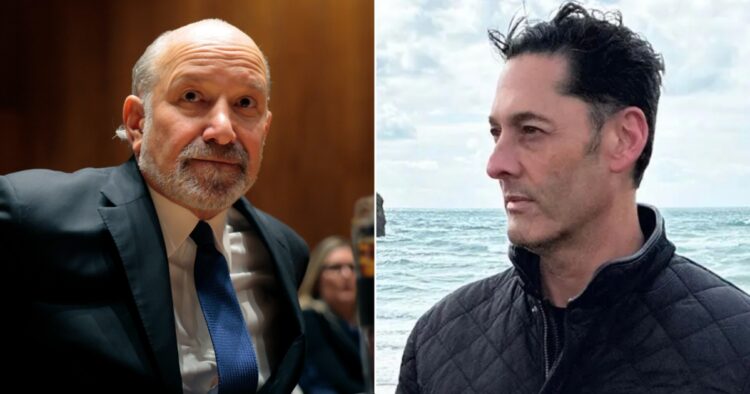
A British trader who exposed links between a US secretary and Jeffrey Epstein has been found dead in Thailand, as reported by the BBC.
Following the death, MPs are calling on the UK’s commercial watchdog’s treatment of whistleblowers to be investigated.
Simon Andriesz, a former senior employee of BCG Partners, previously raised concerns over evidence of foul play between Donald Trump-appointed US secretary Howard Lutnick and Jeffrey Epstein.
Andriesz raised the concerns with the Financial Conduct Authority (FCA), the FBI and other watchdogs after uncovering business links between Epstein and Lutnick earlier this year.
Following his death, MPs have come forward saying that the events raise “deeply troubling questions” about the way whistleblowers are treated after coming forward to the FCA.
Andriesz’s family stated that he ‘took his own life’ on 23 September and that there were no signs of foul play.
What the FCA made of Andriesz’s claims
BCG Partners, owned by Howard Lutnick, let Andriesz go in 2017, but it didn’t keep him from spilling the beans to authorities.
Andriesz uncovered emails between Lutnick and former Prince Andrew in 2013 to, in his own words, “buy a prince”, in exchange for a £1 million loan.
BCG Partners also denies Andriesz’s claims that broker’s bonuses were “embezzled” for improper purposes. A claim the former employee took to the FCA.
However, the FCA had previously told Andriesz there was “insufficient evidence” to his claims.
BCG later told the BBC that it had strong policies protecting whistleblowers and that there would be no retaliation towards Andriesz.
John McDonnell, the Labour backbench MP and chair of the All-Party Parliamentary Group (APPG) on Investment Fraud and Fairer Financial Services, was not convinced.
McDonnell told the Times that Andriesz’s death was a “profound and preventable tragedy”, saying whistleblowers were “an essential part of the financial regulatory system”.
He further warned there would be consequences for the integrity of the system if people did not believe they would be “treated properly, protected appropriately and listened to seriously”.
A group of MPs have now called for the FCA to pay for an independent party to evaluate its handling of whistleblowers.
MPs Call for Investigation Following Death of Lutnick-Epstein Whistleblower
British MPs have demanded an independent investigation into the treatment of whistleblowers by the UK’s financial regulator following the death of Simon Andriesz, a former banker who exposed evidence of business links between US Commerce Secretary Howard Lutnick and convicted sex offender Jeffrey Epstein.
The case has raised serious questions about the protection offered to individuals who expose alleged wrongdoing, particularly when powerful financial institutions and influential political figures are involved.
Andriesz, 57, died in Thailand on 23 September 2026. His family confirmed that he had taken his own life and said there was no suggestion of foul play.
His death has prompted renewed scrutiny of the Financial Conduct Authority (FCA), after the former banker spent years raising concerns about his former employer, BGC Partners, and what he believed was retaliation following his whistleblowing.
Now, politicians are demanding answers, arguing that the regulator must be held accountable for the way it handled his complaints.
Who Was Simon Andriesz?
Simon Andriesz was a former senior employee of BGC Partners, an international financial brokerage firm previously led by Howard Lutnick, who is now serving as US Commerce Secretary under Donald Trump.
Andriesz had worked as a managing director at the company before being dismissed in 2017.
Following his departure, he began reporting concerns about alleged financial misconduct and accounting irregularities within the organisation.
He approached several authorities, including the UK’s Financial Conduct Authority and the US Federal Bureau of Investigation.
His allegations included claims involving the handling of commission money intended for brokers’ bonuses. BGC has strongly denied these allegations.
However, Andriesz’s most internationally significant disclosures concerned the relationship between Lutnick and Epstein.
After documents from the US Department of Justice were released, Andriesz identified correspondence that appeared to show business discussions between the two men.
He subsequently brought the material to the attention of US investigators and parliamentary authorities.
His findings attracted considerable attention because Lutnick had previously spoken publicly about distancing himself from Epstein.
The Epstein Connection That Raised Questions About Howard Lutnick
Andriesz’s disclosures focused on evidence of business contacts between Lutnick and Epstein.
Among the documents he identified was a 2018 email exchange discussing a potential business investment involving both men.
He also uncovered material concerning a proposed business arrangement involving Andrew Mountbatten-Windsor, formerly known as Prince Andrew.
According to Andriesz, the proposal involved a potential £1 million loan and the use of royal connections to attract investment.
BGC disputed aspects of his allegations and said the proposed joint venture did not proceed.
Lutnick’s relationship with Epstein subsequently attracted attention in the United States, leading to questioning before the House Oversight Committee.
During his testimony, Lutnick acknowledged that he and his family had visited Epstein’s private Caribbean island, Little St James, in December 2012.
He told investigators that he could not remember why they had visited.
The disclosures raised questions about the extent of Lutnick’s previous relationship with Epstein and whether his public descriptions of their association were complete.
However, evidence of business contact does not itself establish involvement in Epstein’s criminal activities.
MPs Question the Financial Conduct Authority
The focus has now shifted towards the Financial Conduct Authority and its treatment of Andriesz.
The former banker repeatedly complained that the regulator had failed to protect him after he raised concerns about his former employer.
He believed that the authorities had not properly investigated his allegations and had failed to respond adequately to claims of retaliation.
Weeks before his death, Andriesz spoke at a public event organised by MPs, whistleblowers and campaigners.
He described feeling thoroughly let down by the FCA and said his experience had put him through what he called absolute hell.
He also accused the regulator of paying lip service to its responsibilities towards whistleblowers.
The concerns are particularly significant because whistleblowers often depend on regulatory authorities to protect their identities and investigate allegations that could otherwise remain hidden.
If individuals believe that reporting wrongdoing will expose them to retaliation without meaningful protection, they may become reluctant to come forward.
That is precisely the concern now being raised by MPs.
John McDonnell Demands an Independent Investigation
Labour MP John McDonnell, who chairs the All-Party Parliamentary Group on Investment Fraud and Fairer Financial Services, has been among the most vocal figures demanding action.
He described Andriesz’s death as a profound and preventable tragedy and argued that the circumstances raised serious questions about the UK’s whistleblower protection system.
McDonnell believes that the FCA should not be allowed to investigate its own handling of the case without independent oversight.
The parliamentary group has therefore called for an independent and non-conflicted organisation to examine the regulator’s actions.
The central issue is whether Andriesz received the protection and assistance that should have been available to him after reporting alleged wrongdoing.
McDonnell has also indicated that the parliamentary group could consider conducting its own investigation if the FCA fails to support a genuinely independent process.