
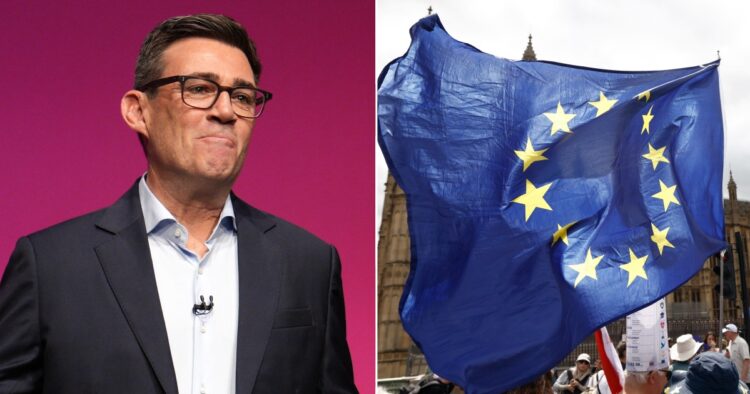
The latest betting odds on the UK rejoining the EU have been revealed.
More than a decade after the United Kingdom voted to leave the European Union, this is the closest we have been to reversing that disastrous decision.
This is thanks to Andy Burnham, who this week gave the strongest hint of any prime minister since Brexit that the UK could rejoin the EU.
In his Labour conference speech on Tuesday, Burnham said Brexit had caused “more harm than good” and he would look for a new consensus on what Britain’s relationship with the EU should be.
He told the conference: “We will not give Britain the clear path we need into the rest of this century until we decide on a long term relationship with what is still our largest market.”
Burnham went on to say that at a UK-EU summit later this year he would “lay out to the country what I believe the different options are for Britain’s long term relationship with our European partners.”
This seemed to hint at the possibility that Brexit could be reversed in some form or another.
The following day, Burnham confirmed that all options were on the table in terms of Britain’s future relationship with the EU, including ‘going all the way’ and reversing Brexit.
Senior Labour figures such as Sadiq Khan have called for the party to put a pledge to rejoin in their next manifesto, with reports suggesting this is now a matter of ‘how, not if.’
Then, the leaders of Spain and France both said they would welcome the UK back to the EU with ‘open arms’, as French president Emmanuel Macron labelled Brexit the “biggest lie of the last 30 years.”
Bookies odds on the UK rejoining the EU
But just how likely is it that the UK could reverse Brexit and rejoin the EU?
Public opinion has well and truly shifted on the matter, and with Labour becoming increasingly vocal in their criticism of Brexit, the latest bookies odds on a ‘Breturn’ have been revealed.
Star Sports have the UK at 5/2 to rejoin the EU before 2035, suggesting it is a very real possibility.
The odds lengthen to 14/1 for the UK rejoining before 2030, which would in theory be the year after the next general election.
Russell Bardon, a spokesperson for Star Sports, said: “With Andy Burnham suggesting on BBC Radio 4’s Today programme that the UK could go ‘all the way’ to rejoining the European Union, we make a return to full EU membership a 5/2 chance before January 1st 2035.
“Burnham has opened the door for campaigning at the next General Election – which must be called before August 2029 – for a mandate to rejoin the EU, and it’s a 14/1 chance that the UK’s EU membership is reinstated before 2030.”
Latest Odds Given on UK Rejoining EU in Next 10 Years as Brexit Debate Intensifies
Britain could be heading towards a dramatic political reversal, with the latest betting odds suggesting that the country could rejoin the European Union within the next decade.
More than ten years after the historic Brexit referendum, the possibility of reversing Britain’s departure is once again attracting serious political attention. Growing dissatisfaction with Brexit, changing public opinion and increasingly outspoken comments from senior Labour politicians have helped bring the question of EU membership back into the national conversation.
The latest bookmakers’ odds suggest that a British return to the European Union is no longer being treated as an entirely remote possibility.
According to figures reported by The London Economic on 1 October 2026, Star Sports has priced the UK at 5/2 to rejoin the European Union before 1 January 2035.
That represents implied odds of approximately 28.6 per cent before bookmakers’ margins.
Meanwhile, the odds of Britain rejoining before 2030 were considerably longer, at 14/1.
The figures suggest that bookmakers believe a return to Europe is possible, although far from guaranteed.
For Nigel Farage and Reform UK, the renewed discussion represents a potentially significant political challenge. For Labour politicians advocating a closer relationship with Europe, it provides an opportunity to revisit one of the most consequential decisions in modern British history.
Bookmakers Reveal the Latest EU Rejoining Odds
The latest reported betting figures have generated considerable interest among those following Britain’s changing relationship with Europe.
Star Sports published the following prices:
| Political outcome | Betting odds |
|---|---|
| UK rejoins EU before 2030 | 14/1 |
| UK rejoins EU before 2035 | 5/2 |
The 5/2 price means a successful £10 bet would return £35, including the original stake.
However, these are bookmaker prices rather than objective probabilities. They reflect market expectations, betting activity and the bookmaker’s margin.
Prediction markets also provide a different picture. Kalshi’s published market prices have recently placed the probability of British EU membership at approximately 20 per cent by 1 January 2035.
The difference between the bookmaker and prediction-market figures demonstrates how uncertain the political outlook remains.
Nevertheless, both sets of figures show that a return to the EU is being discussed as a genuine possibility rather than an impossible political outcome.
Andy Burnham’s Comments Reignite the Debate
One of the biggest developments behind the renewed interest has been Andy Burnham’s increasingly outspoken position on Brexit.
The Labour leader has suggested that Britain should have an honest conversation about the long-term consequences of leaving the European Union.
He has argued that Brexit has caused more economic harm than good and that the UK needs a clearer long-term relationship with its largest nearby trading market.
His comments have attracted attention because they suggest a willingness to discuss options that many senior politicians previously avoided.
Burnham has also indicated that the possibility of going further and eventually rejoining the European Union should not be dismissed.
This represents a significant change in the political conversation.
For years, Labour leaders have attempted to avoid reopening the Brexit argument, fearing that another prolonged debate could alienate voters who supported leaving in 2016.
However, growing public dissatisfaction with the economic consequences of Brexit appears to have encouraged some politicians to reconsider that approach.
Burnham’s intervention has therefore helped make EU membership a legitimate subject of mainstream political discussion again.
Public Opinion Is Moving Towards Rejoining
Another important factor influencing the latest odds is the changing attitude of British voters.
A YouGov survey published on 2 October 2026 asked people whether they believed Britain would rejoin the European Union within the next ten years.
The results showed:
- 11 per cent considered rejoining very likely.
- 33 per cent considered it fairly likely.
- 25 per cent considered it fairly unlikely.
- 12 per cent considered it very unlikely.
- 19 per cent were undecided.
This means 44 per cent believed Britain was likely to return to the EU within the next decade, compared with 37 per cent who thought it unlikely.
The findings suggest that expectations about Britain’s European future have changed considerably.
Importantly, this question measured whether people thought rejoining was likely, rather than whether they personally supported it.
Separate research by Ipsos in June 2026 found that 52 per cent of Britons supported applying to rejoin the European Union, compared with 33 per cent who wanted Britain to remain outside.
Among likely voters in a hypothetical referendum, support for rejoining reached 58 per cent.
These figures indicate that public attitudes towards Brexit have evolved significantly since the referendum.
However, support for rejoining does not automatically mean voters would support every condition attached to EU membership.
Issues such as immigration, financial contributions and European regulatory authority could still influence the outcome of any future referendum.
Nigel Farage Faces a Major Political Challenge
Few politicians have invested more of their political careers in Brexit than Nigel Farage.
The Reform UK leader was one of the most recognisable figures in the campaign to leave the European Union and has repeatedly described Brexit as a historic victory for British democracy.
His political identity remains closely connected to the argument that Britain should control its own laws, borders and economic policies.
Consequently, the possibility of rejoining the EU represents a direct challenge to one of the central achievements Farage has spent decades defending.
If public opinion continues moving towards European membership, Reform could find itself defending a position that increasingly conflicts with the preferences of some voters.
Farage is likely to argue that the economic problems facing Britain are not evidence that Brexit was fundamentally wrong.
Instead, he may point to government failures, taxation, public spending and domestic economic policies as the main reasons for Britain’s difficulties.
He could also argue that returning to the EU would undermine national sovereignty and restore political powers to Brussels.
Nevertheless, the changing political debate presents a serious challenge for Reform.
The party will need to convince voters that remaining outside the EU is still the best long-term option for Britain.
Why Some Britons Want to Reverse Brexit
Support for rejoining is partly driven by continuing concerns about Britain’s economic performance since leaving the European Union.
Businesses have faced additional customs requirements, regulatory changes and administrative costs when trading with European markets.
Smaller exporters have been particularly affected by the additional paperwork involved in selling products across borders.
Some industries have also raised concerns about labour shortages and difficulties recruiting workers from European countries.
Supporters of rejoining believe that returning to the EU could improve trade relationships, encourage investment and strengthen Britain’s economic position.
They also argue that membership would give the UK a stronger voice in decisions affecting the European economy.
However, critics point out that rejoining would involve significant obligations.
Britain would need to accept the EU’s legal framework, contribute financially to its budget and negotiate the conditions of membership.
The country could also face requirements relating to the euro and other European integration arrangements.
Therefore, rejoining would not simply involve restoring the exact arrangements that existed before Brexit.
It would require a substantial political and diplomatic negotiation.
Could Britain Actually Rejoin Before 2035?
Although the latest betting odds suggest that rejoining is possible, the practical process would be extremely complicated.
Under Article 49 of the Treaty on European Union, Britain would need to submit a formal application for membership.
The application would then require approval from the European institutions and unanimous agreement from all 27 existing member states.
The European Parliament would also need to consent to the accession process.
Britain would have to negotiate its membership conditions and demonstrate that it could meet the necessary legal and political requirements.
This process could take several years.
Furthermore, any British government seeking to rejoin would probably need a clear electoral mandate.
That could involve including a commitment in a general election manifesto or holding another national referendum.
With the next general election expected by 2029, a future Labour government could potentially begin reconsidering Britain’s relationship with Europe during the following parliamentary term.
However, a formal application, negotiations and ratification would still require considerable time.
This is why the 2035 betting deadline is particularly interesting.
It provides a relatively short window for Britain to move from political discussion to actual EU membership.
France and Spain Could Welcome Britain Back
Another important consideration is how existing European governments would respond to a British application.
Relations between Britain and several EU member states have improved since Brexit, particularly in areas involving security, defence and economic cooperation.
French President Emmanuel Macron and Spanish Prime Minister Pedro Sánchez have both expressed positive attitudes towards the possibility of Britain returning to the European Union.
Their welcoming comments suggest that the door has not been permanently closed.
However, political enthusiasm from individual European leaders does not guarantee unanimous approval.
Every existing member state would have a say in Britain’s application.
Some countries could demand stronger commitments from the UK before supporting its return.
Others may be concerned about granting Britain special arrangements or exemptions that could encourage future disputes.
The European Union would also need to consider whether British membership would strengthen the organisation in the long term.
Britain remains one of Europe’s largest economies and has significant diplomatic, military and financial influence.
Its return could therefore offer considerable benefits to the bloc.
What Happens Next?
The coming years could be crucial in determining whether Britain’s relationship with Europe moves towards closer integration or remains broadly unchanged.
Several developments will be particularly important.
First, Labour’s future manifesto commitments could establish whether the party intends to pursue a more ambitious relationship with the EU.
Second, public opinion will need to demonstrate sustained support for rejoining rather than a temporary reaction against Brexit.
Third, European governments will need to establish whether they are genuinely prepared to negotiate Britain’s return.
Finally, the economic consequences of Brexit will continue to influence the political debate.
If businesses continue experiencing difficulties and voters increasingly believe that leaving the EU damaged Britain’s economy, the pressure for a fundamental change could grow.
However, if the government succeeds in improving trade arrangements without restoring full membership, support for rejoining could weaken.
The political future remains uncertain.
Conclusion: Could Britain Be Back in Europe Within a Decade?
The latest betting odds suggest that Britain’s return to the European Union is becoming a more serious possibility.
Star Sports has reportedly priced the UK at 5/2 to rejoin before January 2035, while the odds of membership being restored before 2030 stand at 14/1.
Meanwhile, YouGov research indicates that 44 per cent of Britons believe rejoining is likely within the next decade, compared with 37 per cent who consider it unlikely.
Andy Burnham’s willingness to discuss the possibility of returning to Europe has helped reopen a political debate that many believed had been settled.
For Nigel Farage, the prospect represents a potential threat to one of the central arguments underpinning his political career.
For supporters of European integration, however, the changing public mood offers hope that Britain could eventually reverse its decision to leave.
There are still enormous political, legal and diplomatic obstacles to overcome. Rejoining would require a formal application, unanimous approval from all 27 EU member states and a difficult negotiation over the terms of membership.
Nevertheless, the latest developments suggest that Brexit is no longer an untouchable political settlement.
Whether Britain actually returns before 2035 remains uncertain, but one thing is becoming increasingly clear: the debate about Britain’s place in Europe is far from finished.