
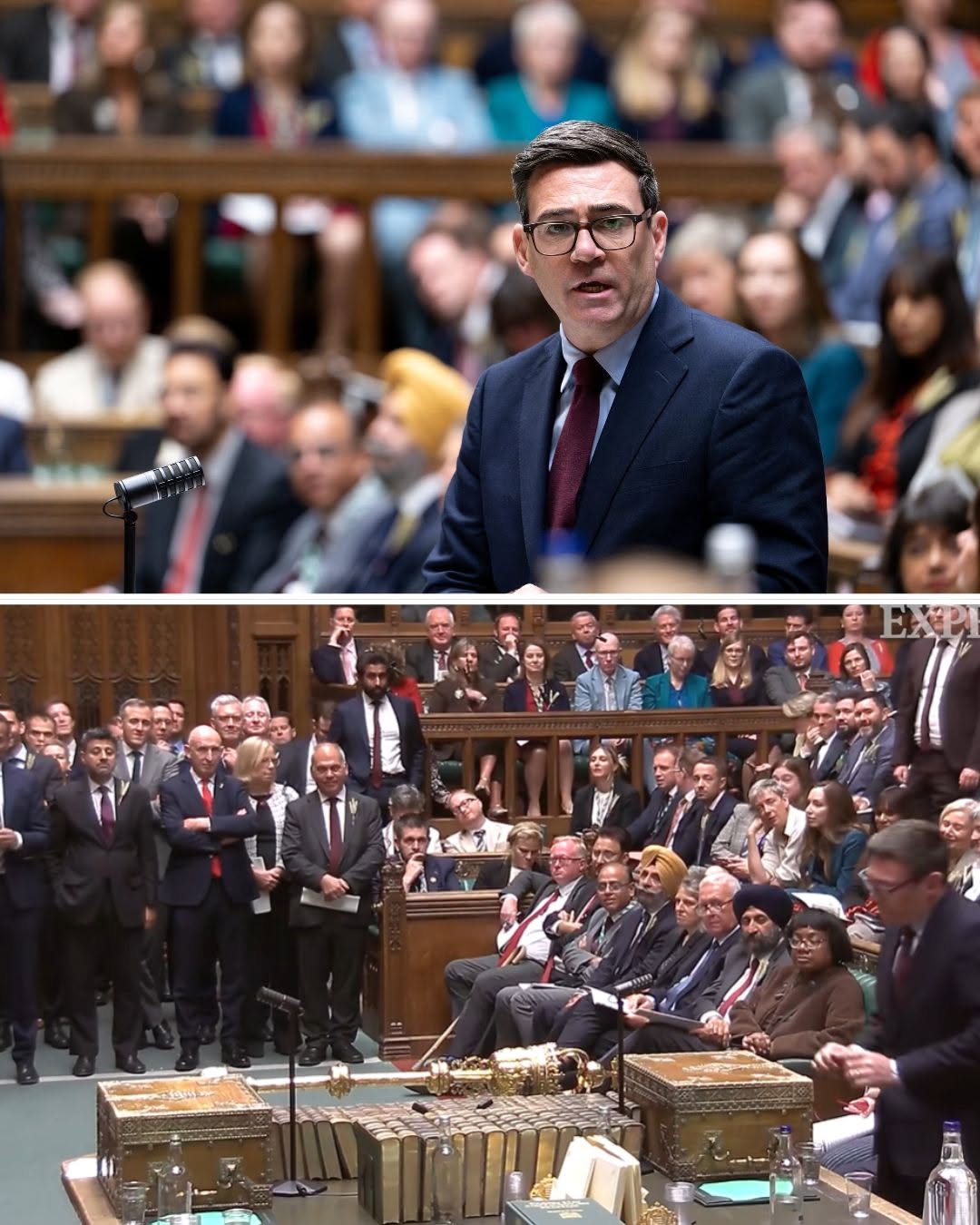
UK Defence Spending Debate Intensifies Amid Claims of a Prime Ministerial “Surrender” on National Security
An alarming political headline alleges that Prime Minister Andy Burnham refused to prioritise military defence over welfare spending, prompting accusations that the government is putting Britain’s security at risk. But the supposed parliamentary confrontation and its dramatic quotations remain unverified, raising a more important question: how should the United Kingdom balance national defence with its domestic responsibilities?
Britain’s defence policy has become an increasingly important subject of political debate as European governments confront an uncertain international security environment.
Russia’s war against Ukraine, instability in the Middle East, cyberattacks and concerns about the long-term readiness of NATO forces have intensified pressure on governments to invest in military capabilities.
Against this backdrop, a dramatic online headline claims that Prime Minister Andy Burnham delivered a controversial statement about the balance between defence spending and welfare.
According to the message, Burnham refused to place military expenditure above social support, provoking angry accusations that his position amounted to a surrender of national security.
The headline further suggests that Parliament was left speechless and that the confrontation was captured on video.
However, the supplied account does not identify a parliamentary session, provide an authenticated recording or reproduce the Prime Minister’s complete remarks.
Those omissions are important.
A disagreement about public spending priorities is not necessarily evidence that a government intends to abandon its defence obligations.
To understand the controversy, it is necessary to examine Britain’s military challenges, the competing demands on public finances and the difference between political criticism and confirmed government policy.
Britain’s Changing Security Environment
The United Kingdom remains one of Europe’s principal military powers.
It is a founding member of NATO, maintains an independent nuclear deterrent and contributes personnel to international security operations.
Its armed forces include the Royal Navy, British Army and Royal Air Force.
However, the nature of military threats has changed significantly over recent decades.
Modern defence planning must account for conventional warfare alongside cyber operations, drones, long-range missiles, intelligence capabilities and threats to critical infrastructure.
Russia’s full-scale invasion of Ukraine in February 2022 reinforced concerns about the possibility of prolonged conventional conflict in Europe.
The war has also demonstrated the importance of ammunition supplies, industrial capacity and the ability to replace equipment lost during sustained operations.
These challenges have encouraged NATO members to reconsider whether their defence budgets and military structures are sufficient.
Is the British Army Really at a 200-Year Low?
The headline refers to the British Army shrinking to its lowest level in approximately two centuries.
That description reflects a genuine long-term concern about the size of Britain’s regular land forces.
The Army is considerably smaller than it was during much of the twentieth century, when conscription, overseas commitments and the Cold War required much larger formations.
Recent years have also brought recruitment and retention difficulties.
Nevertheless, historical comparisons require caution.
The Army’s responsibilities, technology and organisational structure have changed substantially since the nineteenth century.
A modern professional force cannot be assessed solely by comparing personnel numbers with those of an earlier era.
Military effectiveness also depends on training, equipment, logistics, readiness and the ability to operate alongside allies.
A smaller force may possess capabilities unavailable to previous generations, while still facing serious limitations in sustaining large-scale operations.
The central policy question is whether Britain’s present military structure matches the threats it is expected to confront.
What Did the Prime Minister Actually Say?
The circulating headline portrays Burnham as explicitly rejecting the idea that defence should take priority over welfare.
However, it does not provide a complete quotation, the date of the alleged exchange or the identity of the politician who challenged him.
Without those details, the claim cannot be independently assessed.
The description of Parliament being left speechless is similarly unsupported.
Such language is common in political commentary, but it does not establish what occurred during a formal debate.
A verified account would need to identify the parliamentary record, an official government statement or an authentic recording showing the remarks in context.
Until that evidence is available, the allegation that Burnham made a declaration amounting to national surrender should be treated as political characterisation rather than established fact.
Defence and Welfare: A Difficult Budgetary Choice
The broader disagreement concerns two major responsibilities of government.
Defence spending supports national security, military personnel, equipment, intelligence and the protection of Britain’s international interests.
Welfare spending provides financial support to pensioners, disabled people, unemployed individuals and households facing economic hardship.
Both areas serve important public purposes.
Increasing one budget does not always require an equivalent reduction in the other, because governments can also adjust taxation, borrowing or spending elsewhere.
However, public resources are finite, and additional commitments create financial pressures.
Those advocating higher defence expenditure argue that military preparedness is essential to protecting the conditions under which public services can operate.
Others warn that reducing support for vulnerable households could deepen poverty and create serious social consequences.
The debate therefore involves competing priorities rather than a simple choice between security and compassion.
NATO Commitments and International Pressure
Britain’s defence decisions also affect its relationships with allies.
NATO has long used defence spending as a measure of member states’ contributions to collective security.
Following Russia’s invasion of Ukraine, European governments have faced renewed demands to strengthen military readiness and expand defence production.
The United Kingdom has traditionally played a prominent role in NATO operations and strategic planning.
However, meeting alliance expectations involves more than announcing spending targets.
Governments must ensure that additional resources translate into trained personnel, usable equipment, sufficient ammunition and sustainable operational capacity.
A headline suggesting that Britain has surrendered its security cannot substitute for examining these practical measures.
Why Military Recruitment Matters
Personnel shortages are among the most significant challenges facing modern armed forces.
Recruiting and retaining skilled service members can be difficult when military careers compete with civilian employment opportunities.
Long deployments, family separation and concerns about accommodation or career progression may also affect retention.
Addressing these problems requires investment in working conditions as well as military hardware.
Better training, reliable equipment and support for service families can contribute to operational effectiveness.
This illustrates why defence readiness cannot be reduced to one political statement or a single budget figure.
A credible national security strategy must consider the people expected to carry it out.
The Political Meaning of “Surrender”
The word “surrender” carries particular emotional force in debates about national defence.
It suggests that a government has abandoned its responsibilities or accepted defeat before confronting a threat.
Political opponents may use such language to emphasise what they regard as dangerous policy choices.
However, disagreement over the allocation of public funds does not automatically amount to surrender.
A government might favour increasing defence spending gradually while protecting certain domestic programmes.
Critics could reasonably question whether that approach provides sufficient military readiness.
But describing the policy as an abandonment of national security would remain an interpretation unless supported by specific decisions and measurable consequences.
Responsible reporting should make that distinction clear.
What Evidence Would Clarify the Dispute?
Several forms of evidence would help establish what actually happened.
An official parliamentary transcript could show the Prime Minister’s precise words and the questions put to him.
A complete video recording could clarify whether the alleged confrontation occurred and whether remarks were presented in context.
Government budget documents would provide a clearer picture of actual defence commitments.
Military personnel statistics and independent assessments of readiness would help evaluate claims about the Army’s strength.
Without these sources, readers are left with a dramatic accusation rather than a complete account of government policy.
The supplied headline offers no reliable basis for identifying the supposed final explanation given by Burnham.
Inventing that explanation would misrepresent the event.
The Wider Challenge for Britain
The underlying defence debate deserves serious attention regardless of the accuracy of the circulating headline.
Britain must prepare for a security environment shaped by conventional conflict, technological competition and unpredictable international developments.
At the same time, policymakers face pressure to maintain healthcare, pensions, social support and other essential public services.
There are legitimate disagreements about the balance between these responsibilities.
Some believe defence expenditure must increase more rapidly, even if difficult financial decisions follow.
Others argue that security should be understood more broadly, including economic stability, infrastructure resilience and the wellbeing of the population.
These positions are not necessarily mutually exclusive.
The challenge is to establish priorities through transparent decisions and evidence about national needs.
What Can Be Confirmed?
The United Kingdom faces genuine questions about military personnel levels, defence readiness and its ability to meet future security challenges.
The tension between defence expenditure and domestic spending is also a legitimate subject of parliamentary scrutiny.
What remains unverified is the specific confrontation described in the headline.
The supplied material does not establish that Burnham made the alleged statement, that Parliament reacted as described or that the government announced a decision to abandon military preparedness.
There is no sufficient evidence in the headline to conclude that the Prime Minister has surrendered Britain’s national security interests.
Such a serious accusation requires more than emotionally charged language.
A Debate That Demands Evidence
National defence is too important to be reduced to an unfinished quotation or a sensational social media claim.
The British public has a legitimate interest in knowing whether the armed forces possess sufficient personnel, equipment and funding to meet their responsibilities.
Citizens also deserve an informed discussion about the consequences of spending decisions for public services and vulnerable households.
The most useful political debate would examine specific commitments, measurable outcomes and the risks associated with different choices.
Until an authenticated record of the alleged parliamentary confrontation is available, its most dramatic claims should remain unconfirmed.
Ultimately, Britain’s security will be determined not by which politician delivers the strongest accusation, but by whether the government can develop and sustain an effective defence strategy while meeting its wider obligations to the public.