
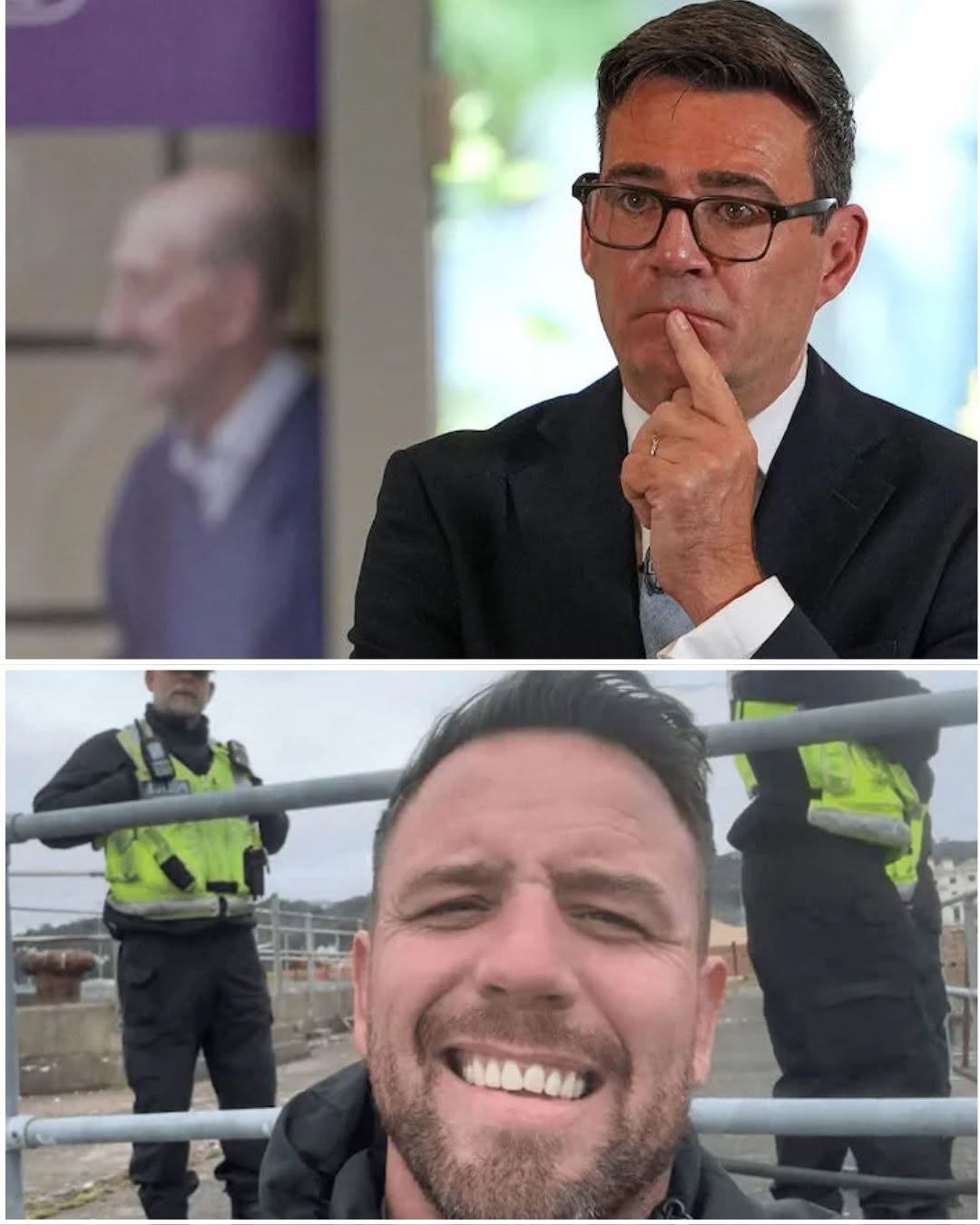
Patriot Platform Announces ‘Stage Two’ After Danny Tommo’s Remand, Promising an 18-Month Expansion
Patriot Platform has declared that the detention of its founder Daniel Thomas, better known as Danny Tommo, will not halt its activities, unveiling what it calls “Stage Two” of an 18-month campaign to expand its organisation and increase political pressure over Britain’s immigration and border policies.
The announcement came during a striking gathering at Hoghton Tower in Lancashire, where around 100 people — many dressed in black and wearing balaclavas — assembled on Sunday, October 4.
Footage from the gathering shows a masked spokesman addressing Prime Minister Andy Burnham and Home Secretary Shabana Mahmood before outlining the group’s plans.
“This movement will not disappear,” he said. “It will grow. This is just the beginning of the Patriot Platform.”
He then announced: “Stage one, recruit. Stage two, begins now.”
The spokesman said that over the next 18 months the organisation intends to become what it describes as Britain’s “most informed, organised, and active political movement”.
It is an ambitious declaration.
Whether Patriot Platform possesses the membership, organisation or resources required to achieve it is another question entirely.
Danny Tommo remains in custody
The group’s announcement follows the remand of Thomas, the activist who created Patriot Platform and became its most recognisable public figure.
Thomas has pleaded not guilty to criminal damage after allegedly slashing an inflatable boat in the English Channel while an emergency responder was aboard.
He has also denied a separate allegation that he failed to disclose the PIN to his mobile phone to police.
At Portsmouth Crown Court on September 29, Thomas was refused bail and remanded in custody ahead of further proceedings. A provisional trial date has been set for March 1, 2027.
Those details are important because some political commentary describes Thomas as though he has already been convicted over the Channel incident.
He has not.
The allegations remain to be tested in court, and Thomas is entitled to the presumption of innocence.
His detention is therefore correctly described as remand pending trial, rather than imprisonment following conviction for the alleged boat incident.
Can Patriot Platform survive without its founder?
Thomas’s absence presents a significant organisational challenge.
He was not simply the public face of Patriot Platform. He was central to its recruitment, fundraising, social-media promotion and demonstrations.
The organisation emerged only recently but quickly gained attention through protests in Dover and Portsmouth, including demonstrations involving masked participants and attempts to disrupt activity associated with migrant arrivals.
Before Thomas was remanded, commentators who monitor far-right organisations were already questioning whether Patriot Platform could transform itself from a personality-driven protest network into a durable national organisation.
His detention now provides the first serious test of that ambition.
Patriot Platform North’s answer is emphatic: it claims the movement will grow without him.
The group has even claimed that its numbers have doubled since Thomas’s arrest.
There is currently no independent evidence establishing that figure.
What exactly is “Stage Two”?
The language used at Hoghton Tower is notable because it suggests the group wants to move beyond demonstrations.
According to the statement delivered there, recruitment represented “Stage One”.
“Stage Two” will apparently focus on organisation, information gathering and political activity over the next year and a half.
The group has said it intends to conduct “research” as part of this process.
But exactly what that research will involve remains unclear.
There is an important distinction between legitimate political research — examining government statistics, submitting information requests, investigating public policy and scrutinising elected representatives — and activities that could cross into harassment, intimidation or unlawful surveillance.
Nothing about the word “research” alone establishes wrongdoing.
The appropriate judgement will depend on what Patriot Platform actually does.
Likewise, applying political pressure is a normal feature of democracy when conducted lawfully.
Citizens are entitled to campaign against immigration policy, organise peaceful demonstrations, lobby MPs and attempt to persuade voters.
Those rights do not disappear because the political position involved is controversial.
The Hoghton Tower gathering
The visual presentation of the October 4 event inevitably attracted attention.
Approximately 100 participants gathered in dark clothing, with many concealing their faces.
After the spokesman finished his statement, members applauded and moved towards the camera.
Lancashire Police confirmed officers were called shortly before 6pm following a report that approximately 100 people had gathered in Hoghton.
Officers attended and the group dispersed shortly afterwards.
Crucially, police said no offences were reported.
Hoghton Tower also made clear that it had not organised or authorised the gathering and had no association with the group.
The historic estate said the event took place without its prior knowledge.
Those facts complicate descriptions portraying the gathering either as an unlawful confrontation or, at the opposite extreme, as an officially sanctioned political event.
It was neither.
Why the masks matter politically
Although police reported no offence at Hoghton, the decision by large numbers of participants to cover their faces has generated criticism.
Opponents argue that the visual effect of around 100 black-clad masked men standing in formation is inherently intimidating.
An independent local councillor, Pauline McGovern, criticised the appearance of the group while stopping short of claiming that intimidation was necessarily its intention.
Patriot Platform’s supporters would likely reject that interpretation and argue that the organisation is engaged in lawful protest against immigration policies they believe successive governments have failed to control.
The group’s own spokesman explicitly said at Hoghton that it was not calling for violence or civil war.
Instead, he said it wanted accountability and a country in which the law “actually means something”.
That distinction should be reported.
So should the appearance and conduct of the demonstrations themselves.
The Government faces a genuine political problem
Patriot Platform’s methods are controversial, but the immigration issue it is exploiting is real.
Small boats continue to cross the English Channel.
The Government continues to face difficult questions over asylum accommodation, border enforcement, returns and the costs associated with the asylum system.
Public concern about immigration also remains politically significant.
A government response that concentrates exclusively on condemning extremist or intimidating behaviour without addressing those underlying concerns risks leaving political space for more radical organisations.
But the opposite mistake is equally serious.
Legitimate dissatisfaction with immigration policy cannot provide blanket justification for unlawful direct action.
Britain’s borders are enforced by authorised state agencies operating under domestic and international law.
Private political organisations do not acquire law-enforcement powers because they believe the Government is failing.
Thomas’s Channel activities changed the stakes
Before his arrest, Thomas had increasingly moved his activism toward direct activity in and around the Channel.
He had crowdfunded money for boats and equipment, describing Patriot Platform as an organised movement intended to take action over Britain’s borders. One fundraising appeal said money would support fuel, accommodation, facilities and professional media equipment.
The subsequent Channel incident led to the criminal-damage allegation he now denies.
That case demonstrates the boundary Patriot Platform will have to navigate during its proposed second phase.
Political campaigning is lawful.
Peaceful protest is lawful.
Researching public policy is lawful.
But direct intervention in maritime operations can create very different legal and safety questions.
“This is just the beginning”
The group’s final message is therefore best understood as a declaration of political intent rather than evidence that it already possesses a national organisation capable of transforming British politics.
Patriot Platform says it will grow.
It says its membership has doubled since Thomas’s arrest.
It says it will spend the next 18 months becoming more informed, organised and politically active.
The first and third claims describe its intentions.
The membership claim remains unverified.
What can be independently established is considerably narrower: approximately 100 people attended the Hoghton gathering, police attended, the participants dispersed and no offences were reported.
Thomas’s detention therefore has not caused Patriot Platform to disappear.
But neither does one highly choreographed gathering demonstrate that the movement has become the national force its leaders claim it will be.
That will depend on what happens during the “Stage Two” the group has now announced.
Will it evolve into a conventional political campaign focused on research, lobbying and peaceful protest?
Will it remain primarily a social-media-driven protest movement?
Or will future direct actions bring its members into further conflict with police and the courts?
Those questions cannot yet be answered.
For now, the most significant development is straightforward:
Patriot Platform is publicly signalling that Danny Tommo’s remand will not end the organisation. It intends to use the next 18 months to expand — and Britain’s authorities, politicians and voters will now be watching closely to see exactly what “Stage Two” means in practice.
Patriot Platform Fires Back After Danny Tommo Is Remanded — And Sends Government a Stark Warning
The reported remand of Danny Tommo has sparked renewed debate over freedom of expression, public order and the relationship between political activism and the criminal justice system. The reaction attributed to Patriot Platform has added another dimension to the controversy, raising questions about how supporters of the movement view the authorities and what they believe the case represents for the future of political protest in Britain.
The situation highlights a growing tension in British public life. Political groups increasingly use online platforms to challenge government decisions, mobilise supporters and demand answers from public institutions. When a prominent figure faces legal proceedings, those networks can quickly become the centre of a wider argument about justice, accountability and the limits of political speech.
However, the precise details of Danny Tommo’s reported remand, the allegations involved and the exact wording of Patriot Platform’s response need to be established from reliable reporting or official records. Without that information, it would be premature to draw conclusions about the case or suggest that the government has acted improperly.
What is clear is that controversies of this kind can have consequences far beyond the individuals directly involved.
A Controversy That Raises Wider Questions
When a recognisable activist is remanded in custody, the decision can attract intense public attention, particularly when the individual has an established following among politically engaged audiences.
For supporters, the news may raise concerns about fairness, proportionality and whether the person is receiving appropriate treatment under the law. They may demand explanations from the authorities and insist that the public should be able to scrutinise the circumstances surrounding the case.
Others may argue that the legal process must be allowed to proceed without pressure from political campaigns or online supporters.
These positions are not necessarily incompatible with the principle that everyone is entitled to a fair process. People can question decisions made by public authorities while recognising that courts must consider evidence, legal requirements and the circumstances of each individual case.
The important distinction is between demanding accountability and declaring a conclusion before the relevant facts have been established.
A remand decision is not the same as a conviction. Depending on the circumstances, a court may order detention before trial when the applicable legal criteria are met. The reasons for any particular decision must be assessed using the available court information rather than assumptions based on an individual’s political views or public profile.
Patriot Platform’s Reported Response
The reported reaction from Patriot Platform suggests that the case has become a subject of wider political discussion.
Political platforms often present legal controversies involving their supporters or associated figures as examples of broader problems. Their statements may focus on civil liberties, the conduct of public institutions, police powers or the government’s approach to protest.
Such responses can encourage supporters to examine questions that might otherwise receive limited attention. They can also place pressure on officials to explain decisions and communicate clearly with the public.
At the same time, a political organisation’s statement is not independent proof that misconduct has occurred. Claims about unfair treatment, political interference or deliberate attempts to silence criticism require evidence.
The public should therefore distinguish between what a platform alleges, what official documents establish and what remains unresolved.
If Patriot Platform has issued a specific warning to the government, the wording and context matter. A demand for transparency or legal accountability is different from a claim that a particular institution has deliberately targeted an individual. Each proposition requires its own supporting evidence.
The strongest public scrutiny is based on verifiable information rather than assumptions about motives.
Why Remand Decisions Attract Attention
Remand is one of the most consequential stages of criminal proceedings because it can involve the loss of liberty before a case has reached trial.
In England and Wales, decisions about whether a defendant should be held in custody before trial are governed by legal rules and judicial assessment. The court may consider matters such as the seriousness of the alleged offence, the risk of failing to attend proceedings, the possibility of further offending and the potential for interference with witnesses or evidence.
The precise factors and their application depend on the circumstances of the case.
These decisions are not intended to determine guilt in advance. The prosecution must still establish the case according to the relevant legal standard, and the defendant retains the right to a fair hearing.
That distinction is essential when a case becomes politically controversial. Public discussion can sometimes treat detention as proof that a person has committed an offence, while supporters may interpret it as evidence that the authorities are acting unfairly. Neither conclusion automatically follows from the fact of remand alone.
Understanding the actual court decision is therefore more useful than relying on speculation.
Where concerns arise, appropriate questions include whether the legal criteria were applied correctly, whether the decision was explained and whether the defendant has access to the procedures available for challenging detention.
Free Speech and the Right to Protest
The wider controversy also touches on the boundaries of freedom of expression in a democratic society.
Political speech can be uncomfortable, confrontational and deeply critical of those in power. Peaceful protest allows citizens to challenge government policies and express disagreement without needing the approval of political leaders.
These freedoms are important because governments and public institutions must remain open to scrutiny.
However, freedom of expression does not remove every legal restriction. Depending on the circumstances, threats, harassment, incitement to violence and certain other forms of conduct may have legal consequences. The relevant question is what was actually said or done, what evidence is available and which laws apply.
The existence of a political message does not, by itself, establish either innocence or wrongdoing.
For Patriot Platform and its supporters, the case may provide an opportunity to argue for greater transparency or clearer protections for political activism. For the authorities, it is important to demonstrate that legal decisions are based on the relevant facts and rules rather than political disagreement.
Both public confidence and individual liberty depend on the credibility of that process.
The Government Faces Questions About Public Confidence
When a legal case becomes a national political issue, government ministers may face demands to comment. Yet the appropriate response depends on the nature of the proceedings and the responsibilities of the office involved.
In Britain, ministers should not attempt to direct the outcome of an individual criminal case. Courts must be able to make decisions independently, free from improper political pressure.
That does not mean the government is beyond criticism. Ministers can be questioned about legislation, policing policy, prison conditions, the operation of the justice system and whether existing safeguards are sufficient.
The distinction is between examining the system and trying to dictate the outcome of a particular case.
If concerns have been raised about the treatment of Danny Tommo, those concerns should be addressed through accurate information and the relevant legal procedures. If a political platform believes a policy change is needed, it can explain the proposed reform and make the case for it publicly.
A government response that relies only on dismissing criticism may deepen distrust. Equally, an accusation of political persecution should not be accepted without supporting evidence.
Transparency is most valuable when it allows competing claims to be examined against established facts.
Social Media and the Speed of Political Mobilisation
Online platforms have changed the way controversies develop in Britain.
Statements can spread widely within minutes, allowing supporters to organise, share information and challenge official accounts. Individuals who previously had little access to national attention can now reach audiences across the country.
This can make public debate more accessible. It can also make incomplete or inaccurate claims difficult to correct once they have circulated.
Legal cases present particular challenges because information may be limited while proceedings are ongoing. Posts can omit important context, confuse allegations with established facts or present speculation as certainty.
Readers should look for original statements, reliable reporting and relevant court information before reaching conclusions.
Supporters of Danny Tommo and Patriot Platform can reasonably demand that questions be answered. They can also help maintain the credibility of their arguments by distinguishing documented facts from claims that have yet to be verified.
The same standard should apply to political opponents and government representatives.
What Happens Next?
The next stage of the controversy will depend on the underlying legal proceedings and the evidence available about the reported response from Patriot Platform.
The most important developments would include confirmation of the circumstances surrounding the remand, any relevant court decisions, the nature of the allegations and any formal statements issued by the parties involved.
If the platform has identified specific concerns about official conduct, those concerns can be assessed against documents, legal requirements and independent evidence. If the government is challenged to respond, the questions should be clearly defined so that the public can understand what is being demanded and why.
It is also important to avoid treating political attention as a substitute for the legal process. A large online following cannot determine guilt, just as official authority should not exempt public institutions from scrutiny.
The purpose of a justice system is to apply the law fairly, not to settle political arguments.
A Test of Accountability and the Rule of Law
The reported dispute involving Danny Tommo and Patriot Platform illustrates how an individual legal case can become a wider argument about state power, civil liberties and public trust.
For sup