

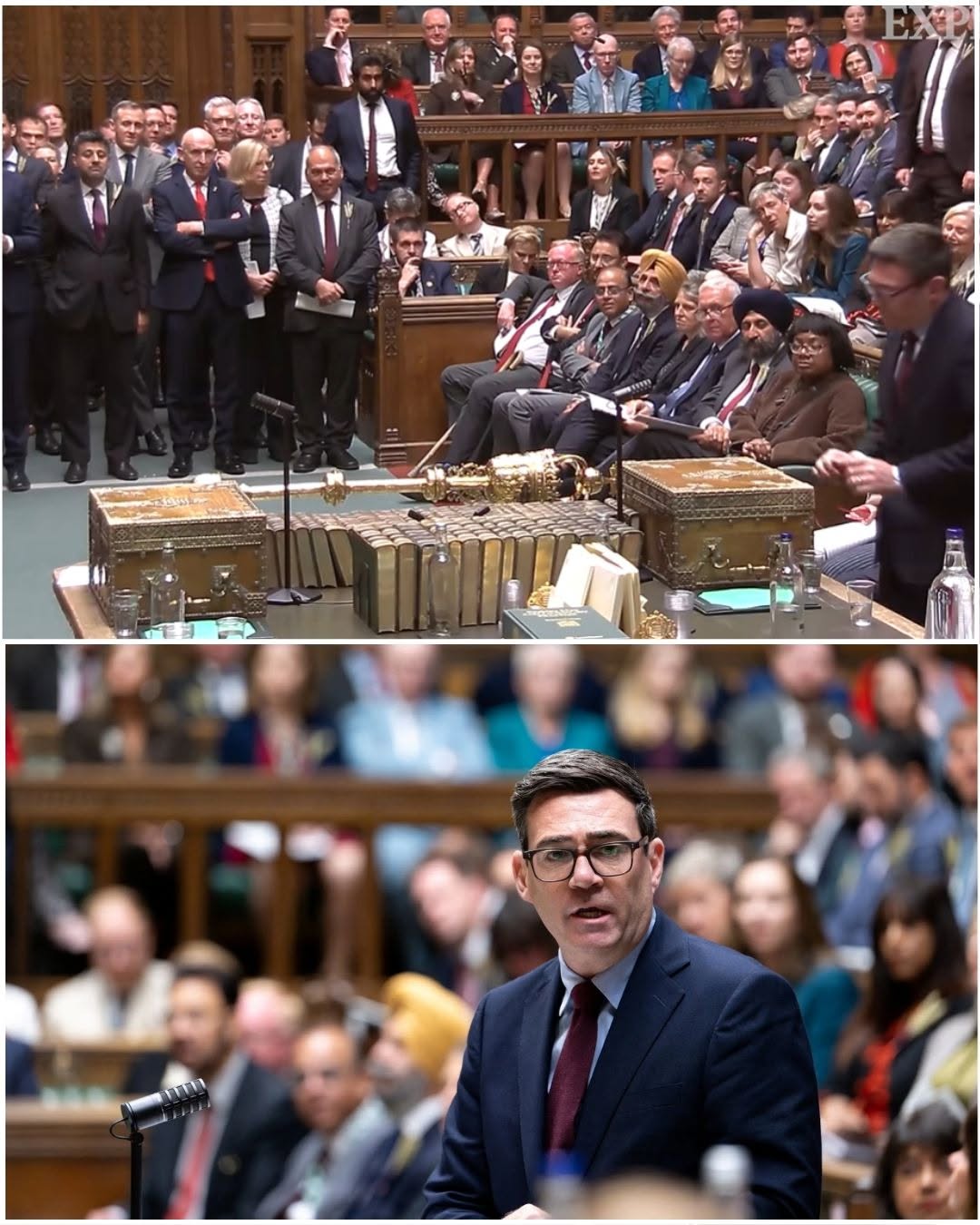
“Defence or Welfare?” Andy Burnham Faces Growing Pressure as Britain’s Military Strength Sparks National Security Debate
LONDON, October 9, 2026 — British Prime Minister Andy Burnham is facing renewed scrutiny over the government’s defence priorities as concerns about the size of the armed forces, rising international threats and pressure on public finances intensify a national debate over whether military security should take precedence over welfare spending.
The controversy follows dramatic claims circulating online that Burnham refused to prioritise defence over welfare during a parliamentary confrontation, prompting opponents to accuse him of effectively surrendering Britain’s national security.
However, the alleged parliamentary exchange has not been independently verified. No authenticated recording or official transcript has been identified confirming that Burnham made the precise statement attributed to him or that Parliament reacted in the manner described.
The underlying questions are nevertheless significant.
Britain faces growing pressure to modernise its military capabilities while maintaining public services, protecting vulnerable households and managing a challenging economic environment.
The debate is particularly sensitive because military personnel numbers have declined substantially over recent decades, even as geopolitical tensions have increased.
For Burnham’s Labour government, the central challenge is determining how much the country should spend on defence, how that money should be allocated and what sacrifices may be required elsewhere in the public budget.
Britain’s Shrinking Armed Forces Raise Serious Questions
Concerns about Britain’s military capacity are supported by official statistics.
According to the House of Commons Library, the United Kingdom had approximately 148,600 full-time armed forces personnel in April 2026, including trained and untrained service members.
That represented a significant decline from approximately 186,000 in April 2012.
The figures reflect long-term changes in recruitment, retention, military organisation and defence planning.
Critics argue that declining personnel numbers could limit Britain’s ability to respond to simultaneous security challenges or sustain prolonged operations.
However, claims that the British Army has reached its smallest size in 200 years require careful interpretation.
Military strength can be measured in several ways, including regular soldiers, trained personnel, reserves and total armed forces strength.
Historical comparisons may also overlook changes in technology, military doctrine and the structure of the armed services.
A smaller modern military is not necessarily less capable in every respect, particularly when it possesses advanced aircraft, submarines, intelligence systems and precision weapons.
Nevertheless, sophisticated equipment cannot entirely replace the personnel needed to maintain operational readiness, protect infrastructure and sustain deployments.
The question facing policymakers is whether Britain’s current force structure remains adequate for the security challenges it could encounter.
A More Dangerous International Environment
The debate is unfolding amid significant concerns about European security and international instability.
Russia’s military activities, cyber threats, tensions involving Iran and uncertainty about the future of international alliances have increased pressure on European governments to strengthen their defensive capabilities.
Britain also faces questions about the resilience of its domestic infrastructure, including energy networks, communications systems, transport facilities and military installations.
A report published on October 8 by the Transition Security Project raised concerns about the country’s defence priorities.
According to reporting on the study, approximately 23% of Britain’s defence budget in 2024–25 was associated with overseas commitments, amounting to more than £14 billion.
The report questioned whether the UK was devoting too much attention to international operations while leaving domestic defence requirements insufficiently addressed.
Its recommendations included reconsidering the balance between overseas deployments and the protection of Britain and Europe.
That argument does not necessarily support reducing military expenditure. Rather, it raises the possibility that existing resources could be used more effectively.
The findings add another dimension to the broader disagreement over whether Britain needs greater defence spending, different spending priorities or both.
What Has the Government Actually Promised?
Despite claims that the prime minister is unwilling to strengthen national defence, the government’s published spending plans indicate a commitment to substantial military investment.
A government defence investment statement issued on June 30, 2026, outlined plans to increase annual defence expenditure from approximately £54 billion in 2024 to almost £80 billion by 2029.
The plan also described a trajectory towards spending 3% of gross domestic product on defence during the next Parliament.
These commitments demonstrate that higher defence spending is part of the government’s stated policy direction.
However, spending announcements do not automatically translate into additional soldiers, operational equipment or improved military readiness.
Defence programmes frequently involve long procurement periods, complex contracts and technological challenges.
Critics may therefore reasonably ask whether the planned investment will deliver measurable improvements quickly enough.
At the same time, describing the government as having abandoned defence entirely would not accurately reflect its published commitments.
The more substantive disagreement concerns whether those commitments are sufficient, properly targeted and financially sustainable.
Defence Spending Versus Welfare: A Difficult Political Choice
The debate over military investment is closely connected to concerns about Britain’s welfare budget.
Public spending on pensions, disability benefits, housing assistance and other forms of financial support represents a substantial share of national expenditure.
Estimates for 2025–26 place welfare spending at approximately £329 billion, with state pensions accounting for a significant portion of that total.
Some Conservative politicians and defence advocates argue that the government must reconsider expenditure priorities if it wants to deliver the military expansion needed to address emerging threats.
Others maintain that reducing support for vulnerable households could create serious social and economic consequences without necessarily resolving the armed forces’ structural difficulties.
The argument is often presented as a choice between national defence and domestic welfare.
In practice, the relationship is more complicated.
Pensions, disability support, military procurement and personnel costs operate under different spending commitments and legal frameworks.
Reducing welfare expenditure would not automatically produce immediate improvements in military capability. Similarly, maintaining social protection does not necessarily prevent governments from increasing defence investment.
The critical question is how limited public resources can be distributed effectively.
Could Britain Be Putting Its Security at Risk?
Defence specialists have warned that Britain needs greater preparedness for potential military emergencies.
A parliamentary briefing published in 2026 highlighted criticism from Lord Robertson, a former NATO secretary-general, who argued that Britain remained insufficiently prepared for the threats it faced.
His concerns included the need for investment in modern capabilities, infrastructure and military readiness.
These warnings have strengthened the argument that additional defence resources may be necessary.
Nevertheless, describing government budget decisions as a complete national surrender goes beyond what the available evidence establishes.
Britain remains a nuclear-armed NATO member with substantial military capabilities, intelligence partnerships and international security commitments.
The country’s armed forces continue to participate in collective defence arrangements and major procurement programmes.
More recently, on October 8, Burnham’s government announced deeper security cooperation with Germany, including measures intended to address cyberattacks and threats to critical infrastructure.
Such initiatives do not resolve every concern about defence readiness, but they demonstrate that security cooperation remains part of government policy.
What About the Alleged Parliamentary Confrontation?
The most dramatic element of the circulating claims concerns an alleged televised exchange in which Burnham supposedly refused to place military defence ahead of welfare spending.
The accompanying descriptions suggest that political opponents were outraged and that Parliament was left stunned by his response.
However, searches of available reporting and parliamentary material have not established the precise exchange described.
There is also no verified basis for attributing the word “surrender” to a particular opponent in connection with this alleged incident.
Without a confirmed date, identifiable questioner and official transcript, it would be inappropriate to present the reported confrontation as established fact.
Parliamentary scrutiny of defence spending is genuine and ongoing, but individual political exchanges must be distinguished from exaggerated descriptions circulated online.
The Bigger Challenge Facing Britain
Ultimately, the defence-versus-welfare debate reflects the difficult choices facing governments during a period of economic pressure and geopolitical instability.
Military leaders require sufficient resources to recruit personnel, maintain equipment and prepare for future threats.
Public services and social-support systems must also respond to an ageing population, rising care needs and financial insecurity.
These responsibilities compete for resources, but they also contribute in different ways to national resilience.
A country with strong armed forces but serious domestic instability may face significant long-term challenges. Equally, extensive social programmes cannot replace credible military capabilities when external threats emerge.
Finding the right balance requires detailed spending reviews, realistic assessments of security risks and greater transparency about the consequences of government decisions.
Opposition politicians have a legitimate role in challenging whether the government’s priorities are appropriate.
The government, in turn, must demonstrate that promised increases in defence spending lead to practical improvements rather than simply larger budget figures.
For Andy Burnham, the central test will not be whether he can deliver a dramatic response in Parliament, but whether his administration can strengthen Britain’s security while maintaining sustainable public finances.
The country’s military personnel shortages, procurement challenges and growing security responsibilities deserve serious examination.
So does the question of how changes to welfare spending would affect millions of people who depend on public support.
Claims that Britain has already surrendered its security may attract attention, but they do not substitute for evidence about military capability or government performance.
The real question is whether Britain can build a stronger defence system without undermining the economic and social foundations it is intended to protect.
That is the debate likely to define the government’s defence policy in the years ahead.
PM’S SHOCKING “SURRENDER” CAUGHT ON TAPE! Political Storm Erupts as Britain Demands Answers
A dramatic political controversy has once again raised questions about leadership, accountability and the future direction of Britain. A headline claiming that the Prime Minister’s shocking “surrender” was caught on tape has fuelled speculation about what may have been said behind closed doors, whether important decisions have been concealed from the public and what the consequences could mean for the country.
In an increasingly divided political environment, even a short recording can become the centre of an intense national debate. Politicians, journalists and members of the public may interpret the same words in very different ways, particularly when the discussion involves national interests, government negotiations or promises made to voters.
However, the precise recording, the identity of the people involved and the circumstances surrounding the alleged remarks must be established before any conclusions can be drawn. The word “surrender” is a powerful political accusation, but it does not automatically demonstrate that a Prime Minister has abandoned a policy or conceded an important national interest.
What matters is the evidence, the context of the conversation and the decisions that followed.
A Recording That Raises Difficult Questions
Recordings have become increasingly influential in modern politics because they can capture statements that might otherwise remain private. When a politician’s words appear to contradict a public position, the resulting controversy can quickly spread beyond Westminster.
For voters, the immediate questions are straightforward. What was actually said? When was the recording made? Who was present? And does the conversation reveal a genuine change in government policy?
Those questions are essential because short recordings can sometimes create misleading impressions when separated from the wider discussion.
A remark made during a negotiation might reflect a temporary compromise rather than a permanent change in direction. A hypothetical suggestion may be presented as a firm commitment, while an informal expression of frustration may be interpreted as an official government position.
The full context can therefore make a substantial difference.
If a recording involving the Prime Minister has genuinely emerged, its authenticity and completeness should be verified before it is used to support accusations of political misconduct.
The public has a legitimate interest in understanding what its leaders say and do, but that interest is best served by accurate information rather than speculation.
Why the Word “Surrender” Carries Such Political Weight
In British politics, the word “surrender” is frequently used to describe what critics consider an unacceptable concession. It can be applied to negotiations with foreign governments, agreements involving international institutions or decisions that opponents believe weaken national sovereignty.
The term is emotionally powerful because it suggests that a leader has abandoned a principle rather than simply adjusted a policy.
Yet political negotiations often involve compromises. Governments must weigh competing priorities, consider economic consequences and assess the practical options available to them.
A compromise is not necessarily a surrender, just as a firm public statement does not guarantee that every demand can be achieved.
The distinction depends on the details.
If a government accepts conditions that significantly depart from its previous commitments, critics may reasonably ask why the change occurred and whether the public was properly informed. Supporters may argue that the agreement secured other benefits or prevented a more damaging outcome.
Both interpretations should be assessed against the actual terms of the agreement and the evidence available.
Without the full recording and its context, it would be premature to conclude that the Prime Minister has surrendered on any particular issue.
Nevertheless, the controversy illustrates why political language matters. Dramatic accusations can shape public perceptions long before the underlying facts are fully understood.
Leadership Under Pressure
Prime ministers face difficult choices when political promises collide with practical constraints.
Economic pressures, international developments, parliamentary arithmetic and negotiations with other governments can all influence decisions. A policy that appears straightforward during an election campaign may become more complicated once ministers must consider its financial, legal and diplomatic consequences.
These challenges do not remove the obligation to explain major decisions.
Voters expect political leaders to provide clear accounts of why a position has changed, what alternatives were considered and what consequences the government expects.
If a recording appears to contradict an earlier public statement, the Prime Minister may face questions about consistency and transparency.
The government would need to explain the circumstances surrounding the conversation and clarify whether it reflects an official decision, a negotiating position or a personal opinion.
The response should address the substance of the issue rather than relying entirely on criticism of political opponents or the people who released the recording.
At the same time, any assessment should distinguish between a genuine contradiction and a statement that has been taken out of context.
Responsible scrutiny requires evidence from all relevant sources.
The Opposition Will Demand Answers
A controversy involving an alleged private conversation can create an opportunity for opposition parties to challenge the government’s credibility.
Opposition politicians may demand that ministers explain the recording, clarify the government’s position and disclose relevant documents where legally appropriate.
They may also question whether the Prime Minister has been sufficiently open with Parliament and the public.
Such scrutiny is a normal part of democratic government. Ministers are expected to explain significant decisions, particularly when those decisions appear inconsistent with previous promises.
However, the effectiveness of opposition scrutiny depends on the quality of the questions being asked.
An accusation may attract headlines, but it does not establish wrongdoing by itself. Opposition parties must also consider the complete evidence and allow the government an opportunity to respond.
The same standard applies to the governing party. Ministers should not dismiss every criticism as political opportunism when legitimate questions remain unanswered.
A meaningful debate should focus on what the recording demonstrates, what it does not demonstrate and what additional information is needed.
That approach gives voters a clearer basis for judging the government’s actions.
The Media’s Role in Establishing the Facts
When a recording becomes the focus of a political controversy, news organisations face an important responsibility.
They must verify the material, establish its origin and examine whether the published excerpts accurately represent the conversation. They should also distinguish between confirmed information and interpretations offered by politicians or commentators.
A sensational headline may suggest a dramatic revelation, but the underlying evidence may be more complicated.
Journalists should establish whether the recording is authentic, whether any significant portions have been omitted and whether the people involved have provided an explanation.
If the material concerns confidential negotiations or national security, additional considerations may arise. Those concerns do not automatically prevent reporting, but they can affect how the information should be handled and what details can responsibly be published.
The public benefits from independent reporting that investigates powerful figures without sacrificing accuracy.
Equally, political leaders should be able to challenge misleading reporting and request corrections when claims are demonstrably inaccurate.
The objective should not be to protect politicians from embarrassment or to maximise the damage caused by a controversial recording. It should be to establish what happened and explain its significance.
Public Trust and the Cost of Unanswered Questions
Trust in political institutions depends partly on whether citizens believe that leaders are being honest about important decisions.
When public statements appear inconsistent with private conversations, people may question whether they have been given a complete explanation.
Such concerns can become particularly significant when the issue involves national security, economic policy, immigration or the country’s international relationships.
However, trust can also be damaged when unverified allegations are presented as established facts.
If a recording is incomplete or its meaning is misrepresented, public discussion may become dominated by an interpretation that does not accurately reflect what occurred.
Correcting that impression can be difficult once a dramatic claim has spread widely.
The best response is transparency wherever possible. Officials should explain the context of important remarks, clarify the government’s actual position and provide supporting documentation when appropriate.
Members of the public should also have access to reliable information that allows them to distinguish a confirmed policy change from a political accusation.
Neither unquestioning acceptance nor automatic suspicion offers a satisfactory basis for evaluating government decisions.
What Would a Genuine Policy Reversal Mean?
If the recording ultimately demonstrates that the Prime Minister privately accepted a major change in policy, the consequences would depend on the subject and the commitments involved.
A reversal affecting an international agreement could prompt questions about diplomatic strategy and the country’s negotiating position. A change involving taxation or public spending could raise concerns about the government’s financial plans. A departure from an election promise could lead voters to question whether the original commitment had been realistic.
In each case, the essential issue would be the substance of the decision.
What was promised previously? What has changed? Why did the government make the decision? What benefits or disadvantages are expected? And were Parliament and the public informed appropriately?
These questions offer a more precise way to evaluate political accountability than relying on the word “surrender”.
A government may defend a change as necessary in response to new circumstances, while critics may argue that the change represents a failure to honour previous commitments.
The evidence should determine which aspects of those arguments are supported.
Without verified information about the alleged recording, no specific policy reversal can responsibly be attributed to the Prime Minister.
The Questions Britain Needs Answered
The controversy surrounding the alleged recording highlights several issues that deserve careful examination.
First, the authenticity and completeness of the material must be established.
Second, the words spoken should be considered in their full context, including the purpose of the conversation and any relevant negotiations.
Third, the government should clarify whether the remarks reflect an official decision or merely a discussion of possible options.
Finally, any claim that the recording demonstrates misconduct, deception or an abandonment of national interests must be supported by evidence.
These standards are important regardless of the political party involved.
A Prime Minister should be accountable for decisions and statements that affect the country. But accountability is strengthened, not weakened, when accusations are tested against verifiable facts.
The public deserves answers that are specific, understandable and supported by evidence.
Conclusion: Evidence Must Come Before Political Verdicts
The headline claiming that the Prime Minister’s shocking “surrender” was caught on tape has the potential to generate intense debate, but the significance of the alleged recording cannot be established from the headline alone.
The decisive questions concern what was actually said, whether the recording is authentic, what circumstances surrounded the conversation and whether any government policy or commitment was changed as a result.
If the evidence reveals a serious contradiction between private statements and public assurances, the government should explain that discrepancy. If the recording has been presented without essential context, that context should also be made available so that the public can reach an informed conclusion.
Political opponents have a legitimate role in questioning government decisions, while journalists have a responsibility to investigate claims carefully. The Prime Minister, in turn, must be prepared to account for decisions that affect the country.
Until the recording and its circumstances are verified, describing the incident as a confirmed act of surrender would go beyond the available evidence.
Britain’s political debate is better served by careful scrutiny than by speculation. The public deserves to know what happened, why it happened and what consequences followed.
Ultimately, the real test of leadership is not whether a dramatic headline dominates the news cycle. It is whether those in power can explain their decisions honestly, respond to legitimate questions and demonstrate that their actions are consistent with the commitments they have made to the people they serve.