

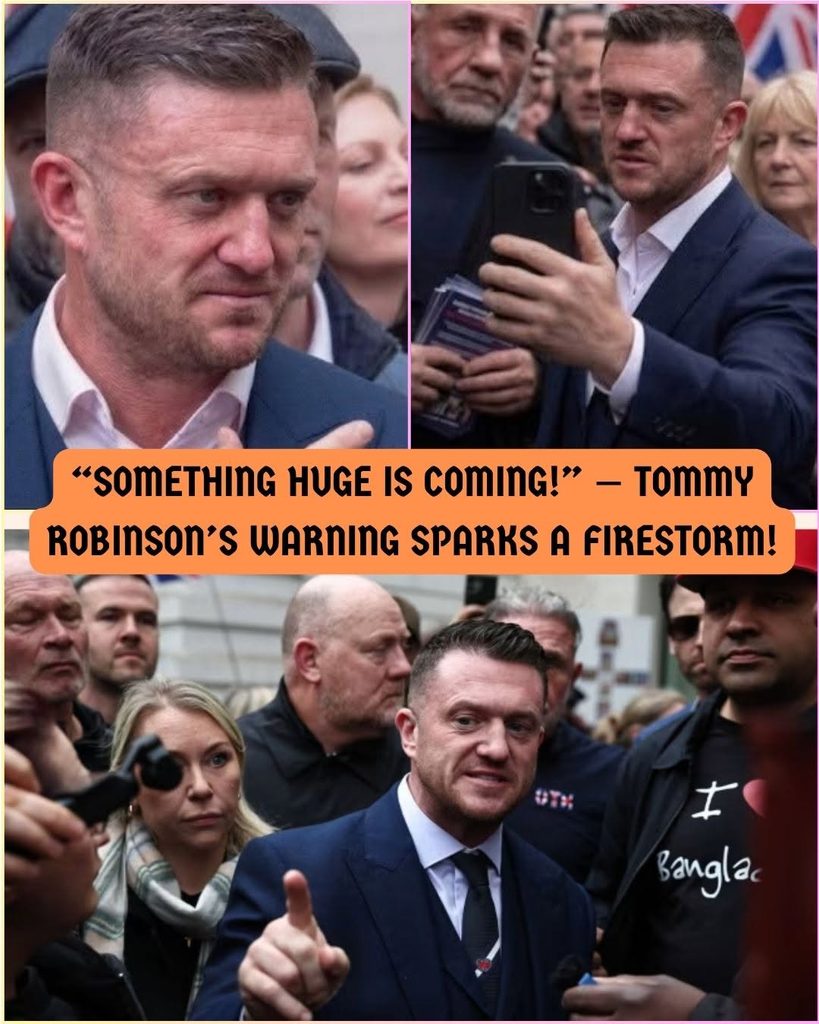
A cryptic warning attributed to British activist Tommy Robinson has ignited a fresh wave of speculation online, with supporters and critics offering sharply different interpretations of what his message could mean for Britain’s increasingly turbulent political landscape.
Robinson, whose real name is Stephen Yaxley-Lennon, has reportedly suggested that “something huge is coming,” framing his message around concerns about Britain’s future. The dramatic wording has circulated widely among supporters and prompted intense discussion on social media, where some users have interpreted it as a prediction of a major political or social development.
Yet the central mystery remains unresolved: what, exactly, was Robinson predicting?
The material accompanying the claim does not provide a complete quotation, a detailed explanation of the supposed development, or independently verifiable evidence showing that a specific event is imminent. That makes caution particularly important. Without additional context, the phrase should not be interpreted as proof that Robinson possesses advance knowledge of a major event.
Instead, the episode offers a revealing glimpse into the political environment in which dramatic warnings can rapidly become national talking points.
A Message Designed to Get Attention
“Something huge is coming” is powerful precisely because it is vague.
The phrase invites audiences to fill in the missing information themselves. For Robinson’s supporters, it could be interpreted as referring to a political breakthrough, a large demonstration, a new campaign or a broader public reaction against government policy.
Critics may see the same language differently, regarding it as an attempt to generate anticipation and mobilize an online following without providing enough information for the prediction to be independently assessed.
Until Robinson provides further details — or the complete context of his remarks is established — neither interpretation can safely be presented as fact.
That distinction is especially important when dealing with a figure who attracts strong reactions across the political spectrum.
Robinson has built a substantial public profile through campaigning on issues including Islamism, immigration, free speech and what he describes as failures by Britain’s political and media institutions. Supporters regard him as someone willing to discuss subjects that mainstream politicians avoid. Critics accuse him of using inflammatory rhetoric and presenting complex social issues in ways that can deepen division.
Those opposing perceptions ensure that almost any major statement from him is likely to generate controversy.
Why the Warning Is Resonating
The response cannot be understood entirely through Robinson himself.
Britain is experiencing heated arguments over immigration, asylum, crime, policing, taxation, public services and confidence in political institutions. These disputes have increasingly moved beyond Westminster and into demonstrations, online campaigns and confrontations between competing political groups.
Against that backdrop, a vague prediction of something “huge” can resonate strongly.
For people already convinced that Britain is approaching a political turning point, Robinson’s statement may appear to confirm their expectations.
But there is an important difference between widespread dissatisfaction and evidence that a dramatic event is actually imminent.
Political movements often thrive on a sense of momentum. Suggesting that major change is approaching can energize supporters, attract attention and encourage people to remain engaged.
That is why the substance behind the language matters more than the language itself.
Could It Be About Immigration?
Given Robinson’s long-running political focus, immigration and national identity are likely to feature prominently in speculation surrounding his remarks.
Migration remains one of Britain’s most contentious political subjects. Small-boat crossings of the English Channel, asylum accommodation and the government’s ability to remove people without permission to remain have all generated significant controversy.
Recent demonstrations connected to migration have further illustrated the intensity of the debate.
Some voters argue that governments have repeatedly promised stronger border controls without producing sufficient results. They view continued irregular migration as evidence of a political establishment unwilling or unable to respond to public concern.
Others warn that migration is frequently discussed through exaggerated claims that can obscure the differences between refugees, asylum seekers, legal migrants and people who have entered or remained in Britain unlawfully.
Human-rights organizations also stress that governments must maintain legal protections for people seeking refuge from persecution.
Without Robinson explicitly connecting his warning to migration, however, it would be speculative to conclude that this is what he meant.
Supporters See a Political Awakening
Among Robinson’s supporters, dramatic warnings about Britain’s future often fit into a wider narrative that established political institutions are losing public confidence.
They argue that concerns once dismissed as politically unacceptable — particularly around immigration, integration and national identity — have moved increasingly into mainstream debate.
From that perspective, “something huge” might not necessarily refer to a single event. It could instead be interpreted as a prediction of a broader political realignment.
Across Europe, established parties have faced growing competition from populist and anti-establishment movements. Britain has experienced its own version of that disruption, with traditional party loyalties becoming less predictable and immigration remaining a powerful electoral issue.
Whether that amounts to the transformation Robinson appears to anticipate is another question.
Social-media enthusiasm should not automatically be confused with national public opinion. Viral posts can create an impression of overwhelming support because algorithms tend to reward emotionally charged material.
Elections and reliable polling provide a better measure of broader political sentiment.
Critics Question the Rhetoric
Robinson’s critics are likely to focus less on the prediction itself and more on the way it is communicated.
They argue that ominous statements can intensify fear without providing audiences with enough evidence to evaluate the underlying claim.
That concern becomes particularly significant when political tensions are already high.
Britain protects robust political speech, including speech that many people find offensive or provocative. But political leaders and activists also operate in an environment where statements can spread instantly to enormous audiences.
Critics therefore argue that influential figures should be precise when making claims about threats, conspiracies or impending national crises.
Supporters counter that such criticism can become an excuse for dismissing uncomfortable political arguments rather than addressing them.
The tension between those positions has become a defining feature of contemporary political debate.
The Missing Evidence Matters
The most important question surrounding Robinson’s latest warning is surprisingly straightforward: what evidence supports it?
If he is referring to a specific development, the public needs enough information to assess the claim.
Is there an upcoming political announcement? A demonstration? New evidence relating to an existing controversy? A campaign launch? Or is the statement simply a broad prediction that public frustration will eventually produce significant political change?
Those possibilities are substantially different.
Until the context becomes clear, reports should resist converting ambiguity into certainty.
A prediction can generate enormous attention without ultimately proving accurate. Similarly, a dramatic statement may later turn out to have referred to something much narrower than audiences initially imagined.
Britain’s Deeper Political Divide
Whatever Robinson ultimately meant, the reaction to his words tells its own story.
A significant section of the British political audience appears receptive to messages suggesting that the country is approaching a moment of fundamental change. At the same time, another section views such rhetoric as part of a dangerous escalation in political polarization.
Both responses reflect declining trust.
When confidence in governments, traditional media and public institutions weakens, alternative political voices gain greater influence. Social media accelerates that process by allowing activists to communicate directly with millions of people without traditional editorial filters.
That can broaden political participation. It can also allow unverified claims to travel much faster than corrections.
The challenge for readers is therefore to separate three different things: what Robinson actually said, what he can substantiate and what other people believe his words mean.
For now, only the warning itself is driving the conversation.
“Something huge is coming” is certainly a compelling political message.
Whether it proves to be a genuine prediction of a significant development, the beginning of a new campaign or simply rhetoric designed to build anticipation remains unknown.
Until more evidence emerges, the biggest story may not be what Robinson claims is coming — but why so many people are rea
“SOMETHING HUGE IS COMING!” — TOMMY ROBINSON’S WARNING SPARKS A FIRESTORM!
A dramatic warning from British activist Tommy Robinson has reignited debate over immigration, national identity and the growing divisions shaping public life in the United Kingdom. His declaration that “something huge is coming” has attracted attention among supporters and critics alike, prompting renewed discussion about what the statement means, why it has generated such a strong reaction and how it fits into Britain’s increasingly polarised political environment.
The phrase is deliberately open-ended. Without a verified explanation of the specific event or announcement Robinson was referring to, it would be premature to conclude that a particular political development, demonstration or campaign is imminent. Nevertheless, the reaction illustrates how short, provocative statements from prominent activists can rapidly become the focus of wider public debate.
For some of Robinson’s supporters, the warning may suggest that a significant moment is approaching in the campaign over immigration and government policy. For his critics, the language raises questions about the consequences of increasingly confrontational political rhetoric. The disagreement reflects a broader struggle over how immigration, protest and national identity should be discussed in modern Britain.
A Cryptic Warning Captures Attention
In an era dominated by social media, a few carefully chosen words can travel far beyond their original audience. A statement suggesting that something major is about to happen can encourage speculation, attract supporters and prompt opponents to respond, even when the details remain unclear.
Robinson has developed a public profile through his campaigning on immigration, Islam, freedom of expression and other contentious social issues. His interventions have frequently generated strong reactions, reflecting the divisions surrounding his political activities and public statements.
The latest warning, as presented in the headline, follows a familiar pattern in contemporary political communication: an announcement creates anticipation before the underlying details are fully understood.
That uncertainty is important. Without a complete statement, its context and confirmation of any planned event, it is impossible to establish precisely what Robinson intended to communicate.
The distinction between a confirmed announcement and online speculation matters because dramatic language can quickly become detached from its original meaning. A prediction of an upcoming campaign, for example, would be very different from a reference to a political speech, a public demonstration or a response to a developing controversy.
For readers, the most useful starting point is therefore to examine the available evidence rather than assume that the strongest interpretation circulating online is necessarily accurate.
Why Tommy Robinson Remains a Controversial Figure
Tommy Robinson, whose real name is Stephen Yaxley-Lennon, became widely known through his involvement in anti-Islam activism and his role in founding the English Defence League in 2009. His political activities have included demonstrations, online campaigning and public interventions concerning immigration and religious identity.
Supporters often frame his activities around freedom of speech, opposition to what they consider failures in immigration policy and demands for greater transparency from public institutions. They argue that controversial subjects should be open to public scrutiny and that criticism of government policy should not automatically be dismissed.
Critics, however, have raised concerns about his rhetoric, his association with anti-Islam activism and the potential for his campaigns to deepen hostility towards minority communities. His public activities have also attracted legal scrutiny at various points, making accurate distinctions between established legal facts, allegations and political commentary especially important.
These competing interpretations help explain why even a brief statement from Robinson can become a larger national talking point.
His supporters may interpret an announcement as an opportunity to mobilise around issues they believe are being neglected. His opponents may view the same message through concerns about polarisation, misinformation or the treatment of vulnerable communities.
Neither reaction establishes what the warning itself refers to. That can only be determined through the original statement and any subsequent clarification.
Immigration Remains Central to Britain’s Political Debate
The attention surrounding Robinson’s warning comes against the background of continuing debate about immigration and asylum policy in Britain.
Questions about small-boat crossings across the English Channel, the processing of asylum applications, accommodation costs and the enforcement of immigration decisions have featured prominently in political discussion.
Some people argue that the government must strengthen border controls, speed up asylum decisions and ensure that people who have no legal right to remain are removed when the law permits. They also raise concerns about pressure on housing, local services and public finances.
Others emphasise the legal and humanitarian obligations associated with asylum, the contribution of lawful migration to certain sectors of the economy and the danger of treating different groups of migrants as though their circumstances were identical.
These disagreements involve several distinct policy questions. The rules governing work visas, family migration, international students and asylum claims are not interchangeable, and each requires its own legal and administrative framework.
Political activists often communicate through broad messages that bring these issues together. However, evaluating specific proposals requires closer examination of the evidence, practical consequences and applicable law.
The public debate is likely to remain intense wherever people believe that government policy is failing to address their concerns. Yet the existence of disagreement does not mean that every dramatic prediction about an impending political event should be accepted without confirmation.
Social Media and the Power of Political Mobilisation
Social media has transformed how political campaigns develop and how public figures communicate with their audiences.
A statement can be circulated through multiple platforms within minutes, with supporters sharing interpretations, critics posting responses and commentators attempting to explain its significance. This process can magnify a message before journalists or the public have access to the full context.
Cryptic announcements are particularly suited to this environment because they invite people to fill in missing information. Some may interpret the message as a promise of a major protest, while others may speculate about a new campaign or political confrontation.
Such interpretations can generate considerable attention, but repetition does not turn speculation into evidence.
The same dynamic affects public demonstrations. Online mobilisation can help people organise lawful gatherings and express their views, but incomplete information can also create confusion about the purpose, timing or scale of an event.
Responsible reporting should therefore distinguish between an individual’s verified words, an officially announced activity and claims made by other users.
For anyone following Robinson’s statement, the key questions are straightforward: What did he say in full? When and where did he say it? Has he explained what he meant? Is there independent confirmation of the event or development being discussed?
Until those questions are answered, the precise significance of the warning remains uncertain.
Freedom of Expression and Public Responsibility
The controversy also raises a broader question about the boundaries and responsibilities of political expression.
In a democratic society, people must be able to criticise governments, challenge immigration policies and organise peaceful demonstrations. Public debate can expose administrative failures, bring neglected issues to attention and encourage officials to explain their decisions.
At the same time, freedom of expression does not remove the responsibility to distinguish factual claims from speculation or to avoid encouraging unlawful conduct.
Political language can affect how audiences understand events and how they perceive other communities. Statements that lack context may be interpreted in ways their original speaker did not intend, while exaggerated online commentary can make an uncertain situation appear more definite than it is.
The appropriate response is not to assume that every controversial statement is dangerous or that every criticism of immigration policy is illegitimate. Instead, claims should be examined on their merits, and any allegation of unlawful conduct should be assessed using evidence.
This approach protects the ability to debate contentious issues while maintaining a clear distinction between lawful political activity and actions that violate the rights or safety of others.
What Could Happen Next?
The next significant development would be a clear explanation from Robinson about the meaning of his warning.
If it refers to a planned demonstration or campaign, useful details would include its purpose, timing, location and the issues organisers intend to raise. If it refers to a political announcement or a response to a current controversy, the original statement would help establish the intended context.
Until such information is available, claims about a major impending event should be treated cautiously.
Political observers may examine how supporters and critics respond, whether other public figures comment and whether the statement leads to a confirmed announcement. Those developments could help explain the wider significance of the episode without requiring assumptions about events that have not been established.
The government’s response, if any is warranted, would also need to be considered in light of the actual circumstances rather than speculation.
Britain’s immigration debate already contains substantial disagreements about enforcement, public spending, legal rights and national identity. A new statement can bring those divisions back into focus, but its lasting importance will depend on what follows and whether it produces a concrete development.
Conclusion
Tommy Robinson’s reported declaration that “something huge is coming” has generated attention because it combines an ambiguous promise of change with issues that are already deeply contested in British public life.
For supporters, the statement may represent the possibility of renewed political activity around immigration and government accountability. For critics, it raises familiar concerns about polarisation and the influence of provocative rhetoric.
The precise meaning of the warning, however, cannot be established from the headline alone. Without a verified explanation or confirmation of a specific event, predictions about what will happen next remain speculative.
The episode nevertheless illustrates the influence that political activists can exercise in a media environment where short statements can quickly become national talking points.
Ultimately, the significance of the warning will depend on the evidence that emerges, the actions that follow and the substance of any proposals or announcements. Until then, the most responsible approach is to follow confirmed information, distinguish fact from interpretation and judge the wider debate on its merits rather than on the intensity of the headlines.