
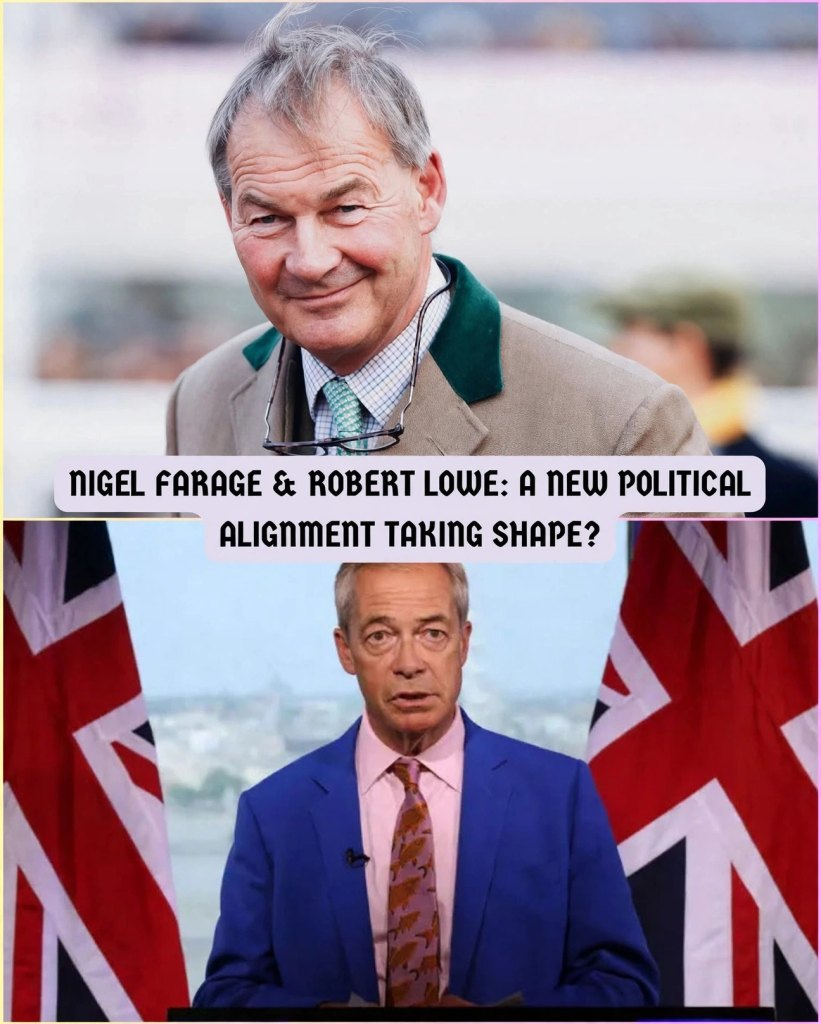
British politics is rarely short of unexpected developments, but few recent events have generated as much discussion as the public appeal by Member of Parliament Robert Lowe urging Nigel Farage to set aside past disagreements in the interests of what he described as “the good of the country.” Although no formal political agreement has been announced, the proposal has immediately fueled speculation across political circles, social media, and news commentary about whether a renewed partnership between two prominent figures associated with Britain’s political right could reshape the country’s political landscape ahead of the next general election. At this stage, many of the discussions remain speculative, and there is no confirmed indication that such cooperation will ultimately materialize. Nevertheless, the public nature of the appeal has revived broader conversations about leadership, party unity, electoral strategy, and the changing priorities of British voters during a period of continuing political uncertainty.
The attention surrounding Lowe’s remarks reflects more than the personalities involved. It also highlights the continuing debate over the direction of conservative and right-leaning politics in the United Kingdom. For several years, immigration, economic pressures, public services, taxation, national sovereignty, and questions surrounding Britain’s post-Brexit future have remained central issues in political debate. Different political movements have attempted to position themselves as the most credible advocates for addressing these concerns, while voters have increasingly scrutinized not only individual policies but also whether opposition parties can present themselves as disciplined and united alternatives to the government. Against this backdrop, even a simple public invitation for cooperation carries symbolic significance that extends well beyond the individuals directly involved.
Nigel Farage remains one of the most recognizable political figures in modern British politics. Over several decades, he has built a reputation as a vocal campaigner on issues relating to Britain’s relationship with the European Union, border security, immigration policy, and national sovereignty. His role during the Brexit campaign established him as a significant political force, even though he has not consistently held parliamentary office throughout his career. Farage has continued to influence public debate through political campaigning, media appearances, and leadership roles within parties advocating for stricter immigration policies and institutional reform. His supporters frequently credit him with changing the national political conversation, while critics argue that his rhetoric has often been divisive. Regardless of perspective, few observers dispute his ability to attract public attention whenever major political developments arise.
Relations between political figures are rarely static, and disagreements among individuals sharing broadly similar policy priorities are common within democratic systems. Political alliances often evolve in response to changing electoral circumstances, leadership transitions, public opinion, and strategic calculations. Throughout British political history, rivals have occasionally become allies when broader objectives appeared to outweigh previous differences. Conversely, long-standing partnerships have also fractured over policy disagreements or leadership disputes. Against this historical background, Lowe’s public invitation naturally prompted observers to ask whether a genuine reconciliation might now be possible or whether the statement primarily represented an attempt to encourage wider unity among supporters rather than signal imminent organizational change.
The timing of the proposal has attracted particular attention because Britain continues to experience significant political volatility. Public opinion surveys have reflected shifting levels of support among the major political parties, while smaller parties continue seeking opportunities to expand their electoral influence. Economic challenges, debates surrounding inflation, housing affordability, healthcare capacity, immigration management, taxation, and public sector performance remain high on the political agenda. During periods of uncertainty, discussions surrounding leadership, coalition-building, and strategic cooperation often become more prominent as political organizations evaluate how best to maximize electoral support before voters next head to the polls.
Supporters of closer cooperation between Farage and Lowe argue that fragmentation among parties or movements appealing to similar voter groups may reduce their overall electoral effectiveness. Under Britain’s first-past-the-post electoral system, dividing votes among multiple candidates or organizations can sometimes produce outcomes that differ significantly from overall national vote shares. Some political analysts therefore argue that greater coordination between individuals sharing similar priorities could potentially strengthen their ability to influence future elections. Advocates of this perspective contend that unity would allow greater focus on policy proposals rather than internal disagreements, enabling campaign resources and public messaging to be concentrated more effectively.
Other commentators have approached the proposal with greater skepticism. Some argue that public appeals for reconciliation can sometimes serve strategic communications purposes rather than represent active negotiations behind the scenes. Political figures frequently use public statements to shape narratives, encourage supporters, test public reaction, or influence broader debates without necessarily indicating that formal agreements are imminent. From this perspective, Lowe’s comments may be interpreted as an invitation for discussion rather than evidence that concrete plans already exist. Without confirmation from all parties involved, analysts caution against assuming that cooperation will necessarily follow.
Questions also remain regarding how Nigel Farage himself may respond. Public speculation has naturally focused on whether he might welcome renewed dialogue, decline the invitation, or choose a more cautious approach while evaluating political circumstances. At present, no definitive outcome has been established, and any assumptions regarding future decisions remain speculative. Political leaders frequently balance multiple considerations, including organizational priorities, policy objectives, electoral strategy, relationships with supporters, and long-term political ambitions. Consequently, even seemingly straightforward public invitations can involve complex strategic calculations before any formal decisions are reached.
Beyond individual personalities, the episode has renewed discussion concerning the broader ideological direction of Britain’s political right. Different groups emphasize varying priorities, including immigration reform, tax policy, economic competitiveness, constitutional issues, healthcare reform, crime reduction, energy policy, environmental regulation, defense spending, and government efficiency. Although many organizations share overlapping concerns, differences regarding implementation, leadership style, communication strategy, and institutional reform sometimes create divisions that complicate efforts toward closer cooperation. Whether those differences can be reconciled depends not only upon political personalities but also upon substantive policy negotiations.
Immigration continues to occupy a particularly significant position within these discussions. For several years, debates concerning legal migration, asylum policy, border security, integration, labor market requirements, and international obligations have featured prominently within British politics. Farage has consistently advocated stricter immigration controls, while Lowe has similarly argued for stronger border management and more effective enforcement mechanisms. Supporters believe tougher policies would reduce pressure on public services, housing, and infrastructure. Critics respond that immigration policy involves legal, humanitarian, demographic, and economic considerations requiring balanced approaches that comply with both domestic legislation and international commitments. The continuing prominence of this issue partly explains why cooperation between influential political figures attracts substantial public attention.
Economic policy represents another important area shaping political debate. Britain continues confronting questions regarding productivity growth, business investment, taxation, inflation, public borrowing, infrastructure spending, and long-term competitiveness. Different political movements propose contrasting strategies for stimulating economic development while maintaining sustainable public finances. Some emphasize reducing government expenditure and lowering taxes to encourage investment, whereas others prioritize public investment, social protection, and targeted industrial policy. Any future political alliance would likely need to demonstrate coherent positions across these areas if it hoped to persuade voters seeking comprehensive policy alternatives.
Leadership itself often plays a decisive role in electoral politics. Modern political campaigns frequently focus not only on policy platforms but also on perceptions of competence, credibility, communication skills, and personal trustworthiness. Political scientists regularly observe that voters may evaluate leaders as symbols representing broader organizational strengths or weaknesses. Consequently, speculation regarding possible cooperation between Farage and Lowe naturally extends beyond individual personalities toward questions about leadership structure, decision-making processes, campaign organization, and public messaging. Even without immediate institutional changes, discussions surrounding leadership can significantly influence public expectations.
Media coverage has contributed substantially to the visibility of the story. News organizations, commentators, political analysts, and social media users have interpreted Lowe’s remarks through different lenses depending upon their editorial perspectives and political viewpoints. Some portray the proposal as potentially transformative, emphasizing opportunities for greater unity. Others stress uncertainty, noting that political negotiations frequently prove more complicated than public statements initially suggest. Still others focus on the symbolic implications rather than immediate practical consequences, arguing that the conversation itself reflects broader dissatisfaction with existing political arrangements among certain segments of the electorate.
Social media has amplified these discussions considerably. Online platforms allow political statements to spread rapidly, encouraging immediate reactions from supporters, opponents, journalists, and independent commentators. Within hours of Lowe’s appeal, numerous users had begun debating potential electoral scenarios, leadership arrangements, policy priorities, and strategic implications. Such discussions illustrate how contemporary political communication increasingly unfolds simultaneously through traditional media and digital platforms, where speculation can develop quickly despite limited confirmed information. While social media provides opportunities for broader public participation, it also highlights the importance of distinguishing verified facts from opinion, prediction, and rumor.
Historical experience suggests that political realignments can occur unexpectedly, particularly during periods characterized by economic uncertainty, declining public trust, or significant institutional change. Britain’s political system has witnessed multiple examples of parties merging, splitting, forming electoral agreements, or redefining their ideological identities over time. However, history also demonstrates that many widely discussed alliances ultimately fail to materialize because of leadership differences, policy disagreements, organizational challenges, or changing political circumstances. Consequently, observers generally caution against assuming that public speculation necessarily predicts future political outcomes.
Public opinion will ultimately remain one of the most important factors shaping any future developments. Political leaders may pursue cooperation when they believe voters desire greater unity, but they must also consider whether supporters perceive such partnerships as credible and beneficial. Electoral success depends not only upon organizational decisions but also upon public confidence, campaign effectiveness, policy clarity, candidate quality, and broader national circumstances. Opinion polling, while useful for identifying trends, represents only a snapshot of public attitudes at particular moments and should therefore be interpreted carefully rather than regarded as definitive forecasts of election results.
The episode also raises broader questions regarding political strategy in increasingly competitive electoral environments. As traditional party loyalties evolve and voter preferences become more fluid, political organizations frequently reassess how best to communicate priorities, build coalitions, and distinguish themselves from competitors. Calls for unity may therefore reflect recognition that electoral fragmentation presents practical challenges under Britain’s voting system. Whether such appeals succeed depends upon many factors extending beyond personal relationships, including organizational structures, policy compatibility, local campaigning capacity, financial resources, and sustained public engagement.
At present, the most significant fact remains relatively straightforward: Robert Lowe has publicly encouraged Nigel Farage to put past differences aside in pursuit of what he considers the national interest. Beyond that confirmed development, many of the broader claims circulating online concern possibilities rather than established outcomes. There has been no official confirmation that a formal alliance, organizational merger, or joint political strategy has been agreed upon. Responsible analysis therefore requires distinguishing between verified statements, informed political analysis, and speculative commentary generated during periods of heightened public interest.
Whether the proposal ultimately develops into meaningful political cooperation or remains simply an important moment in Britain’s continuing political conversation will depend upon future decisions made by those directly involved. Regardless of the outcome, the discussion has already highlighted enduring questions concerning leadership, unity, electoral strategy, public confidence, and the future direction of conservative politics in the United Kingdom. As political parties prepare for future electoral contests, developments such as these are likely to continue attracting considerable attention from supporters, critics, journalists, and independent observers alike. Until further official announcements emerge, however, much of the debate remains centered not on confirmed political change but on the possibilities that such public appeals have brought into the national conversation.
Nigel Farage and Rupert Lowe: Public Call for Unity Rekindles Debate Over the Future of Britain’s Political Right
A renewed call for unity involving Nigel Farage and Rupert Lowe has brought fresh attention to the future of Britain’s political right, raising questions about whether competing figures and movements can overcome their differences to pursue a shared political agenda.
The relationship between Farage, the leader of Reform UK, and Lowe, a politician associated with a more hard-line approach to immigration and national sovereignty, has attracted interest because of the potential implications for Britain’s changing political landscape. Their supporters may share concerns about immigration, government accountability and the direction of the country, but common ground on major issues does not necessarily translate into agreement over leadership, strategy or policy.
The prospect of unity therefore raises a broader question: can Britain’s right-wing political forces work together without losing the identities and priorities that distinguish them?
At a time when public debate over immigration, taxation, public services and Britain’s relationship with Europe remains intense, the answer could influence how these political movements develop in the years ahead.
Why Unity Has Become Such an Important Question
Political unity can offer substantial advantages to movements seeking to challenge established parties. A common message can reduce internal disagreements, improve coordination and make it easier to persuade voters that a political alternative is capable of governing.
For supporters of Reform UK, Nigel Farage has become the most recognisable figure associated with the party’s challenge to the traditional political establishment. His political appeal has been closely connected to immigration control, criticism of established parties and demands for significant changes to Britain’s governing priorities.
Rupert Lowe has attracted attention for his own outspoken positions on immigration, public spending and national political leadership. His approach has sometimes been associated with demands for more uncompromising action than those advocated by other political figures.
Where politicians share broad objectives but differ over tactics or the pace of change, calls for unity can become particularly significant.
Supporters may argue that disagreements should not distract from the larger objective of changing government policy. They may believe that cooperation would help concentrate political energy on issues that unite their supporters rather than allow disputes between prominent individuals to dominate public discussion.
However, unity is not simply a matter of exchanging supportive statements. It requires agreement on practical questions, including policy priorities, organisational structures, candidate selection, leadership responsibilities and the mechanisms for resolving disagreements.
Without such agreement, calls for cooperation may generate attention without producing lasting political change.
Farage’s Role in Britain’s Changing Political Right
Nigel Farage has spent much of his political career campaigning for a fundamental change in Britain’s relationship with the European Union and challenging the positions of established political parties.
His role in the Brexit movement helped establish him as a prominent figure in British politics. Through Reform UK, he has continued to argue for changes to immigration policy, government spending and the country’s political priorities.
For many supporters, Farage represents a challenge to a political system they believe has failed to respond adequately to public concerns. They see his emphasis on border enforcement and national sovereignty as a response to issues that have remained unresolved across successive governments.
Critics, however, question whether Reform UK’s proposals would deliver the results its supporters expect. They also raise concerns about the practical details, financial implications and wider consequences of some of the party’s policies.
These disagreements are part of the normal contest over political ideas. Farage’s influence does not mean that every politician who shares his views will automatically support his leadership or accept the party’s entire programme.
That distinction is important when considering any call for unity involving Lowe. Cooperation between political figures can take several forms, from shared campaigning on particular issues to a formal organisational alliance. Each would have different implications for Reform UK and the wider political right.
The crucial question is whether common objectives are sufficient to overcome disagreements about strategy and leadership.
Rupert Lowe’s Position and the Demand for a More Hard-Line Approach
Rupert Lowe has attracted attention for advocating forceful positions on immigration and government accountability. His political appeal among some voters is linked to the belief that existing institutions have not delivered sufficiently decisive changes.
Those who favour a more hard-line approach argue that political leaders should set clear objectives, enforce rules consistently and avoid making promises that cannot be implemented. They may also contend that a political movement must be prepared to challenge established assumptions if it wants to change policy significantly.
Such arguments can create pressure on parties that seek to combine strong rhetoric with a practical programme for government.
The challenge is that agreement on broad objectives does not necessarily settle the details. Two politicians may both support lower immigration, for example, while disagreeing about which visa categories should be restricted, how asylum claims should be handled or how employers should respond to changes in the labour market.
They may also differ over economic policy, the role of public services and the balance between reducing taxation and maintaining government spending.
A public appeal for unity can encourage discussions about these differences, but it does not establish that they have been resolved.
For Lowe, the political significance of any rapprochement with Farage would depend on the specific terms of cooperation and whether the two figures could maintain a constructive relationship while pursuing their respective priorities.
Immigration Remains a Central Point of Common Ground
Immigration is one of the issues most likely to bring different sections of Britain’s political right together.
Supporters of stricter controls argue that the government should have greater authority over who enters the country and that immigration levels must be considered alongside housing availability, infrastructure and the capacity of public services.
They also frequently demand faster asylum decisions, stronger action against people-smuggling networks and more effective enforcement when someone has no legal right to remain in Britain.
Farage and Lowe have both attracted attention through their positions on immigration, although the precise details of their respective proposals should be assessed individually rather than assumed to be identical.
Their supporters may see cooperation on the issue as an opportunity to maintain pressure on the government and challenge parties that they believe have failed to deliver effective border management.
Yet immigration policy involves more than deciding whether overall numbers should rise or fall. It includes work and student visas, family migration, asylum applications, legal appeals, removals and cooperation with other countries.
Any serious programme must explain how proposed restrictions would work, what exemptions would apply and how the government would fulfil its legal obligations.
This is where political unity would need to translate into detailed policy agreement. Shared frustration with the existing system is not, by itself, a complete plan for reform.
The Challenge of Competing Leadership Ambitions
One of the most difficult obstacles to political unity is the question of leadership.
Political movements often depend on recognisable figures who have built their own support bases, communication styles and policy priorities. Bringing those figures together can strengthen a common campaign, but it can also create tension over who sets the agenda and receives credit for success.
Farage’s prominence within Reform UK gives him a distinct position in the party’s organisation and public identity. Lowe’s political profile and independent views mean that any cooperation would need to account for his own priorities and the expectations of his supporters.
A lasting arrangement would require clarity about decision-making. Would cooperation be limited to individual policy issues? Would it involve joint campaigning? Would there be an agreement over candidates and constituencies? How would disagreements be handled when the two sides reached different conclusions?
These questions may appear administrative, but they often determine whether political alliances survive.
An alliance based mainly on shared criticism of opponents can struggle once it has to make difficult choices about taxation, public spending or the distribution of political influence. A more durable arrangement would need agreed objectives and a credible process for managing disputes.
Without clear commitments, public calls for unity may remain symbolic rather than develop into a substantial political partnership.
Could Division Weaken Britain’s Political Right?
The question of unity matters because disagreements within a political movement can affect its ability to communicate a consistent message.
When prominent figures criticise one another publicly, attention can shift away from their policies towards internal disputes. Supporters may become frustrated, while potential voters may question whether the movement could coordinate effectively if entrusted with greater responsibility.
Different factions can also compete for influence over the same voters. If their campaigns focus on similar concerns but offer conflicting strategies, the overall political debate may become more fragmented.
On the other hand, disagreement is not always a weakness. Distinct political voices can challenge established leadership, bring neglected issues into discussion and encourage more detailed examination of proposed policies.
A movement that suppresses every disagreement in the name of unity may struggle to address legitimate concerns among its own supporters.
The challenge is therefore not to eliminate all differences. It is to establish whether disagreements can be handled constructively while maintaining a clear and credible programme.
For Farage and Lowe, the central question is whether cooperation would help advance their stated objectives or create additional complications over political control and public messaging.
What It Could Mean for the Conservative Party
Any closer cooperation between figures on Britain’s political right would also have implications for the Conservative Party.
The Conservatives have historically drawn support from voters with different priorities, including those who emphasise fiscal restraint, national sovereignty, traditional institutions and business interests. The rise of Reform UK has intensified debate over how the party should respond to voters who want stricter immigration controls and a more confrontational approach towards the political establishment.
If figures such as Farage and Lowe were to find common ground on a shared programme, the debate over the future direction of the right could become more intense.
Some Conservative supporters might favour closer cooperation with Reform UK on selected policies. Others could argue that the Conservatives should preserve a separate identity and focus on presenting their own programme to the electorate.
There would also be questions about policy compatibility. Agreement on immigration would not necessarily imply agreement on taxation, public expenditure, economic regulation or the future of public services.
Political parties must decide not only which policies they support but also how they intend to implement them and which compromises they are prepared to make.
Consequently, any developments involving Farage and Lowe would form part of a broader debate about political identity, organisation and the relationship between established parties and newer challengers.
The Importance of Policy Beyond Political Personalities
Public interest in prominent political figures can make personal relationships appear more important than the substance of their proposals. Yet voters ultimately need to understand what different political movements would do if given the opportunity to influence government.
On immigration, that means examining the proposed rules, enforcement mechanisms and legal safeguards. On the economy, it means understanding how tax changes would affect households, businesses and public finances. On public services, it means asking how funding and staffing would be maintained.
A shared political message becomes more meaningful when it is supported by specific commitments.
Farage and Lowe could potentially find areas where their positions overlap, but the extent of that overlap should be established through their public statements and any concrete agreements rather than assumed from a general appeal for unity.
Their supporters would also need to decide whether cooperation requires compromise and, if so, which compromises would be acceptable.
A political movement that promises major change must demonstrate that it can turn broad ambitions into workable decisions. That requirement applies whether its leaders operate independently, cooperate informally or establish a more formal alliance.
Conclusion: Unity Could Shape the Next Chapter of Britain’s Right
The debate surrounding Nigel Farage and Rupert Lowe highlights a central question facing Britain’s political right: can figures with overlapping objectives work together while preserving their own identities and approaches?
For supporters, unity may offer an opportunity to concentrate attention on immigration, national sovereignty and dissatisfaction with established political institutions. They may see cooperation as a way to reduce internal conflict and give greater clarity to their political objectives.
Others may question whether differences over leadership, policy details and political strategy would make a durable arrangement difficult to maintain.
The answer will depend on more than public statements. It will require clear commitments, practical cooperation and a willingness to address disagreements openly.
The future of Britain’s political right will also depend on how its various movements respond to economic pressures, public-service challenges and the expectations of voters who want more than strong rhetoric.
Ultimately, political unity is valuable only when it helps produce a coherent programme and credible action. If Farage and Lowe can establish common ground on specific policies, their cooperation could influence the wider debate over the direction of British conservatism and right-wing politics. If their differences remain unresolved, the call for unity may instead illustrate the difficulties of bringing together competing political ambitions.
For now, the broader issue remains whether Britain’s political right can turn shared concerns into a clear and practical vision for the country’s future.