


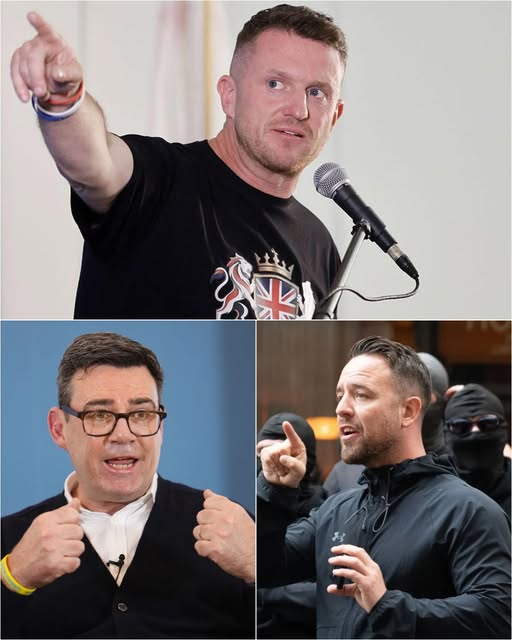
Danny Tommo Remains in Custody as Tommy Robinson Backs Challenge to High-Profile Channel Boat Case
PORTSMOUTH — Anti-migration activist Daniel Thomas, widely known as Danny Tommo, remains in custody after a judge rejected his latest bail application, intensifying a politically charged dispute that has drawn support from Tommy Robinson and mobilised hundreds of protesters. But despite increasingly dramatic claims online, the case remains at this stage a criminal prosecution rather than the constitutional showdown some supporters have portrayed.
Thomas, 37, appeared by video link from HMP Winchester at Portsmouth Crown Court on September 29. He faces allegations arising from an incident in the English Channel on September 22 involving an inflatable boat.
He has pleaded not guilty to criminal damage and also denies a separate allegation that he failed to disclose the PIN to his mobile phone under Section 53 of the Regulation of Investigatory Powers Act 2000.
Judge James Newton-Price KC refused an application for bail made by Thomas’s barrister, Simon Pentol KC.
A provisional trial date has now been set for March 1, 2027, while Thomas is scheduled to return to court by video link on November 12.
Those developments are significant. But claims that Tommy Robinson has devised a legal manoeuvre capable of throwing Britain’s judicial system into “total chaos” go considerably beyond what has been established in court.
What is Thomas accused of doing?
The case originates from an incident in the Channel in which Thomas allegedly damaged an inflatable vessel.
Prosecutors allege that he used a knife on the boat while an emergency responder was still aboard. Video footage circulating online appears to capture at least part of the incident, although the footage and surrounding circumstances will ultimately have to be assessed as evidence during criminal proceedings.
Thomas disputes criminal liability.
At Basingstoke Magistrates’ Court on September 25, he pleaded not guilty to criminal damage and elected to have the case tried at Crown Court. He also pleaded not guilty to the allegation concerning his phone PIN.
The value of the alleged damage has itself been an issue because the vessel was reportedly returned to France, complicating an immediate assessment of the financial loss.
None of these allegations has yet been proved at trial.
Thomas therefore remains legally presumed innocent.
Why is Tommy Robinson involved?
Stephen Yaxley-Lennon, better known as Tommy Robinson, has publicly supported Thomas.
Robinson attended the September 25 proceedings at Basingstoke Magistrates’ Court and sat in the public gallery as Thomas appeared by video link.
He has subsequently questioned Thomas’s treatment and argued publicly that the case is politically motivated.
Robinson has also discussed arguments he says Thomas’s defence could raise, including questions concerning the alleged damage, evidence surrounding the Channel incident and police access to Thomas’s phone.
But an important distinction is being lost in some online coverage.
Robinson is not Thomas’s barrister.
The formal legal arguments in court are being made by Thomas’s defence team, including Simon Pentol KC. Robinson can campaign publicly, raise money, criticise prosecutors or discuss possible arguments, but those activities should not automatically be described as Thomas’s official “legal strategy.”
A source sympathetic to Robinson reported him discussing possible defence arguments and challenging the decision to remand Thomas, but that remains Robinson’s public account of the case rather than an authoritative statement of what the court will ultimately decide.
The bail battle
The most consequential development so far concerns Thomas’s liberty before trial.
He was initially remanded in custody following his magistrates’ court appearance.
His lawyers then sought bail at Portsmouth Crown Court.
Judge Newton-Price rejected the application on September 29 and remanded Thomas in custody. According to court reporting, the judge specifically indicated that he was setting political motivations aside when considering the bail decision.
That statement is particularly relevant because supporters have characterised Thomas’s detention as political punishment.
They are entitled to challenge the bail decision and question whether Thomas is being treated consistently with other defendants.
But the existence of a politically controversial defendant does not itself establish that a judicial decision was politically motivated.
Likewise, being refused bail does not establish guilt.
Pre-trial detention and criminal conviction are legally separate matters.
Hundreds mobilised after Thomas’s arrest
The political dimension of the case is nevertheless impossible to ignore.
Thomas founded Patriot Platform, an anti-migration movement that has organised demonstrations and disruptive actions in southern England.
After his arrest, supporters gathered outside a police investigation centre in Basingstoke demanding his release.
Sky News reported approximately 200 demonstrators, while other reporting put the gathering at around 300. Many were dressed in black and protesters chanted “Free DT.”
Police maintained a significant presence around both the demonstrations and court proceedings.
The mobilisation demonstrates that Thomas’s case has already developed significance far beyond an ordinary criminal-damage prosecution.
To supporters, he has become a symbol of opposition to Britain’s handling of irregular Channel migration.
To critics, his movement represents an increasingly confrontational form of anti-migration activism.
Those interpretations help explain the intense public attention surrounding what would otherwise be a relatively narrow set of criminal allegations.
Government criticism focuses on the protests
The original viral account also links the controversy to Manchester Mayor Andy Burnham.
Current reporting does not establish Burnham as the government figure issuing the principal warnings concerning Thomas’s recent demonstrations.
Instead, Angela Rayner, currently serving as Communities Secretary, has publicly criticised the style of protests associated with Thomas.
Rayner argued that peaceful political protest is legitimate but criticised masked demonstrations she regarded as intimidating to communities. She also expressed concern about hostility directed toward RNLI volunteers involved in rescuing people at sea.
Those comments concern protest tactics and public order.
They do not amount to government control over Thomas’s criminal proceedings.
In the British system, ministers do not simply decide whether a particular defendant receives bail. Bail is determined through the courts under legal rules and according to the circumstances before the judge.
Any allegation that ministers secretly directed Thomas’s detention would therefore require substantial evidence.
None has currently emerged publicly.
Why the case has become so politically explosive
Thomas’s prosecution comes during an unusually tense period in Britain’s migration debate.
His Patriot Platform has organised protests around ports and coastal communities associated with migrant arrivals.
Earlier in September, hundreds of black-clad demonstrators descended on Dover and blocked roads leading toward the port. Thomas had been working to bring disparate anti-migration groups together into a more coordinated movement.
Supporters argue that such activism reflects frustration with successive governments’ inability to stop irregular Channel crossings.
Critics argue that masked groups, disruptive tactics and confrontations around migrants and rescue services can intimidate local communities and create public-order risks.
Both debates now intersect with Thomas’s criminal case.
But they remain legally distinct.
A person can strongly oppose the government’s immigration policy without committing an offence.
Conversely, political opposition to immigration does not provide immunity from criminal law if prosecutors can prove an offence beyond reasonable doubt.
That distinction will be central when Thomas eventually faces trial.
Is there really a constitutional crisis?
Nothing currently reported supports such a conclusion.
There is no evidence that Parliament has been thrown into disorder over Thomas’s prosecution.
There is no established constitutional confrontation between the government and the judiciary.
And no verified legal manoeuvre from Robinson has emerged that could fundamentally destabilise Britain’s court system.
What does exist is a politically sensitive criminal case involving a prominent activist, a contested bail decision and an increasingly mobilised group of supporters.
That is consequential without requiring more dramatic language.
Thomas’s defence can challenge prosecution evidence, make further applications where legally permitted and advance arguments about the alleged offences when the case reaches trial.
The prosecution, meanwhile, will have to prove its allegations in court.
The judge and ultimately, where applicable, a jury must consider evidence rather than the political popularity or unpopularity of the defendant.
What happens next?
The timeline is now clearer than some viral accounts suggest.
The major Tuesday hearing already occurred on September 29.
Thomas appeared from HMP Winchester, his bail application was refused and a provisional trial date was established. His next scheduled court appearance is November 12, with the trial provisionally listed for March 1, 2027.
Tommy Robinson is likely to remain an influential public supporter, and Thomas’s detention may continue to provide a rallying point for anti-migration activists.
But public campaigning and courtroom strategy should not be conflated.
The central legal questions remain comparatively straightforward: Can prosecutors prove that Thomas committed criminal damage? Can they prove the separate alleged offence concerning his phone PIN? And will his defence establish sufficient grounds to defeat either allegation?
Those questions will be decided through criminal proceedings.
For now, Thomas remains an accused man awaiting trial — not a convicted offender, not someone whose guilt has been established, and not, on the evidence presently available, the centre of a constitutional crisis.
Britain’s ongoing debate over free speech, protest rights and the treatment of political activists has entered another contentious chapter following claims that Tommy Robinson is pursuing a legal strategy aimed at securing the release of jailed activist Danny Tommo. The reported development has attracted attention because it brings together two controversial figures, questions about the justice system and a wider argument over the limits of political activism in the United Kingdom.
The dramatic claims surrounding the case have prompted speculation about what legal avenues might be available and whether the dispute could generate further pressure on politicians and public institutions. However, the precise details of Robinson’s reported strategy, the legal status of Danny Tommo and the grounds on which any challenge might be made require confirmation before definitive conclusions can be drawn.
What is clear is that cases involving politically active individuals can quickly become more than ordinary legal disputes. They can develop into national conversations about fairness, accountability, freedom of expression and the relationship between public protest and the rule of law.
Tommy Robinson’s Latest Reported Intervention
Tommy Robinson, whose real name is Stephen Yaxley-Lennon, is a prominent and controversial British political activist known for his campaigns involving immigration, national identity and freedom of expression. His public activities have generated considerable support among some campaigners, while critics have challenged his methods and the wider political messages associated with his movement.
Any reported attempt by Robinson to help secure the release of another activist would fit within a broader pattern in which legal controversies become central to political campaigning. Supporters may see such an intervention as an effort to challenge decisions they regard as unjust, while opponents may question whether the campaign accurately represents the legal circumstances of the individual involved.
The distinction between political advocacy and formal legal action is important. Public statements, demonstrations and online campaigns can draw attention to a case, but they do not themselves change a court order or guarantee someone’s release.
If Robinson intends to pursue a legal challenge, its significance would depend on the specific arguments, the evidence available and the procedural route being used. Without verified information about those details, claims that a particular strategy will produce a dramatic outcome should be treated cautiously.
Who Is Danny Tommo?
The name Danny Tommo has appeared in activist-related discussions, but the circumstances of the reported imprisonment and the precise legal basis for any proposed intervention need to be established through reliable documentation.
In any case involving a jailed individual, several questions are essential. What offence was involved? Which court issued the sentence? Has an appeal already been lodged? Are there outstanding proceedings, and what legal options remain available?
The answers matter because different circumstances require different approaches. A person challenging a conviction may need to pursue an appeal, while someone disputing the legality of detention may need to rely on a different legal procedure. A request for early release would also be subject to rules that depend on the sentence and the relevant legal framework.
It would be misleading to assume that a campaign led by a high-profile activist automatically establishes that a conviction was unsafe or that a prisoner is being held unlawfully.
At the same time, every defendant and prisoner is entitled to the protections provided by law. If credible evidence raises concerns about a conviction, sentencing decision or procedural irregularity, those concerns can be examined through the appropriate legal channels.
The strongest assessment of Danny Tommo’s situation would therefore begin with the court’s decision and any subsequent legal developments rather than unverified social media claims.
Could a Legal Challenge Lead to His Release?
The prospect of securing someone’s release depends on the legal circumstances of their case. In England and Wales, criminal convictions and sentences can be challenged through established procedures, although the appropriate route depends on the nature of the alleged error and the stage reached in the proceedings.
An appeal may be possible where there are recognised grounds to challenge a conviction or sentence. Other mechanisms may be relevant in particular circumstances, but they have specific requirements and cannot simply be used as a substitute for an unsuccessful argument in court.
A legal team would ordinarily need to identify the decision being challenged, establish the relevant grounds and provide evidence or legal reasoning capable of satisfying the applicable test.
If a challenge succeeds, the consequences could vary. A court might quash a conviction, order a retrial, change a sentence or grant another form of relief, depending on the circumstances. None of these outcomes can be assumed before the legal arguments have been examined.
Public campaigns can sometimes encourage scrutiny of cases that might otherwise receive limited attention. However, the strength of a legal argument ultimately depends on the evidence and the law, not on the size of the online audience supporting it.
For that reason, any suggestion that Robinson possesses a strategy guaranteed to secure Danny Tommo’s release would require strong supporting evidence.
Why Parliament Could Become Involved in the Debate
The language of a parliamentary firestorm suggests the possibility of political confrontation, but it is important to distinguish between a controversy attracting attention in Westminster and an issue being formally considered by Parliament.
Members of Parliament can raise concerns about the administration of justice, question ministers about government policy and discuss broader issues relating to civil liberties. Parliamentary committees may also examine systemic questions where these fall within their remit.
However, individual criminal cases are subject to important constitutional principles. Politicians do not ordinarily have the authority to overturn a judicial decision simply because a campaign has attracted public support.
The independence of the judiciary is a fundamental feature of the British constitutional system. Courts must be able to decide cases according to the law and the evidence without being directed by political pressure.
This does not mean that the justice system is beyond criticism. Court procedures, sentencing policy and access to appeals can all be debated, and genuine errors must be capable of being addressed through lawful mechanisms.
The challenge is to ensure that political scrutiny strengthens confidence in the justice system rather than creating the impression that legal outcomes should depend on which campaign attracts the most attention.
Free Speech, Protest and the Rule of Law
The reported dispute touches on one of the most sensitive questions in British public life: how should society protect freedom of expression while maintaining the rule of law?
The right to express political opinions, criticise government decisions and organise peaceful protests is an important part of democratic society. Campaigners must be able to challenge public institutions, and controversial opinions do not automatically justify legal restrictions.
Nevertheless, freedom of expression does not remove the obligation to comply with criminal law or court orders. The precise legal protections available depend on the circumstances, and the rights of one person must be considered alongside the rights and safety of others.
These principles can become difficult to discuss when a case is associated with a highly polarising political figure. Supporters may view legal proceedings as part of a wider struggle for civil liberties, while critics may argue that campaign rhetoric oversimplifies the conduct that led to the proceedings.
A careful examination must separate the political message from the specific facts of the case. The relevant questions include whether the law was applied correctly, whether procedural safeguards were respected and whether the available appeal mechanisms are adequate.
Those questions can be considered without assuming either that every prosecution is justified or that every politically controversial defendant has been treated unfairly.
The Power of Online Campaigns
Modern political activism increasingly relies on social media, livestreams and online fundraising to mobilise supporters. A single announcement can rapidly circulate among audiences across the country, creating pressure for journalists, politicians and public institutions to respond.
For activists seeking to draw attention to a legal case, this can provide an opportunity to publicise documents, organise demonstrations and encourage supporters to follow developments.
However, online campaigns also create risks. Headlines can exaggerate the significance of an event, claims may be repeated before they have been verified, and legal developments can be presented as definitive victories or defeats when the actual position is more complicated.
A claim that a legal strategy will produce chaos in Parliament, for example, is not the same as evidence that parliamentary proceedings have been disrupted or that a court has accepted the argument being advanced.
Responsible reporting requires clear distinctions between what a campaigner has said, what legal action has actually been taken and what an independent court has decided.
These distinctions are particularly important when the subject involves an individual’s liberty and reputation.
The Wider Political Consequences
If Robinson’s reported campaign develops into a sustained public controversy, it could contribute to broader discussions about criminal justice, political protest and the treatment of activists.
For his supporters, the campaign may represent an opportunity to demand transparency and challenge decisions they believe deserve further scrutiny. Others may focus on the need to protect judicial independence and ensure that legal arguments are assessed without political interference.
Politicians could face questions about whether existing appeal procedures are sufficiently accessible, whether sentencing rules are applied consistently and how public confidence in the justice system can be maintained.
Yet any proposed reform would need to be assessed on its merits rather than solely through the circumstances of one high-profile case. A change intended to address a genuine procedural problem should be supported by evidence that the problem exists and that the proposed solution would improve the system.
Similarly, a campaign’s popularity cannot replace the need for credible evidence when challenging a particular conviction.
The wider debate is likely to be most productive when it focuses on verifiable facts, established legal principles and specific proposals for improvement.
What Happens Next?
The immediate questions concern the nature of Robinson’s reported legal strategy, the status of Danny Tommo’s case and whether any formal proceedings have been initiated.
Court records, statements from legal representatives and reliable reporting would help clarify whether a challenge has been filed, what grounds it relies upon and whether any hearing or decision is expected.
Until those details are confirmed, it would be premature to describe the strategy as a breakthrough or to predict that it will lead to Danny Tommo’s release. It would also be inaccurate to suggest that Parliament faces inevitable disruption simply because a controversial campaign has attracted attention.
Ultimately, the case highlights the complicated relationship between political activism and the justice system. Public campaigns can bring attention to disputed decisions, but legal remedies must be secured through the procedures established by law.
Whether Robinson’s reported intervention produces a significant development will depend on the evidence, the legal arguments and the decisions of the relevant authorities. For now, the central issue is not the dramatic language surrounding the campaign, but whether a properly supported legal challenge exists and what it could realistically achieve.