
South Korea holds emergency cyber security meeting as alert level raised
South Korea has joined the countries issuing warnings to organisations over the PHP programming language.
Its government has raised its private-sector cyber security alert level and activated emergency response measures, according to Yonhap News Agency.
The national security office is also holding an emergency cyber security meeting on the vulnerability in the system.
China tells organisations to strengthen cyber security monitoring
China’s industry ministry has warned organisations over the vulnerabilities in the PHP programming language.
PHP is used by almost 70% of websites, according cyber security firm Cloudflare, and underpins popular platforms such as WordPress and Magento.
The industry ministry recommends strengthening cyber security monitoring, timely changing of accounts, passwords and keys.
It also urges organisations and users to immediately conduct a comprehensive inspection and to upgrade to the latest secure version of the programming language.
AI agents helped uncover vulnerabilities
OpenAI, which runs ChatGPT, said in the past two months it has been leading a team of researchers to address the flaw in the PHP programming language, and supported its developers as it led the fixes.
The company described the incident as “one of the most impactful security issues in recent memory”, adding that while AI can help to uncover issues, it can also aid attackers.
Science and technology editor Tom Clarke said it appears AI agents found a global flaw “that’s been hiding in plain sight for years, unseen by human hackers”.
“It was clearly visible to AI models. This is likely just the first emergency repair job the internet is going to need in the age of AI cyber risk,” he explained.
‘It’s the beginning of a wider wave of attacks’
Alp Toker, a cyber security expert and director at NetBlocks, called the issue “highly impactful” – and warned the disruption caused by nefarious actors, which has so far been “limited”, could become “more widespread”.
Speaking to Matt Barbet on The World, Toker explained that the incident “means that anybody on the web can essentially access your web server if you’re running the [PHP] software”.
He said that the risk had been “very limited because the people who found the vulnerability kept it under wraps for quite a while, but in the last few days it has been seen in the wild”.
Watch his comments below…
‘Millions’ of exploitation attempts
There have been “millions” of exploitation attempts since a “critical” security flaw affecting websites around the world emerged, according to the head of a major tech company.
Cloudflare CEO Matthew Prince posted the update on social media…
X This content is provided by X, which may be using cookies and other technologies. To show you this content, we need your permission to use cookies. You can use the buttons below to amend your preferences to enable X cookies or to allow those cookies just once. You can change your settings at any time via the Privacy Options. Unfortunately we have been unable to verify if you have consented to X cookies. To view this content you can use the button below to allow X cookies for this session only.
Amazon Web Services also said this flaw is now “being broadly exploited in the wild” – and has revealed that suspected hackers tried to capitalise on the vulnerability days before it was publicly announced.
What sites have gone dark?
Websites linked to governments across Europe have gone offline as organisations rush to protect their systems, although some are now back up and running.
In the UK, the Office for Budget Responsibility (OBR) said it had taken its website offline “in view of the critical security issues affecting PHP”.
Oxfordshire County Council and Hillingdon Council both separately said they had temporarily taken down their websites as a precaution while they investigate.
A UK government spokesperson said work was under way to “identify and patch any potential exposure”.
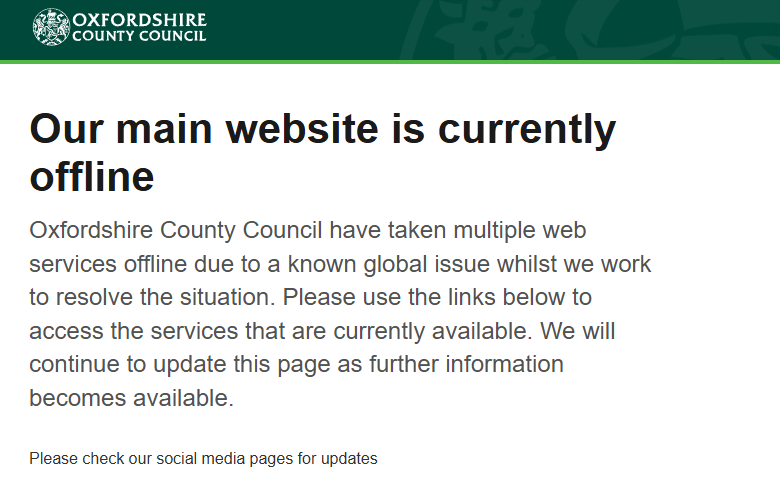
While websites linked to French, Danish, Finnish and Dutch governments all appeared to go offline as organisations rushed to protect their systems, some are now back up and running.
Earlier France’s Interior Ministry said it had placed all of its websites into preventive maintenance. Users visiting French government websites were told there was “ongoing maintenance”.
In the Netherlands, several organisations took public-facing websites offline, while Danish municipal IT company Kombit said it had shut down several services, including the national school communication platform.
The Czech government took its website offline yesterday evening, and disruption was also widespread in Finland, where state IT services provider Valtori said government public network services had been taken offline “as a precautionary measure”.
Websites taken down around the world
A critical software update has been issued to government and business websites around the world due to vulnerabilities in programming language.
Developers behind the PHP programming language, extensively used across the internet, said a set of new updates fixing two previously identified critical vulnerabilities was now live.
It strongly encouraged users to update software immediately – leaving tech teams around the world scrambling to patch the critical flaw.
Those unable to apply key fixes should consider taking their websites down, UK and international cyber security officials have warned.
Welcome to our coverage
Good morning and welcome to our live coverage as government and business websites around the world have been taken down in a bid to protect organisations.
A critical software update was issued over vulnerabilities in programming language.
The developers of the PHP programming language, which is extensively used across the internet, said yesterday that a set of new updates fixing two previously identified critical vulnerabilities was now live.
Stay with us as we bring you live updates.