

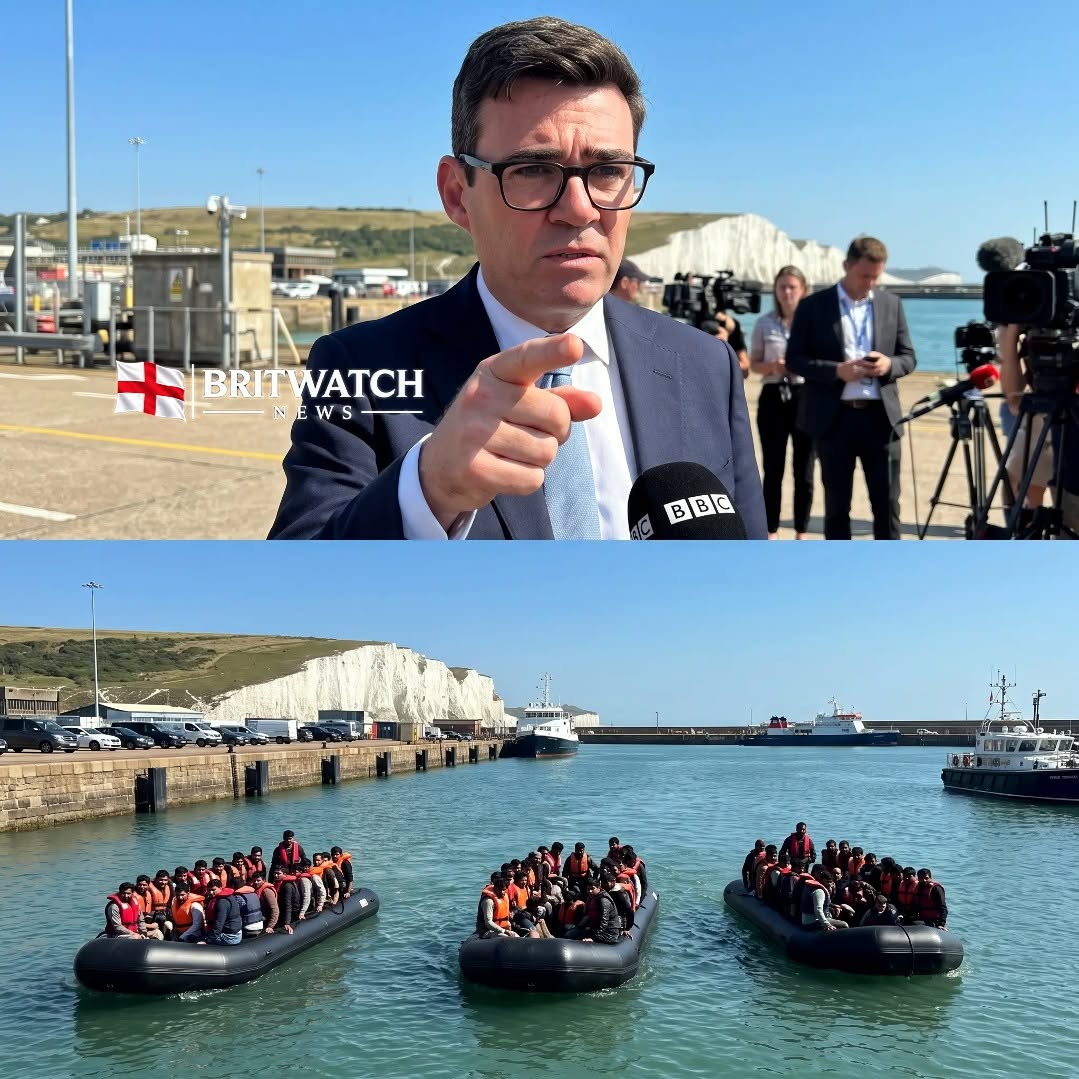
A dramatic surge in Channel crossings has reopened one of the most politically sensitive questions facing Prime Minister Andy Burnham’s government: can ministers credibly say Britain is making progress on small boats when hundreds of people can still arrive in a single day and some vessels are reaching British shores without being detected?
On September 23, 781 people arrived in the UK aboard 10 small boats, according to Home Office figures. It was the highest number recorded on a single day in 2026, surpassing the previous annual high of 752 on July 29.
The number was striking enough on its own. But it came immediately after two separate small boats made what the Home Office records as “uncontrolled landings” on September 21 and 22 — meaning vessels reached Britain without being intercepted in the normal way.
Those incidents have given critics fresh ammunition against a government that has repeatedly argued that its approach to border enforcement is beginning to work.
Yet the statistics also reveal a more complicated picture than either side’s political messaging suggests.
781 Arrivals in One Day — But Crossings Are Down Overall
The September 23 figure is difficult for the government to dismiss.
The 781 people arriving that Wednesday represented the busiest single day of 2026. By September 24, the provisional total for the year had reached 18,565.
But compared with the same point in 2025, that total was 42% lower. At the equivalent stage last year, 32,188 people had crossed the Channel. It was also around 26% below the comparable total in 2024.
That means two apparently contradictory statements can both be true.
Britain experienced its busiest day of small-boat crossings this year — while the total number of crossings in 2026 remained substantially below last year’s level.
The government has understandably focused on the second statistic. The Home Office has said that its progress is “indisputable,” highlighting the 42% year-on-year reduction and what it describes as the lowest level of summer arrivals since 2020.
Critics, however, point to the 781-person day and the uncontrolled landings as evidence that serious vulnerabilities remain.
Two Boats Reaching Shore Undetected Raised a Different Concern
The uncontrolled landings may be more significant from a border-security perspective than the headline daily total.
Official Home Office data show one uncontrolled landing on September 21 and another on September 22.
Reporting by The Times suggested that smugglers have begun adapting their tactics by launching smaller vessels from a much wider section of the French and Belgian coastline. Some departures have occurred substantially farther west than the areas traditionally associated with Channel crossings, potentially stretching surveillance and interception resources.
One boat carrying 51 people reportedly departed from Normandy and spent more than 33 hours at sea before reaching Britain.
The development matters because the government’s border strategy does not depend only on reducing the overall number of people crossing. It also relies on intelligence, surveillance and cooperation with French authorities to identify launches before vessels can arrive uncontrolled on British beaches.
Home Secretary Shabana Mahmood reportedly ordered an urgent examination of the two incidents.
Describing the incidents as proof that Britain’s entire surveillance system has failed would go too far. But they do demonstrate that smugglers continue to adapt to enforcement measures.
Why the Government Says Its Policies Are Working
There is independent evidence supporting at least part of Labour’s argument.
The National Crime Agency said in September that law-enforcement activity had been a “key factor” in reducing crossings during the first half of 2026.
Its assessment identified several factors: disruption of supplies of boats and engines, operations against smuggling networks and increased French intervention against launches. Small-boat arrivals in the first half of 2026 were 41% lower than during the same period in 2025, while the number of boats fell by 47%.
The Border Security Command has similarly reported increased disruption of organised immigration-crime networks and more than 100 NCA-led operations targeting them.
That does not mean government policy alone explains the decline.
Migration routes are affected by numerous factors including weather, conditions elsewhere in Europe, enforcement by other countries, smuggling prices and changes in the nationalities and destinations of migrants.
Claims that the reduction is entirely a Labour achievement therefore deserve caution — just as claims that government policy has made no difference are difficult to reconcile with the available evidence.
Returns Have Also Increased — Although the Numbers Need Context
Ministers also frequently point to removals from the UK.
Official Home Office figures show that 80,286 returns were recorded between July 1, 2024 and July 31, 2026, including both enforced and voluntary departures.
In the two years to June 2026, there were 78,137 returns, 52% more than during the previous two-year period.
But those figures include several different groups and should not be treated as synonymous with deporting small-boat arrivals.
Of the 80,286 total returns recorded between July 2024 and July 2026, 6,103 involved people who had originally arrived by small boat.
So the government can accurately say overall returns have increased. Critics can equally point out that only a fraction of total Channel arrivals have subsequently been returned.
Burnham’s Comments on Anti-Immigration Protest Add Another Layer
The border argument has become even more contentious because Burnham has also criticised some recent anti-immigration demonstrations.
Speaking after protests in Dover, Portsmouth, Gosport and Basingstoke, Burnham condemned groups whose participants wore black clothing and face coverings, saying behaviour intended to intimidate was “not the British way.”
Importantly, he also acknowledged that many members of the public had genuine concerns about immigration.
“I recognise the concern that many people in the public have around immigration,” he told ITV, before drawing a distinction between expressing those concerns and intimidating members of the public or attacking police.
Critics argue that government rhetoric risks associating legitimate opposition to immigration with extremism or racism.
That criticism raises a legitimate political question, but Burnham’s complete remarks were more qualified than the suggestion that he simply labelled everyone protesting against immigration as racist.
Peacefully supporting tougher border controls is not in itself evidence of racism. Equally, opposition to immigration does not exempt protesters from ordinary laws governing violence, obstruction or intimidation.
What About Housing Asylum Seekers in Barracks and Hotels?
Another source of anger concerns the use of hotels and other accommodation for asylum seekers.
The government faces competing pressures here. People who claim asylum generally require accommodation while their cases are processed if they cannot support themselves. At the same time, hotel accommodation has become expensive and politically controversial, particularly in communities where residents feel they were given little consultation.
Calls for all people arriving irregularly to be detained until removal would represent a major change in policy.
Importantly, arriving in Britain through an unauthorised route does not automatically mean that someone can immediately be removed. Almost all small-boat arrivals claim asylum, and those claims must be considered under the relevant legal framework. The House of Commons Library reports that small boats remain the most prominent unauthorised route into the UK.
That does not prevent the government from detaining individuals in legally defined circumstances, but universal indefinite detention would raise substantial practical, financial and legal questions.
The Bigger Problem for Labour Is Credibility
Calling Burnham a liar because 781 people crossed on one day does not follow automatically from the available evidence.
The broader statistics do show a significant reduction in crossings during 2026.
But neither can ministers point to that reduction and suggest that the border problem has been resolved.
Two uncontrolled landings in two days exposed gaps in detection. A single day still brought 781 people across the Channel. Smuggling networks remain capable of changing tactics, and thousands continue to make dangerous journeys.
At the same time, crossings are down substantially year on year, enforcement agencies say disruption activity has contributed to that decline, and removals have increased.
That is the reality Labour must explain.
The political danger comes when either side presents only the statistic that supports its argument.
For opponents of the government, the 781 arrivals and two undetected boats demonstrate that significant weaknesses remain.
For Labour, the 42% year-on-year decline shows that the trend is moving in the direction ministers promised.
Both facts belong in the same debate.
The question voters will ultimately have to judge is not whether Britain’s Channel problem has disappeared — clearly it has not — but whether the current reduction can be sustained, whether uncontrolled landings can be prevented, and whether the government can turn improving headline numbers into a border system that the public actually trusts.
781 Channel Arrivals and Two Undetected Landings Put Labour’s Border Claims Under Fresh Scrutiny
Britain’s immigration debate has entered another difficult phase after 781 people crossed the English Channel in small boats in a single day, while two vessels reached the Kent coastline without being intercepted. The developments have renewed questions about the effectiveness of Labour’s border strategy and whether the government can deliver on its promise to tackle irregular migration.
The figures, published on 24 September 2026, marked the highest daily number of small-boat arrivals recorded so far this year. The two undetected landings added to the pressure, prompting Home Secretary Shabana Mahmood to order an urgent review of border security operations.
For a government that has repeatedly promised stronger enforcement and action against people-smuggling gangs, the timing was particularly challenging. Ministers were required to explain why the boats reached British shores while also defending the broader results of their policies.
However, the statistics reveal a more complicated picture than a single record-breaking day suggests. Although the daily total was high, the provisional number of crossings for the year remained significantly below the equivalent period in 2025.
A record day puts border enforcement under pressure
According to Home Office figures, 781 people arrived in the United Kingdom in ten small boats on Wednesday, 23 September. The crossings brought the provisional total for 2026 to 18,565.
That figure represented a 42 per cent decrease compared with the 32,188 arrivals recorded by the same point in 2025. It was also 26 per cent below the equivalent figure for 2024, when 25,165 people had crossed the Channel in small boats.
The contrast created a difficult political situation for Labour.
On one hand, ministers could point to the year-on-year decline as evidence that enforcement measures were having an effect. On the other, the record daily total demonstrated that substantial numbers of people could still make the journey despite increased attention to coastal surveillance and cooperation with French authorities.
The government has argued that reducing crossings requires sustained action against criminal networks, improved intelligence-sharing and stronger international cooperation. Officials have also acknowledged that further work is necessary.
For critics, however, the latest figures raise questions about whether the government’s strategy can produce lasting reductions rather than temporary improvements.
The distinction between daily and annual figures matters. A record day does not automatically demonstrate that an entire policy has failed, just as a lower annual total does not prove that every element of border enforcement is working effectively.
The challenge for ministers is to explain both results clearly and show how they intend to prevent dangerous crossings from continuing.
Two boats reach the coast undetected
The security concerns became more serious after two boats reached the Kent coastline without being intercepted within two days.
One vessel arrived at Folkestone on Monday morning. Another reached Samphire Hoe, near Dover, on Tuesday afternoon. Following the second incident, 21 people were detained after the boat made it ashore.
The landings were particularly notable because uncontrolled arrivals had become uncommon in official reporting. The incidents therefore raised questions about coastal surveillance, the coverage of patrols and the ability of authorities to identify and respond to boats approaching the shore.
Mahmood described the failures to intercept the vessels as unacceptable and ordered the Border Security Command to investigate what had happened.
The review is important because interception is not simply about preventing an arrival. Authorities also need to identify people, assess their circumstances, respond to possible criminal activity and ensure that anyone requiring urgent assistance receives appropriate attention.
Small boats can present significant risks to passengers, particularly when they are overcrowded or exposed to changing weather conditions. Preventing dangerous crossings and disrupting smuggling networks are therefore matters of both border control and public safety.
The government will need to establish why the two boats were not intercepted, whether existing procedures were followed and whether changes to surveillance or operational coordination are required.
Until those findings are available, it would be premature to conclude that the incidents resulted from a specific equipment failure, staffing shortage or deliberate decision.
Lucy Powell faces questions over Labour’s promises
Education Secretary Lucy Powell also faced questions about the government’s response after the landings.
Powell acknowledged that the incidents were concerning but argued that it was impossible to stop every crossing at every moment. She stressed that the overall picture had improved and pointed to the work being undertaken by border personnel, police and international partners.
Her comments reflected the government’s argument that border enforcement should be judged by the broader trend rather than by a single day or isolated incident.
Nevertheless, the wording attracted criticism from political opponents, who argued that the public expected stronger assurances from ministers.
The difficulty for Labour is that promises to reduce crossings create expectations that every visible failure will be scrutinised. When boats reach British beaches without interception, ministers must explain what happened and demonstrate that lessons will be learned.
At the same time, an absolute guarantee that no boat will ever reach the coastline would be difficult to deliver in practice. The Channel is a busy maritime area, and the authorities must monitor changing routes, weather conditions and the tactics used by smuggling networks.
The central question is therefore whether the government can improve interception rates, reduce dangerous journeys and demonstrate measurable progress over time.
Political opponents seize the opportunity
The latest figures prompted renewed criticism from opposition politicians.
Conservative representatives argued that the undetected landings exposed weaknesses in Labour’s approach and questioned whether the government could fulfil its commitments to stop irregular crossings.
Reform UK also called for tougher action, including a greater role for the Royal Navy. Its representatives argued that existing enforcement arrangements were insufficient to prevent arrivals.
The Liberal Democrats, meanwhile, advocated closer cooperation with European partners and changes to the UK’s approach to migration and asylum.
These competing proposals demonstrate that the political disagreement is not limited to whether crossings should be reduced. Parties also disagree over the methods, legal arrangements and international partnerships they believe would be most effective.
Any proposed policy must be assessed against practical questions: would it reduce departures, disrupt the criminal networks organising crossings, protect lives and comply with the UK’s legal obligations?
Strong political language may attract attention, but the effectiveness of a policy depends on evidence of its results.
The role of people-smuggling gangs
Behind the daily arrival figures lies a wider criminal problem. People-smuggling networks organise dangerous journeys, often charging vulnerable passengers substantial sums while placing them aboard unsuitable vessels.
Disrupting these networks requires cooperation between British and French authorities, intelligence-sharing, investigations into organisers and action against the financial arrangements that sustain the trade.
Simply increasing patrols may not resolve every problem if criminal groups adapt their methods or shift departure points. Authorities must also consider how to identify emerging routes and prevent people from being placed at risk before they reach the Channel.
The government’s emphasis on international cooperation reflects this challenge. Yet ministers must demonstrate that agreements and operational measures are producing tangible results.
The latest incidents have strengthened the case for examining whether surveillance coverage and intelligence-sharing are adequate along the wider coastline, rather than focusing exclusively on the busiest crossing areas.
What happens next?
The urgent review ordered by Mahmood will be an important test of the government’s response. Its findings should help establish why the two boats reached shore undetected and whether additional measures are necessary.
Labour will also need to explain how it intends to sustain the reduction in annual arrivals while responding to sudden increases in daily crossings.
The figures present both a challenge and an opportunity. The record day and the two uncontrolled landings raise legitimate questions about enforcement. The lower year-to-date total compared with 2025, meanwhile, is relevant evidence that should not be ignored.
Neither set of figures alone provides a complete verdict on the government’s strategy.
Ultimately, public confidence will depend on whether ministers can show that border operations are improving, that smuggling networks are being disrupted and that dangerous journeys are becoming less common.
The latest events have placed Labour’s promises under renewed scrutiny. Whether that scrutiny leads to significant policy changes will depend on the findings of the review and the government’s ability to turn its stated objectives into measurable results.
For now, the central question remains unanswered: can Labour maintain the broader decline in crossings while preventing further boats from reaching British shores without interception?