
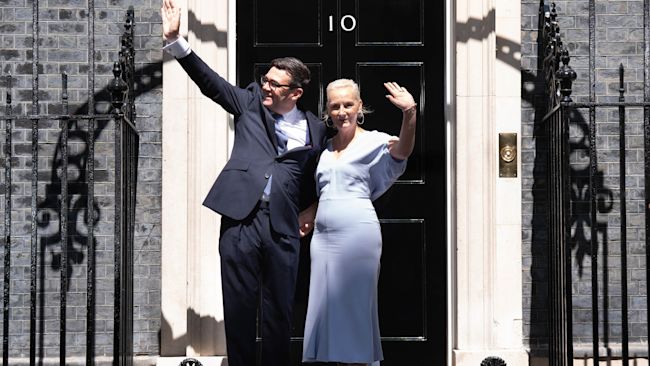
Andy Burnham has pledged to “help people to live well” in his first speech as prime minister and said he will unveil new cost-of-living measures on Tuesday, his second day in office.
Speaking from Downing Street in front of a crowd of political allies, Burnham said he will deliver a “new political model”, claiming “people at home are fed up with politics”.
He said he would announce measures on Tuesday to help with the rising cost of living and would set out a ten-year plan later this year.
Burnham became prime minister after “kissing hands” with the King on Monday – the private ceremony by which he accepted the invitation to form a government.
Sir Keir Starmer, who stood down as party leader in June, gave his official resignation to the King, and following a short speech in Downing Street, waved goodbye to No 10.
Delivering his speech with no lectern and no notes, Burnham declared that his first act upon entering No 10 is “to end rough sleeping in our country”.
“I will put the care of people at the heart of everything I do,” he said, as he outlined his plans to give an additional £340 million to the cause.

In his first mentions of policy as prime minister, he said: “We will build more council homes. That is the fair and sustainable way to bring the welfare bill down to meet our fiscal rules. And to honour our commitments on defence to our international partners.”
He concluded his speech by urging people to “pull with me” to “build a new national sense of unity, of common purpose and positivity”.
Within hours of being sworn in, it was confirmed Burnham had spoken to US President Donald Trump.
In a wide-ranging call, the leaders spoke about the World Cup, Manchester and the situation in the Middle East, Downing Street said.
A spokesperson said: “The prime minister began by congratulating the president on a successful World Cup and agreed that England had an excellent tournament.
“The prime minister also hoped that he would be able to show the president what Manchester had to offer during a visit in the future.”
Ukrainian president Volodymyr Zelenskyy also said he spoke with Burnham.
In a post on X, he said he congratulated him on taking office and thanked him for the warm words said about the plight of Ukrainians.
Zelenskyy said: “We agreed to discuss our future cooperation, including our work within the Anti-Ballistic Coalition, during a meeting in the near future. Thank you, Andy. Thank you, Britain!”

Several international leaders have already expressed their well wishes to the new PM on social media.
French President Emmanuel Macron extended his congratulations to Burnham, saying: “I hope that we will deepen our relationship in service of our peoples and by giving new momentum to the partnership between the United Kingdom and the European Union.”
Australian Prime Minister Anthony Albanese, German Chancellor Friedrich Merz, Nato General Secretary Mark Rutte and EU President Ursula von der Leyen have all also congratulated Burnham.
The former Manchester mayor’s move into No 10 makes him the seventh prime minister in a decade, something he acknowledged in his speech. He promised to “rise to the new challenge” so that the UK can “regain our stability”.
Starmer had earlier delivered his final speech as prime minister, saying that his “work is done”.

He called his time in office “the privilege of my life” and spoke of his achievements, including his work in Ukraine, lifting children out of poverty, reducing immigration and improving defence and security.
Starmer wished Burnham every success and said: “He has my full support.”
His final words as prime minister were: “I thank the British people for the opportunity to serve. I go with good grace, I go with a smile, and I go proud of everything that we have achieved.”
After entering No 10, Burnham will need to appoint his cabinet, ending the ongoing speculation about who he will choose for his top team.
Several cabinet ministers will likely be sacked to make way for some Burnham allies, with prisons minister James Timpson resigning earlier on Monday morning.
Lord Timpson was brought into the House of Lords under Starmer and was on Downing Street to watch his farewell speech, alongside Deputy Prime Minister David Lammy and Chancellor Rachel Reeves.
Burnham has been tight-lipped about his selections, but is believed to have been weighing up either Energy Secretary Ed Miliband or Home Secretary Shabana Mahmood to be chancellor.
Monday caps a rapid transition for Burnham, coming barely a month after he returned to Westminster following his victory in the Makerfield by-election.
Without a full leadership contest, the new prime minister is also yet to set out much of his agenda for his premiership.
He has previously said he wants to devolve power away from Westminster as one of his key priorities, driving that agenda with a new “No 10 North” in Manchester, which he is expected to visit later in the week.
Promising a “reset of priorities”, Burnham has also announced he will scrap Starmer’s flagship digital ID programme to focus money and attention on the cost of living.
Subscribe free to our weekly newsletter for exclusive and original coverage from ITV News. Direct to your inbox every Friday morning.
Liberal Democrat leader Sir Ed Davey has urged Burnham to engage other parties to solve the “social care crisis”, calling for guaranteed rights for family carers, a universal safety net and protection against “catastrophic costs”.
Conservative leader Kemi Badenoch has also written to Burnham, saying her party will work with him to cut the welfare bill and calling for him to rule out tax rises and back new oil and gas drilling.
Badenoch told Burnham she would “never shirk” from holding him to account, adding: “You will enter office without having set out a clear plan on any of the issues facing our country.
“You have refused calls to come to Parliament for questions from MPs, and you have not submitted yourself to serious media scrutiny. This is not a promising start.”