

Reform UK’s Councillor Crisis: What the Departures Mean for Nigel Farage’s Party
The rapid growth of Reform UK in British local politics has been one of the most striking developments in recent years. The party, led by Nigel Farage, has successfully presented itself as a powerful alternative to the traditional political establishment. Its electoral success, particularly in the 2025 and 2026 local elections, gave it a substantial presence in councils across Britain. However, behind the impressive election results lies a serious organisational problem: a significant number of Reform councillors have already resigned, defected, been suspended, expelled, or otherwise left their positions. A recently updated tracker records 151 departures from an intake of 2,130 councillors, meaning that about 7.1% of the party’s elected councillors have already left.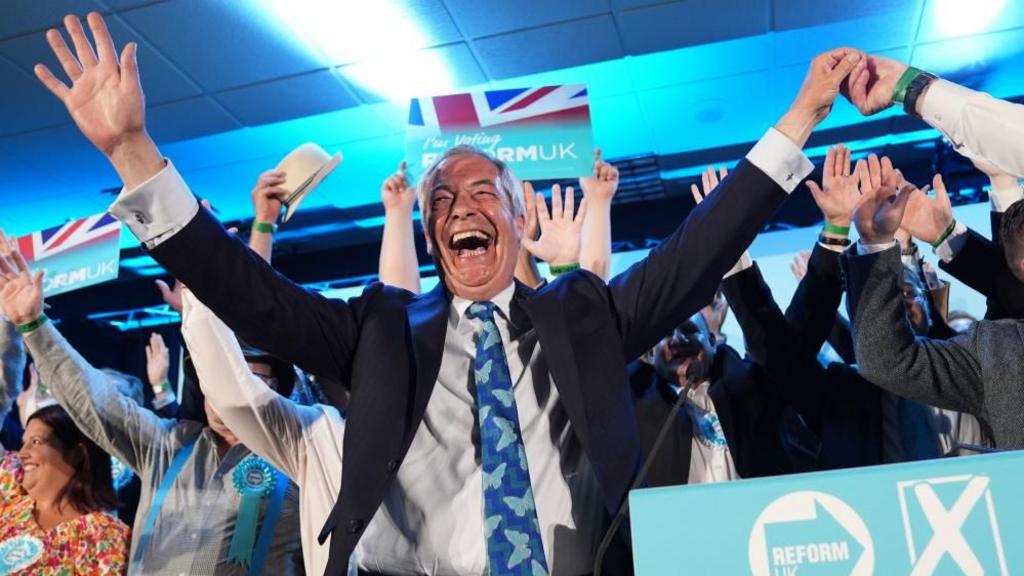
The headline that Reform is losing a newly elected councillor approximately every three days is therefore more than an attention-grabbing statistic. It raises important questions about the party’s ability to transform electoral popularity into stable political organisation. Winning elections is one challenge; maintaining a disciplined, competent and united group of representatives is another. For Reform UK, the second challenge may prove increasingly important as the party attempts to establish itself as a serious long-term political force.
One of the clearest problems concerns candidate selection and vetting. Reform achieved a dramatic breakthrough in local elections, but some candidates attracted controversy almost immediately after being elected. In several cases, old social-media posts or comments became public, forcing the party to suspend or remove representatives. For example, Stuart Prior, a newly elected councillor in Essex, resigned after allegations concerning racist, Islamophobic and extremist social-media content. Reform revoked his party membership. Other newly elected councillors also faced investigations or suspensions over controversial statements.
These incidents create a difficult political dilemma for Reform. On the one hand, the party has an obvious reason to act quickly when candidates are associated with racism, antisemitism or other offensive material. Allowing controversial representatives to remain in the party could damage Reform’s reputation and give opponents an opportunity to portray the entire organisation as extremist. On the other hand, repeated expulsions and suspensions suggest that the party’s candidate-selection process may not have been sufficiently rigorous before the elections.
The problem becomes especially significant when a political party experiences rapid growth. Established parties have decades of experience in recruiting candidates, training elected representatives and dealing with internal disputes. Reform, by contrast, has expanded at extraordinary speed. Candidates who previously had little or no experience in local government suddenly found themselves responsible for public services, council budgets and major political decisions. Some may have been attracted by Reform’s growing popularity without fully understanding the responsibilities associated with elected office.
The tracker provides useful evidence of the scale of the problem. Its figures divide departures into several categories: 62 councillors resigned, 26 were expelled, 17 were suspended, 41 defected to another party, and five lost their seats. These categories are important because they demonstrate that the problem cannot simply be described as a series of scandals involving unsuitable candidates. Some councillors have voluntarily left, while others have moved to different political parties. This indicates that Reform’s difficulties may involve not only candidate vetting but also internal culture, leadership and political management.
Defections are particularly significant. A councillor who leaves because of a disagreement with the party is different from a councillor who is removed because of offensive behaviour. Defections can indicate dissatisfaction with party leadership or uncertainty about Reform’s political direction. When several representatives leave within a relatively short period, voters may begin to question whether the party is capable of maintaining unity.
This matters because local councillors are not merely political symbols. They have practical responsibilities that affect people’s daily lives. Councils deal with issues such as housing, waste collection, roads, planning, social care, education and environmental policy. A party that wins control of a council therefore has to demonstrate competence as well as ideological commitment. Reform’s performance in local government will increasingly be judged not by speeches made during election campaigns but by whether councils under its control actually function effectively.
The party’s policies have already generated controversy. In Essex, for example, Reform’s administration announced cuts to net-zero initiatives after taking control of the county council. Critics argued that some of the measures being removed could affect public health, active travel and environmental resilience, while Reform defended its approach as a rejection of what it considers ideological spending. Whatever one’s political position, such decisions illustrate the transition Reform is making. It is no longer simply an opposition movement criticising the decisions of other parties; in several councils, it is responsible for making difficult decisions itself.
This transition creates a challenge for Nigel Farage. His political strength has historically been closely connected to his personal public profile. He is an experienced campaigner and communicator who has played a central role in British Eurosceptic politics for many years. Reform’s electoral success has therefore been strongly associated with his leadership. Yet a party that depends heavily on one individual can encounter difficulties when problems arise at the local level.
Recent controversies surrounding Farage have added to the pressure. In August 2026, Reform suspended Tim Montgomerie, a prominent Conservative defector and former adviser to Boris Johnson, after he publicly criticised Farage and other senior figures. Montgomerie had questioned Farage’s political judgement and criticised his handling of issues including a large political donation. The dispute illustrated the growing tensions within the party at a time when Reform is attempting to consolidate its position.
However, it would be wrong to conclude that the councillor departures automatically mean Reform is collapsing. Political parties regularly lose representatives, and the raw number of departures needs to be considered in relation to the party’s overall size. Reform began with a relatively small local-government presence and then expanded dramatically. The current tracker records 2,130 councillors in its baseline intake, so the 151 departures represent a minority of the total. Furthermore, some departures may have little connection with ideological disagreement or organisational failure. Councillors can leave because of personal circumstances, changes in employment, legal restrictions or other individual reasons.
Nevertheless, the timing is important. Losing an elected representative several years into a political term is not necessarily unusual. Losing representatives only weeks or months after a major electoral victory is more damaging because it creates the impression of instability at precisely the moment when voters expect a new administration to demonstrate competence. Reform’s political opponents are therefore likely to use the departures as evidence that the party was better prepared to win elections than to govern.
The party now faces a crucial test. If Reform can improve its candidate-vetting procedures, provide better training for councillors and establish clearer internal standards, the current difficulties may eventually become a temporary stage in its development. Rapidly expanding organisations often experience growing pains. Reform could argue that it is learning from its mistakes and building the structures necessary for long-term success.
If, however, departures continue at the current rate, the consequences could be more serious. Constant resignations, defections and disciplinary controversies would consume the party’s attention and undermine public confidence. They could also make it harder for Reform to recruit experienced candidates in future elections. People considering standing for the party may hesitate if they believe that internal disputes or leadership disagreements could quickly become public.
Ultimately, the councillor tracker is significant not simply because it provides a striking number, but because it reveals the difference between electoral popularity and political organisation. Reform UK has demonstrated that it can attract voters who are dissatisfied with established parties. The harder task is proving that it can convert that dissatisfaction into effective and sustainable government.
For Nigel Farage, the next stage of Reform’s development will therefore be crucial. The party cannot rely indefinitely on protest politics or the popularity of its leader. Its future will depend increasingly on the performance of its elected representatives. If Reform can turn its rapidly expanding network of councillors into a disciplined and competent political organisation, the current departures may eventually be remembered as an early period of adjustment. If it cannot, the statistic of losing a councillor every three days may become a symbol of a much deeper organisational crisis.
In conclusion, Reform UK’s councillor losses deserve attention, but they should be interpreted carefully. The departures do not by themselves prove that the party is failing, nor do they erase its considerable electoral achievements. They do, however, expose weaknesses in candidate selection, internal discipline and political management. As Reform moves from being a protest movement towards becoming a governing force in local government, these weaknesses will become increasingly difficult to ignore. The real test for Farage and his party is no longer whether they can win elections. It is whether they can keep the people they elect, govern effectively, and build an organisation capable of surviving beyond the personality of its leader.