

Mr Farage was attacked by the Tories (Image: Getty)
The Conservatives have warned that Reform UK cannot be taken seriously on the economy ahead of a major speech by Nigel Farage in the City of London tomorrow. Mr Farage will deliver his first proper remarks on his party’s economic policy tomorrow since he confirmed he has ripped up Reform’s previous manifesto commitments on tax and spending.
However the Tories have accused the party of still offering “madcap left-wing policies” like hiking welfare spending and nationalising industries. Shadow Chancellor Sir Mel Stride warned: “It’s impossible to take Reform seriously on the economy when their promises disintegrate after five minutes, and they remain committed to extra welfare spending and a huge expansion of the state. They are a one-man band and have resorted to junking promises they made only recently in a desperate attempt to appear economically credible.”
Get the latest politics news – straight from our team in Westminster and more
Invalid email
You agree you are 18 or over. We use your sign-up to provide content in ways you’ve consented to and to improve our understanding of you. This may include adverts from us and third parties based on our knowledge of you. You can unsubscribe at any time. More Info.

Mel Stride attacked Reform’s ‘left-wing’ policies (Image: Getty)
“In local government they have failed to find savings and are instead planning tax hikes on hard-working families. Their left-wing, tax-raising, debt-increasing proposals for the national economy would leave families paying the price.
“Only the Conservatives have the plan, the strong team and a leader with a backbone to get spending under control, cut taxes and deliver a stronger economy.”
Last month Mr Farage said a Reform government will not cut taxes until it has brought public spending under control, ditching the party’s 2024 commitments to cut taxes by £90 billion.
At the last election the party pledged to abolish a swathe of unpopular taxes in its first 100 days, including stamp duty, fuel duty and inheritance tax, but many economists warned this would repeat the errors of Liz Truss’s Mini-Budget.
He promised that Reform will “never borrow to spend, as Labour and the Tories have done for so long; instead, we will ensure savings are made before implementing tax cuts.”

Mr Farage will deliver a speech from the City of London (Image: Getty)
Mr Tice, who largely wrote last year’s manifesto as leader before Mr Farage’s return, also confirmed that the party’s policy of increasing the income tax threshold to £20,000 is now only an ‘aspiration’.
Mr Farage will deliver a speech on the economy tomorrow morning from the City of London as he sets out his party’s approach to tax and spend.
Mr Tice said last month: “A manifesto is based on a point in time. The principles behind it are absolutely rock solid.
“We said we’ve got to make very significant savings in order to fund a different way to run the economy.
“What’s happened since then is that the state of the economy, because of the mismanagement by this Labour government, the numbers have got far worse. And we will be focusing relentlessly, as I’ve been saying, on the savings.”
Tories Issue Fresh Attack on ‘Left-Wing’ Reform Hours Before Major Nigel Farage Speech
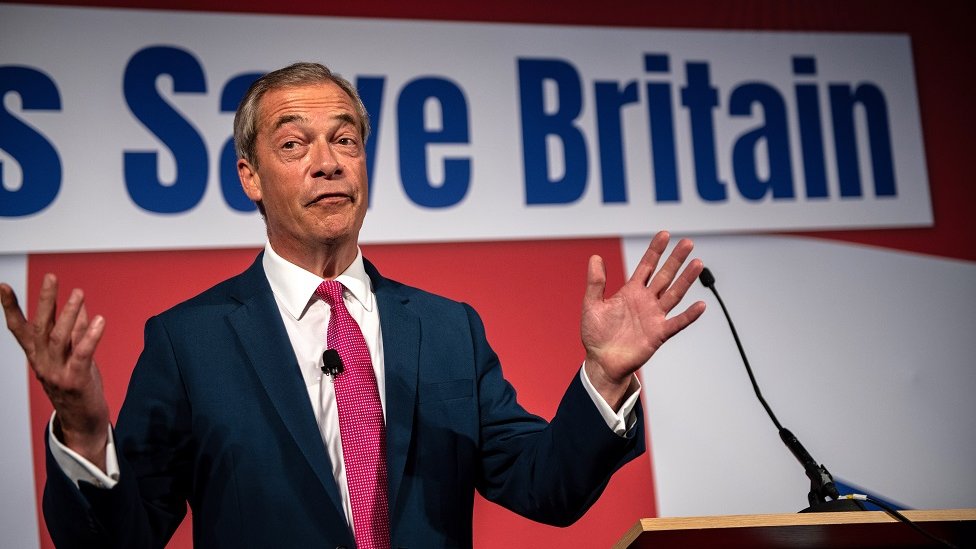
The Conservative Party has launched a fresh attack on Reform UK, accusing Nigel Farage’s party of pursuing policies that are inconsistent with traditional conservative principles, just hours before a major speech by the Reform leader.
The intervention comes as competition on the British right continues to develop, with Reform UK seeking to expand its support while the Conservatives attempt to rebuild their political position. The exchange highlights an increasingly important question in British politics: what does the modern right actually stand for?
The Conservatives’ description of Reform as “left-wing” is a political argument rather than an objective classification. Reform rejects that characterization and presents itself as a party committed to lower taxes, stronger borders, greater national sovereignty and significant changes to government.
Nevertheless, the Conservative criticism reflects a broader debate about Reform’s economic and social policies.
For years, Farage has been associated with campaigns against high taxation, increased regulation and large government. His political profile was built particularly around Brexit, where he argued that Britain should regain greater control over its laws, borders and trade policy.
Since returning to frontline politics with Reform UK, he has attempted to broaden that message into a wider programme covering taxation, immigration, public services, energy policy and economic growth.
That expansion has inevitably created new areas of disagreement with the Conservatives.
The latest Conservative attack focuses on the argument that Reform’s policies could involve a larger role for the state in certain areas than traditional Conservatives would support. This is an important distinction because the political divide between the two parties is no longer simply about Brexit.
The Conservatives have historically presented themselves as the party of lower taxation, private enterprise, fiscal restraint and individual responsibility, although governments led by the party have also increased public spending in response to events such as the Covid-19 pandemic and the energy crisis.
Reform, meanwhile, has attempted to combine economically conservative themes with policies designed to appeal to voters who feel that the political system has failed them.
That combination has produced an unusual political coalition.
Reform supporters can include people who previously voted Conservative, Labour or for other parties. Some are primarily motivated by immigration. Others are concerned about taxation, national identity, public services or dissatisfaction with Westminster.
This creates both opportunities and challenges for Farage.
A broad coalition can increase a party’s reach, but different groups of supporters may expect very different things from government.
The Conservatives’ decision to attack Reform shortly before Farage’s speech therefore has a strategic context. The timing ensures that the criticism becomes part of the political discussion surrounding his appearance.
Rather than allowing Reform to set the agenda entirely through Farage’s speech, the Conservatives are attempting to define the debate in advance.
That approach is increasingly common in modern politics.
Political parties rarely wait for an opponent to finish making an argument before responding. Statements, interviews and social-media posts are often released hours or even minutes before major political events.
The objective is not necessarily to change the other party’s supporters. It can also be aimed at persuading undecided voters, reinforcing existing supporters and creating a media narrative around the event.
For Reform, the response is likely to be straightforward: reject the Conservative characterization and argue that the party represents voters who have been ignored by both Labour and Conservative governments.
Farage has repeatedly positioned Reform as an alternative to the traditional two-party system. His political argument is that Britain needs a substantial change rather than a simple transfer of power between established parties.
That message has helped distinguish Reform from the Conservatives.
However, the accusation that Reform is “left-wing” introduces an important policy question.
Political labels can be misleading if they are used without examining individual policies. A party can support lower taxation while also advocating substantial government intervention in particular sectors. It can be socially conservative while supporting economic policies that differ from traditional free-market thinking.
Consequently, understanding Reform requires looking at specific proposals rather than relying entirely on labels.
The same applies to the Conservatives.
The modern Conservative Party contains competing traditions. Some Conservatives prioritize free markets and low taxation, while others place greater emphasis on national sovereignty, immigration control, public services and community cohesion.
Those differences have become increasingly visible since Brexit.
The political environment has also changed because voters themselves are less predictable.
Traditional party loyalties have weakened over recent years. Many voters are now more willing to move between parties depending on the issue, the candidate and their assessment of the government’s performance.
That makes Reform’s challenge particularly important for the Conservatives.
If Reform attracts voters who previously supported the Conservatives, the Conservative Party must decide how to respond. It can emphasize differences with Reform, attempt to recover voters through policies on immigration and taxation, or focus on rebuilding its broader political identity.
Each approach carries different political consequences.
The Conservatives’ latest attack suggests that the party is willing to challenge Reform not only on individual policies but also on its ideological identity.
That is significant because Farage’s appeal has partly depended on the argument that Reform represents a new political alternative.
If Conservatives can persuade voters that Reform’s policies are inconsistent with conservative principles, they can challenge one of the foundations of that argument.
But Reform has its own counterargument.
Its supporters can point to the party’s emphasis on lower taxation, deregulation, immigration control and national sovereignty as evidence that it belongs firmly on the right of British politics.
The disagreement therefore involves competing definitions of what “right-wing” and “conservative” politics should mean in the twenty-first century.
Farage’s speech provides an opportunity to develop that argument further.
Major political speeches are important because they allow party leaders to move beyond individual controversies and explain their wider political vision.
For Farage, that usually involves themes such as restoring national confidence, reducing immigration, changing the relationship between citizens and government and challenging what he sees as an entrenched political establishment.
His opponents, however, are likely to focus on whether his proposals are financially realistic, practically achievable and compatible with existing institutions.
Those questions cannot be answered simply through rhetoric.
They require detailed examination of policy costs, legislation, implementation and likely effects.
That is particularly true for economic proposals.
Promises to reduce taxes or increase spending must be considered alongside the government’s overall finances. Similarly, immigration policies must be examined not only in terms of headline targets but also enforcement mechanisms, international agreements, legal obligations and administrative capacity.
This is where the political debate could become more substantive.
The Conservatives’ latest criticism may generate headlines, but Farage’s response will be judged by the policies he puts forward and the explanations he gives for them.
The exchange also illustrates how Britain’s political landscape has moved beyond the simple Labour-versus-Conservative contest.
Reform UK has become an important participant in the national debate, while other parties, including the Liberal Democrats and Greens, continue to compete for support.
The result is a more fragmented political environment in which traditional assumptions about voting behaviour are increasingly difficult to maintain.
For Conservative politicians, the challenge is particularly direct because Reform competes for some of the same voters.
For Farage, the challenge is different. Expanding beyond protest politics requires convincing voters that Reform can provide detailed and workable solutions across the full range of government responsibilities.
The coming debate will therefore involve more than political labels.
It will involve competing ideas about taxation, immigration, government spending, regulation, national sovereignty and the role of the state.
The Conservatives have chosen to make their criticism before Farage takes the stage. That ensures the Reform leader begins his speech with a political challenge already placed in front of him.
His response will provide an indication of how he intends to frame Reform’s identity and distinguish it from both Labour and the Conservatives.
Ultimately, the argument over whether Reform is genuinely “left-wing” cannot be settled by a slogan.
It depends on the policies being proposed, the principles behind them and how those policies compare with competing political traditions.
What is clear is that the Conservatives are increasingly treating Reform as a major political competitor rather than a temporary protest movement.
And with Farage preparing to deliver another major speech, the political battle over the future direction of Britain’s right is entering another significant phase.