


Tories Launch Fresh Attack on “Left-Wing” Reform as Nigel Farage Faces Crucial Political Test
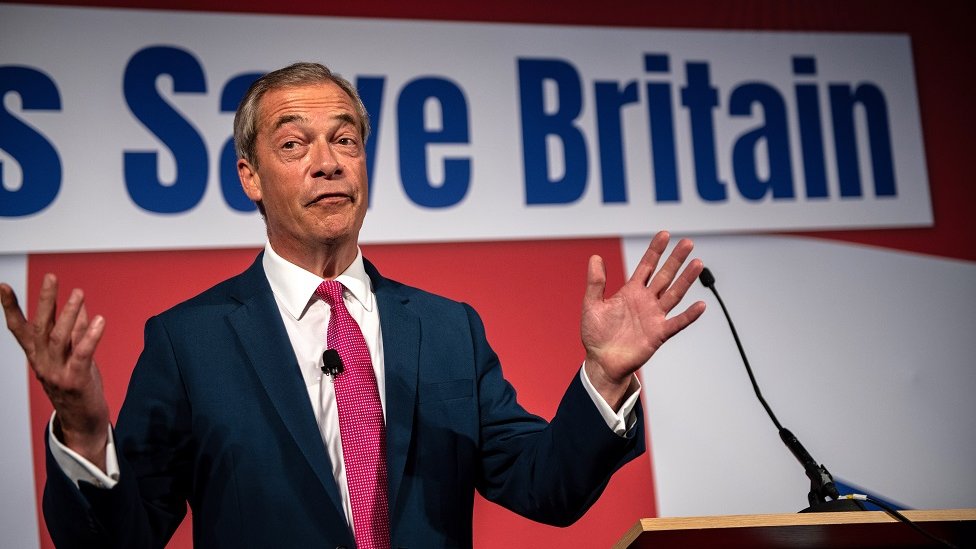
Nigel Farage is preparing for another major political speech, but before he takes to the stage, the Conservatives have launched a fresh attack on Reform UK.
The message from the Tories is striking.
They want voters to believe that Reform is not the radical right-wing alternative it claims to be.
Instead, they argue, Nigel Farage’s party is becoming something very different — and, in their words, increasingly “left-wing”.
It is an extraordinary accusation.
For years, Farage has built his political career around challenging the political establishment from the right.
He has attacked Labour for being too interventionist.
He has criticised Conservative governments for failing to control immigration.
He has demanded lower taxes and a smaller state.
He has campaigned against Net Zero policies.
And he has repeatedly presented Reform as the political force capable of breaking the old Westminster consensus.
Now the Conservatives are attempting to turn that argument upside down.
Their message is essentially this:
Reform is not the solution to Britain’s problems. It is another form of political interventionism wearing the clothes of a revolution.
A battle for the right
The attack comes at a particularly important moment.
The Conservative Party is fighting for its political survival.
Reform has spent years taking votes from the Tories.
Farage’s movement has attracted voters who once regarded themselves as natural Conservatives but became increasingly frustrated with the party’s record in government.
Immigration was a major factor.
Taxes were another.
The cost of living played a role.
So did the sense that Conservative politicians had promised change but delivered too little.
Reform benefited from that frustration.
But the Conservatives are now attempting to reverse the political flow.
Kemi Badenoch and her allies want former Conservative voters to return.
And one of their most powerful arguments is that Reform is not really the traditional conservative alternative.
What does “left-wing Reform” mean?
The phrase sounds contradictory.
Reform is widely associated with the political right.
Its immigration proposals are considerably tougher than those of Labour.
Its approach to national sovereignty is strongly associated with the right.
Its criticism of Net Zero appeals to many conservative voters.
And its economic message includes significant tax-cutting ambitions.
So why would Conservatives call it left-wing?
The answer lies in a different definition of political ideology.
The Tory argument focuses on areas where Reform proposes major government intervention.
They can point to large-scale economic promises, industrial policy, state involvement and ambitious spending commitments.
Their argument is not necessarily that Reform agrees with Labour on everything.
It is that Reform sometimes proposes using the power of the state in ways that traditional Conservatives would reject.
That is a much more sophisticated attack.
Farage’s economic challenge
Farage wants to persuade voters that Britain can become wealthier by cutting taxes, reducing bureaucracy and encouraging investment.
But Reform also promises significant changes to public services and national institutions.
The party’s platform includes proposals for the NHS, energy, immigration, policing and the civil service.
That creates a tension.
How much should the state do?
How much should government spend?
Where should intervention stop?
These are traditional Conservative questions.
And the Tories now have an opportunity to say that Reform does not have sufficiently conservative answers.
The welfare state question
The welfare state provides another example.
Reform’s rhetoric often focuses on helping British workers and families.
That can include stronger support for certain groups and policies designed to protect domestic industries.
Politically, that message can appeal to voters who feel abandoned by globalisation.
But traditional Conservatives may see parts of it as a form of economic nationalism.
That distinction matters.
The political right is not automatically united.
There is a difference between free-market conservatism and populist economic nationalism.
Farage increasingly occupies the second territory.
Reform’s appeal to working-class voters
This is one of the reasons Reform has become such a threat to both Labour and the Conservatives.
Farage is attempting to build a coalition that crosses traditional political boundaries.
He wants working-class voters.
He wants former Conservative voters.
He wants Brexit supporters.
He wants people who are angry about immigration.
He wants people who believe taxes are too high.
And he wants voters who simply think the political system has failed.
That requires a broader message than traditional conservatism.
It requires economic policies that appeal to voters who do not necessarily identify with free-market ideology.
The “left-wing” accusation as a Tory weapon
The Conservatives therefore have a clear strategic objective.
They want to redefine Reform before Reform can redefine British politics.
If Reform is seen as the only serious alternative to Labour, the Conservatives could become irrelevant.
But if voters start asking whether Reform is economically conservative enough, the Tories regain political space.
This is why the timing of the attack matters.
Farage is preparing to address a large audience.
His speech is an opportunity to reinforce his image as the leader of Britain’s political insurgency.
The Conservatives want to interrupt that narrative.
They want voters to hear another message before Farage gets to make his case.
Farage’s response
Farage is unlikely to accept the accusation quietly.
His entire political career has been built around confronting attacks from established parties.
He can argue that the Conservatives have no credibility when discussing the political right.
After all, the Conservatives were in government for years.
They promised to reduce immigration.
They promised to cut taxes.
They promised to control government spending.
They promised to restore political competence.
Yet many of their former supporters believe they failed.
Farage can therefore respond with a simple question:
If the Conservatives were genuinely conservative, why did millions of voters leave them?
That is a powerful political counterattack.
The legacy of the Conservative government
This is the Tories’ fundamental weakness.
They cannot erase their record.
Reform’s rise happened partly because Conservative voters became dissatisfied with Conservative government.
Farage can remind them of that every time he speaks.
He can point to high taxes.
He can point to immigration.
He can point to public spending.
He can point to political instability.
And he can argue that the Conservative Party had its opportunity.
Now Reform deserves one.
That argument remains potent among voters who feel betrayed by the Conservatives.
But Reform has its own vulnerabilities
The Tories also have a point that Reform cannot simply dismiss.
As Reform becomes more popular, its policies receive greater scrutiny.
A protest movement can make promises without explaining every detail.
A potential government cannot.
If Reform wants to run Britain, voters will ask:
How much will everything cost?
Which taxes will be cut?
Which services will change?
How many civil servants will lose their jobs?
What happens to public spending?
How will immigration policy work legally?
What happens to Britain’s international relationships?
These questions cannot be answered with slogans.
The danger of overpromising
Farage’s greatest political strength is his ability to make complicated frustrations sound simple.
But that can also become his greatest weakness.
If Reform promises too much, voters may eventually demand proof.
If the numbers do not add up, opponents will attack.
If policies require years to implement, supporters may become impatient.
And if Reform has to compromise, critics will accuse it of becoming exactly what it once opposed.
This is the classic problem of populist movements.
Winning support is easier than maintaining it after gaining responsibility.
The Conservative strategy
The Tories therefore have a relatively simple strategy.
Do not try to out-Farage Farage on every issue.
Instead, ask voters whether they really trust Reform to govern.
The Conservatives can say:
Reform has anger.
Reform has publicity.
Reform has momentum.
But does Reform have the machinery to run the country?
That question could become increasingly important.
Farage’s changing political role
There is another reason the attack matters.
Farage is no longer simply an outsider.
He is now a national political figure with MPs, councillors and a large organisation behind him.
Reform has become a serious political force.
That means the standards applied to Farage are changing.
Voters are no longer simply asking whether he can challenge the establishment.
They are asking whether he can replace it.
That is a much harder test.
The “uniparty” contradiction
Interestingly, the latest Conservative attack comes after Farage himself has repeatedly attacked what he calls the political “uniparty”.
He argues that Labour and Conservatives are fundamentally similar on too many important issues.
He says both have failed to solve Britain’s major problems.
That is central to Reform’s identity.
But the Conservatives are now turning the argument around.
They are effectively saying:
Perhaps Reform is becoming another part of the same political system.
Perhaps it has started making compromises.
Perhaps it is moving towards policies that are not genuinely conservative.
And perhaps voters should return to the Conservatives.
That is the political battle now taking shape.
A fictional conversation between two Tory voters
Imagine two fictional Conservative voters talking before Farage’s speech.
“I used to vote Conservative.”
“So why did you switch?”
“Because they didn’t deliver.”
“Would you vote Reform again?”
“Maybe.”
“But don’t you think Reform is becoming too interventionist?”
“I hadn’t thought about it.”
That final sentence is precisely what the Conservatives want.
They want former Tory voters to think twice.
They want doubts.
They want questions.
They want to create uncertainty about whether Reform is truly the political home of the right.
Farage must now define Reform
That means Farage faces an important opportunity.
His speech cannot simply repeat familiar attacks on Labour.
He needs to explain what Reform actually stands for.
What kind of economy does it want?
How big should government be?
What should happen to public services?
What should Britain’s relationship with the world look like?
How will immigration be controlled?
How will taxes be reduced?
And perhaps most importantly:
What makes Reform fundamentally different from the Conservative Party?
The clearer the answers, the harder the Tory attack becomes.
The battle for former Conservatives
The political reality is that Reform and the Conservatives are competing for many of the same voters.
They may disagree on strategy.
They may disagree on ideology.
But electorally, there is enormous overlap.
That makes their relationship intensely competitive.
Every Reform gain can mean another Conservative loss.
Every Conservative recovery can weaken Reform.
And every voter who returns to the Tories makes Farage’s path to power more difficult.
This is no longer simply Labour versus Reform.
It is increasingly a three-way struggle.
Labour is watching closely
Keir Starmer’s Labour Party has every reason to watch the conflict with interest.
A divided right can benefit Labour.
If Reform and the Conservatives spend their energy attacking each other, Labour may regain voters in constituencies where the opposition is fragmented.
But Labour cannot assume this will last.
If either Reform or the Conservatives emerges as the dominant opposition force, the political landscape could change rapidly.
The current rivalry is therefore a battle that Labour cannot afford to ignore.
Reform’s biggest question
Ultimately, the Conservatives’ accusation raises a genuine political question.
Can Reform become a mass movement without losing its ideological identity?
Every successful political party faces this dilemma.
Too radical, and it may struggle to win a majority.
Too moderate, and its original supporters may conclude that it has betrayed them.
Farage must therefore walk a narrow line.
He needs to broaden Reform’s appeal without making the party look like another version of the Conservatives.
He needs to promise change without frightening voters who want stability.
And he needs to attack the establishment while preparing to become the establishment.
The speech could be a defining moment
That is why the timing of the Tory attack is important.
Farage’s speech gives him a chance to answer the criticism directly.
He can explain why Reform is different.
He can challenge Conservative credibility.
He can present a vision of government.
And he can attempt to reassure voters who are attracted to Reform but remain uncertain about its ability to govern.
The Conservatives, meanwhile, will hope that their “left-wing Reform” message sticks.
If it does, Farage faces a serious problem.
If it does not, the Tories may find themselves losing even more ground.
The battle for Britain’s right
British politics is undergoing a profound transformation.
Labour remains the governing force.
But the opposition is fragmented.
The Conservatives are attempting to rebuild.
Reform wants to replace them.
Farage wants to become Prime Minister.
And the battle between Reform and the Conservatives may ultimately determine whether that ambition succeeds.
The accusation that Reform is “left-wing” is therefore more than an insult.
It is a strategic attempt to redefine the party.
The Tories are saying:
Do not assume Reform is the conservative answer.
Farage’s response will almost certainly be:
Do not forget why you abandoned the Conservatives in the first place.
That is the political argument now unfolding.
And as Nigel Farage prepares to deliver another major speech, the stakes are higher than another headline.
He must convince voters that Reform can change Britain without becoming another establishment party.
The Conservatives must convince former supporters that Reform is not truly conservative.
Labour must hope the two sides continue fighting.
And millions of voters are watching.
The question is no longer simply whether Reform can defeat Labour.
It is whether Nigel Farage can defeat the Conservatives first.
Because before Reform can take power, it may have to win the war for the soul of Britain’s political right.