

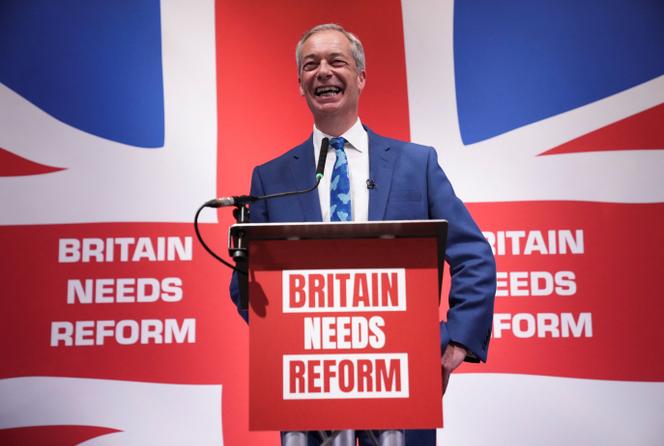
The Real Reason Brits Are Ready to Vote for Farage — and It’s Nothing to Do With Brexit
For much of Nigel Farage’s political career, there was an easy explanation for his popularity.
Brexit.
Farage became one of the defining figures of Britain’s campaign to leave the European Union, and for years his political identity was inseparable from the argument that Britain should reclaim control from Brussels. It was tempting, therefore, to assume that Reform UK’s rise was simply the aftershock of the 2016 referendum.
But that explanation is becoming increasingly inadequate.
The real reason many Britons are prepared to vote for Farage today is broader, more emotional and potentially more significant: they believe the political system has stopped listening to them.
That is the finding hiding beneath Reform UK’s rise.
Recent research by the National Centre for Social Research suggests that Reform’s support is distinguished not only by attitudes towards Brexit, but by wider dissatisfaction with the state of the country.
In other words, Farage’s biggest opportunity may no longer be Brexit.
It is discontent.
The politics of dissatisfaction
Britain has changed dramatically since the referendum.
Brexit has happened. The United Kingdom has left the European Union. The arguments that dominated the 2016 campaign have gradually been replaced by new concerns: housing, wages, taxes, public services, immigration, crime, the NHS and the cost of living.
Yet the sense of political frustration that helped produce Brexit has not disappeared.
If anything, it has evolved.
Many voters who feel that their lives have become harder are not necessarily thinking about Brussels when they consider voting Reform. They are thinking about whether their government is competent, whether politicians understand ordinary people and whether anything actually changes after an election.
That is a much more powerful political problem for Labour and the Conservatives.
YouGov’s latest major study of Reform voters found that immigration remains the party’s most important issue, with 86% of Reform supporters identifying it as one of the country’s most important problems. But the study also found that perceptions of honesty and the need for political change are major attractions.
That combination is revealing.
Voters are not simply saying, “I want Brexit again.”
They are saying, “I want somebody to do something.”
Farage’s greatest weapon: authenticity
There is another reason Farage remains so effective.
He looks and sounds different from the traditional Westminster politician.
That does not mean everyone likes him. Quite the opposite.
YouGov found in July 2026 that 65% of Britons viewed Farage unfavourably, compared with only 25% who viewed him favourably. Only 16% considered him trustworthy. Yet 50% regarded him as decisive.
That apparent contradiction tells us something important.
Farage does not need to be universally liked.
He needs to appear decisive to enough people who believe that conventional politicians have become too cautious, too scripted or too disconnected.
His appeal is therefore partly psychological.
He offers certainty in an uncertain political environment.
He tells voters that the problems they see are real.
He tells them that somebody is responsible.
And he promises to do something dramatic about them.
That is a powerful formula.
Immigration has replaced Brexit as the central issue
If there is one policy issue now driving Reform’s popularity, it is immigration.
Research by YouGov found that 54% of Reform supporters identify trusting the party to manage immigration as one of the reasons that most appeals to them. Perceptions of honesty and the belief that Reform represents necessary change follow closely behind.
More in Common’s research reaches a similar conclusion: around six in ten Reform voters say the party’s immigration policies are a top reason for their support.
This is crucial.
It means Farage has successfully transferred his political identity from one defining issue to another.
Brexit was about sovereignty.
Immigration is also about sovereignty.
Brexit was about the belief that politicians should be accountable to British voters.
Immigration is presented by Reform as a test of whether politicians are capable of enforcing the decisions they make.
The underlying emotional message is therefore remarkably similar even though the policy debate has changed.
Britain should be in control of its own future.
That is the thread connecting Farage’s political career.
But there is more than immigration
It would also be a mistake to assume that every Reform voter is motivated by immigration alone.
The same YouGov research found that the cost of living and defence were the next most important concerns among Reform supporters, followed by crime, welfare, the economy and the NHS.
And there is an important difference between voters who have moved from different political parties.
Former Labour voters who now support Reform are particularly concerned about the cost of living and the NHS.
That makes Reform’s rise particularly disruptive.
If Farage were simply attracting former Conservative voters, Labour could largely ignore him.
But he is competing for voters who previously belonged to Labour as well.
These voters do not necessarily share a traditional Conservative worldview.
Some want stronger public services.
Some support government intervention.
Some are economically insecure.
What they share is a belief that the established parties have failed to deliver.
The “anti-establishment” vote
This may be the real secret of Reform.
People can vote for a party without loving its entire programme.
YouGov found that 22% of Reform voters support the party partly because they see the alternatives as worse. Among former Labour voters, that figure rises to 31%.
That is enormously significant.
It means some Reform voters are not converts.
They are defectors.
They are not necessarily saying, “Reform is my perfect political home.”
They are saying, “I don’t want the other lot.”
This is how political systems become unstable.
When voters stop identifying strongly with traditional parties, elections become competitions between alternatives rather than expressions of long-term loyalty.
And once that happens, a political outsider can grow extraordinarily quickly.
The problem for Labour
For Labour, this presents a particularly uncomfortable challenge.
It cannot simply explain Reform’s popularity as right-wing anger.
That would miss the voters who are leaving Labour.
The deeper question is why some people who once saw Labour as their natural political home now believe that Reform understands them better.
The answer appears to involve both cultural and economic frustration.
Some former Labour voters want tougher immigration controls.
Others feel that their communities have been neglected.
Some are frustrated by the cost of living.
Others believe politicians spend too much time talking about Westminster politics and not enough time addressing problems in their neighbourhoods.
Farage’s message is designed to capture all of those frustrations at once.
He does not need to offer a detailed explanation for every problem.
He only needs to convince voters that the existing system is responsible for them.
The uncomfortable truth about Brexit
This does not mean Brexit was irrelevant.
It clearly remains part of Farage’s political history and identity.
But the evidence suggests that Reform’s current coalition cannot be understood simply through the Leave vote.
The National Centre for Social Research has specifically examined whether Reform support is primarily explained by ideological outlook, including attitudes towards Brexit, or by wider dissatisfaction with the state of the country.
The answer points towards something broader.
The political mood that produced Brexit has outlived the referendum itself.
The question has changed.
In 2016, voters were asked whether Britain should remain inside the European Union.
Today, many are asking a different question:
Does anyone in politics actually represent people like me?
That is a much harder question for the established parties to answer.
Farage understands the emotional side of politics
This is where Farage’s political instincts have consistently served him well.
He understands that elections are not fought entirely on spreadsheets.
People vote with memories, identities, frustrations and hopes.
A politician can have a technically impressive policy programme and still fail to connect with voters.
Farage’s strength is that he rarely sounds as though he is delivering a policy seminar.
He talks in ordinary political language.
His supporters often interpret that as honesty.
His critics interpret it as oversimplification.
But both reactions demonstrate the same thing: he is difficult to ignore.
British Future’s 2026 immigration tracker found a striking contrast in perceptions of political trust on immigration. Among potential voters for their respective parties, 76% trusted Farage a great deal or a fair amount when he talked about immigration, compared with only 35% for Keir Starmer.
That does not mean Farage is trusted by Britain as a whole.
He clearly is not.
But it demonstrates that he has established a powerful connection with his target electorate.
And that creates a serious danger
The danger for the established parties is not simply that Farage might win votes.
It is that he has identified a problem they cannot easily fix.
If voters believe politicians are dishonest, disconnected and ineffective, giving them another policy announcement will not necessarily restore trust.
They need to believe that politics itself can deliver.
That requires visible results.
It requires competent government.
And it requires politicians who understand why people are angry rather than simply telling them that they should not be angry.
This is where Reform has an advantage.
It can remain outside the traditional political establishment while attacking the establishment.
But there is a catch.
If Reform gains power, it becomes the establishment.
And then voters will judge Farage by the same standard they apply to everyone else.
The great test for Reform
This may ultimately be the biggest question surrounding Farage.
Can a party built around dissatisfaction successfully govern?
Campaigning is about identifying problems.
Government is about solving them.
Reform can promise to stop illegal immigration, reduce taxes, cut welfare spending and restore public services.
But once in office, every promise becomes a practical problem involving money, legislation, courts, diplomacy and administrative capacity.
Recent Reform welfare proposals illustrate the difficulty. The party says its planned overhaul could save £50 billion a year, while critics warn that the measures could increase poverty and cause severe hardship among disabled people.
This is the point at which the anti-establishment coalition could become difficult to maintain.
A voter can unite with someone against the establishment.
It is much harder to unite around the question of what government should actually do.
Farage’s moment may therefore be bigger than Brexit
The irony is that Farage may have moved beyond the political issue that made him famous.
Brexit gave him his breakthrough.
Immigration has given him a new battlefield.
But dissatisfaction has given him something even more powerful: a reason for voters to abandon old political loyalties altogether.
That is why his rise matters.
And that is why reducing Reform’s popularity to Brexit would be a serious analytical mistake.
The deeper story is about trust.
It is about representation.
It is about whether voters believe that established political parties understand the country they are governing.
And it is about a growing willingness to punish politicians who fail to deliver.
Farage has positioned himself as the beneficiary of that anger.
He tells voters that the political system has failed them.
He tells them that Westminster needs to be shaken up.
And he presents himself as the person willing to do it.
Whether he can actually deliver is another question.
But for now, that may not be the question voters are asking.
They are asking something much simpler:
“Who is actually listening to us?”
And that is the real reason Farage can win votes in Britain today.
It has much less to do with Brexit than many people think.
It has everything to do with a country where millions of voters no longer feel that the old political order deserves their loyalty.