

The RNLI has temporarily closed its Portsmouth station following anti-migrant protests in the city.
Volunteers for the service were branded “traitors” after bringing 120 migrants, who had been rescued from a single dinghy, ashore near Portsmouth Lifeboat Station.
Protests erupted near the station and threats against the RNLI and its personnel skyrocketed across the country.
Volunteers have had their addresses leaked online and some have been told not to wear their RNLI uniform in public on the grounds of safety.
The station in Eastney has now been closed since 10 September and Eastney RNLI have also taken down their Facebook page.

The Poole Old Lifeboat Museum also shut down after several incidents of anti-migrant protesters verbally assaulting their volunteers.
RNLI chief executive Peter Sparkes slammed the hate as coming from those who “hide behind a balaclava or a keyboard”, whose “action is wholly unacceptable”.
He said: “Recent events have generated deliberate misinformation and a misunderstanding about the RNLI – our purpose, our tasking, and particularly our lifesaving work in the Channel.
“Sadly, as a result, some of our volunteers and staff have been the subject of online and, in the worst cases, physical abuse.”
A spokesperson for the charity said that Portsmouth Lifeboat Station had been “temporarily off service” since 10 September.
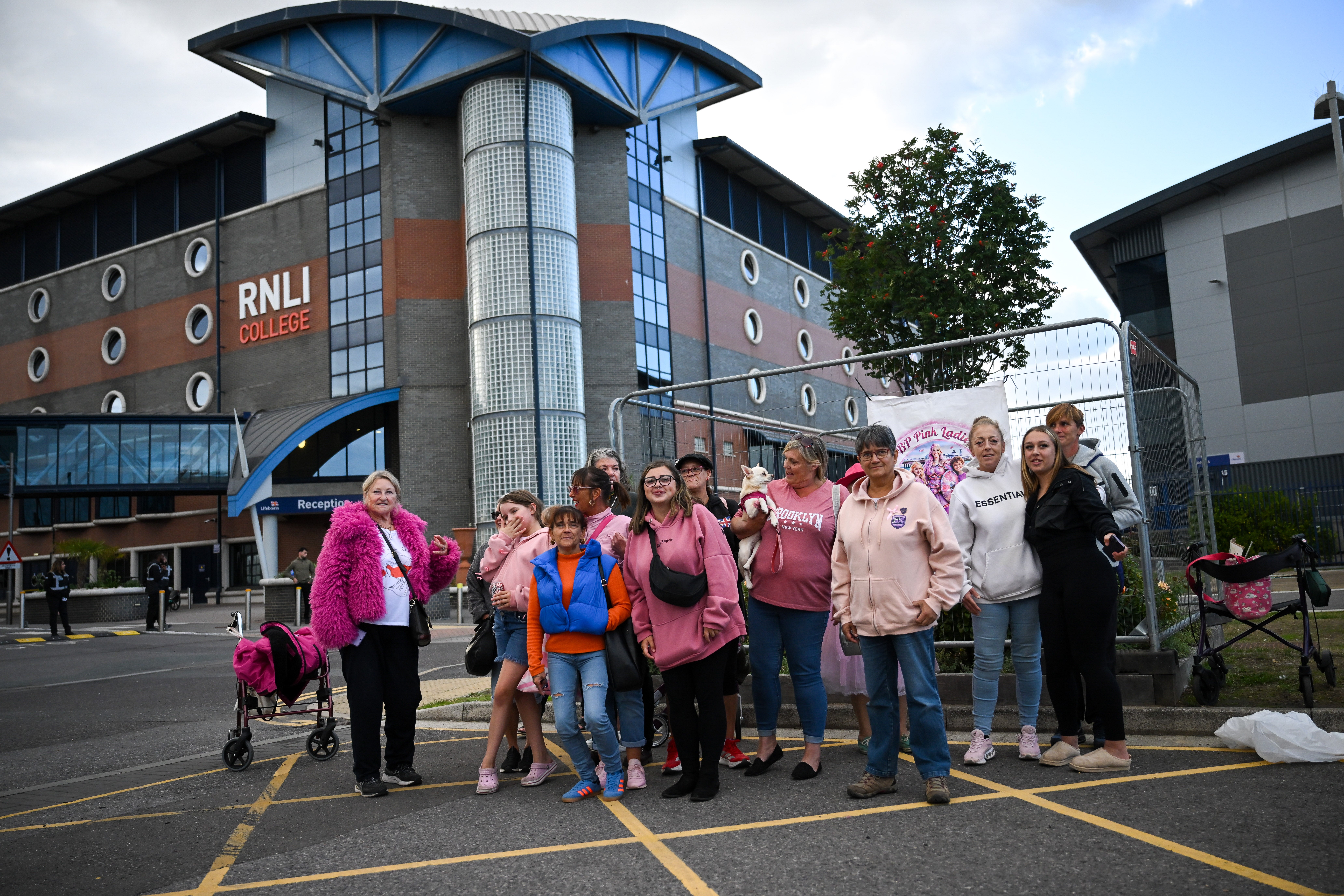
“We hope to have the lifeboat station back on service as soon as possible.
“Search and rescue cover continues to be provided through established contingency arrangements, including flank RNLI stations and other declared assets.
“At times, it is not unusual for lifeboat stations around the UK and Ireland to be temporarily unavailable due to maintenance or other operational requirements.
“In such circumstances, established contingency arrangements are put in place to ensure continued search and rescue cover.”
Police have launched an investigation into abusive social media content directed at RNLI volunteers, including two who had their photos, full names and home addresses leaked.
Chief inspector Adam McCaig warned that attempting to intimidate or obstruct maritime rescue teams actively endangers human lives.
“The RNLI exists to save lives at sea, and any disruption to that mission could have serious consequences for those in need of urgent assistance,” Mr McCaig said.
“We would advise anyone considering carrying out any action that could hinder the RNLI’s vital lifesaving work to carefully consider the implications.”
RNLI Closes Portsmouth Lifeboat Station After Huge Anti-Migrant Protests
The Royal National Lifeboat Institution has temporarily taken its Portsmouth lifeboat station out of service after a wave of anti-migrant protests and growing hostility towards its volunteers.
The decision follows a dramatic incident earlier this month in which RNLI crews helped bring approximately 120 asylum seekers ashore at Eastney after they were rescued from a small boat in the Channel. The arrival triggered a large protest, with demonstrators attempting to prevent the people from leaving the area and police being deployed to control the situation.
What followed was not simply a political argument over immigration. The controversy quickly turned towards the RNLI itself, with volunteers accused by protesters of helping migrants reach Britain. Some volunteers were branded “traitors”, while personal details belonging to members of the service were reportedly circulated online.
The RNLI has subsequently taken additional security precautions, including advising volunteers to consider avoiding RNLI-branded clothing if they believe wearing it could expose them to danger. The Portsmouth station has also removed its Facebook presence amid the heightened tensions.
The temporary closure is being presented by the charity as a safety measure rather than a withdrawal from its lifesaving responsibilities.
Jacqui Irons, the RNLI’s head of region for the south-east, said the Portsmouth station had been temporarily taken off service while the organisation reviewed crew safety and wellbeing following the events of September 6.
The charity has also stressed that search-and-rescue coverage has not simply disappeared. Other RNLI stations and declared maritime assets are being used through established contingency arrangements.
That distinction is important.
The RNLI operates a network of lifeboat stations around the British and Irish coasts. Individual stations can occasionally become unavailable for operational or maintenance reasons, with neighbouring resources providing cover.
In Portsmouth, however, the circumstances are unusual because the closure follows a politically charged confrontation involving the organisation’s own volunteers.
The dispute began when an unusually large small boat reached the Portsmouth area. RNLI crews assisted after the vessel was intercepted, helping bring the people on board safely to shore.
The arrival became the focus of a major demonstration.
Hundreds of anti-migrant protesters gathered around the area, with some attempting to block roads and prevent coaches carrying the newly arrived asylum seekers from leaving. Police officers were deployed, and reports described clashes, damage to police vehicles and the use of dispersal powers.
The protest subsequently developed into a wider campaign directed at the RNLI.
For the charity, this created a difficult situation. Its volunteers had been carrying out a maritime rescue, but their actions were interpreted through the much larger political debate surrounding illegal immigration and Channel crossings.
The RNLI has repeatedly stated that its role is to save lives at sea. Its crews do not decide who crosses the Channel, who is granted asylum or where people are subsequently taken for processing.
The charity says its lifeboats respond when requested to assist people whose lives may be in danger.
According to figures published by the RNLI, its lifeboats launched 9,058 times during 2025, while only 109 of those call-outs involved small boats in the Channel. That represented approximately 1.2 per cent of its rescue work during the year.
The figures underline the broader nature of the organisation’s work.
RNLI crews respond to emergencies involving a wide range of people and vessels. Their work includes rescues involving leisure craft, fishing boats, swimmers and other maritime emergencies.
Nevertheless, the political sensitivity of Channel crossings means that even a relatively small part of the RNLI’s work can attract considerable attention.
The Portsmouth events have demonstrated how quickly that attention can turn into hostility.
The RNLI’s chief executive, Peter Sparkes, criticised what he described as misinformation and misunderstanding about the charity’s role. He said some staff and volunteers had experienced online abuse and, in the most serious cases, physical abuse.
The organisation has also warned that volunteers should not feel obliged to put themselves in danger because of their association with the charity.
That advice reflects a broader concern about the personal consequences of the protests.
Some RNLI volunteers reportedly had their photographs, names and home addresses circulated online. Police subsequently began investigating abusive social-media material directed at members of the organisation.
For volunteers, the issue is particularly sensitive because many give their time without being paid.
They train to respond to emergencies, often at short notice and in difficult conditions. Their work depends on public trust and cooperation.
Being confronted or targeted because of a rescue operation creates an entirely different type of risk.
The situation has not been limited to Portsmouth.
The RNLI’s headquarters in Poole has also been the focus of protests. The Poole Old Lifeboat Museum temporarily closed after volunteers experienced verbal abuse from protesters. Security measures have been increased at several RNLI locations.
The spread of protests has raised questions about whether a dispute over immigration policy is beginning to affect emergency services beyond the immediate location where asylum seekers arrive.
At the centre of the political disagreement is Britain’s continuing struggle with Channel migration.
Small boats have become one of the most visible symbols of the country’s immigration debate. Governments have promised to reduce crossings, while political parties have proposed different approaches to border enforcement, asylum processing and the relationship with France.
The RNLI, however, occupies a different position.
It is not responsible for immigration policy.
Its crews cannot determine whether a person on a boat is an asylum seeker, a migrant or someone else before deciding whether assistance is required. Their immediate concern is whether people at sea need rescuing.
This distinction has become increasingly important as political arguments have intensified.
Supporters of tougher immigration controls may object strongly to the government’s handling of Channel crossings. But the question of how those crossings should be stopped is separate from the question of what rescuers should do when people are in danger.
The Portsmouth controversy has brought those two issues together in a particularly visible way.
The protests have also highlighted the role of social media in organising demonstrations.
Anti-migrant activists used livestreams and online posts to encourage supporters to travel to Portsmouth. Daniel Thomas, known as Danny Tommo, was among those involved in mobilising demonstrators. His Patriot Platform organisation had also been involved in protests connected with Channel migration elsewhere on the south coast.
The rapid organisation of large groups through social media creates additional challenges for police and emergency organisations.
A local protest can quickly attract people from other parts of the country. Demonstrations can grow significantly within hours, while online footage can spread images of confrontations far beyond the original location.
For the RNLI, that means a single rescue can potentially result in threats against volunteers who had no involvement in immigration policy whatsoever.
The organisation has therefore sought to reassure staff and volunteers while maintaining its central mission.
Its message is that rescuers should continue to assist people in danger at sea, but that their own safety must also be protected.
The temporary closure of Portsmouth is consequently a significant development.
It does not mean that the RNLI has abandoned the area or stopped responding to emergencies. Instead, other rescue resources are being used to maintain coverage while the situation is assessed.
The charity has said it hopes to return the station to service as soon as possible.
The police response will also remain important.
Authorities must balance the right to peaceful protest with the need to prevent violence, intimidation, obstruction and other criminal behaviour. Demonstrating against immigration policy is lawful, but that does not provide protection for conduct that breaches criminal law.
One person arrested in connection with the Portsmouth protest has already appeared in court and admitted a charge of violent disorder, while facing a separate allegation involving an assault on a police officer.
The case illustrates how the events surrounding the protests are now moving beyond political debate and into the criminal justice system.
For Portsmouth itself, the consequences are likely to continue after the crowds have gone.
The city remains an important maritime centre, and its emergency services must be able to operate regardless of political disagreements. The temporary RNLI closure has therefore raised concerns about how public demonstrations can affect organisations whose primary responsibility is emergency response.
The controversy also presents a difficult test for the wider debate over immigration.
People can legitimately disagree about the government’s asylum policies, the number of people crossing the Channel and the methods used to control the border. But those political disagreements increasingly intersect with the work of organisations that are not responsible for making those policies.
The RNLI has found itself at the centre of that tension.
Its Portsmouth volunteers did not create Britain’s immigration policy. They were responding to a maritime incident.
Yet their actions became a highly visible part of a national argument.
The station’s temporary closure is a reminder that political conflict can have practical consequences far beyond Parliament and election campaigns. It can affect volunteers, emergency services, local communities and the ability of organisations to perform their normal duties.
For the RNLI, the immediate priority is clear: protect its people while ensuring that maritime rescue coverage continues.
For the police, the challenge is maintaining public order while protecting lawful protest.
And for politicians, the Portsmouth events demonstrate the intensity of the public debate surrounding immigration and Channel crossings.
Whether the RNLI station can soon return to normal operations will depend partly on the security situation around the site.
What happens next will also be watched closely because Portsmouth has become an example of how Britain’s migration debate can move rapidly from political argument to confrontation on the streets.
For more than two centuries, the RNLI has been associated with rescuing people from danger at sea. The current controversy has placed that traditional mission in the middle of one of Britain’s most divisive political debates.
The organisation’s decision to temporarily close its Portsmouth station shows just how serious the situation has become.
But the RNLI has also made clear that the closure is temporary and that alternative rescue arrangements remain in place.
The broader question is whether the political dispute surrounding Channel migration can be kept separate from the work of emergency volunteers.
For now, Portsmouth stands at the centre of that unresolved tension.