
Andy Burnham will put Labour in a stronger position to win back voters it is at risk of losing to Zack Polanski’s Greens, new research for PoliticsHome has found.
The new nationwide survey, carried out late last month by the research organisation Thinks Insight & Strategy, also suggests that the prime minister-in-waiting will help shore up Labour’s right flank against Reform UK.
Ben Shimshon, co-founder and CEO of Thinks Insight & Strategy, said Burnham “definitely opens a window of opportunity” for Labour and “should give the party real hope”.
However, the findings also indicate that the public will expect Burnham to deliver change quickly after he enters Downing Street, which is expected to happen later this month.
The research is based on an online survey of 2,079 people between 24-25 June, alongside four focus groups with people who voted Labour at the 2024 general election but are now considering either the Greens or Nigel Farage’s Reform.
The fieldwork was conducted after both Burnham’s victory in the Makerfield by-election and Prime Minister Keir Starmer’s resignation announcement.
The results, shared exclusively with PoliticsHome, suggest that Burnham is currently well-placed to improve Labour’s electoral prospects as it tries to rebuild support ahead of the next general election.
Burnham will almost certainly replace Starmer in No 10 later this month after securing his return to the House of Commons in emphatic fashion in June.
Among those who voted Labour two years ago, a third (33 per cent) told the survey that a Burnham leadership made them more likely to vote for the party again next time around, while 12 per cent said it made them less likely.
The survey for PoliticsHome found that the former Greater Manchester mayor is particularly popular with 2024 Labour voters now considering the Greens, with 44 per cent of this group saying they were more likely to vote Labour with Burnham as leader.
This is higher than any other group of Labour 2024 voters now considering other parties.
Equal shares of 2024 Labour voters who are considering the Conservatives and Liberal Democrats (both 33 per cent) say they are likelier to vote Labour with Burnham as leader, as did 31 per cent of those now looking at Reform. Thirty-nine per cent of 2024 Labour voters who are currently considering Rupert Lowe’s Restore Britain said they were more likely to stick with Labour under Burnham, though this was based on a small sample.
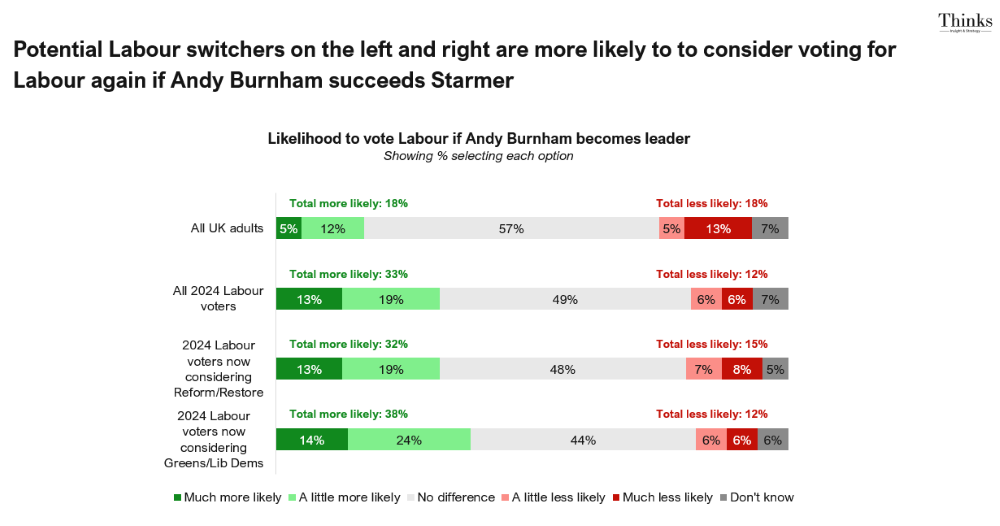
“For Labour, Burnham definitely opens a window of opportunity. Both 2024 Labour voters who are now considering Green, and, to a slightly lesser extent, those who are now considering Reform UK, are more likely than average to say that Keir Starmer’s replacement increases their chance of voting Labour. That should give the party real hope,” said Shimshon.
“But it also speaks to the tightrope Burnham needs to walk, as these voters have very different priorities, and want very different things from their government.”
He added: “Across the survey and in the focus groups, the hope is both low-definition and low-patience: voters don’t know much about ‘Andy’ – they like his vibes, his accent and his manner – but they’re not yet convinced he’s truly different.”
If, as expected, Burnham becomes the UK’s seventh PM in a decade later this month, he will be under pressure to deliver results quickly, the findings suggest.
Over half of respondents (54 per cent) said they would know within six months whether a new prime minister was doing a good job, and only 19 per cent said they would give them longer than that. Twelve per cent said they would know straight away. 2024 Green voters were the most patient, while Reform voters were the least patient.
Just over half of respondents (51 per cent) said that if Burnham is effective as PM, they would see real improvements within a year of him entering office, while 37 per cent said it would take at least a year or two.
These results suggest that voters are willing to be less patient with Burnham than they were with Starmer when he first entered No 10 following Labour’s 2024 election victory.
In early July 2024, nearly two-thirds of people (62 per cent) told Thinks Insight & Strategy research for PoliticsHome that even if the Starmer administration was effective, “it will take a year or two before we start seeing improvement.”
On a Burnham premiership, Shimshon added: “The direction of travel needs to be clear within 12 months, and whatever it is, that direction needs to feel like change.”
Farage and Reform have called on Burnham to call a snap election after becoming PM, arguing that he will not have a proper mandate to govern.
Even some on Burnham’s own side have said he should go to the country. Alan Johnson, the former Labour cabinet minister, has said the incoming PM should call a snap election because the mandate he’ll soon inherit was “gifted to him” by Starmer.
On the question of whether Burnham should call a snap election after entering Downing Street, public opinion broadly breaks down along party lines.
Overall, around a third (34 per cent) of people said that a new PM should call a general election as soon as possible after taking office. This was particularly pronounced among 2024 Reform (68 per cent) and Conservative (52 per cent) voters, while just 20 per cent of 2024 Labour voters agreed.
Nearly half of respondents (46 per cent) said the new PM should be bound by the 2024 manifesto, while 35 per cent said they should be free to break from it.
However, the same proportion (46 per cent) told the survey that Burnham must deliver change, even if it means breaking some promises made two years ago.
“In the abstract, voters cleave to the idea that the ‘right and proper’ thing to do is to stick to the manifesto (even though very few among the electorate will ever have familiarised themselves with it),” said Shimshon.
“What this shows is that, when it comes down to it, most voters would trade that off against seeing the change they so badly want actually happen.”
Burnham’s Leadership Test: Balancing Expectations, Reform and Political Survival
The research paints a picture of a Labour Party entering a crucial period of transition. While Andy Burnham appears to offer a potential route to rebuilding support among voters who have become dissatisfied with the party, the findings also highlight the enormous expectations that will immediately surround his premiership.
Unlike a newly elected prime minister entering office after a general election victory, Burnham would begin his leadership under a very different set of circumstances. He would inherit an existing parliamentary majority and a manifesto already presented to voters, but without having personally led the party into the election.
That situation creates both opportunities and challenges. Supporters argue that Burnham could present himself as a fresh start, offering a different style of leadership and reconnecting Labour with communities that feel ignored by Westminster. Critics, however, may argue that he has not received a direct personal mandate from voters and will need to prove quickly that he represents genuine change rather than simply a change of personnel.
One of Burnham’s biggest challenges will be maintaining support across Labour’s broad electoral coalition. The research suggests that he has appeal among voters considering both the Greens and Reform UK, two groups with very different political priorities.
Green-leaning voters often focus on issues such as climate policy, public services, inequality, and social reform. Reform supporters, by contrast, tend to prioritise issues including immigration, taxation, national identity, and concerns about the effectiveness of government.
Winning back both groups simultaneously will require careful political positioning. A strategy designed to appeal strongly to one side could risk alienating the other.
Political analysts suggest that Burnham’s personal image may be one of his greatest strengths. His long career as mayor of Greater Manchester has allowed him to develop a reputation outside Westminster politics, with supporters pointing to his regional background and communication style as qualities that could help Labour reconnect with voters.
However, image alone may not be enough. The research indicates that many voters currently have a positive impression of Burnham without necessarily having a detailed understanding of his policies. This creates a limited window in which he must transform public goodwill into confidence in his ability to govern.
The first months of a Burnham government would therefore likely be dominated by pressure for visible results. Public patience appears limited, with many voters expecting improvements in areas such as living standards, healthcare, housing, public services, and economic performance.
This presents a familiar challenge for incoming leaders. Governments often require years to implement major reforms, but voters increasingly expect immediate evidence that political change is making a difference.
The economy is likely to be one of the biggest tests. Rising living costs, pressure on public finances, and concerns about productivity will shape public perceptions of whether the new government is succeeding.
Healthcare will also remain a major issue. The National Health Service continues to be one of the most important concerns for voters, and any delays in improving waiting times or access to services could quickly affect public confidence.
Housing represents another difficult area. Younger voters, urban communities, and many working families continue to face affordability challenges. A government seeking to demonstrate change may face pressure to accelerate housebuilding while balancing environmental and local concerns.
Immigration policy could become another defining issue. With Reform UK continuing to compete for voters who want stricter controls, Burnham would need to decide how Labour responds to concerns about border management while maintaining its wider values.
At the same time, the rise of the Greens creates pressure from another direction. Labour will need to convince environmentally focused voters that it remains committed to ambitious climate policies while also addressing economic concerns from workers and businesses.
The possibility of an early general election adds another layer of uncertainty. Opponents argue that Burnham should seek a direct mandate from voters rather than govern on the basis of a victory achieved under a previous leader.
Supporters, however, may argue that governments regularly change leaders between elections and that political stability requires allowing administrations to complete their parliamentary terms.
Ultimately, the decision will depend on political calculations. A snap election could provide an opportunity to secure a fresh mandate, but it could also expose Labour to voter frustration if the public believes the government has not delivered enough progress.
The research suggests that voters are not necessarily demanding immediate perfection. Instead, they appear to be looking for a clear sense of direction and evidence that government priorities have changed.
This may be Burnham’s central challenge: convincing the public that his leadership represents more than a different personality at the top of government.
The coming months will reveal whether the positive perceptions identified in the polling can translate into lasting political support. If Burnham succeeds in creating a sense of momentum, Labour could strengthen its position against both Reform UK and the Greens.
If expectations rise faster than results can be delivered, however, the same voters currently viewing him as a source of hope could quickly become disappointed.
For now, Andy Burnham enters the centre of British politics with both an opportunity and a warning. Voters appear open to change, but they are also demanding proof that change is possible.