
Robert Jenrick has vowed that Reform UK will “defuse the benefits bomb set to bankrupt Britain”, in his first speech since being named as Nigel Farage’s “shadow chancellor”. Dubbing the UK’s soaring welfare bill an “economic and moral disaster”, he pledged to stop foreigners receiving handouts and prevent claimants getting cash for “spurious” mental health reasons.
Mr Jenrick also confirmed the party had performed a U-turn over plans to end the two-child benefit cap, and would retain current rules that restrict the amount of Universal Credit paid to larger families. Labour is to scrap the cap, handing 570,000 households in Great Britain an average of £5,400 each in extra benefit payments. Mr Farage previously indicated Reform would either follow suit or remove the cap for working families.
But in a speech in London’s financial district, Mr Jenrick declared: “A Reform government will restore the cap in full. We are the party of alarm clock Britain – a party for workers and not welfare.”
Get the latest politics news – straight from our team in Westminster and more
Invalid email
You agree you are 18 or over. We use your sign-up to provide content in ways you’ve consented to and to improve our understanding of you. This may include adverts from us and third parties based on our knowledge of you. You can unsubscribe at any time. More Info.

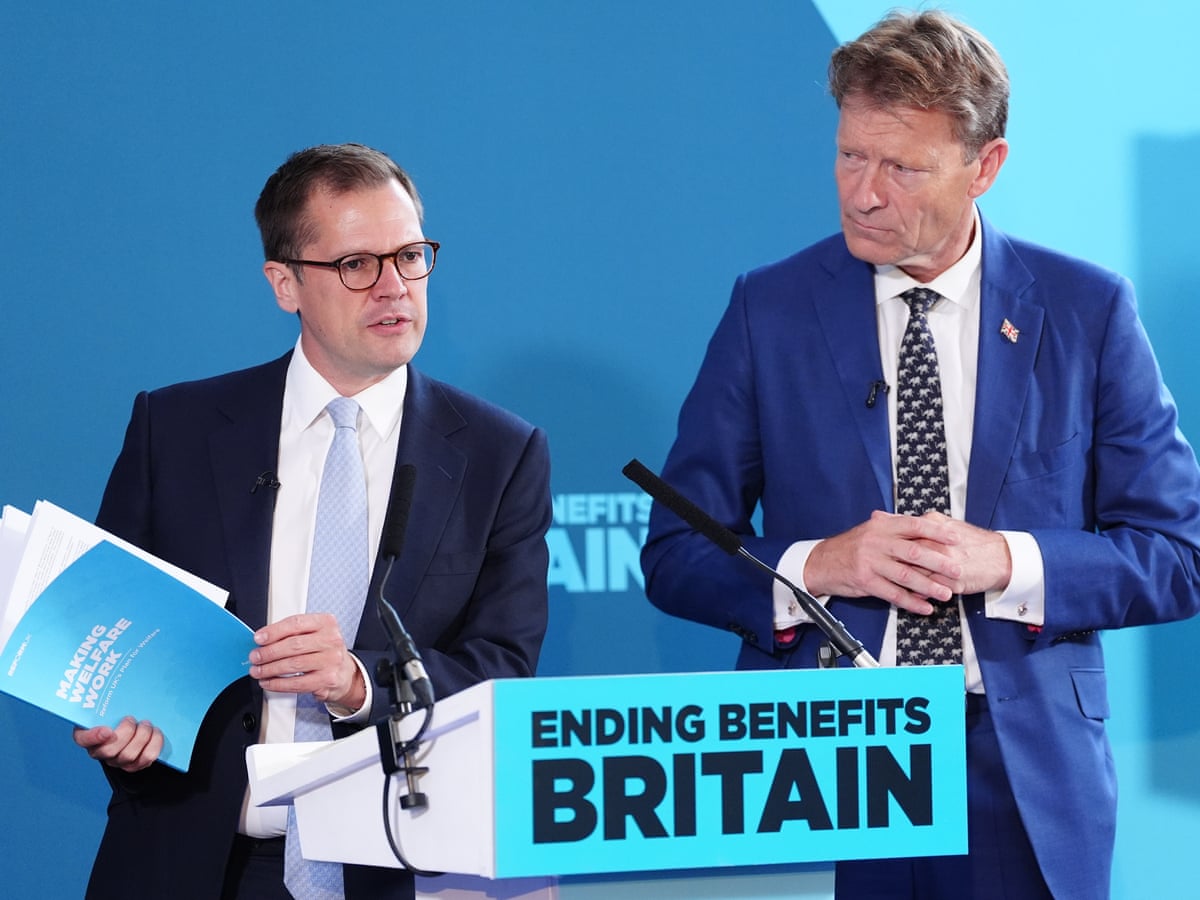
Nigel Farage and Robert Jenrick hold a press conference in London (Image: Getty)
Labour branded the announcement “cruel” and highlighted predictions that ending the cap would mean 450,000 fewer children in relative poverty.
It also appeared that Mr Farage had been reluctant to accept the U-turn, as he told journalists after the speech: “My attempt at being pro-family has failed.”
Mr Jenrick refused to commit a Reform government to maintaining the pensions triple lock, saying an announcement on the state pension would be made at a later date, but dropped a heavy hint that the policy or something very similar will remain.
Questioned by the Express, the former Conservative cabinet minister said: “We’re going to be saying more about this in the coming days, but I’ve always been a supporter of the triple lock.
“It’s incredibly important that we provide dignity and security to older people on fixed incomes in the last decades of their life – particularly at a time like this, where there are such challenging circumstances with the cost of living.
“So I don’t think your readers will be disappointed, but we’ll say more in the coming weeks.”
Mr Jenrick was named as Reform’s “shadow chancellor” this week, alongside home affairs spokesman Zia Yusuf, education spokesman Suella Braverman and business spokesman Richard Tice, who would also serve as deputy prime minister in a Reform government.
The appointments are designed to end a perception that Reform is a “one-man band”, as Mr Farage put it, and demonstrate the party has the experience required to run the country.
In a lengthy speech, Mr Jenrick set out plans to stop “net zero” policies influencing economic decisions, force UK employers to train British staff rather than importing foreign workers, and “ruthlessly” crack down on scammers and shoplifters.
But the speech was also designed to reassure financial markets by pledging that a Reform government would follow “strict fiscal rules” and introduce tax cuts only when the nation can afford it.
Mr Jenrick dubbed Reform “reassuring revolutionaries” and promised no “wild spending splurges alongside big tax cuts”.
He said: “We will instil a fiscal discipline that has been sorely missing, spending only what we can afford and never saddling future generations with the bill for our profligacy.”
The MP added: “I give you my word that a Reform government will never play fast and loose with your savings.”
*** Ensure our latest politics headlines always appear at the top of your Google Search by making us a Preferred Source. Click here to activate or add us as Preferred Source in your Google search settings. ***
Plans to slash the welfare bill include restricting benefits to UK nationals, and ensuring people can only claim sickness benefits for mental health conditions if they have a medical diagnosis.
Mr Jenrick said: “On current course, one in eight people are set to claim disability benefits in four years’ time – that’s almost nine million people.
“The number claiming disability benefits for an attention disorder has more than doubled since Covid. We all know a significant number of these claims are spurious.
“And that we’re just giving up on over half a million young people, discarded as ‘unfit to work’. So our benefits system is broken.”
He vowed: “We will stop those with mild anxiety, depression, and similar conditions from claiming disability benefits and instead encourage them into the dignity of work.
“We will reinstate in-person assessments and require clinical diagnoses to weed out those who are choosing a life on benefits.”
He added: “And we’ll make sure only British nationals can claim benefits in the first place.”
Conservatives pointed out that Mr Farage and Mr Jenrick, who defected from the Tories in January, had previously been staunch critics of each other.
Kevin Hollinrake, chairman of the Conservative Party, said: “One week Nigel Farage says Robert Jenrick is a fraud, next week he’s Reform’s economic guru. You cannot trust a word he says.
“Reform’s economic policy changes by the week. Just two weeks ago, Rob Jenrick voted to lift the two-child benefit cap. Today, he claims he would reinstate it. They make even Keir Starmer look consistent.”
He added: “Reform is a one-man band. The only view that counts is Nigel Farage’s, and he wants more welfare.”
Labour chairwoman Anna Turley said: “Robert Jenrick has united the Right behind a cruel child poverty pact that would see nearly half a million kids pushed into poverty.
“Farage’s party is stuffed full of former failed Tories who are now hell-bent on continuing their damaging legacy, with working people and their children set to pay the price.”
Reform Benefits Bombshell Revealed by Robert Jenrick – Stops Handouts for Foreigners
Reform UK has unveiled one of its most significant welfare proposals yet, with Robert Jenrick announcing plans that would fundamentally change who is eligible for benefits in Britain.
The former Conservative politician, who is now Reform UK’s finance spokesman, has presented the proposals as part of a wider overhaul of the welfare system. Under the plan, Reform says that welfare benefits would generally be restricted to British citizens, with limited exceptions.
Jenrick described the proposal as an attempt to ensure that Britain’s welfare system prioritises people who are citizens and taxpayers in the country. The announcement immediately generated a political debate about immigration, public spending, welfare eligibility and the rights of foreign nationals who legally live and work in Britain.
The proposal is particularly significant because Reform’s plan extends well beyond Universal Credit. According to ITV News, the party’s proposals would affect a wide range of welfare payments and support, including housing benefit, pension credit, Jobseeker’s Allowance, child benefit, free childcare and disability benefits.
Reform argues that the change would save taxpayers billions of pounds.
However, the size of those potential savings, and the consequences of the proposed restrictions, have become subjects of considerable political and factual debate.
Jenrick’s “foreign welfare” plan
The policy was formally presented by Jenrick and Reform deputy leader Richard Tice under the title “Making Welfare Work.”
Reform’s central proposal is straightforward: foreign nationals would generally no longer be entitled to welfare benefits under a Reform government.
Jenrick said that the welfare state should be primarily for British citizens and argued that access to benefits should be linked more closely to citizenship and contribution.
The party’s own announcement states that only British citizens would generally be entitled to benefits, with limited exceptions. It specifically mentions certain people who have served in the Armed Forces and foreign nationals who have made sufficient contributions to qualify for the state pension.
Reform has summarised its position in particularly direct terms: “No British citizenship. No entitlement.”
The proposal would therefore represent a major departure from the current system.
At present, benefit eligibility can depend on factors including immigration status, residence, contributions, income, work history and the particular benefit involved. Reform’s proposal would introduce citizenship as a much more decisive dividing line.
How much money does Reform say it could save?
Reform estimates that restricting access to welfare in this way could save approximately £21 billion a year by 2029.
The party says this could equate to around £700 per household. It argues that the savings could subsequently be used either to reduce taxes or to fund public services.
These figures are Reform’s own estimates rather than independently established savings.
That distinction is important because the actual financial effect of such a policy would depend on how the rules were implemented, how many people were affected, what exemptions were created and what administrative or legal costs arose from the changes.
The Government and opposition parties would also be able to challenge Reform’s assumptions about how much could realistically be saved.
Nevertheless, £21 billion is a substantial figure, making the proposal one of the most important elements of Reform’s economic programme.
Which benefits would be affected?
The proposal covers considerably more than Universal Credit.
ITV reported that Reform’s new plans could restrict access to almost all major welfare payments for foreign nationals, including:
- Universal Credit
- Housing Benefit
- Pension Credit
- Jobseeker’s Allowance
- Child Benefit
- Free childcare
- Disability benefits
The breadth of the proposal has attracted particular attention because some of these benefits are not simply designed as income replacement for unemployed people.
Child Benefit, for example, is connected to children and families, while disability benefits can provide support to people whose ability to work is affected by a disability.
This means that the consequences of the policy could vary considerably depending on the individual circumstances of those affected.
Reform argues that the fundamental principle should remain the same: welfare support should prioritise British citizens.
Critics, however, have questioned whether citizenship should determine access to social security for people who have legally lived, worked and paid taxes in Britain for many years.
What about EU citizens?
One of the most politically sensitive elements of the proposal concerns EU citizens.
According to reporting by Euronews, Reform’s original proposal included European Union citizens with settled status.
This is significant because settled status was established under the UK’s post-Brexit immigration arrangements and provides eligible EU citizens with rights to live in Britain indefinitely.
Changing benefit rights for people with settled status could therefore create legal and political complications.
Reform’s current policy information makes an important distinction: people with EU settled status are not included in the party’s proposal to abolish Indefinite Leave to Remain itself, but the party says their entitlement to welfare would nevertheless change under a Reform government.
That means settled status and welfare entitlement would effectively become two separate questions.
A person could retain the right to live in Britain while facing restrictions on access to certain benefits.
The state pension exception
Reform’s policy also contains an important exception for foreign nationals who have reached pension age.
The party says foreign nationals who have made sufficient National Insurance contributions to qualify for the state pension would continue to receive it.
This is significant because the state pension operates differently from many means-tested benefits.
It is linked to an individual’s National Insurance record, with eligibility depending on their contribution history and other rules.
Reform’s position is therefore not simply that every benefit paid to every foreign national would disappear.
Instead, the party proposes a system in which citizenship would generally determine access to welfare while certain contributory rights would continue.
The distinction is reflected in Reform’s official policy document, which states that foreign nationals of pension age who have made sufficient National Insurance contributions would retain their residence rights and receive the state pension.
Reform’s argument: taxpayers first
Jenrick has framed the proposal around the principle that Britain’s welfare system should serve people who have contributed to the country.
He argues that British taxpayers should not be expected to finance welfare payments for people who have not contributed sufficiently to the system.
Richard Tice has made a similar argument, saying that the reforms are intended to protect the welfare system for British people who genuinely need support.
This reflects one of Reform’s wider political themes: reducing what the party describes as Britain’s reliance on overseas labour and reducing public spending associated with immigration.
The party has linked welfare reform to its immigration policy, arguing that restricting access to benefits would make Britain less attractive to people who might otherwise come to the country primarily for economic reasons.
The £50 billion welfare package
The foreign-national welfare proposal is only one part of Reform’s much larger welfare programme.
Before the announcement, Jenrick had already outlined plans aimed at reducing spending on sickness and disability benefits.
Reform has described its overall welfare programme as capable of saving around £50 billion, with approximately £21 billion associated with restricting benefits for foreign nationals and a much larger package of reforms aimed at sickness and disability benefits.
The figures have generated substantial controversy.
Critics have accused Reform of targeting vulnerable people, while the party says it is attempting to make the welfare system financially sustainable and encourage more people who can work to enter employment.
The debate therefore goes beyond immigration.
It is also about the future structure of Britain’s welfare state.
Questions over the Universal Credit figures
One particular statistic used by Reform in promoting the policy has been challenged.
The party initially stated that government data showed the share of Universal Credit paid to foreign nationals had risen to 15.5 percent in January 2026.
Full Fact examined the claim and concluded that this interpretation was incorrect.
According to Full Fact, the 15.5 percent figure referred to the proportion of Universal Credit claimants who were not British or Irish citizens—not the proportion of total Universal Credit expenditure going to foreign nationals.
Full Fact also reported that this proportion had actually been falling since 2024.
Reform subsequently corrected part of its welfare-policy material.
This does not by itself settle the wider argument over whether restricting benefits for foreign nationals would save money. But it demonstrates why the financial claims surrounding the proposal need to be examined carefully.
The political argument
The policy has immediately divided political opinion.
Reform supporters argue that citizenship should be a central principle of the welfare system and that taxpayers should have greater priority when public money is distributed.
Critics argue that foreign nationals who legally live and work in Britain can also pay taxes and National Insurance, and that removing benefits from people who have established lives in Britain could create hardship.
There is also a question about incentives.
Reform believes restricting welfare access could encourage employment and reduce migration incentives.
Critics may argue that the policy could discourage some skilled workers from coming to Britain or make it harder for employers to recruit overseas workers in sectors where shortages remain.
The actual effect would depend heavily on the details of the final legislation.
The connection with immigration reform
The benefits policy cannot be separated from Reform’s wider immigration programme.
The party has also proposed abolishing Indefinite Leave to Remain for future migrants and replacing it with renewable five-year visas.
Its official policy proposes higher salary thresholds, mandatory English-language requirements and stricter character requirements.
Reform says work visas would remain available for critical national shortages, but would be subject to caps and requirements for employers to train British workers.
The welfare policy therefore forms part of a broader strategy.
Reform wants to change not only who can come to Britain, but also what rights migrants have after arriving.
Under the party’s proposed system, immigration status, citizenship and access to welfare would become much more closely connected.
A major change for families
One of the most consequential aspects of the proposal could involve families.
Child Benefit and free childcare are among the forms of support identified in reports about Reform’s plan.
That means the consequences could extend beyond individual workers to households containing children.
A foreign national who is working, paying taxes and raising children in Britain could potentially face different treatment from a British citizen living in an otherwise identical household.
This is one reason the proposal has generated such strong reactions.
The question is not merely whether benefits should be reduced.
It is about whether citizenship should determine access to social security even where individuals have established long-term connections with Britain.
What happens to people already living in Britain?
Another major question concerns people who are already legally resident in the UK.
Reform’s policy information makes clear that the party wants to change welfare entitlement for foreign nationals, including people who may retain immigration rights.
However, the exact implementation would require legislation and detailed regulations.
Questions would have to be answered about transitional arrangements, people with permanent residence rights, refugees, family members, workers who have paid National Insurance and people receiving contributory benefits.
There could also be legal questions surrounding existing international agreements and the UK’s post-Brexit arrangements.
The precise wording of any future legislation would therefore matter enormously.
Reform’s broader economic argument
Jenrick’s welfare announcement is part of a wider economic programme.
Reform has also proposed raising the personal income-tax allowance to £15,000, cutting energy bills, reducing employer National Insurance and introducing further measures aimed at encouraging employment and business investment.
The party argues that welfare savings could help finance tax reductions.
Its supporters see this as part of a broader attempt to reduce the size of government and leave more money in the hands of taxpayers.
Critics are likely to focus on whether the savings are realistic and whether reductions in welfare spending could create additional costs elsewhere.
Those questions cannot be resolved simply by the headline figures.
A potentially transformative proposal
Robert Jenrick’s announcement has placed welfare reform firmly at the centre of Reform UK’s political programme.
The headline message is clear: under Reform’s proposed system, British citizenship would generally become a prerequisite for receiving welfare benefits, subject to specific exceptions.
The party says the change could save £21 billion a year by 2029 and allow money to be redirected towards British taxpayers and public services.
But the proposal also raises difficult questions about people who have legally settled in Britain, EU citizens with settled status, families with children, disabled people and foreign workers who have paid taxes and National Insurance.
The debate will therefore be about much more than a single benefits policy.
It will concern what Britain believes the welfare state is for, who should be entitled to receive support and how citizenship should relate to social security.
Reform has made its position unmistakable: welfare should be primarily for British citizens.
Whether that principle becomes law would ultimately depend on electoral support, parliamentary numbers, legislation and the legal challenges that could follow.
For now, Jenrick’s announcement marks a significant expansion of Reform UK’s policy agenda—and ensures that immigration and welfare are likely to remain closely connected at the heart of Britain’s political debate.