

Rachel Reeves Just Showed Us She’s Completely Lost the Plot – It’ll Make Your Blood Boil
Rachel Reeves has spent much of her time as Chancellor insisting that Britain is finally turning a corner. She has repeatedly pointed to stronger growth, falling borrowing and rising investment as evidence that her economic strategy is working.
But there is a growing problem with that argument.
The British public is not living inside a Treasury spreadsheet.
For millions of households, the economy is judged by a much simpler test: Can I afford my bills, and do I have more money left at the end of the month?
And on that measure, the picture remains painfully mixed.
The latest figures expose exactly why Reeves’s confident declarations have become increasingly difficult to swallow. The UK economy did grow by 0.4 per cent in the second quarter of 2026, following an impressive 0.6 per cent expansion in the first quarter. Britain has even been the fastest-growing G7 economy so far this year.
That sounds impressive.
Yet at almost exactly the same time, inflation climbed to 2.9 per cent in July, largely because of rising energy costs. Public debt reached almost £3 trillion, while the government unexpectedly recorded a £1.8 billion borrowing deficit in July.
So when Reeves says Britain is stronger, voters are entitled to ask a rather awkward question:
Stronger for whom?
The Chancellor’s confidence is becoming the problem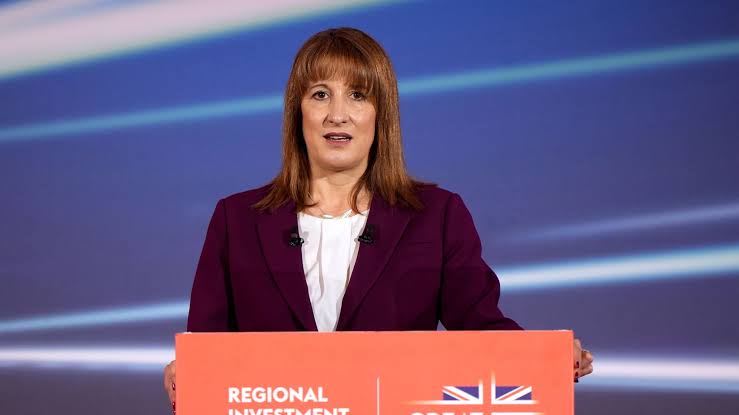
Reeves has never been shy about defending her record.
In her July Mansion House speech, she declared that Britain was strong, pointing to economic growth, increased investment, higher productivity and rising wages. She argued that her decisions had repaired the public finances while allowing the government to invest heavily in infrastructure and public services.
That is a perfectly respectable political argument.
But it becomes much less convincing when the government simultaneously faces an extraordinary fiscal squeeze.
The July borrowing figures were particularly uncomfortable.
The government expected to be in a much stronger position, yet instead recorded a £1.8 billion deficit. The cumulative deficit for the financial year had reached £56.7 billion, around £2.3 billion more than the Office for Budget Responsibility had forecast.
Government debt has also climbed to around £2.98 trillion, equivalent to roughly 94 per cent of GDP.
This is not an economic apocalypse.
But it is certainly not a picture of unlimited financial freedom.
And that distinction matters enormously.
The energy crisis makes the rhetoric look worse
Perhaps nothing illustrates the disconnect better than energy bills.
The government has repeatedly promised to help families with the cost of living. Reeves announced measures intended to reduce household pressure, including support aimed at energy costs.
Yet the energy price cap was subsequently increased by 13 per cent, while inflation accelerated from 2.6 per cent in June to 2.9 per cent in July.
For a household struggling to pay its bills, this is not an abstract economic debate.
It is the difference between worrying about the electricity bill and worrying about whether the electricity bill can actually be paid.
That is why the government’s language can sometimes sound so detached from ordinary experience.
Ministers can talk about GDP.
They can talk about fiscal consolidation.
They can talk about investment.
But families are talking about mortgage payments, supermarket prices, energy bills and rent.
The political danger is obvious.
If people hear that the economy is “strong” while their own finances feel increasingly fragile, they may conclude that the government is simply not listening.
And then came the productivity bombshell
Perhaps the most extraordinary development for Reeves is the growing suggestion that some of the pessimism surrounding Britain’s productivity performance may have been exaggerated by unreliable data.
Research from the Centre for Economic Performance at the London School of Economics has suggested that productivity may have been growing at around 1.6 per cent a year since mid-2024, considerably faster than earlier official estimates. The analysis argued that weaknesses in the Labour Force Survey may have distorted the picture of employment and productivity.
If that analysis proves correct, it creates an extraordinary counterfactual.
Reeves made difficult decisions partly in response to a gloomy economic outlook.
She raised taxes.
She tightened fiscal policy.
She repeatedly emphasised the need for caution.
But what if some of the pessimism was based on bad data?
That does not mean every decision was wrong.
It does, however, raise an uncomfortable question about whether the government became unnecessarily pessimistic because it was looking at an economic dashboard that was not telling the full story.
And that is the sort of question that can haunt a Chancellor long after leaving office.
The tax burden is still hanging over Britain
Reeves’s supporters argue that higher taxes were necessary to repair the public finances and protect public services.
There is a legitimate case for that.
Britain entered Labour’s period in office with significant pressures on the NHS, local government, infrastructure and debt servicing. Reeves wanted to demonstrate to financial markets that Labour could be trusted with the country’s finances.
The difficulty is that taxes do not exist in isolation.
Higher taxes affect households.
They affect businesses.
They affect investment decisions.
They affect hiring.
And they can influence how quickly an economy grows.
This is why the debate over Reeves’s record is not simply about whether borrowing went up or down.
It is about whether the combination of taxation, spending and regulation has created an environment in which Britain can achieve sustained growth.
And that remains far from settled.
The government’s own numbers contain a warning
The latest economic picture is actually remarkably contradictory.
On one side, growth is strong.
Britain expanded by 0.6 per cent in the first quarter and 0.4 per cent in the second. GDP per capita also increased in the second quarter, while services and technology investment provided important support.
On the other side, inflation is moving in the wrong direction.
Unemployment has been elevated.
Retail sales have recently disappointed.
Borrowing has overshot expectations.
Debt is approaching £3 trillion.
And the government’s fiscal headroom is shrinking.
That is not a collapse.
But neither is it the clean economic success story that political speeches sometimes imply.
It is an economy performing better in some areas while remaining extremely vulnerable in others.
Reeves’s biggest problem may be what she left behind
The irony is that Reeves is no longer responsible for fixing these problems.
Andy Burnham is now Prime Minister.
John Healey is Chancellor.
Yet they have inherited many of the constraints that defined Reeves’s time at the Treasury.
The new government has promised cheaper energy, lower transport costs, more regional investment, stronger public services and ambitious programmes on housing and infrastructure.
All of those promises sound attractive.
All of them require money.
And the Treasury has already been warned that new spending commitments need to be funded through savings elsewhere or additional revenue. Fiscal headroom has fallen substantially, while rising gilt yields are making government borrowing more expensive.
This is the trap.
Burnham wants to change Britain.
Healey needs to keep the markets calm.
And Reeves’s fiscal legacy is sitting between the two.
There is one particularly uncomfortable possibility
What if Reeves was not completely wrong?
That may be the most irritating conclusion for her critics.
Britain is currently recording surprisingly strong growth. Private-sector activity has improved, consumer confidence has reached a two-year high and the economy has outperformed expectations in the first half of 2026.
It is therefore impossible to argue honestly that Reeves simply destroyed the economy.
The evidence does not support that.
But it is equally impossible to ignore the other side of the story.
The public finances remain under enormous pressure.
Inflation is above target.
Energy costs are rising.
Debt is huge.
And households are still waiting to feel the promised improvement in their living standards.
That is why the real criticism of Reeves is more subtle than the headline suggests.
The question is not whether she “lost the plot”.
It is whether she became so focused on demonstrating fiscal credibility that she underestimated how difficult it would be to make ordinary people feel economically secure.
The October Budget could settle the argument
The biggest test will come with John Healey’s first Budget on October 28.
He faces a fiscal hole, expensive commitments and pressure to maintain confidence in Britain’s economic management.
If taxes rise again, Reeves’s critics will claim that her economic model has left Labour trapped in a cycle of taxation.
If spending is cut, Labour’s supporters may accuse the government of abandoning its promises.
If borrowing increases, financial markets could become nervous.
And if the government does very little, voters may wonder what exactly has changed.
There is no easy escape.
That is why Reeves’s legacy is now becoming so politically important.
The verdict is still being written
Rachel Reeves did not single-handedly create every economic problem Britain faces.
The country has struggled with weak productivity for years. Global energy shocks have pushed prices higher. War and geopolitical instability have affected markets. Britain entered this period with enormous structural problems.
But a Chancellor is judged by the choices made while holding the office.
Reeves chose higher taxation, fiscal caution and significant public investment.
She defended those choices with extraordinary confidence.
Now the evidence is producing a much more complicated verdict.
Britain is growing.
But households remain under pressure.
Productivity may be stronger than previously believed.
But the public finances are still stretched.
The economy has proved resilient.
But inflation is rising again.
And the government has ambitions that appear considerably larger than its available fiscal room.
That is the part that should make Reeves’s critics angry — not because the economy is “wrecked”, but because the story is far more complicated than the triumphant speeches suggest.
The British economy is not a disaster.
It is not a miracle either.
It is an economy at a crossroads.
And if the next Budget forces Labour to choose between higher taxes, spending cuts and broken promises, Rachel Reeves’s greatest political legacy may not be the policies she announced.
It may be the difficult choices she has left for everyone else.
And for the new government, that is a reality no amount of political spin can make disappear.