
Poll: Should Restore Britain Stand Aside for Reform in Makerfield By-Election?
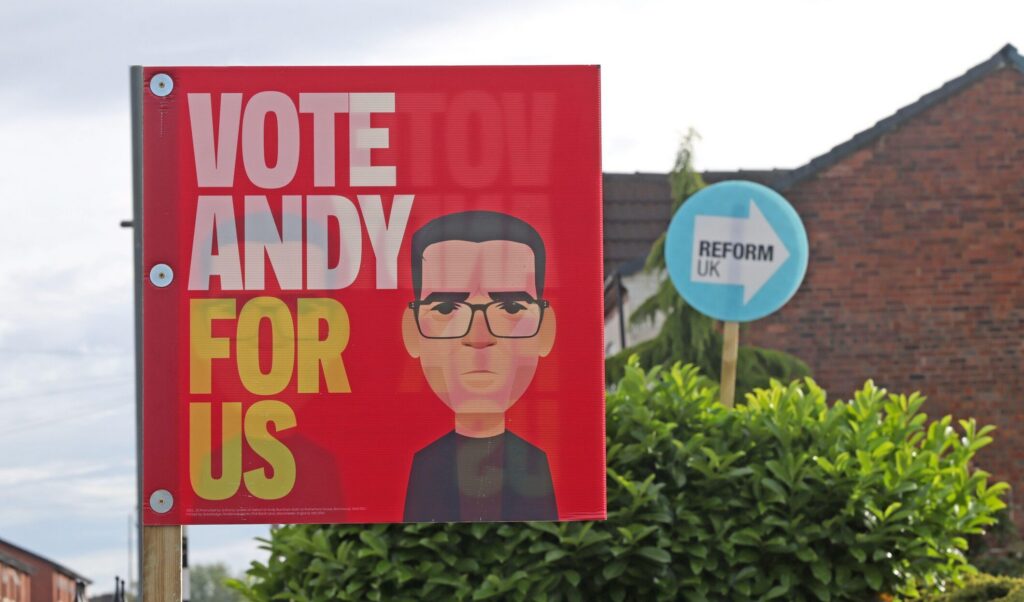
The battle between Reform UK and the newly emerging Restore Britain movement has raised a crucial question for the future of Britain’s political right: should Restore Britain stand aside and allow Reform UK to fight Labour alone in constituencies such as Makerfield?
The question is more than a tactical disagreement between rival parties.
It goes to the heart of whether Britain’s right-wing parties can cooperate or whether competing candidates will continue to split the vote and hand victories to Labour.
The Makerfield by-election provided a striking example of the problem.
Andy Burnham won the contest for Labour with 24,927 votes, or 54.8%, while Reform UK’s Rob Kenyon finished second on 15,696 votes, or 34.5%. Restore Britain’s Rebecca Lee Shepherd received 3,111 votes, or 6.8%.
On the face of it, the result was a comfortable Labour victory.
But look beneath the headline figures and a very different political question emerges.
Could Reform have defeated Labour if the Restore Britain vote had gone elsewhere?
That is the argument now hanging over Nigel Farage, Reform UK and Rupert Lowe’s breakaway movement.
The numbers tell an intriguing story
The mathematics of Makerfield are impossible to ignore.
Reform finished around 9,231 votes behind Labour.
Restore Britain won more than 3,000 votes.
Even if every Restore Britain voter had supported Reform, however, Reform would still have fallen short.
That is an important point.
The result cannot simply be described as a Reform victory that was “stolen” by Restore Britain.
Even combining the Reform and Restore Britain totals would have produced roughly 18,800 votes — still substantially below Burnham’s 24,927.
But elections are rarely that straightforward.
A unified right-wing campaign might have attracted additional voters who were reluctant to support either party individually.
It might also have created a stronger sense that Reform was the only realistic challenger to Labour.
That is precisely why the question of electoral cooperation remains so politically important.
Makerfield was a huge test for Reform
The contest was already unusual before polling day.
Andy Burnham had returned to Parliament by contesting the seat after leaving his position as Greater Manchester mayor.
His victory was politically significant because it gave him the parliamentary platform necessary to pursue national Labour leadership ambitions.
For Reform, meanwhile, Makerfield represented an opportunity to demonstrate that the party could challenge Labour in the North.
The result was therefore about much more than one constituency.
It became a test of whether Reform could convert its growing national support into parliamentary victories.
And the answer was disappointing for Farage.
Reuters described the contest as one of the most consequential by-elections in recent British political history, noting that the split between Reform and other populist right-wing forces was potentially important.
Restore Britain complicates Farage’s strategy
Restore Britain is particularly significant because it is competing for many of the same voters as Reform.
The movement, associated with former Reform MP Rupert Lowe, has adopted a strongly nationalist and anti-establishment political position.
That means there is considerable overlap between the two parties’ potential electorates.
But there are also important differences.
Reform wants to become a major national political force under Farage.
Restore Britain has positioned itself as a more uncompromising alternative on several issues.
That creates a fundamental strategic dilemma.
If both parties contest the same seats, they can divide the right-wing vote.
If they cooperate, they could potentially defeat Labour and the Conservatives in constituencies where neither would succeed alone.
The poll question is therefore simple
Should Restore Britain stand aside for Reform?
There are strong arguments on both sides.
Supporters of cooperation would argue that the priority should be defeating Labour.
Critics would respond that Restore Britain has every right to contest elections and that Reform should not expect smaller parties to surrender their democratic independence.
That disagreement is unlikely to disappear.
The case for standing aside
The strongest argument is electoral mathematics.
Britain’s first-past-the-post system rewards concentration of votes.
A party does not need to win a majority of votes nationally to win a large number of parliamentary seats.
It simply needs to finish ahead of its opponents in individual constituencies.
That makes vote splitting extremely dangerous.
If Reform wins 35% of the vote and Restore Britain wins 8%, while Labour wins 40%, the two right-wing parties could collectively have more support than Labour but still lose the seat.
That is the fundamental weakness of a divided right.
In a proportional electoral system, the situation would be very different.
Under first-past-the-post, however, two parties competing for the same voters can effectively cancel each other out.
The case against standing aside
Restore Britain supporters would have an obvious response.
Why should they abandon candidates, policies and voters simply to strengthen Reform?
The party has its own political identity.
Its supporters may believe that Reform is too moderate on some issues.
They may distrust Farage.
They may prefer Lowe.
And they may want to use elections to build an independent political organisation.
Standing aside could also damage Restore Britain’s credibility.
If the party repeatedly withdraws candidates, voters may conclude that it is not genuinely seeking power.
That could make it harder to build a long-term national movement.
Rupert Lowe’s position matters
Rupert Lowe’s role is crucial.
He was once a senior figure within Reform before a bitter split with Farage.
His subsequent political project has created a direct challenge to Reform’s dominance on the British right.
That personal history makes cooperation particularly difficult.
Political alliances are much harder when the leaders involved have already experienced a major breakdown in trust.
Farage and Lowe are not simply competing politicians.
They are competing over who should define Britain’s populist right.
The Farage problem
For Nigel Farage, this creates an uncomfortable strategic problem.
He wants Reform to become the dominant force on the right.
That requires smaller parties either to disappear, merge with Reform or stand aside.
But publicly demanding that Restore Britain withdraw could make Reform look insecure.
It could also strengthen Lowe’s argument that Farage wants to control the entire movement rather than cooperate with political allies.
Farage therefore needs to achieve cooperation without appearing to surrender authority.
That is a difficult balance.
Makerfield demonstrated the danger
The Makerfield figures provide a useful case study.
Labour won 54.8%.
Reform won 34.5%.
Restore Britain won 6.8%.
The Conservative candidate received only 2.2%.
The combined Reform and Restore Britain vote was therefore substantially larger than Reform’s vote alone, although still below Labour’s total.
This means that the argument cannot simply be that Restore Britain “cost Reform the seat”.
The numbers do not support such a straightforward conclusion.
But they do demonstrate the existence of a fragmented anti-Labour vote.
That fragmentation could become much more consequential in closer constituencies.
The UCL polling was a warning
Before the election, polling by UCL Policy Lab and More in Common found Labour on 45%, Reform on 40% and Restore Britain on 8% in Makerfield.
The poll also found that 13% of likely voters remained undecided.
That was a remarkably close contest.
The final result turned out to be much more favourable to Burnham than the polling suggested.
But the poll demonstrated why Reform and Restore Britain were watching each other so closely.
A relatively small change in tactical voting could potentially alter the result in a genuinely marginal constituency.
Tactical voting could become the new battleground
The British right may therefore face an increasingly important question at future elections:
Do voters want to vote for their preferred party, or do they want to vote against Labour?
Those are not always the same thing.
A Reform supporter may prefer a Reform candidate but recognise that Restore Britain has a better chance of defeating Labour in a particular constituency.
A Restore Britain supporter might face the opposite calculation.
This creates opportunities for tactical voting websites, polling organisations and local campaign groups to influence behaviour.
It also creates enormous pressure on party leaders to demonstrate which candidate is actually capable of winning.
Reform cannot simply assume it owns the right-wing vote
This is perhaps the most important lesson from Makerfield.
Reform UK may be one of Britain’s most important political forces, but it does not automatically own every anti-establishment vote.
Restore Britain exists because some voters believe Reform does not go far enough or does not represent them.
The Conservatives are also attempting to recover voters who have moved towards Reform.
And other parties, including the Greens, can attract voters who might otherwise have supported Labour.
British politics is becoming increasingly fragmented.
That makes electoral strategy more important than ever.
A divided right could benefit Labour
Labour’s biggest advantage in such a fragmented political environment is that its opponents may compete against one another.
The party does not necessarily need to become dramatically more popular if the opposition vote remains divided.
That is a crucial consideration for Andy Burnham’s Government.
If Reform and Restore Britain fight each other in dozens of constituencies, Labour could win seats with relatively modest shares of the vote.
The Conservatives could also benefit from a split between the two populist parties in some constituencies.
The ultimate winner could therefore be neither Reform nor Restore Britain.
It could be the establishment parties they are trying to defeat.
But cooperation carries risks
A formal electoral pact might solve one problem while creating another.
Suppose Reform and Restore Britain agree that only one candidate will stand in certain constituencies.
Which party gets which seats?
Who decides?
What happens when both parties believe they can win?
How are local candidates selected?
What policies appear in the joint campaign?
And what happens after the election?
These questions can become extremely difficult.
A pact without genuine trust could collapse during the campaign.
Reform’s national ambitions
Farage has made it clear that he wants Reform to become a serious governing party.
That means the party needs to look more disciplined and professional.
The party’s recent political activity has increasingly focused on detailed policy areas including immigration, taxation, crime, defence and public services.
But a governing party cannot spend all its time fighting potential allies.
Farage needs to decide whether Reform’s long-term objective is to dominate the entire right or to build alliances with groups that share its objectives.
Restore Britain faces its own dilemma
Lowe’s movement faces an equally difficult decision.
Standing alone could allow Restore Britain to establish an independent identity.
But if the party repeatedly finishes third or fourth, voters may eventually abandon it for a larger challenger.
First-past-the-post is particularly unforgiving to small parties.
A party can receive hundreds of thousands of votes nationally and still win very few seats if its support is spread thinly.
Restore Britain therefore needs to build concentrated pockets of support.
Alternatively, it needs a political arrangement with Reform.
Neither option is easy.
The Conservatives are the forgotten player
It would also be a mistake to assume that every anti-Labour vote belongs to Reform or Restore Britain.
The Conservative Party remains a significant force.
Although its support has suffered in recent years, a Conservative recovery could further complicate the electoral arithmetic.
In some constituencies, Conservatives could be the main challenger to Labour.
In others, Reform could be dominant.
Elsewhere, Restore Britain could potentially become competitive.
A national electoral pact would therefore be extraordinarily difficult to organise.
The Clacton result adds another dimension
Farage has just won the Clacton by-election, securing 22,239 votes and 62.8% of the vote.
However, the contest was highly unusual because the major parties did not field candidates, leaving Farage facing a field dominated by independents and novelty candidates, including Count Binface.
That result gives Farage a fresh parliamentary platform.
But it does not necessarily demonstrate that Reform can win ordinary three- or four-way marginal constituencies.
Indeed, analysts have argued that the Clacton victory may tell us relatively little about Reform’s national prospects.
The real test remains constituencies where Reform faces Labour, Conservative and potentially Restore Britain candidates simultaneously.
The bigger question is Britain’s future electoral map
The dispute between Reform and Restore Britain reflects a much broader transformation in British politics.
For decades, Westminster politics was dominated by two major parties.
That system has weakened.
Voters are increasingly willing to switch parties.
New political movements can gain support rapidly.
Regional identities have become more important.
And traditional party loyalties have weakened.
The result is a much more fragmented political landscape.
First-past-the-post has not disappeared, however.
That creates a tension between the way voters behave and the way parliamentary seats are allocated.
Could there be an electoral pact?
It is possible.
If Reform and Restore Britain conclude that Labour is the principal threat, cooperation may become attractive.
They could potentially agree on informal arrangements in selected constituencies.
One party could stand down where the other has a realistic chance of winning.
This would allow both organisations to retain their identities while avoiding the worst effects of vote splitting.
But such an arrangement would require significant political maturity.
It would also require Farage and Lowe to put electoral arithmetic above personal rivalry.
That may be easier said than done.
What Makerfield really tells us
The most useful lesson from Makerfield is not that Restore Britain cost Reform a victory.
The evidence does not justify such a simple conclusion.
Instead, Makerfield shows that the right-wing vote is fragmented and that fragmentation matters.
Labour won comfortably.
Reform was second.
Restore Britain established a meaningful presence.
The Conservatives were squeezed.
That is an electoral landscape very different from the traditional two-party contests of previous decades.
For Farage, that should be a warning.
For Lowe, it is an opportunity.
The question voters must answer
If voters are asked whether Restore Britain should stand aside for Reform, there is no objectively correct answer.
If the overriding objective is to defeat Labour, cooperation makes obvious strategic sense.
If the objective is to build a new political movement with its own identity and policies, standing aside makes considerably less sense.
Everything depends on what voters and party leaders consider the ultimate priority.
Final verdict
The Makerfield by-election has reopened one of the most important strategic questions facing Britain’s political right.
Should Reform UK and Restore Britain compete against one another?
Or should they cooperate to prevent their votes being divided?
The figures show why the question matters. Reform secured 34.5%, while Restore Britain won 6.8%. Labour, meanwhile, took 54.8% and secured a majority of 9,231 votes.
Simply transferring Restore Britain’s votes to Reform would not have been enough to defeat Andy Burnham.
But future constituencies could be considerably closer.
That makes the question of tactical cooperation increasingly important.
Farage has the strongest national profile.
Lowe has a rival political organisation and access to voters who may not want to support Reform.
Both men therefore have something to gain from cooperation — and something to lose from it.
The danger is that personal rivalry could ultimately achieve what Labour itself cannot: keeping the right divided.
For Reform UK, the strategic choice is becoming clearer. It can fight every rival for every vote and risk splitting the opposition, or it can find a way to cooperate without surrendering its political identity.
And for Restore Britain, the decision is equally stark:
build alone, or stand aside in the constituencies where Reform has the best chance of winning?
The answer could shape not just the next by-election, but the future balance of power in Westminster.
Leave a Reply
You must be logged in to post a comment.