
The Fire in Golders Green: A Fictional Story of Fear, Suspicion and London’s Security Crisis
The first flames appeared shortly before two o’clock in the morning.
Golders Green was unusually quiet. The streets of north London were almost empty, and most of the windows surrounding the synagogue were dark. Then a sudden orange glow appeared in the distance.
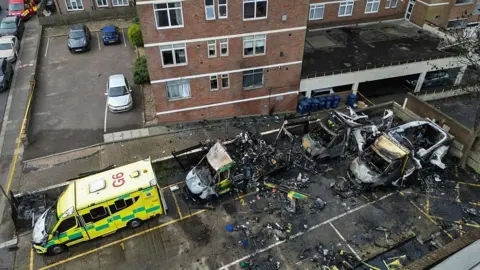
Four ambulances were burning.
Within minutes, emergency crews arrived. Smoke filled the street, windows were broken and the sound of explosions echoed between the buildings.
No one was killed.
But by sunrise, London had begun asking a terrifying question:
Who had wanted these ambulances to burn?
In this fictional political drama, the attack quickly became one of the most serious security incidents Britain had experienced in years.
The vehicles belonged to a Jewish volunteer medical organisation serving the local community. They were not military vehicles. They were not government property. They existed to help people in medical emergencies.
That fact made the attack particularly disturbing.
A fictional resident named Miriam Cohen stood behind a police cordon that morning.
“My neighbour’s ambulance was destroyed,” she said. “People here use these vehicles when someone is having a heart attack, when a child is injured, when an elderly person collapses. They are supposed to save lives.”
The Metropolitan Police immediately launched a major investigation.
Officers collected CCTV footage from surrounding streets. Forensic specialists examined the remains of the vehicles. Detectives interviewed residents and searched for witnesses.
The investigation initially focused on antisemitic hatred.
The circumstances appeared deliberate.
The attack had occurred near a synagogue.
The vehicles belonged to a Jewish organisation.
And CCTV appeared to show masked individuals approaching the ambulances before setting them alight.
But then something else happened.
An organisation claiming to be an Iranian-aligned militant group published a statement claiming responsibility.
The message spread rapidly online.
Suddenly, the investigation had changed.
What initially appeared to be a local hate crime might have been connected to a wider international security threat.
The police were cautious.
A fictional senior counter-terrorism officer, Detective Chief Superintendent David Harris, addressed reporters.
“We are aware of a claim made online,” he said. “Our investigators are working urgently to establish whether that claim is genuine, whether the organisation behind it actually exists in the form described, and whether it has any connection to the individuals responsible for this attack.”
The statement was deliberately careful.
Harris knew that intelligence claims could be misleading.
A group could claim responsibility for an attack it had not carried out.
A genuine organisation could exaggerate its involvement.
An online statement could be designed to create fear rather than communicate truth.
And in the world of terrorism investigations, attribution mattered.
If Iran had genuinely directed an attack on British soil, the consequences could be enormous.
It could trigger diplomatic action.
It could increase security around Jewish institutions.
It could lead to sanctions.
It could even produce a confrontation between London and Tehran.
But accusing a foreign government without sufficient evidence could create an international crisis.
The government therefore moved carefully.
The fictional Home Secretary held an emergency meeting with intelligence officials, police commanders and foreign-policy advisers.
On the table was a simple question:
Was this an isolated act of antisemitic violence, or part of something larger?
The intelligence community offered no immediate answer.
There were indications that Iranian-linked networks had previously threatened dissidents and Jewish targets in Europe.
But indications were not proof.
The Home Secretary understood the danger.
“If we say Iran is responsible and we are wrong,” she told her advisers, “we could create a diplomatic disaster.”
A security official replied:
“And if we refuse to investigate the Iranian connection and it is real?”
Nobody answered.
Outside the meeting room, the political pressure was growing.
Opposition politicians demanded transparency.
Some accused the government of being too cautious.
Others warned against making accusations before investigators had established the facts.
A fictional Conservative MP declared:
“The British public deserves to know whether a foreign regime is sponsoring attacks in our cities.”
A government minister responded:
“The British public deserves the truth, not speculation.”
The argument became increasingly heated.
Meanwhile, the Jewish community was frightened.
Security was increased around synagogues, schools and community centres.
Parents changed their children’s routines.
Some elderly residents stopped attending evening events.
Volunteer ambulance crews became nervous about returning to work.
Yet the organisation’s leaders insisted that they would continue.
“We exist to save lives,” said fictional Hatzola volunteer Aaron Levy. “We will not allow people who want to frighten us to determine whether we help our neighbours.”
His words were widely praised.
But fear was difficult to defeat with speeches.
For one fictional teenager, the attack changed the way she saw London.
“I used to think attacks like this happened somewhere else,” she said. “Now I know they can happen on the street where I live.”
The police investigation continued.
Detectives discovered CCTV footage showing three figures moving through the area.
Their faces were concealed.
Their clothing provided few clues.
But investigators found traces of accelerant and began reconstructing the movements of the suspects before and after the attack.
Then came the first breakthrough.
A camera several streets away had captured a vehicle leaving the area shortly after the fires began.
The number plate was partially visible.
Investigators traced the vehicle to a fictional man named Karim Rahman.
Rahman had no known history of terrorism.
He had never appeared on a security watchlist.
He worked irregular jobs and lived in a small flat in north London.
Police searched his home.
They found several mobile phones.
They also discovered encrypted communications.
The investigation suddenly became much more complicated.
Rahman insisted that he had nothing to do with the attack.
“I drove that car,” he admitted. “But I was not involved in the fire.”
Investigators did not immediately believe him.
Yet his lawyer argued that the government was rushing to construct an international conspiracy around an ordinary criminal investigation.
“This is a dangerous moment,” the lawyer said. “My client must be judged on evidence, not on political assumptions.”
The question of Iran remained unresolved.
British intelligence examined communications allegedly connected to the attack.
Analysts searched for evidence of planning, financing or instructions from outside Britain.
They found fragments.
But fragments were not enough.
One message appeared to refer to “the London operation”.
Another mentioned “the northern community”.
But investigators could not determine whether the messages were directly connected to the Golders Green attack.
The government therefore resisted calls for an immediate accusation.
Then, weeks later, a fictional intelligence report changed everything.
Investigators concluded that there were credible indications of foreign involvement.
The report did not prove that the Iranian government had personally ordered the attack.
Instead, it suggested that individuals connected to an Iran-aligned network might have provided encouragement, resources or logistical assistance.
The distinction was important.
It meant the investigation was no longer simply about three people setting fire to ambulances.
It had become part of a wider examination of foreign interference and proxy activity in Britain.
The Prime Minister addressed Parliament.
“We will defend the British people against terrorism, antisemitism and foreign interference,” he said.
“But we will also follow evidence. We will not allow fear to replace facts.”
The statement received support from across the political spectrum.
Even some of the government’s harshest critics agreed that attribution had to be based on evidence.
The fictional attack nevertheless changed Britain.
Security around Jewish institutions increased.
Police forces reviewed intelligence-sharing arrangements.
Ministers examined how foreign governments and proxy groups could operate through individuals inside the United Kingdom.
And communities began asking a deeper question.
Could Britain remain an open society while protecting itself from people who wished to exploit that openness?
There was no easy answer.
London had always been a city of extraordinary diversity.
People from different religions, cultures and countries lived beside one another.
That diversity was one of the city’s greatest strengths.
But it could also create vulnerabilities.
A foreign conflict could suddenly appear on a London street.
An argument thousands of miles away could become a source of fear in a local community.
The Golders Green attack demonstrated how quickly international politics could become local reality.
For Miriam Cohen, however, the political arguments were secondary.
She stood outside the community centre one evening and watched volunteers preparing replacement medical equipment.
“We lost ambulances,” she said.
“But we didn’t lose our purpose.”
The new vehicles were eventually brought into service.
Their lights flashed through the streets once again.
They answered emergency calls.
They transported patients.
They helped strangers.
They did exactly what the old vehicles had done before the fire.
That was perhaps the most powerful response to the attackers.
They had tried to create fear.
Instead, the community continued helping people.
The investigation remained open.
Some suspects faced court.
Intelligence agencies continued examining possible foreign connections.
Politicians continued debating how Britain should respond.
But the fictional story of the Golders Green fire ultimately became about more than Iran, terrorism or antisemitism.
It became a story about the fragile boundary between fear and evidence.
In moments of crisis, people naturally want immediate answers.
They want to know who is responsible.
They want someone to blame.
They want governments to act.
But justice requires patience.
An accusation is not a conviction.
A propaganda statement is not proof.
A political theory is not an intelligence assessment.
And suspicion, however understandable, must eventually be tested against evidence.
The flames had destroyed four ambulances in a few minutes.
The political consequences could last for years.
Britain now faced a difficult challenge: to protect its communities without allowing fear to destroy trust, and to confront foreign threats without abandoning the principles of evidence and law.
Late one evening, the fictional detective Harris returned to the scene.
The scorch marks were still visible on the pavement.
But the ambulances were gone.
In their place stood new vehicles.
Clean.
White.
Ready for service.
Harris looked at them for a long moment.
He knew that his investigation was not finished.
There were still unanswered questions.
Who had planned the attack?
Who had paid for it?
Who had ordered it?
And had the online claim of responsibility been genuine?
He had no answers yet.
But he knew one thing.
The truth would matter more than the headline.
And in a city living under the shadow of terrorism and international conflict, that principle might be the most important form of security Britain possessed.