
Poland Draws a Hard Line at Its Borders — and Europe Is Watching as the Migration Debate Enters a New Era
At Poland’s eastern frontier, Europe’s migration debate is no longer an abstract argument conducted in television studios or Brussels conference rooms.
It is visible in steel.
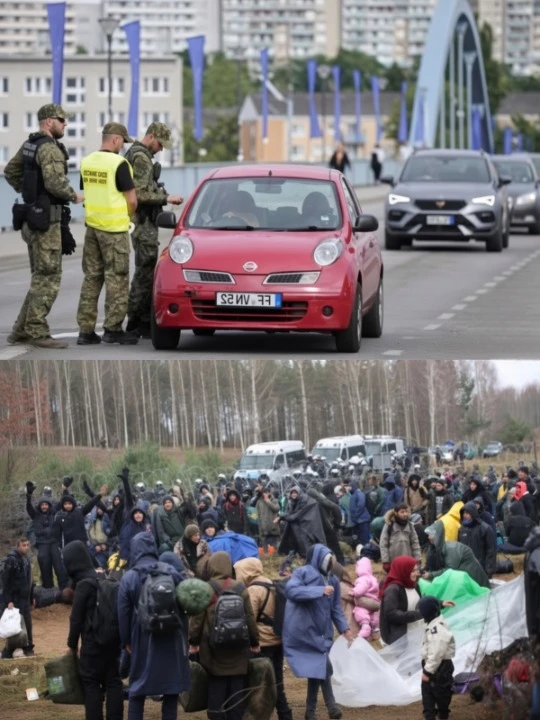
A towering barrier cuts through forests along the Belarusian border. Cameras, electronic sensors and patrols monitor routes once used by migrants attempting to enter the European Union. Soldiers and border guards operate inside a restricted security zone. Farther west, travellers crossing from Germany can once again encounter Polish border checks — an extraordinary sight inside a European Union built around the principle of passport-free movement.
Poland has decided that control comes first.
And whether Europe sees that decision as a model of national self-defence or a warning about the erosion of humanitarian protections may shape the continent’s immigration policy for years.
Warsaw argues that it is confronting something more dangerous than ordinary irregular migration. Polish authorities accuse Belarus, backed by Russia, of deliberately facilitating migrant movements toward the Polish frontier as part of a broader campaign of “hybrid” pressure against the European Union. The border crisis began escalating in 2021, and Poland has progressively transformed its eastern frontier into one of Europe’s most fortified borders.
The results, according to the Polish government, have been dramatic.
Polish officials reported only 235 attempted irregular crossings from Belarus during the first half of 2026, compared with more than 15,500 attempts during the same period a year earlier. Authorities said the attempts detected this year had been stopped.
For supporters of Poland’s strategy, those numbers tell a simple story.
The tougher border worked.
But the methods used to produce that outcome have opened an argument that reaches far beyond Poland.
From Migration Policy to National Security
Poland’s approach rests on a fundamentally different interpretation of what is happening at its border.
If the people arriving were simply migrants independently choosing a route into Europe, critics argue, Poland would primarily be dealing with an asylum and humanitarian challenge.
Warsaw says that description is dangerously incomplete.
The Polish government maintains that Belarus has deliberately used migrants as instruments of political pressure, helping people from the Middle East, Africa and elsewhere reach the EU frontier in an effort to destabilise Poland and Europe. That claim has received significant recognition across European institutions, which have themselves increasingly discussed the “instrumentalisation” of migration by hostile states.
Once migration is interpreted as a security weapon, the political calculation changes.
A government facing hostile state activity will naturally argue that it cannot operate its frontier exactly as it would under normal conditions.
Poland has therefore built physical barriers, expanded surveillance, deployed large numbers of security personnel and established a buffer zone restricting access to parts of the Belarusian frontier. The Interior Ministry extended that buffer zone through the end of August 2026, saying it remained necessary to maintain operational readiness and effective border protection.
Even more controversially, Poland introduced legislation allowing temporary restrictions on the ability to lodge applications for international protection at the Belarusian border.
The mechanism, introduced in March 2025 and repeatedly extended, contains exceptions for certain vulnerable people, including unaccompanied minors, pregnant women, some individuals with serious health needs and people considered at genuine risk of serious harm in Belarus.
Poland says that is a security necessity.
Human-rights organisations say it threatens one of the foundations of European refugee law.
And that disagreement is where the real battle begins.
The Humanitarian Question Poland Cannot Escape
However migrants arrive at a border — even when another government may have manipulated their journey — they remain human beings.
Some may be economic migrants.
Some may have been misled by smugglers.
Some may have legitimate claims to refugee protection.
Some may be fleeing governments or armed groups that could imprison, torture or kill them if they are returned.
Determining which category someone belongs to normally requires an individual assessment.
That is why organisations including the UN refugee agency, the Council of Europe and other rights bodies have expressed concern about restricting access to asylum. The European Union Agency for Fundamental Rights said in July that reports of summary returns, violence and restricted asylum access were continuing along routes that included the Belarusian frontier. It also stressed the importance of the principle of non-refoulement — the prohibition against returning people to places where they face serious persecution or harm.
The consequences are not theoretical.
Associated Press reported this year on Afghan migrants in Poland who feared deportation despite claiming that returning to Taliban-controlled Afghanistan could place them in grave danger. Rights advocates argued that some had not received adequate opportunities to have their protection claims individually considered.
For critics, cases like these expose the central weakness in Poland’s approach.
A border can be exploited by Belarus and still contain people genuinely entitled to protection.
Both things can be true.
That makes the moral problem considerably harder than slogans suggesting Europe must simply choose between “open borders” and “closed borders.”
Poland’s Crackdown Is Spreading Westward
The eastern frontier is only part of the story.
Poland has also restored temporary checks on its normally open Schengen borders with Germany and Lithuania, and those controls are currently scheduled to remain in place until October 1, 2026. Poland’s Interior Ministry says the checks are designed to combat irregular migration and protect internal security.
That development carries enormous symbolic weight.
The Schengen area was built around one of modern Europe’s most visible achievements: citizens could drive from one country to another without routinely encountering border posts and passport checks.
Yet Poland is far from the only European country reconsidering that model.
Germany has tightened its own border enforcement. Italy and other governments have demanded tougher action against irregular arrivals. The migration crisis in Spain’s Ceuta enclave this August generated fresh calls across the EU for stronger external borders, faster returns and more aggressive action against smuggling networks.
What once looked like an unusually hard Polish position is increasingly part of a wider European shift.
That may be Poland’s most important political victory.
Warsaw does not necessarily need every country to copy every Polish measure. It only needs the European mainstream to accept its fundamental argument: without credible border enforcement, public support for the entire asylum system eventually collapses.
That argument is gaining ground.
Supporters Say Poland Has Proved the Critics Wrong
To those who defend Poland’s crackdown, the evidence is sitting directly in the border statistics.
Attempts have fallen dramatically.
The physical barrier is harder to penetrate.
Smuggling routes have been disrupted.
The Polish state has demonstrated that an EU member can refuse to accept uncontrolled entry simply because another country pushes people toward its border.
Supporters also point to Poland’s enormous response to Ukraine as evidence that tough border enforcement does not automatically equal hostility to refugees.
Poland has hosted a vast Ukrainian population since Russia’s full-scale invasion, with EU asylum authorities estimating around 1.5 million Ukrainian nationals were living in the country in the context of temporary protection and migration management.
The Polish argument, therefore, is not necessarily “no refugees.”
It is closer to: Poland decides who enters Poland — not smugglers, not Belarus and not Russia.
That distinction resonates far beyond Warsaw.
Critics See a Dangerous Precedent
But Europe’s refugee protections were created precisely because governments cannot always be trusted to decide that unwanted people do not deserve a hearing.
Human-rights advocates fear that allowing governments to suspend asylum access whenever migration is described as a security threat creates a loophole large enough to swallow the protection system itself.
Today, Belarus may genuinely be manipulating migration.
Tomorrow, another government could use much weaker evidence to justify turning away asylum seekers.
Once exceptions become normal, critics warn, Europe risks retaining refugee rights on paper while making them increasingly inaccessible in practice.
There is also the question of what happens on the other side of the fence.
Stopping someone from crossing does not make that person disappear.
Migrants can become trapped in forests and border zones, exposed to cold, hunger, violence and exploitation. Human Rights Watch and other organisations have documented allegations of pushbacks and mistreatment at the Poland-Belarus frontier over recent years.
That is the uncomfortable reality behind the political success story.
A border policy can be effective and still raise serious humanitarian questions.
Europe Is Moving Closer to Poland
Perhaps the most consequential development is that Europe itself has changed.
The question dominating EU politics is increasingly no longer whether borders should be enforced.
It is how aggressively they should be enforced — and what legal safeguards must survive while governments do it.
The EU’s Migration and Asylum Pact entered into application in June 2026, introducing a new framework for screening, border procedures, responsibility-sharing and migration management. At the same time, European officials are under growing political pressure to accelerate deportations, disrupt smuggling networks and prevent sudden mass arrivals.
Poland therefore finds itself in an unusual position.
It remains heavily criticised by rights organisations.
Yet the political direction of Europe is moving closer to Warsaw’s emphasis on deterrence and control.
That does not mean Poland has won the argument.
Far from it.
Europe must still answer the question Poland’s border forces cannot resolve with fences or surveillance cameras:
How do you defend a border against genuine manipulation without abandoning the individual who genuinely needs protection?
Poland believes Europe spent too many years asking only the second half of that question.
Its critics fear governments are now forgetting it entirely.
Between those positions lies the future of European migration policy.
And on a heavily guarded frontier running through the forests between Poland and Belarus, that future is already being tested.