

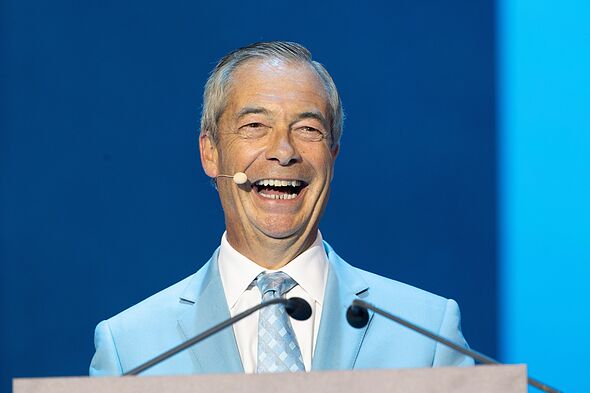
Reform UK leader Nigel Farage looks set to have the last laugh (Image: Getty)
They thought it was all over. But Nigel Farage is having the last laugh, because events over the past few days have shown he is still very much a contender for No 10.
It’s true that in recent months, the Reform UK leader has been rocked by a series of funding-related allegations. There was the £5million gift from Thai-based crypto tycoon Christopher Harborne. The gift itself was entirely legal and in no way against any parliamentary rules, but Mr Farage’s enemies claim he should have registered it, meaning details would appear on the House of Commons website.
Get the latest politics news – straight from our team in Westminster and more
Invalid email
You agree you are 18 or over. We use your sign-up to provide content in ways you’ve consented to and to improve our understanding of you. This may include adverts from us and third parties based on our knowledge of you. You can unsubscribe at any time. More Info.
Then there was the undercover sting by Channel 4, in which senior Reform figures – who have since been suspended – were filmed apparently discussing ways to accept a £500,000 donation from a wealthy American, even though it would have been against the law. The donation was never made. But it all provided ammunition for Mr Farage’s enemies.
And there is some evidence that the mud constantly thrown at Mr Farage has dented Reform UK’s popularity, although this should not be exaggerated. Opinion polls suggest about 25% of voters still back Reform.
But now, Mr Farage is fighting back. Reform is receiving two massive donations, giving it a war chest to ensure British politics really does become a fair fight.
Because while all the focus has been on Reform, the other parties have been receiving huge sums of money from donors for decades.
Ben Delo and Christopher Harborne are giving Reform £36million each, making a total of £72million.
Mr Farage said the money would be used “for one purpose only: to make certain we are ready to form a government at the next election”.
He said Reform would fund “the best research and policy department British politics has ever seen” and recruit “the best minds in every area”.
And deputy leader Richard Tice said: “What these two donations are trying to do is to actually level the playing field.
“We’re relatively new, we haven’t had the vast donations over the last five to 10 years that Labour and the Tories have had, so we need to employ campaign managers up and down the country, we need to employ brilliant policy people, the best minds, in order to ensure that we have the best policies.”
In 2024, for example, the Conservatives received £15million from a body called The Phoenix Partnership, owned by businessman Frank Hester.
A hedge fund called Quadrature Capital handed £4million to Labour in the same year.
Ecotricity, owned by energy entrepreneur Dale Vince, gave Labour £3.6million.
And union UNISON gave Labour £2.7million while USDAW gave £2.2million, the GMB gave £1.9million, and Unite gave £1.8million.
All of that is just in one year. And those are only some of the biggest donations – there are many more.
This has traditionally been considered perfectly normal. And there’s nothing wrong with it. The only real alternative would be for parties to get more money from taxpayers.
As Mr Tice says, political parties need buildings and staff. They need to carry out research and develop policies. And they need representatives across the country to organise campaigns and print leaflets.
The traditional parties have this infrastructure. They need it, and they have to pay for it somehow.
But Reform is in exactly the same boat. It needs infrastructure, too, if British voters are to have the option of choosing a Reform government on polling day.
These two donations, mammoth though they appear, will give Mr Farage and his party a fighting chance at the next election – on something close to equal terms with the other parties.
Nigel Farage’s Enemies Thought They’d Destroyed Him – Now He’s Laughing at Them
For Nigel Farage, the past few months have brought an unusually intense combination of political pressure, financial controversy and questions about the future direction of Reform UK.
Yet despite the turbulence, Farage remains firmly at the centre of the party he leads.
The Reform leader has faced investigations and criticism over party finances, the suspension of senior officials and controversy surrounding a series of large political donations. At the same time, Reform has secured substantial new funding, expanded its organisation and demonstrated its ability to attract support in former Conservative strongholds.
The result is a political situation that is considerably more complicated than either Farage’s supporters or opponents might suggest.
Those who expected the latest controversies to force him out of frontline politics have not seen that happen. Instead, Farage has continued to lead Reform, returned to the House of Commons and used the party’s growing financial resources to prepare for the next phase of its political campaign.
A difficult summer for Farage
The pressure on Farage intensified during the Reform UK conference in September.
The party was already facing questions over political donations when an undercover investigation appeared to show senior Reform figures discussing ways of obtaining financial support from a supposed American donor.
Farage subsequently suspended two senior officials, Dan Jukes and James Orr, after the allegations emerged. He said the pair had not been authorised to act in the way shown in the footage and described their conduct as a “human error”.
The controversy prompted renewed scrutiny of Reform’s internal structures and its procedures for dealing with donations.
Farage nevertheless rejected the suggestion that Reform itself had broken the law.
He told reporters that he expected further investigations, arguing that political opponents and what he called the establishment would continue examining the party as it grew.
That response has become characteristic of Farage’s approach to political pressure: deny wrongdoing, challenge the motives of his critics and continue campaigning.
The £72 million that changed the argument
Then came an extraordinary development.
Reform received £72 million from cryptocurrency entrepreneurs Ben Delo and Christopher Harborne, with each contributing £36 million.
The donations immediately triggered a national debate over political funding because of their unprecedented size.
Farage has insisted that the donations comply with existing electoral law. Reuters reported that both donors are British citizens who had been living abroad, while the government has been considering legislation that would introduce a £100,000 annual cap on political donations from British expatriates.
The donations have therefore created both an enormous financial opportunity for Reform and a new source of political controversy.
For Farage, the money provides the resources to transform Reform from a relatively lean insurgent organisation into a much larger political machine.
Critics, meanwhile, have questioned whether donations of such scale give wealthy individuals disproportionate influence over British politics.
That argument is now likely to remain central to the debate over Britain’s political funding rules.
Farage’s answer: build the organisation
Farage has not responded to the controversy by reducing Reform’s ambitions.
Instead, the party has begun planning a substantial expansion of its organisational infrastructure.
According to reporting by the Guardian, Farage intends to use part of the £72 million to recruit approximately 400 campaign managers and other professional staff.
Reform is also advertising dozens of positions covering campaigning, communications, branch coordination and creative work.
The strategy reflects an important change in Reform’s development.
For years, Farage’s political organisations relied heavily on volunteers, small teams and highly centralised campaigning.
The availability of tens of millions of pounds allows the party to build a much more extensive permanent organisation.
That could improve its capacity to fight elections, conduct local campaigning and maintain constituency-level operations.
But the transformation is not universally welcomed within Reform.
Some grassroots activists have reportedly complained that the party needs more volunteers knocking on doors rather than large numbers of professional managers.
That disagreement illustrates a broader challenge facing Reform: how to professionalise without losing the activist culture that helped it grow.
Farage returns to Parliament
Another development has strengthened Farage’s position.
After resigning his Clacton seat in July, he returned to Parliament through a by-election on 13 August.
The official parliamentary result shows Farage winning 22,239 votes.
His return meant that Reform once again had its leader sitting in the Commons.
The by-election was unusual because Farage had previously held the seat after winning the 2024 general election, then resigned before contesting it again.
His victory gave him a parliamentary platform from which to lead Reform’s opposition to the government.
It also allowed him to portray the result as evidence that his political movement remains capable of winning constituency contests.
The result itself does not establish how Reform would perform nationally at a future general election, but it did return Farage to the Commons at a crucial moment for his party.
The party’s conference message
At Reform’s September conference, Farage attempted to shift attention from controversy towards policy.
He announced a “100-day pledge” covering immigration, energy, healthcare and other areas.
Among his commitments was a promise to stop small-boat crossings within the first 100 days of a Reform government.
He also promised action on energy costs and changes to the NHS, while other senior Reform politicians presented proposals covering taxation, education and welfare.
The conference was therefore designed to demonstrate that Reform was moving beyond protest politics and preparing for government.
Whether voters accept that argument is a matter for them, but the organisational resources now available to the party have made such preparation substantially easier.
The leadership question
One of the most interesting questions surrounding Farage is not simply whether his opponents can damage him, but whether Reform can eventually operate without him.
A September analysis by the Guardian reported that Farage remained highly popular among Reform members despite weeks of controversy.
A poll of 850 Reform members conducted by Lord Ashcroft in June found that four in five wanted Farage to remain leader even if Reform did not enter government after the next election.
The same polling found that potential successors were considerably less established among the party membership.
Zia Yusuf and Richard Tice were the most frequently mentioned alternatives, while Robert Jenrick received much less support in the survey.
The figures illustrate the extent to which Farage remains personally important to Reform.
They also highlight a potential long-term challenge: building an organisation whose identity is not completely dependent on one individual.
A party under pressure but still expanding
Farage’s opponents can point to several controversies surrounding Reform.
The party has faced scrutiny over political donations, questions about internal discipline and disagreements involving some councillors and activists.
The Guardian recently reported that several Reform councillors had been members of a Facebook group linked to the Patriot Platform, a group involved in recent protests and clashes with police. Some councillors subsequently distanced themselves from the group.
Reform has also experienced internal tensions over how the party should respond to such controversies.
These episodes have created political difficulties for Farage because they raise questions about the people and organisations operating around Reform.
Yet controversy has not stopped the party from expanding its resources or developing its organisational structure.
That contrast is central to understanding Farage’s current position.
The political funding battle
The £72 million donations have arguably become the biggest issue of all.
Farage argues that the money is lawful under the rules that existed when the donations were made.
The government is considering changes that could impose tighter restrictions on political donations connected to British citizens living overseas.
Critics of Reform argue that donations of tens of millions of pounds demonstrate why the rules need to change.
Farage’s response is that Reform should not be prevented from competing with Labour and the Conservatives for financial support.
The dispute therefore goes beyond Reform itself.
It raises fundamental questions about whether Britain should permit very wealthy individuals to contribute enormous sums to political parties, whether donation limits should be introduced, and how trade-union funding should fit into any new system.
Those questions are likely to remain politically significant regardless of what happens to Farage personally.
Why Farage remains central
The idea that Farage has been politically “destroyed” is difficult to reconcile with the developments of recent weeks.
He remains Reform’s leader.
He has returned to Parliament.
His party has received £72 million in new donations.
Reform is recruiting staff and expanding its organisational machinery.
And Farage continues to dominate the party’s public profile.
At the same time, it would be equally inaccurate to suggest that the controversies have had no consequences.
YouGov’s September political favourability tracker found that 69 per cent of Britons held an unfavourable view of Farage, the highest figure recorded by that tracker over its ten-year history, while 24 per cent viewed him favourably. YouGov noted that the survey followed Reform’s conference and further controversy surrounding donations.
Those figures demonstrate that Farage’s position inside Reform and his standing among the wider public are two different questions.
He can remain highly influential within his party while simultaneously facing substantial public opposition.
What comes next?
The next stage will be about whether Reform can convert its growing financial and organisational resources into sustained political campaigning.
The £72 million provides the party with resources on a scale it has not previously possessed.
Farage’s plan to recruit hundreds of campaign staff indicates an intention to build a permanent political machine rather than rely solely on the enthusiasm of volunteers.
But money alone does not determine political outcomes.
Reform still faces questions about candidate selection, internal discipline, policy detail, relationships with other parties and the ability of its rapidly expanding organisation to operate consistently across the country.
Farage therefore enters the next phase with both significant advantages and significant political liabilities.
His opponents have subjected him to intense scrutiny, and some controversies have produced genuine internal difficulties.
But the evidence does not show a politician who has disappeared from the political stage.
Instead, Farage has responded to the pressure by returning to Parliament, defending his party’s finances, expanding Reform’s organisation and setting out an ambitious programme for its first 100 days in government.
Whether that strategy succeeds politically is ultimately a question for voters.
For now, the clearest fact is that the controversies surrounding Farage have not ended his leadership of Reform UK. If anything, the party is entering a new phase in which its leader has more money, a larger organisation and a much bigger political operation to manage — while facing equally serious questions about how that power should be used.