

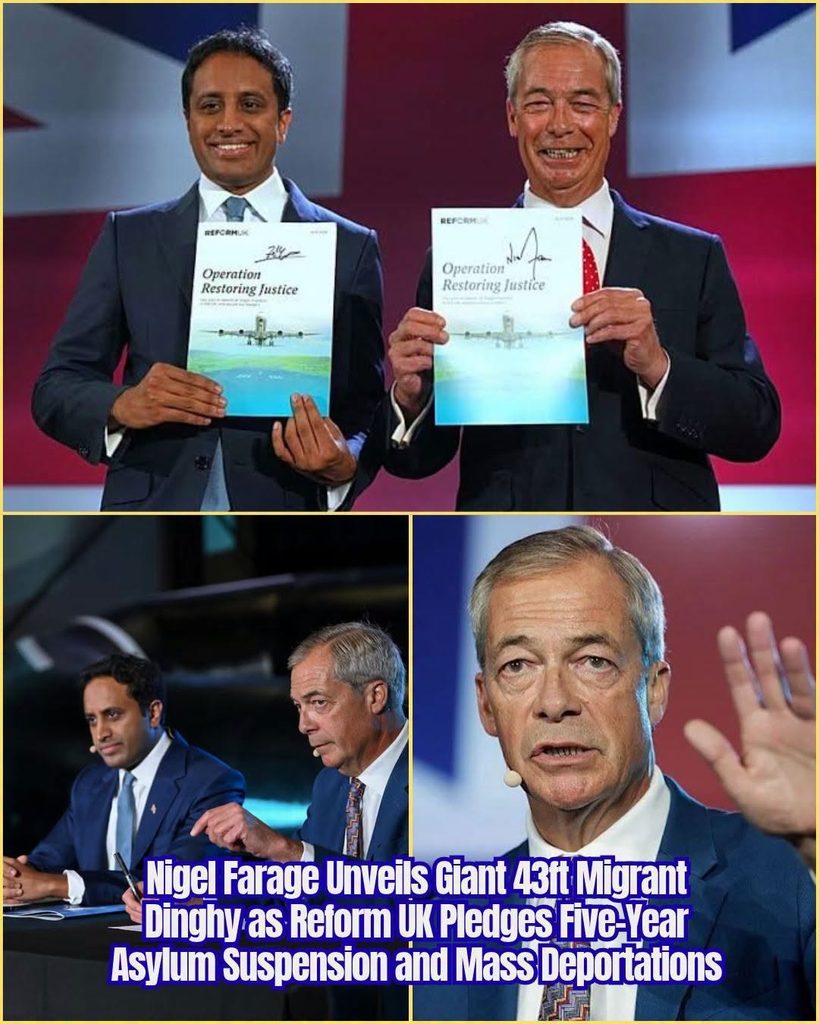
Nigel Farage has unveiled one of Reform UK’s most far-reaching immigration proposals yet, pledging to suspend Britain’s asylum system for up to five years while standing beside a giant replica migrant dinghy at a press conference in Kent.
The Reform UK leader made the announcement on Monday, October 12, presenting a series of measures he said would restore control over Britain’s borders if his party formed the next government.
At the centre of the event stood a 43-foot inflatable boat replica, which Reform said represented the vessel used to carry 230 people across the English Channel during a single crossing in August.
Farage used the display to argue that the scale of Channel crossings demanded a fundamental change in government policy.

Under the proposals, a Reform administration would suspend new asylum claims for up to five years and automatically reject approximately 90,000 outstanding applications and appeals.
Those affected would face removal from Britain, including families with children.
The party also intends to close most legal refugee resettlement routes, although it would retain an exception for Ukrainians who fled Russia’s full-scale invasion in 2022.
Another major element involves reviewing asylum approvals granted since 2024.
People whose countries of origin were subsequently classified as safe could face having their protection withdrawn.
Farage also outlined plans to increase pressure on governments that refused to accept the return of their nationals.
Potential measures would include visa restrictions, tariffs, asset-related sanctions and limits on airline access to British airspace.
Countries mentioned in discussions surrounding the proposals included Pakistan, Somalia, Eritrea, Afghanistan and Syria.
The Reform leader argued that the measures were necessary to address what he described as a national security emergency.
He also reiterated his ambition to stop small-boat crossings within the first 100 days of a Reform government.
However, the announcement immediately drew criticism from refugee organisations and political opponents.
Critics warned that automatically rejecting asylum applications could prevent people fleeing persecution from receiving individual assessments of their circumstances.
They also raised concerns about the compatibility of the proposals with Britain’s international refugee obligations and the practical difficulties involved in arranging large-scale deportations.
The government has defended its own approach, pointing to efforts to reduce Channel crossings while reforming the asylum and appeals system.
The latest proposals highlight the widening differences between the main political parties over immigration enforcement, humanitarian protection and border security.
For Reform UK, the announcement represents a commitment to replacing much of the existing asylum framework with a significantly more restrictive system.
For opponents, it raises questions about legal safeguards and the consequences for vulnerable people seeking protection.
The policies remain proposals rather than enacted measures and would depend on Reform UK entering government and overcoming potential legal and operational challenges.
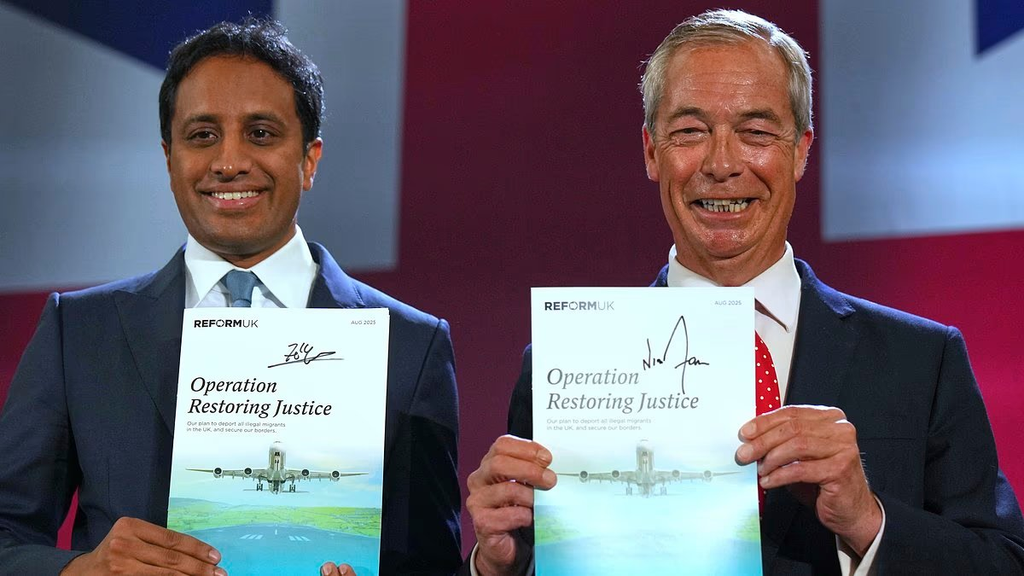
With immigration continuing to dominate Britain’s political debate, Farage’s giant boat display has ensured that his latest announcement attracts considerable attention.
The central question now is whether the party can demonstrate how such sweeping changes would operate in practice.
Nigel Farage Unveils Giant 43ft Migrant Dinghy as Reform UK Pledges Five-Year Asylum Suspension and Mass Deportations
Nigel Farage and Reform UK have placed immigration firmly back at the centre of Britain’s political debate, with a reported giant 43-foot migrant dinghy display drawing attention to the party’s demands for a tougher approach to irregular migration. Alongside proposals for a five-year suspension of asylum claims and large-scale deportations, the announcement highlights the increasingly sharp divisions over border control, national security and the future of Britain’s immigration system.
The dramatic image of a large inflatable boat is designed to focus attention on one of the most visible aspects of the migration debate: people crossing the English Channel in small vessels. But behind the political spectacle lies a much more complicated set of questions. Could the proposed measures be implemented legally? How would they affect people seeking protection? And what would they mean for the government’s responsibilities, public spending and Britain’s international relationships?
Reform UK has made tighter immigration controls a central part of its political identity. Its proposals appeal to voters who believe successive governments have failed to manage migration effectively. However, the practical consequences of any sweeping change would depend on the legislation, resources and international agreements required to put it into effect.
A Giant Dinghy Becomes a Political Symbol
A 43-foot migrant dinghy, if used as described, would provide a striking visual centrepiece for a political announcement. Images of small boats have become closely associated with arguments about the UK’s borders, the asylum system and the government’s ability to control irregular arrivals.
For Reform UK, such a display would offer a way to turn an abstract policy debate into something immediately recognisable. The boat represents a wider question about how people enter the country, how their claims are assessed and what happens when they have no legal right to remain.
Supporters of tougher controls argue that repeated crossings undermine confidence in the immigration system. They believe the government must demonstrate that irregular entry will not automatically lead to a prolonged stay in Britain.
Others caution that the presence of a boat does not tell the full story of the people aboard, the circumstances of their journeys or the legal status of individual passengers. People arriving by irregular routes may have very different reasons for leaving their countries, and their claims must be assessed according to the relevant legal framework.
The political significance of the display therefore lies not simply in its size, but in the questions it raises about enforcement, humanitarian responsibilities and public confidence.
Reform UK’s Proposed Five-Year Asylum Suspension
The reported proposal for a five-year suspension of asylum claims would represent a major change to the UK’s approach to international protection.
Asylum is the process through which a person seeks protection because they fear persecution or serious harm in their home country. The legal obligations surrounding asylum involve domestic legislation and international commitments, including protections against returning people to places where they face certain serious dangers.
A blanket suspension would consequently raise substantial legal and operational questions. Its exact meaning would be crucial. Would it stop people from submitting claims, prevent claims from being processed, restrict particular routes or change the rules governing eligibility? These are different policies with different consequences.
A proposal to suspend the system cannot be evaluated properly without knowing its precise legal mechanism.
The government would also need to consider what happened to people who arrived during the suspension. If claims could not be processed, authorities would still have to decide how to handle accommodation, detention where legally permitted, removal and cases involving people who could not safely or lawfully be returned.
The financial implications would also matter. A policy intended to reduce long-term costs could create additional expenses if people remained in the country while their legal status was unresolved.
For supporters, a suspension may appear to offer a clear break from the existing system. For critics, it could create legal disputes and leave difficult questions about individual protection unanswered. The outcome would depend on the details and whether the policy could be implemented consistently with the law.
Mass Deportations: Ambition and Practical Challenges
Reform UK’s reported commitment to mass deportations raises another major question: how could the UK remove large numbers of people who do not have a legal right to remain?
Deportation and removal are not single administrative actions. Authorities may need to establish a person’s identity and nationality, determine their legal status, consider outstanding appeals or protection claims and secure the necessary travel documents.
Cooperation from other governments is often essential. If a destination country does not accept a person’s return or disputes their nationality, the process may be delayed. Cases can also involve family circumstances, medical concerns or other legal factors that authorities must consider.
A large-scale programme would require substantial administrative capacity and careful planning. The government would need sufficient trained staff, detention facilities where legally justified, transport arrangements and agreements with destination countries.
The costs would also require scrutiny. A serious assessment would examine the projected expense per removal, the number of cases likely to be completed and the potential savings from ending accommodation arrangements or reducing the number of unresolved cases.
Supporters of tougher enforcement argue that credible removal procedures are essential if immigration rules are to command public confidence. Critics question whether ambitious targets can be achieved without excessive expense, lengthy legal disputes or risks to individual rights.
These questions cannot be settled by a headline or a numerical pledge alone. They require detailed plans, realistic estimates and transparent reporting on results.
Why Immigration Remains a Major Political Issue
Immigration continues to divide opinion because it intersects with several concerns at once.
Some voters focus on border security and believe the government should exercise stronger control over who enters and remains in the country. Others are concerned about the impact of migration on housing, public services and local communities. Employers, meanwhile, may emphasise the importance of overseas workers in sectors experiencing recruitment shortages.
There are also humanitarian and legal considerations, particularly for people escaping conflict or persecution.
These issues are related, but they are not interchangeable. Legal migration, irregular entry, asylum applications, visa overstaying and the removal of people without permission to remain involve different rules and policy responses.
Treating every category as the same can make it harder to understand what a proposed reform would actually achieve.
For Reform UK, a central challenge is to show how its proposals would address each category while meeting legal requirements. For its political opponents, the challenge is to explain how existing or alternative policies can provide effective border management without creating unnecessary delays or costs.
The public debate is likely to remain intense because voters want clear answers about outcomes, not simply competing promises.
The Government Faces Pressure to Respond
A high-profile announcement by Farage would put additional pressure on the government to explain its own approach to migration.
Ministers would need to demonstrate what is being done to prevent dangerous crossings, disrupt criminal smuggling networks, process asylum applications efficiently and remove people who have no legal basis to remain.
They would also need to explain the limits of existing enforcement powers and the role played by cooperation with other countries.
Criticism from Reform UK may resonate with people who believe that previous commitments have not produced sufficient results. However, evaluating the government’s record requires evidence, including reliable figures on arrivals, decisions, removals, processing times and spending.
Likewise, any alternative policy should be judged against measurable outcomes rather than the strength of its presentation.
The government and opposition also have different responsibilities. Ministers must administer the system within the law, while opposition parties must explain how their proposed changes would work and what trade-offs they would involve.
Could the Proposals Change Britain’s Immigration Debate?
The reported dinghy display and policy pledges may increase attention on Reform UK’s immigration agenda, but the long-term significance will depend on what follows.
Detailed policy documents, legal analysis, financial estimates and clear explanations of implementation would allow the public to assess whether the proposals are practical. Without those details, debate risks becoming a contest of dramatic images and sweeping claims.
A five-year suspension of asylum claims and a large-scale deportation programme would involve fundamental questions about legal obligations, government capacity, international cooperation and the treatment of individuals. Those questions deserve serious examination regardless of political affiliation.
There is also a distinction between announcing a policy and delivering it. Governments must turn commitments into workable procedures, allocate resources and demonstrate that the intended results have been achieved.
For voters, the most useful test is whether a proposal can reduce irregular migration, maintain public safety, control costs and operate within the law.
A Defining Test for Reform UK
Nigel Farage’s reported presentation of a giant migrant dinghy captures the political importance of the small-boats issue. The accompanying pledges would, if implemented as described, mark a substantial shift in the UK’s approach to asylum and removal procedures.
Supporters may see the proposals as a necessary response to years of frustration over immigration control. Opponents may question their legality, feasibility, cost and humanitarian consequences.
The crucial details remain the precise wording of the proposed suspension, the legal framework for removals, the resources required and the arrangements for people who cannot lawfully be returned.
Ultimately, the debate will be decided by more than the symbolism of a large boat. It will depend on whether the policies can be translated into effective, lawful and financially sustainable measures—and whether they deliver the outcomes their supporters expect.
Britain’s immigration debate is unlikely to disappear soon. The challenge for every political party is to move beyond slogans and provide clear, evidence-based answers about how the country should manage its borders, meet its legal responsibilities and maintain public confidence in the system.