

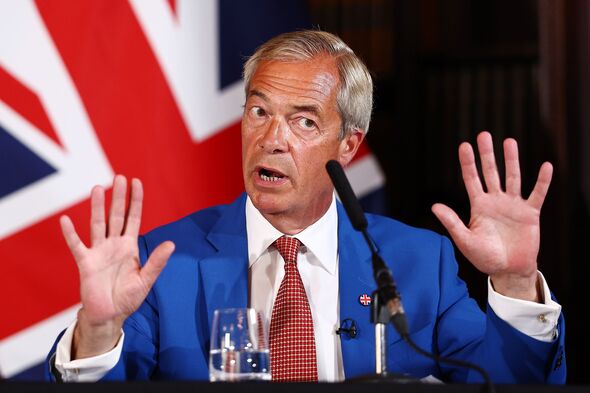
Nigel Farage Reveals Bombshell Migration Plan as Channel Crossings Surge
Nigel Farage has once again placed immigration at the centre of Britain’s political debate.

And this time, the timing could hardly be more dramatic.
A record-breaking Channel crossing involving 230 migrants on a single overcrowded dinghy has provided Reform UK with exactly the kind of image that allows Farage to make his strongest political argument: that Britain has lost control of its borders and that the government needs to take much more decisive action.
The overall number of Channel crossings may actually be lower than at the same point last year. But politics is rarely governed by averages.
One extraordinary boat can dominate the headlines.
One photograph can change the national conversation.
And one dramatic incident can give an opposition leader the opportunity to argue that the government’s strategy is fundamentally failing.
That is exactly what Farage has done.
Reform UK has unveiled what it calls “Operation Fortress”, a highly controversial plan that would put the Royal Navy at the heart of efforts to stop small boats crossing the English Channel. The proposal is designed to prevent migrant vessels from reaching Britain and, where possible, return them towards France or another safe destination.
Farage’s message is deliberately uncompromising.
He argues that Britain cannot continue with a system in which criminal smuggling gangs launch overcrowded boats from the French coast while the British state waits for them to arrive.
The political logic is simple.
Stop the boats and you stop the business model.
If migrants believe that paying smugglers thousands of pounds will no longer result in reaching Britain, demand for the crossings should eventually decline.
It is a powerful argument.
But it is also an argument that raises some enormous questions.
The Channel is not an empty stretch of water.
It is one of the busiest shipping areas in the world.
Large commercial vessels, ferries, fishing boats and smaller craft operate across it every day.
Introducing military vessels into that environment to intercept overloaded inflatable boats would therefore be an extraordinarily complicated operation.
And the people inside those boats are not simply illegal migrants in a political debate.
They are human beings at sea.
Some may be refugees.
Some may have genuine asylum claims.
Others may not qualify for protection.
But if a boat is sinking, the immediate issue becomes rescue.
International maritime obligations do not disappear because a vessel is carrying people who may have entered Britain illegally.
That is one of the central criticisms of Farage’s proposal.
Experts have warned that using military force to turn boats around could create additional dangers rather than eliminate them. Former naval officers and other specialists have questioned whether the plan is realistic and whether it could make already dangerous crossings even more hazardous.
That criticism deserves serious attention.
A desperate smuggler who believes British authorities are about to intercept his boat may behave unpredictably.
Passengers may panic.
The vessel may become unstable.
People could fall into the water.
And a crowded dinghy carrying more than 200 people could turn into a mass-casualty incident within minutes.
This is the uncomfortable reality behind the political slogans.
Britain needs to control its borders.
But border control cannot be separated from maritime safety.
That does not mean Farage’s concerns are illegitimate.
Quite the opposite.
The extraordinary 230-person crossing demonstrates why voters remain deeply frustrated.
According to reports, the 15-metre inflatable vessel was so heavily loaded that it was visibly struggling in the water. It represented the largest number of migrants recorded arriving on a single boat.
That is a remarkable development.
It suggests that smuggling gangs are adapting.
If law enforcement makes smaller boats more difficult to operate, criminals may simply put more people on each vessel.
In other words, fewer successful crossings do not necessarily mean the underlying problem has disappeared.
The government says enforcement efforts have disrupted smuggling networks and contributed to a reduction in overall arrivals.
But Reform has a straightforward response.
If boats are still arriving, the system is still failing.
That argument is politically effective because it focuses on visible outcomes.
People may not know how many smuggling networks have been disrupted.
They may not understand the details of asylum processing.
They may not follow every agreement between Britain and France.
But they understand what a giant dinghy carrying 230 people looks like.
It looks like a border that is under pressure.
Farage understands that perfectly.
This is why the announcement of Operation Fortress could prove to be politically valuable even if its practical implementation remains uncertain.
It gives Reform ownership of the immigration debate.
Instead of responding to government announcements, Farage is setting the agenda.
He is forcing Labour to explain what it would do differently.
He is forcing ministers to defend cooperation with France.
And he is forcing the Conservatives to decide whether they support or oppose a significantly tougher approach.
That is exactly where Farage is strongest.
His opponents may criticise his policies as unrealistic or extreme.
But if they spend the entire week explaining why they cannot do what Farage proposes, he has already won one important political battle.
He has made them argue on his territory.
Immigration has been central to Farage’s political career for decades.
It helped define his Brexit campaign.
It helped build support for UKIP.
And it remains one of the most important reasons many Reform voters say they support the party.
The Channel crisis therefore fits perfectly into the political identity Farage has created.
His argument is not simply that immigration numbers are too high.
It is that Britain has lost sovereignty over who enters the country.
That distinction matters.
For many Reform supporters, the issue is about control.
Who decides who comes to Britain?
Who enforces the border?
Who determines whether an asylum claim is genuine?
Who removes people who have no legal right to remain?
And ultimately, who is responsible when the system fails?
Farage’s answer is that elected British politicians must take responsibility.
That message is likely to resonate with voters who believe successive governments have promised action without delivering enough.
But there is a danger for Reform.
The more Farage presents himself as a potential Prime Minister, the more voters will expect detailed answers.
Opposition politicians can promise dramatic action.
Governments have to implement it.
That means Farage must explain what happens when a Royal Navy vessel intercepts a boat carrying asylum seekers.
What legal authority would govern the operation?
Where would the passengers be taken?
Would France accept them?
What happens if France refuses?
What happens if the boat is in distress?
Would Britain still be required to rescue those on board?
How would the government distinguish between a safe interception and an emergency?
These questions are not minor details.
They determine whether the policy can actually work.
And France has already made clear that it is unhappy with the idea of Britain using military force in the Channel to return migrants.
That creates another problem.
Britain cannot solve a bilateral problem unilaterally if the other country refuses to cooperate.
The relationship with France is crucial.
Both countries want to reduce dangerous crossings.
Both want to tackle people-smuggling gangs.
Both have an interest in preventing deaths at sea.
But they disagree over how this should be achieved.
Turning the issue into a confrontation between London and Paris might be politically satisfying.
It would not necessarily make the boats stop.
There is another reason why the timing of Farage’s announcement matters.
Andy Burnham is still new to Downing Street.
His government is trying to establish its identity.
It wants to present itself as energetic, interventionist and focused on delivery.
But immigration is one of the areas where Labour remains particularly vulnerable.
If Farage can make every new Channel arrival into evidence of Labour’s failure, Burnham will struggle to control the political narrative.
The record 230-person dinghy is therefore more than a migration story.
It is a political weapon.
It allows Farage to ask a simple question:
If the government is succeeding, why are boats like this still arriving?
Labour can respond that overall crossings are down.
It can point to cooperation with France.
It can point to arrests and disrupted smuggling operations.
It can promise faster asylum decisions.
All of those arguments may be valid.
But they compete against a much simpler political message.
The boats are still coming.
That is the challenge Burnham faces.
He cannot simply dismiss Farage as a populist.
He has to demonstrate that his government has a credible plan of its own.
That plan will need to combine enforcement with diplomacy.
It will need stronger action against criminal gangs.
It will need an efficient asylum system.
It will need a functioning returns policy.
And it will need safe, legal routes for people who genuinely qualify for protection.
Without those elements, the problem is unlikely to disappear.
There is also a lesson from the changing behaviour of smugglers.
The record dinghy suggests that criminal networks are constantly adapting.
They are businesses.
They respond to incentives.
If one method becomes more difficult, they look for another.
That means Britain cannot rely on one dramatic military operation.
It needs intelligence.
It needs financial investigations.
It needs cooperation with French authorities.
It needs to identify the organisers rather than simply intercepting their customers.
And it needs to make the entire business model less profitable.
That is considerably harder than deploying a few ships.
But it may ultimately be more effective.
Farage deserves credit for forcing the question.
For too long, British immigration debates have sometimes become trapped between two extremes: promises of tougher enforcement on one side and warnings about humanitarian consequences on the other.
The reality is that Britain needs both control and humanity.
A country can have secure borders without abandoning people in danger.
It can enforce immigration laws while maintaining asylum protections.
It can prosecute smugglers while protecting genuine refugees.
The challenge is making all of those principles work simultaneously.
Farage’s plan is deliberately designed to challenge the assumption that the current balance is acceptable.
That is its political strength.
Its weakness is that the practical details remain much harder than the slogan.
“Stop the boats” is simple.
Stopping them safely, legally and permanently is not.
That is the standard Reform must eventually meet.
For now, however, Farage has succeeded in changing the conversation.
The record crossing has handed him the perfect political backdrop.
The government’s statistics may show progress.
But the images tell a different story.
And in modern politics, images can be extraordinarily powerful.
The question is what happens next.
If crossings continue, Farage will say that Labour has lost control.
If the government succeeds in reducing them further, Burnham will argue that patient enforcement and international cooperation are working.
If Reform’s Operation Fortress becomes the centre of the debate, Farage may find himself closer to the political mainstream than his critics would like.
But if experts’ warnings prove correct and the plan turns out to be unsafe or impossible to implement, the announcement could eventually become an embarrassment.
That is why this is such a significant moment.
Farage has played a powerful political card.
The Channel crisis has given him the opportunity.
A record-breaking dinghy has given him the image.
And Operation Fortress has given him a policy headline.
Now he must prove that his plan is more than a headline.
Britain does need control of its borders.
It does need to stop criminal gangs exploiting vulnerable people.
And it does need an asylum system that voters can trust.
But the ultimate measure of any migration policy is not how tough it sounds.
It is whether it works.
The boats need to stop.
The smugglers need to lose their business.
Genuine asylum seekers need a lawful route to protection.
And, above all, people should not be dying in the Channel.
Nigel Farage has made his argument.
Now the country gets to judge whether his bombshell plan is the answer — or simply the latest political response to a problem that has proved far more complicated than any slogan suggests.