


Nigel Farage Plans to Intercept Every Channel Migrant: “Not a Single One”
Nigel Farage has unveiled one of the toughest immigration proposals yet from Reform UK, promising that his party would intercept every small boat attempting to cross the English Channel if it wins the next general election. The proposal would place the Royal Navy at the centre of a much more aggressive border policy and represents a major escalation in Britain’s political debate over illegal migration.

Under the plan, Reform UK would seek to prevent small boats from reaching British waters and return those on board to France. Farage has presented the policy in uncompromising terms, insisting that not a single person travelling across the Channel in a small boat should be allowed to enter Britain through that route.
The announcement is likely to generate intense political controversy. Supporters will argue that the policy is necessary to restore control over Britain’s borders and prevent dangerous journeys organised by criminal smuggling gangs. Critics, however, are likely to question whether the plan could be implemented legally and practically, particularly when people on board may claim asylum or refuse to return to France.
The proposal therefore raises much bigger questions about Britain’s immigration system, international cooperation and the limits of government power.
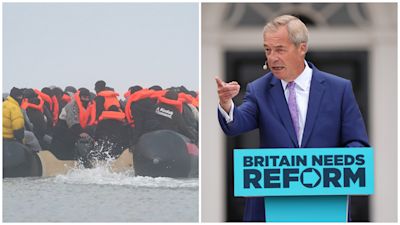
A Dramatic Change in Border Policy
The central idea behind Farage’s proposal is straightforward.
Instead of allowing small boats to cross the Channel and then dealing with migrants after they arrive in Britain, Reform wants to stop the journeys before they reach British territory.
The party says the Royal Navy would intercept the boats and return their occupants to France. The policy would therefore attempt to change the calculation facing people considering the journey.
At present, people smugglers can tell potential customers that reaching British waters gives them an opportunity to enter the UK and potentially claim asylum. Farage argues that this expectation is one of the main incentives behind the crossings.
His solution is to remove that incentive completely.
If people know that their boats will be intercepted and returned to France, Reform believes fewer will be willing to pay thousands of pounds to smugglers.
The proposal is therefore intended not only as a border-control measure but also as a deterrent.
Why the Channel Has Become a Political Flashpoint
Small-boat migration has become one of the most politically sensitive issues in Britain.
Thousands of people have crossed the Channel in recent years, creating pressure on the asylum system and contributing to the expansion of temporary accommodation for asylum seekers.
The issue has also become closely associated with public frustration over Britain’s ability to control its borders.
Farage has repeatedly argued that successive governments have failed to deliver meaningful control. Reform UK has made immigration one of the central themes of its political platform, presenting itself as the party most willing to take radical action.
The latest proposal fits directly into that strategy.
Rather than focusing primarily on processing asylum applications after people arrive, Reform wants to prevent the arrivals themselves.
That distinction is politically important.
The Humanitarian Argument
The policy also has a humanitarian justification in Farage’s presentation.
Small boats crossing the Channel are often overcrowded and poorly equipped. The journey can be extremely dangerous, particularly in difficult weather and busy shipping lanes.
Supporters of interception argue that preventing boats from making the journey could save lives.
From this perspective, the policy is not simply about keeping migrants out of Britain. It is also about preventing people from being placed in the hands of criminal gangs and exposed to the risk of drowning.
People smugglers profit from the desperation of migrants who believe that crossing the Channel is their best route to Britain.
If the journey becomes impossible, Reform argues, the smuggling business model will be weakened.
This argument is likely to be central to the party’s defence of the policy.
The Legal Challenge
However, implementing such a policy would not be straightforward.
Many people travelling across the Channel may say that they are seeking asylum. International refugee law provides important protections for people fleeing persecution, and governments must consider their legal obligations when dealing with asylum claims.
The question would therefore be whether Britain could return people to France without examining their individual circumstances.
The legal relationship between Britain and France would also be crucial.
A policy of returning people to France cannot simply be imposed unilaterally. It would require cooperation from French authorities.
France would have to agree to accept people intercepted by British forces, and the two governments would need a clear legal and operational framework.
Without such an agreement, Farage’s proposal could encounter major practical obstacles.
The French Reaction
The policy is also likely to create diplomatic tension.
Britain and France already cooperate on efforts to prevent Channel crossings. French authorities patrol beaches and attempt to disrupt smuggling operations before boats depart.
However, Britain’s proposal to intercept boats at sea and return their passengers would place a different level of responsibility on France.
The French government would have to decide whether it was willing to accept people returned from British waters.
This could become a major point of negotiation between London and Paris.
The success of Farage’s plan would therefore depend partly on Britain’s relationship with France.
A British government cannot solve Channel migration entirely on its own because the problem involves two countries, international waters and organised criminal networks operating across borders.
The Role of the Royal Navy
Farage’s decision to involve the Royal Navy is particularly significant.
The Royal Navy is traditionally associated with national defence, maritime security and military operations rather than immigration enforcement.
Using naval resources to intercept migrant boats would represent a major change in the way Britain approaches Channel crossings.
There would also be questions about operational safety.
Small inflatable boats are often overcrowded and unstable. Any attempt to intercept them must avoid causing accidents or putting passengers at greater risk.
The Royal Navy would therefore require clear rules of engagement and coordination with other agencies.
The government would need to determine exactly what sailors could do, how boats would be stopped and what would happen to passengers once they were intercepted.
These practical details could prove just as important as the political announcement itself.
Reform’s Broader Immigration Strategy
The interception proposal should also be understood as part of Reform UK’s wider immigration agenda.
Farage has previously advocated much tougher measures against illegal migration, including large-scale deportations and stronger border controls.
The party’s broader argument is that Britain needs to restore a clear distinction between legal and illegal immigration.
Reform claims that the current asylum system creates incentives for people to make dangerous journeys because arrival in Britain can lead to accommodation, legal assistance and the possibility of eventually obtaining permission to remain.
The party wants to reverse that incentive structure.
Interception would therefore be only one part of a larger policy programme.
Supporters See a Clear Message
For Reform supporters, the simplicity of the proposal is one of its greatest strengths.
The message is easy to understand: if someone attempts to enter Britain illegally by small boat, they will not be allowed to complete the journey.
This contrasts with policies that involve complicated asylum procedures, lengthy legal appeals and negotiations with multiple countries.
Farage has built much of his political appeal around straightforward messages, and the Channel proposal fits that style.
It also reinforces Reform’s broader argument that previous governments have talked about controlling immigration without taking sufficiently decisive action.
Critics Will Question Whether It Can Work
Opponents are likely to argue that the policy oversimplifies a complicated problem.
Stopping boats at sea does not necessarily eliminate the reasons people leave their countries. If one route becomes more difficult, migrants and smugglers may search for alternative routes.
There is also the possibility that smugglers could use even more dangerous vessels or attempt crossings at different locations.
Critics may therefore argue that the policy could move the problem rather than solve it.
Others will question the financial cost of deploying naval resources and establishing a permanent interception system.
The government would need to invest heavily in ships, personnel, surveillance and detention or processing facilities.
The Political Calculation
For Farage, however, the political benefits may be significant even before the policy is implemented.
Immigration is one of the issues on which Reform UK has attempted to distinguish itself most clearly from Labour and the Conservatives.
By promising to intercept every Channel migrant, Farage is reinforcing the image of Reform as the party prepared to take the most uncompromising approach.
The proposal also places pressure on his political opponents.
If Labour rejects the plan, Reform can accuse the government of being too weak on border control.
If the Conservatives support similar policies, Farage can argue that they are copying Reform.
Either way, immigration remains central to the political debate.
A Difficult Test for Any Future Government
The real test would come if Reform actually entered government.
Opposition parties can make ambitious promises without having to confront the practical limitations of international agreements, courts, budgets and public administration.
Government is different.
A Reform government would need to negotiate with France, establish legal procedures, deploy naval resources and deal with challenges from courts and international organisations.
It would also need to demonstrate that interception actually reduces the number of crossings.
If crossings fell dramatically, Farage could claim that his deterrence strategy had succeeded.
If crossings continued through alternative routes, the government would face pressure to explain why the policy had failed to achieve its central objective.
Conclusion
Nigel Farage’s promise to intercept every small boat crossing the English Channel represents one of the strongest immigration proposals yet put forward by Reform UK.
The policy is built around a simple principle: prevent the boats from reaching Britain rather than waiting until passengers arrive before beginning the asylum and removal process.
Farage argues that this would protect Britain’s borders, weaken the people-smuggling gangs and reduce the danger of Channel crossings.
However, turning the promise into reality would be considerably more complicated.
Britain would need French cooperation, a clear legal framework and a carefully designed maritime operation. Questions about asylum rights, safety at sea, international law and the cost of deploying the Royal Navy would all have to be addressed.
The proposal nevertheless demonstrates how central immigration has become to Reform UK’s political strategy.
Farage is betting that voters want a government willing to make much tougher decisions at the border. His message is deliberately absolute: if people attempt to cross the Channel illegally in small boats, they should not be allowed to reach Britain.
Whether such a policy could actually work remains uncertain.
But politically, the announcement is already significant. It sets a clear dividing line between Reform UK and its rivals and ensures that the question of who controls Britain’s borders will remain one of the defining issues of the next general election.
:::{“fallbackMarkdown”:””,”reference”:{“matched_text”:” “,”prefix”:null,”start_idx”:12751,”end_idx”:12751,”safe_urls”:[],”refs”:[],”alt”:””,”prompt_text”:null,”type”:”sources_footnote”,”sources”:[{“title”:”News – Nigel Farage”,”url”:”https://nfarage.com/news/?utm_source=chatgpt.com”,”attribution”:”Nigel Farage”}],”has_images”:false},”showLoginRequiredCard”:false}