
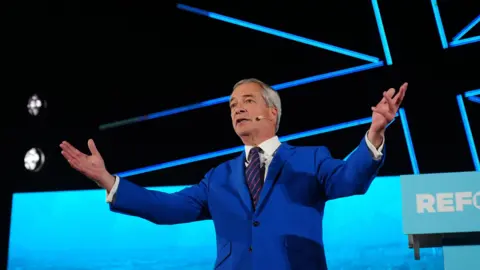
Nigel Farage declared that he is putting Reform UK on a general election “war footing” as he spoke at a rally today.
Hitting out at Sir Keir Starmer, the Reform leader told the event in Birmingham that the “political life of the most unpopular and most useless prime minister in living memory is drawing to a close”.
It comes as the Prime Minister is battling to stay in No 10 amid the Lord Mandelson scandal following the resignation of his chief of staff Morgan McSweeney.
Sir Keir is fighting for his political future after admitting he appointed the former Labour grandee as US ambassador despite knowing his friendship with Jeffrey Epstein continued after the financier’s conviction for soliciting a minor for prostitution in 2008.
Nigel Farage Makes Huge Announcement at Reform Rally as Keir Starmer on Brink
Nigel Farage has placed Reform UK on what he described as a “general election war footing”, telling a major party rally in Birmingham that his party is preparing for an election that could arrive sooner than expected.
Speaking to around 2,000 supporters at the National Exhibition Centre on February 9, Farage called on Prime Minister Keir Starmer to resign and said Reform was preparing to fight the next general election. The rally came at a particularly difficult moment for the Labour government, following the controversy surrounding former ambassador Peter Mandelson and a series of senior resignations inside Downing Street.
Farage’s announcement was significant because it went beyond another criticism of the government. He indicated that Reform was moving towards a more formal election structure and preparing to unveil a shadow cabinet.
The move suggested that the party wanted to demonstrate that it was developing the organisation and personnel required to operate as a potential government rather than simply functioning as an opposition movement.
Reform declares itself ready for an election
At the Birmingham rally, Farage told supporters that Reform UK was ready for a general election and argued that the party could be called upon to campaign much sooner than the official parliamentary timetable would normally suggest.
He described the party as being on a “general election war footing” and said the forthcoming local elections in May would be particularly important.
The language was deliberately focused on preparation.
Reform had already been attempting to expand its presence beyond Westminster, using local elections and by-elections as opportunities to build an electoral organisation. The Birmingham rally gave Farage a platform to present those activities as part of a larger national strategy.
Rather than waiting for an election to be called, Reform wanted its candidates, activists and senior politicians to be ready in advance.
That approach also reflected Farage’s argument that political circumstances could change rapidly.
Pressure on Keir Starmer
The announcement came as Starmer faced one of the most serious political crises of his premiership at that point.
The controversy centred on the government’s decision to appoint Peter Mandelson as Britain’s ambassador to the United States. Questions about Mandelson’s relationship with Jeffrey Epstein created intense political pressure, eventually contributing to the resignation of Starmer’s chief of staff Morgan McSweeney and communications director Tim Allan.
Starmer subsequently faced calls to resign from political opponents and some figures within the Labour movement.
However, he rejected those demands.
In a meeting with Labour MPs and peers on February 9, Starmer told colleagues that he was “not prepared to walk away”. He acknowledged mistakes and discussed changes to the operation of Downing Street while arguing that Labour needed to remain united.
The contrast between the two events was politically striking.
While Starmer was attempting to reassure Labour MPs that his government could recover from the crisis, Farage was standing before Reform supporters and presenting his party as an organisation preparing for a possible change of government.
The shadow cabinet announcement
One of the most important elements of Farage’s announcement was his plan to establish a Reform UK shadow cabinet.
The idea was to give senior Reform figures responsibility for specific policy areas and provide a clearer picture of how the party might organise itself if it entered government.
Farage subsequently unveiled the first part of that frontbench team on February 17.
Robert Jenrick, who had defected from the Conservatives, was given the Treasury brief. Former Conservative minister Suella Braverman was given responsibility for education, skills and equalities. Reform deputy leader Richard Tice took responsibility for business, trade and energy, while Zia Yusuf was given the home affairs and migration portfolio.
Farage said the structure was intended to show that Reform was developing beyond a party dominated by a single prominent figure.
The party described the new arrangement as a “machine for government”, with further appointments expected.
The development was important because Reform’s political identity had previously been closely associated with Farage himself.
Creating a larger frontbench gave the party an opportunity to put other figures in front of voters and give them responsibility for specific policy areas.
A different kind of Reform
The move towards a shadow cabinet represented an attempt to change how Reform UK was perceived.
Farage had spent many years as the most recognisable face of Britain’s Eurosceptic movement, eventually becoming an MP for Clacton at the 2024 general election.
Reform subsequently sought to broaden its political programme beyond Brexit.
Immigration remained central to its platform, but the party also focused on taxation, energy costs, public services, economic growth, government spending and opposition to aspects of the UK’s net-zero policies.
The February rally therefore came at a point when Reform was attempting to demonstrate that it had developed from a protest-oriented electoral force into a party capable of presenting candidates and policies across the country.
Farage’s planned frontbench was part of that process.
The local elections as a test
Farage also placed considerable emphasis on the May local elections.
Local elections can provide parties with opportunities to demonstrate organisational strength, recruit councillors and test messages with voters before a nationwide contest.
For Reform, they offered another opportunity to expand its presence at the grassroots level.
A party seeking to contest a general election needs more than a nationally recognised leader. It requires candidates, constituency organisations, campaign volunteers and a network capable of operating across hundreds of seats.
The emphasis on the local elections therefore reflected a practical side of Reform’s strategy.
The party was not simply discussing what might happen at Westminster. It was attempting to build an organisation that could compete at different levels of British politics.
Starmer’s fight to remain in Downing Street
The political crisis facing Starmer was also broader than the Mandelson controversy.
Labour had been dealing with internal disagreements, pressure from opposition parties and concerns about its political position.
On February 9, Starmer sought to reassure Labour MPs that he intended to remain in office and continue leading the government. He reportedly told colleagues that the challenge facing Labour was serious but that the party needed to remain focused on governing.
The immediate crisis therefore did not result in Starmer’s resignation.
That distinction matters when assessing Farage’s comments.
The Reform leader’s claim that an early election might arrive was a political assessment rather than an announcement that an election had actually been scheduled.
The government remained in office, Parliament continued to function and the constitutional timetable for a general election remained separate from Farage’s political campaign.
From rally rhetoric to political organisation
The significance of the Birmingham rally ultimately lay in what happened afterwards.
Farage’s announcement was followed by the formal unveiling of Reform’s first shadow cabinet on February 17. That provided a concrete organisational structure behind the earlier promise.
The choice of figures was also notable.
Jenrick and Braverman brought experience from the Conservative government, while Tice had already been a senior figure within Reform and Yusuf had played an important role in the party’s policy operation.
Their appointments demonstrated that Reform was seeking to combine experienced Westminster politicians with figures who had risen through the party itself.
Farage’s role remained central, but the party was developing a broader public-facing team.
What the announcement meant
The February rally therefore represented more than a single speech.
It marked an attempt by Reform UK to present itself as an organisation preparing seriously for national government.
For Farage, the immediate political message was that Reform believed it should be ready for an election whenever one arrived. For Starmer, the same moment came during a period when his leadership was under intense scrutiny but he was publicly insisting that he would continue as prime minister.
The competing messages illustrated the political tension of the period.
Reform was talking about government preparation, while Labour was dealing with questions about leadership and the future direction of the administration.
Yet the eventual timing of any general election could not be determined by a Reform rally alone.
What Farage could control was his party’s preparation.
By announcing a move towards a shadow cabinet and placing Reform on what he called a general election “war footing”, he signalled that the party intended to build the machinery necessary to contest power.
The subsequent frontbench appointments showed that the announcement was followed by concrete organisational changes.
For British politics, the episode demonstrated how quickly a party can move from campaigning around dissatisfaction with the government to constructing a more conventional opposition structure.
Reform’s challenge was therefore no longer simply to attract attention. It was to build a team capable of explaining detailed policies, contesting constituencies and maintaining a coherent political organisation.
Meanwhile, Starmer’s position remained a matter of political debate, but his immediate response was clear: he rejected calls to step aside and told Labour colleagues that he intended to continue.
The Birmingham rally consequently became an important moment in the developing contest between Labour and Reform.
Farage had announced preparation.
Starmer had announced that he was staying.
The next stage would be determined not by the rhetoric of one rally, but by subsequent political events, electoral results and decisions about when Britain would next go to the polls.