

Nigel Farage Is About to Pulverise Stuttering Keir Starmer Thanks to One Simple Thing

British politics has entered another period of extraordinary uncertainty. The traditional parties are under pressure, voters are increasingly willing to abandon long-established loyalties, and political personalities can sometimes matter almost as much as political programmes. At the centre of this shifting landscape are Nigel Farage and Keir Starmer, two politicians who represent dramatically different visions of Britain and who have built their political identities around very different approaches to communication.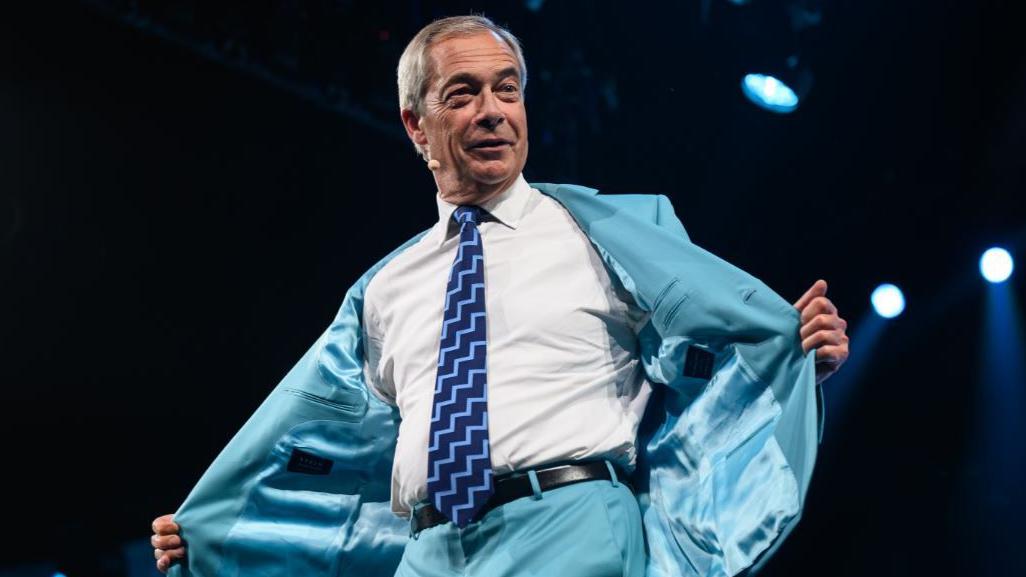
The claim that Farage is about to “pulverise” Starmer may sound deliberately dramatic, but it captures a genuine political argument: Farage has one advantage that Starmer has repeatedly struggled to match—simplicity. Farage has developed a political style that turns complicated frustrations into straightforward messages. Whether voters agree with those messages is another question. But his ability to identify an issue, give it a memorable explanation and repeat it relentlessly is one of the most powerful weapons in modern politics.
Starmer, by contrast, has often appeared more cautious and managerial. His political language tends to emphasise competence, responsibility and practical government. Those qualities can be valuable, particularly for a leader attempting to demonstrate that he is capable of running a country. Yet they can also create a communication problem. A politician can be competent without sounding compelling, and a government can have policies without giving voters a simple emotional reason to support them.
That is where Farage’s advantage becomes significant.
The “one simple thing” is not necessarily a particular policy. It is his ability to make voters feel that he understands what they are angry about.
For years, Farage has presented himself as an outsider who is willing to say what mainstream politicians supposedly avoid saying. His political career has been built around subjects such as immigration, Brexit, national sovereignty and dissatisfaction with the established political class. His supporters see this as honesty and plain speaking. His opponents see it as provocative populism. Whatever one’s judgement, the strategy is remarkably easy to understand.
Farage rarely asks voters to remember an elaborate political theory. Instead, he identifies a problem and gives it a villain, a cause or a simple solution. This creates a powerful political narrative because voters do not experience politics as a collection of government documents. They experience it through wages, housing costs, public services, taxes, immigration, crime, transport and their sense of whether the country is moving in the right direction.
A politician who can connect those everyday experiences to a clear story has an enormous advantage.
This does not mean that Farage automatically wins. Simplicity can become oversimplification. Complex national problems rarely have one cause or one solution, and political slogans can hide difficult practical questions. Immigration, economic growth, public spending and Britain’s relationship with the rest of the world cannot simply be reduced to a sentence on a campaign poster.
Yet elections are not university seminars. Political communication depends heavily on clarity.
That is precisely where Starmer faces his challenge.
When Starmer first emerged as the leader of the Labour Party, one of his greatest political strengths was his ability to appear serious and competent. He could present himself as a contrast to the turbulence associated with previous Conservative governments. His appeal was partly based on reassurance: Labour could be trusted with government, the party had changed, and politics could become more professional.
But once a politician is in government, the standard changes. Opposition leaders can promise transformation. Governments have to explain trade-offs, defend unpopular decisions and accept responsibility for disappointing outcomes. The language that works in opposition can therefore become less effective in office.
This is particularly dangerous when an opponent is offering a much simpler story.
Imagine two political messages. One says that economic problems require difficult choices, long-term investment, fiscal discipline and careful reform. The other says that politicians have ignored ordinary people for too long and that the political establishment needs to be confronted.
The first may be more sophisticated. The second may be more memorable.
That distinction matters.
Farage understands the value of political theatre. He knows that a memorable confrontation can generate enormous attention, particularly in an age when political communication is no longer controlled by television news and newspapers. A short speech, interview exchange or social-media clip can reach millions of people without requiring them to watch an entire political programme.
Starmer therefore faces a difficult opponent: someone who is highly experienced at turning political frustration into a personal and emotional argument.
The danger for Starmer is not simply that Farage will persuade every voter to support him. That is unlikely to be necessary. Farage’s influence can be significant even if his party does not dominate British politics. He can force other parties to respond to issues that he has placed at the centre of public debate. He can shift the terms of political discussion. He can make other politicians defend positions they would rather avoid discussing.
This is arguably more important than winning a particular argument.
The rise of populist politics across many democracies has demonstrated that political movements can gain influence by challenging the assumptions of established parties. Farage has repeatedly demonstrated an ability to occupy political territory that mainstream politicians once considered uncomfortable. His opponents may reject his conclusions, but they cannot always ignore the questions he raises.
Starmer’s response cannot simply be to imitate Farage.
That would probably be a mistake. If Labour attempted to reproduce Farage’s rhetoric without possessing the same political identity, it could appear artificial. Starmer’s strength lies elsewhere: government competence, institutional credibility and the ability to turn promises into practical policy.
His task is to combine those strengths with clearer communication.
The problem is that competence is difficult to make exciting.
A functioning public service does not usually produce a viral video. A carefully designed economic reform rarely generates the same emotional response as a dramatic political confrontation. Governments are often rewarded for preventing disasters that never happen, which makes their achievements inherently difficult to communicate.
Farage, meanwhile, can remain focused on dissatisfaction.
That asymmetry gives him an important political advantage.
However, there is another side to the story. A politician who promises simple solutions eventually has to answer complicated questions. If Farage’s political movement gains greater power and influence, voters will expect more than criticism of the establishment. They will want to know how policies will be funded, implemented and sustained. Protest politics can be powerful, but governing politics is considerably harder.
This is where Starmer could fight back.
Rather than attempting to out-Farage Farage, Starmer could make the political contest about results. If the government can demonstrate improvements in living standards, public services, economic performance and national confidence, it can offer voters something more substantial than rhetoric. The challenge is making those achievements visible and understandable.
Ultimately, the political battle between Farage and Starmer is therefore a battle between two styles of politics.
One is built around confrontation, personality and simple explanations. The other is built around institutional authority, caution and managerial competence.
Neither style is automatically superior.
But in an age of fragmented media, declining trust and political frustration, the politician who can explain a complicated world in a sentence often has an advantage over the politician who needs ten paragraphs.
That is Farage’s “simple thing”.
He knows how to make politics feel personal.
He knows how to turn frustration into a narrative.
And he knows that people are more likely to remember a politician who appears to be speaking directly to them than one who sounds as though he is addressing a committee.
Whether that will be enough to “pulverise” Starmer is another matter. Politics is unpredictable, and British voters have repeatedly demonstrated that today’s certainty can become tomorrow’s disappointment. Farage still faces the difficult task of converting attention into sustained support, while Starmer retains the considerable advantages of incumbency and governmental power.
But one lesson should already be clear.
If Starmer wants to defeat Farage politically, he cannot rely on being the more reasonable man in the room. He must also become the clearer one.
Voters need to understand not only what the government is doing, but why it matters to their lives. They need a story that connects policy with everyday experience. They need reasons to believe that the future will be better than the present.
Farage has spent years mastering that particular language of politics.
Starmer now has to prove that he can speak one of his own.
Because in modern British politics, the politician who explains the problem most simply can often control the conversation—even when the real solution is anything but simple.