

Nigel Farage Donor Row Deepens as Reform UK Deputy Issues Defiant Response – “Smear!”
The political controversy surrounding Nigel Farage and Reform UK has intensified after fresh questions were raised about donations made to the party. Reform UK deputy leader Richard Tice has strongly rejected allegations of financial wrongdoing, describing the accusations as a politically motivated “smear”. However, the issue has become more serious because police are investigating donations connected to a company controlled by Tice.
The controversy centres on money received by Britain Means Business, a fundraising vehicle associated with Tice. According to reports, the organisation received £1 million from Fiona Cottrell in June 2024. Two payments of £250,000 were subsequently made to Reform UK before the 2024 general election. The Metropolitan Police are investigating the transactions following a referral from the Electoral Commission.
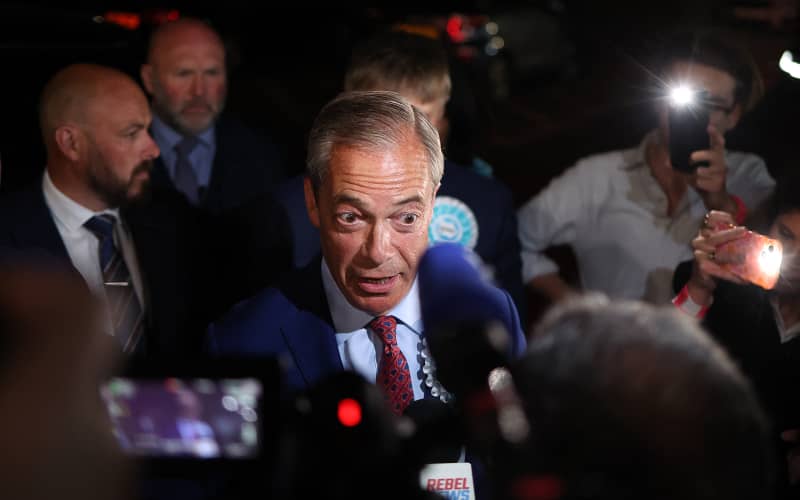
For Reform UK, the timing of the allegations is particularly uncomfortable. The party has been attempting to present itself as a political alternative to the established parties. Nigel Farage has built much of his political reputation on attacking what he calls the political establishment and arguing that ordinary voters have lost trust in traditional politicians. Financial controversies therefore create a potential contradiction between Reform’s political message and questions surrounding its own finances.
Richard Tice has responded aggressively to the allegations. He has argued that Fiona Cottrell is a legitimate donor and rejected suggestions that the money was improperly provided. He has also questioned why information about the police investigation became public before he was contacted directly. Tice described the situation as a politically motivated campaign against Reform and its leadership.
However, the existence of an investigation means that the controversy cannot simply be dismissed as a political argument. The Metropolitan Police have confirmed that an investigation was launched in February 2025 following a referral from the Electoral Commission. Two people have reportedly been interviewed under caution, while early investigative advice has been sought from the Crown Prosecution Service. The police have also made clear that no arrests have been made.
This distinction is important. An investigation does not mean that Reform UK or its representatives have been found guilty of breaking the law. Police investigations are designed to establish whether offences have occurred. Until the process is completed, allegations should not automatically be treated as proven facts.
Nevertheless, political parties have a responsibility to maintain public confidence in their finances. Donations are particularly sensitive because wealthy individuals can potentially gain influence through political funding. British law therefore places restrictions on who can donate to political parties and establishes rules governing political finance.
Reform UK has insisted that it follows the relevant rules. A party spokesperson said that Reform takes pride in its vetting of donations and follows the Electoral Commission’s requirements. From the party’s perspective, the controversy is therefore not evidence of wrongdoing but another example of what it considers hostile scrutiny from the media and political opponents.
The issue is also connected to wider questions about Nigel Farage’s financial affairs. Farage has faced scrutiny over a separate £5 million gift from cryptocurrency investor Christopher Harborne. The gift was reportedly received in 2024, before Farage became an MP, and questions have been raised about whether it should have been declared. Farage has maintained that he complied with the rules and has argued that the money was connected to his security.
These separate controversies have created a difficult political environment for Reform UK. Even if each individual allegation is eventually dismissed, the accumulation of questions can damage public confidence. Voters may begin to wonder whether Reform’s financial arrangements are sufficiently transparent.
This is particularly important because Reform’s political identity depends heavily on trust. Farage has repeatedly argued that established political parties are disconnected from ordinary people and that politicians should be held accountable. Reform therefore has to meet a high standard when dealing with questions about its own behaviour.
At the same time, Reform supporters are likely to see the controversy differently. Many may believe that the party is being targeted precisely because it threatens the established political order. The party has experienced rapid growth, and its success has challenged both Labour and the Conservatives. From this perspective, negative coverage can be interpreted as an attempt to damage Reform before it becomes even more powerful.
Tice’s use of the word “smear” reflects this interpretation. By describing the allegations as politically motivated, he attempts to shift the focus away from the details of the donations and towards the motives of those reporting or investigating them. This is a familiar political strategy: rather than accepting the accusations at face value, a politician questions the credibility and intentions of the people making them.
However, such a strategy carries risks. If politicians repeatedly describe investigations as politically motivated without addressing the underlying questions, voters may conclude that they are avoiding scrutiny. Transparency is usually a stronger response than simply attacking critics.
The controversy involving Fiona Cottrell is particularly sensitive because she is the mother of George Cottrell, a former associate of Farage who was convicted of fraud-related offences in the United States. The family connection does not itself prove that any donation was unlawful, but it has increased media interest in the source and movement of the money. Tice has emphasised that he has known the Cottrell and wider family for many years and considers Fiona Cottrell to be a permissible donor.
The police investigation will therefore be important in determining whether the allegations have a legal basis. Until investigators reach a conclusion, both supporters and critics of Reform should be cautious about making definitive claims.
The wider political consequences, however, may arrive long before any investigation is completed. Political parties depend heavily on public perception. A party that campaigns on transparency and accountability can be particularly vulnerable when questions arise about its own financial arrangements.
For Labour and the Conservatives, the controversy provides an opportunity to attack Reform. Both parties have an interest in preventing Farage from presenting himself as the only credible alternative to the political establishment. Labour has already accused Reform of facing a growing series of financial controversies, while welcoming the police investigation.
Reform, on the other hand, is likely to continue arguing that its opponents are afraid of its electoral success. The party has described critical reporting as a series of “hit jobs” and “smears” and insists that such attacks will not prevent it from pursuing its political ambitions.
The dispute therefore represents more than a question about individual donations. It has become part of a larger struggle over who controls the political narrative in Britain. Farage wants Reform to be seen as a movement challenging the establishment, while his opponents want voters to focus on questions about money, accountability and political standards.
There is also an important democratic principle involved. Political parties need access to funding to organise campaigns, communicate with voters and operate effectively. At the same time, voters need confidence that political donations are lawful and transparent. If either principle is weakened, public trust can suffer.
The best outcome would therefore be a clear and independent examination of the allegations. If the donations complied with the law, Reform should be able to move forward with its reputation strengthened. If investigators discover wrongdoing, the party and those responsible should face the appropriate consequences.
For Nigel Farage, the controversy creates another challenge at a time when he is trying to establish Reform UK as a serious national political force. His personal popularity remains an important asset, but the party cannot depend entirely on his public profile. It also needs strong organisational structures and confidence in its financial arrangements.
Richard Tice’s defiant response demonstrates that Reform has no intention of quietly accepting the allegations. His accusation of a politically motivated smear shows how determined the party is to fight back against criticism. Yet political confidence will ultimately need to be matched by evidence and transparency.
In conclusion, the Reform UK donor controversy has become increasingly serious because police are investigating donations linked to a company controlled by Richard Tice. Tice has strongly denied wrongdoing and described the allegations as a political smear, while Reform insists that its donations are properly vetted. At this stage, an investigation should not be confused with proof of criminal conduct. Nevertheless, the continuing questions place pressure on Reform UK to provide clear answers about its finances.
The controversy may ultimately be decided not by political rhetoric but by evidence. If Reform can demonstrate that its financial arrangements comply with the law, it can argue that the allegations were exaggerated. If serious irregularities are discovered, the party will face a much greater political crisis. For now, the donor row represents another major test for Nigel Farage and Reform UK as they attempt to turn their growing popularity into long-term political power.