
The enemy commander is confident. His elite 272nd Regiment has destroyed South Vietnamese units before. They’ve ambushed American paratroopers. They’ve overrun special forces camps. But what the Viet Cong don’t know is that among those 450 Americans are 17 105 mm howitzers and a lieutenant colonel named John Vessey, who is about to make military history.
By the time the sun reaches its peak, 647 enemy bodies will litter this clearing. And that lieutenant colonel, he’ll go on to become the chairman of the Joint Chiefs of Staff. This is the Battle of Fire Base Gold. And for the Viet Cong, attacking it was a huge mistake. To understand why this battle happened, we need to understand where it happened.
War zone C was the Viet Cong’s backyard. This remote stretch of jungle in Tay Ninh province, hugging the Cambodian border, was home to COSVN, the Central Office for South Vietnam, the communist command center controlling all military operations in the south. In February 1967, the American military launched Operation Junction City, the largest operation of the entire Vietnam War. The goal was simple but ambitious.
Find COSVN and destroy it. Over 30,000 troops poured into war zone C, 22 American infantry battalions, four South Vietnamese battalions, 17 artillery battalions, nearly 3,000 Air Force sorties. It was the hammer meant to smash the communist command structure once and for all. But here’s where the Viet Cong made their first mistake.
Instead of melting into the jungle and waiting out the American offensive, the commander of communist forces in the south, General Nguyen Chi Thanh, chose to stand and fight. Thanh was a hawk. While General Vo Nguyen Giap, the legendary architect of the French defeat at Dien Bien Phu, argued that attacking American firepower head-on was suicide, Thanh believed in conventional warfare.
He believed his elite units could defeat the Americans in pitched battle. On March 19th, 1967, American helicopters began dropping soldiers into a clearing near the abandoned village of Suoi Tre. The mission: establish fire support base Gold, a platform for the 17 howitzers that would support the ongoing operation.
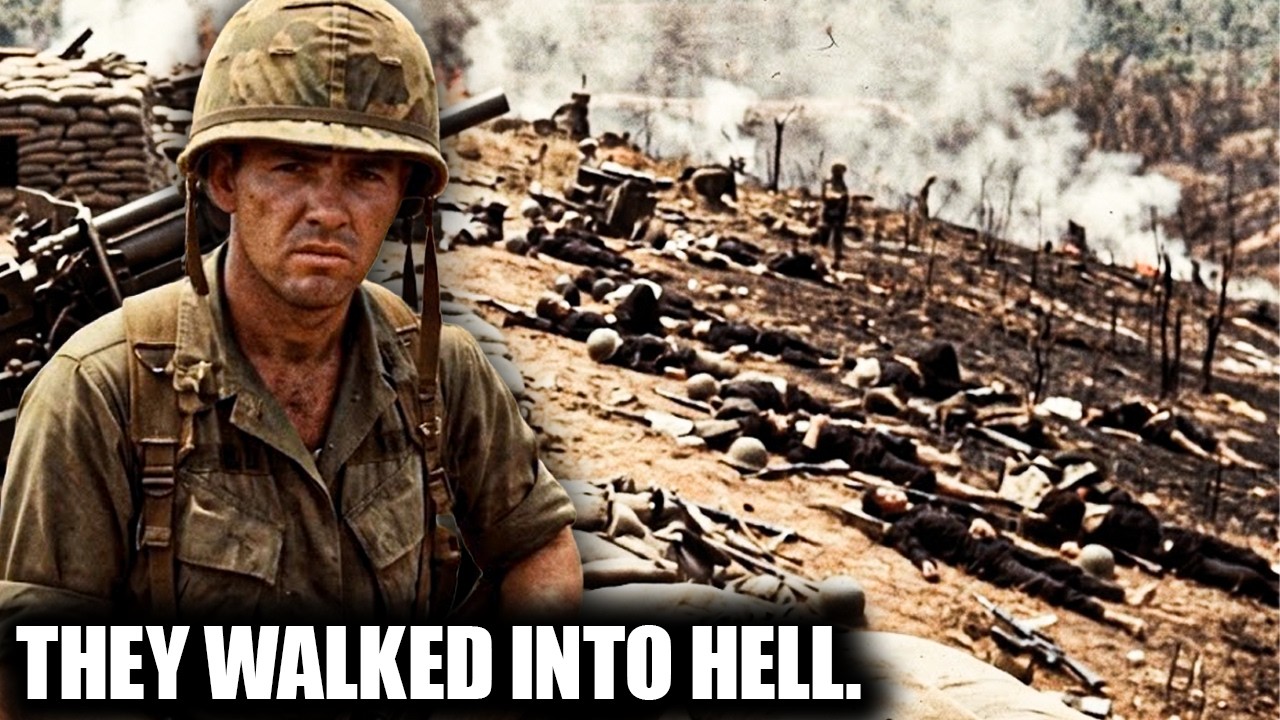
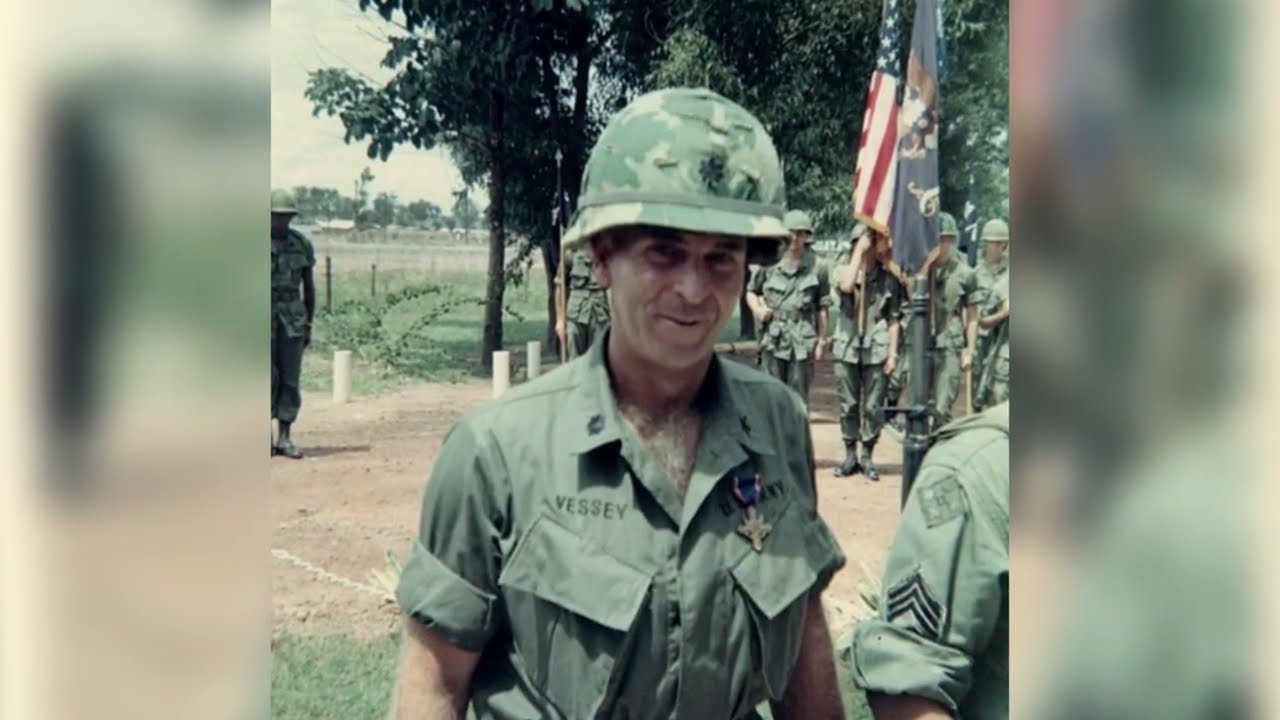
Within hours, the base took shape. A star-shaped pattern of gun pits, foxholes around the perimeter, barbed wire, M45 quad mount .50 caliber machine guns. It was a textbook fire base, but this fire base was different because at its center, commanding the 2nd Battalion, 77th Field Artillery, was a 44-year-old lieutenant colonel who had already earned a battlefield commission in World War II at Anzio, a man who would one day advise President Reagan on nuclear strategy.
His name was John William Vessey Jr. The warning signs were there. They just didn’t matter. 11 days earlier, on March 10th, the Viet Cong had attacked another fire base called Prek Klok II. It was a dress rehearsal for what was coming. At Prek Klok, the Americans used their howitzers in direct fire mode, leveling their guns at charging enemy infantry.
>> >> They killed 197 Viet Cong while losing only three Americans. It should have been a lesson. Instead, Thanh’s forces regrouped and planned an even larger assault. On March 19th, as the first helicopters landed at the new fire base, command detonated explosives buried in the landing zone exploded.
Three helicopters were destroyed, six more damaged, 15 Americans killed, 28 wounded. It was an ambush and it was just the beginning. The next day, March 20th, patrols spotted enemy soldiers observing the fire base from the tree line. That night, a listening post reported movement in the darkness, whispered voices, the metallic clink of weapons being readied. The 272nd Regiment was coming.
At erupted. More than 650 mortar rounds rained down on fire base Gold in the first minutes of the attack. 60 mm, 82 mm. >> >> The explosions walked across the perimeter, shredding sandbags, collapsing bunkers, killing men where they stood. And then came the infantry.
From the eastern tree line, waves of Viet Cong soldiers emerged screaming, firing AK-47s and RPGs. The main assault hit Company B on the eastern perimeter. At the same time, a faint attack struck the western side to prevent reinforcement. >> >> The 272nd Regiment had come to destroy fire base Gold and they had brought everything.
The enemy was equipped for a massacre. 50 RPG-2 rocket launchers, 30 light machine guns, thousands of AK-47s, Browning automatic rifles captured from previous battles, nearly 2,000 stick grenades. They expected to overrun the fire base within hours and then ambush the relief column that would inevitably come.
By 7:11 a.m., barely 40 minutes into the battle, Company B’s 1st Platoon was overrun. The enemy was inside the perimeter. An Air Force forward air controller orbiting overhead in his tiny spotter plane called in F-4 Phantoms loaded with napalm. They dropped their ordinance dangerously close to American positions, incinerating VC soldiers caught in the open. But the napalm wasn’t enough.
The VC kept coming. By 7:50, Company B was running out of ammunition. The captain on the ground made a desperate call. He needed beehive rounds fired directly into his own positions. The enemy was that close. At 8:15, a platoon from Company A that had been outside the perimeter on ambush duty made the insane decision to fight their way back through enemy lines.
They charged directly through VC positions, somehow reaching the fire base alive to reinforce the defenders. By 8:25, the northern perimeter was breached. One of the quad .50 machine gun positions was overrun. Its crew destroyed the weapon with thermite grenades rather than let it fall into enemy hands.
The Viet Cong were now within 15 m of the artillery guns, 5 m from the medical aid station where wounded Americans lay helpless. This is where the Viet Cong’s gamble >> >> turned into catastrophe. Lieutenant Colonel John Vessey moved to the gun line. Around him, 14 of 17 howitzers had been damaged by mortar fire.
But Vessey wasn’t going to let that stop him. He personally rallied his artillery men, >> >> organizing hasty repairs under fire. Within minutes, all but three guns were operational again. And then, Vessey did something that would earn him the Distinguished Service Cross, the Army’s second highest decoration for valor.
He ordered his guns to fire beehive rounds at point-blank range. The beehive round was designed for exactly this nightmare scenario. Officially called the M546 APERS-T, it was essentially a shotgun shell for a howitzer. Inside each round were 8,000 steel flechettes, tiny fin darts that would spread in a cone of death when the shell detonated.
Normally, beehive rounds were fired with time fuses set for air burst. But Vessey’s crews didn’t have time for calculations. They disabled the timers and leveled their 105 mm howitzers at the advancing enemy. They were going to fire these massive artillery pieces like shotguns, point-blank at human beings 75 m away.
50 m. Sometimes as close as 15 m. Imagine. 8,000 steel darts traveling at nearly 1,000 m per second, turning a 105 mm howitzer into the deadliest close-quarters weapon in military history. That morning, Vessey’s artillery battalion fired 40 beehive rounds. Then, when they ran out of beehive ammunition, they switched to high explosive shells, still firing horizontally into the charging enemy.
By the end of the battle, they had expended over 2,000 rounds of artillery at point-blank range. Veterans who survived that day >> >> described finding VC bodies stacked in layers in the foxholes. The flechettes had torn through rank after rank of charging soldiers. One survivor later wrote that the foxholes looked like mass graves, bodies piled three and four deep from the carnage.
For his actions that day, John Vessey received the Distinguished Service Cross. His citation reads, “With complete disregard for his own safety, Lieutenant Colonel Vessey repeatedly moved through the fire base, >> >> encouraging his men and directing their fire. When the perimeter was breached, he personally led counterattacks to restore defensive positions.
” For the men who survived that morning, the memories never faded. Page Lanier was a munitions officer with the 2nd Battalion, 77th Field Artillery. During those desperate hours, he personally resupplied the guns with over 2,000 artillery rounds and 41 beehive rounds. More than 50 years later, at a memorial ceremony, Lanier shared what the battle means to him.
We look to it as a memorial service. It’s not something to really celebrate. We all feel very much for our soldiers that we lost, and we also remember all the soldiers we have lost since then. >> >> Lanier’s words remind us that behind every casualty figure is a human story. But on that morning in March 1967, the men at Firebase Gold weren’t thinking about memorials.
They were fighting for their lives, and help was finally on the way. At 6:40 a.m., just 10 minutes after the attack began, Colonel Marshall Garth at Brigade Headquarters received word that Firebase Gold was under assault. He immediately ordered every available unit to converge on the Firebase, but getting there wouldn’t be easy.
The 2nd Battalion, 12th Infantry, commanded by Lieutenant Colonel Joe Elliott, had marched 4 km from the Firebase the previous day. When the call came, they turned around and started pushing back through dense bamboo jungle toward the sounds of battle. The Viet Cong had anticipated this. Enemy security elements tried to block their advance.
Snipers harassed them. Mortar rounds fell on their column, but Elliott’s men kept moving. They treated their wounded on the march, never stopping. In less than 2 hours, they covered 4 km of hostile jungle while under fire. One veteran later described the urgency. The message was that unless we reach the assailed units, over 300 of our fellow soldiers would be killed or worse.
At 9:00 a.m., the first elements of 2/12 Infantry burst through the tree line on the southwestern edge of the Firebase. They immediately counterattacked, pushing the Viet Cong back from the breached perimeter. But the real game changer came 12 minutes later. The 2nd Battalion, 22nd Infantry, a mechanized unit with M113 armored personnel carriers, and the 2nd Battalion, 34th Armor, with M48 Patton tanks, had been searching for a way to cross the Soi Sai Mat River for 24 hours. When the attack came,
they finally found one. Their solution was pure American improvisation. They sank an armored personnel carrier in the riverbed and drove their tanks over it. At 9:12 a.m., the armor crashed through the jungle from the southwest, .50 caliber machine guns blazing, 90-mm tank guns firing canister rounds filled with steel balls.
The tanks swept the flanks of the Viet Cong assault force, cutting down anyone who tried to escape. Captain Robert Hempill of Company B later wrote, “Like the cavalry in the Old West, an armored task force arrived just in the nick of time to relieve the besieged defenders of Firebase Gold. By 9:30, the perimeter was resecured.
By 11:45, the battle was over.” >> >> The 272nd Viet Cong Regiment, one of the most elite units in the Communist arsenal, had been shattered. The aftermath was staggering. American forces counted 647 Viet Cong bodies on the battlefield. Intelligence later estimated that another 200 or more had been carried away. The Americans captured seven prisoners, two of whom died of their wounds.
They recovered an arsenal, 50 RPG, two rocket launchers, 30 light machine guns, 49 AK-47s, 13 Browning automatic rifles, 31,000 rounds of ammunition, nearly 2,000 grenades. American losses, 31 killed, 187 wounded. >> >> 92 were evacuated. 95 returned to duty the same day. The kill ratio was more than 20 to 1.
That afternoon, bulldozer tanks dug two mass graves. One veteran, Mario Salazar, later wrote, “By noon of the 21st, 647 enemy bodies were collected and placed in two huge common graves dug by tanks with optional bulldozer blades. I remember eating my lunch of cold C rations with my feet hanging over the edge of one of the graves.
” Later that day, >> >> General William Westmoreland, commander of all US forces in Vietnam, arrived by helicopter to survey the battlefield. What he saw confirmed his strategy of attrition. If the enemy could be lured into attacking American firepower, they would be destroyed. The 3rd Brigade, 4th Infantry Division, and all attached units received the Presidential Unit Citation for extraordinary heroism.
It was equivalent to every man in those units receiving the Distinguished Service Cross. So, why was attacking Firebase Gold a huge mistake? First, the tactical failure. The Viet Cong underestimated what artillery could do at close range. 17 howitzers firing beehive rounds turned the Firebase into a death trap.
They planned to overrun the position quickly and then ambush the relief column. Instead, the relief column broke through every blocking position, and the attackers were massacred. Second, they ignored their own warning. 11 days earlier, at Prek Klok II, they had seen exactly what American artillery could do in direct fire mode.
They attacked anyway. Same tactics, same result, only worse. Third, they played directly into American strategy. Westmoreland wanted the enemy to mass for attacks on fortified positions. He wanted battles of attrition where American firepower could achieve lopsided kill ratios. Firebase Gold was exactly what he hoped for.
But the most devastating consequence was strategic. The 272nd Regiment was rebuilt after Soi Tre, but with North Vietnamese Army regulars instead of native southern Viet Cong. Those original southern cadres, men with local knowledge, family connections, and deep roots in the villages, were irreplaceable.
The destruction of elite VC units throughout 1967 fundamentally changed the character of the Communist forces in the south. Ironically, the losses at Firebase Gold and other Junction City battles convinced General Thanh that conventional attacks on American firebases were suicidal. His solution, attack the cities instead.
Within weeks of Soi Tre, COSVN began planning what would become the Tet Offensive of January 1968, the massive countrywide assault that shocked America and changed the course of the war. Thanh himself wouldn’t live to see it. He died on July 6th, 1967, officially of a heart attack, though some American intelligence sources believe he was wounded in a B-52 strike on COSVN headquarters.
And Lieutenant Colonel John Vessey, he kept rising through the ranks. He commanded a division. He served as Vice Chief of Staff of the Army. And in 1982, President Ronald Reagan appointed him the 10th Chairman of the Joint Chiefs of Staff, the nation’s highest military position. He remains the only draftee in American history to reach that office.
When Reagan asked what qualified him for the job, Vessey’s answer was simple. 46 years of service from private to four-star general. The Firebase concept that proved so deadly at Soi Tre would be replicated more than 8,000 times across Vietnam before the war’s end. Each one was a statement, “Come attack us, and we will destroy you.
” The Battle of Firebase Gold lasted less than 6 hours. But for the men who fought there, and for the history of the Vietnam War, its echoes lasted far longer. On March 21st, 1967, the Viet Cong bet everything on overwhelming 450 Americans. It was a huge
What Patton Said to the Guard Who Threatened His POWs
On May 1st, 1945, General George S. Patton walked into the largest prisoner of war camp in Nazi Germany and saw what had been done to his men, and what he said next was quiet, low, and absolutely meant. That moment, a few words spoken under his breath in a liberated camp in Bavaria, tells you more about who Patton actually was than almost anything else in the historical record, more than any speech, more than any battle, more than any Hollywood film could capture.
To understand what he said that day, and why it landed the way it did, you need to understand what the men in that camp had been living through, and you need to understand the war Patton had been fighting on behalf of every American soldier who had been captured, caged, starved, and left to wait for a rescue that kept not arriving.
If you grew up in the decades after World War II, the image of Patton is already somewhere in your head. The helmet, the ivory-handled pistols, the riding crop, that gravelly, authoritative voice delivered by George C. Scott in the 1970 film that opened with one of the most famous speeches in movie history. Here is the first thing worth knowing.
Almost all of that image holds up, except the voice. Patton’s actual speaking voice was noticeably high-pitched, and contemporaries who encountered him for the first time were consistently surprised by it. The man who projected pure aggression and dominance on the battlefield spoke in a way that did not match the image at all, and that small disconnect tells you something about the distance between the legend and the person. George Smith Patton, Jr.
was born on November 11th, 1885 in San Gabriel, California, a community just east of Los Angeles, into a family where military service was not a career choice, but a bloodline. His grandfather commanded the 22nd Virginia Infantry during the Civil War and was killed at the Third Battle of Winchester, and his great uncle fell at Gettysburg leading the 7th Virginia during Pickett’s Charge.
Family belief even held that the Patton’s descended from 16 of the barons who had signed the Magna Carta. History, legacy, and military service were not abstractions in that household. They were the air the family breathed. Patton genuinely believed in reincarnation and stated on multiple occasions that he had fought in previous wars in previous lives, that he was a warrior who had simply been born into the wrong century and was forced to wait through the long years of peace until history finally needed him again.
By the time World War II arrived, he was already in his mid-50s, and he had been preparing his entire adult life for something that might never come. And then it came. As commander of the U.S. Third Army, Patton became one of the most aggressive and effective field generals in American history, and his philosophy was almost absurdly simple.
Attack constantly, move fast, never let the enemy rest or dig in. His men did not dig foxholes because foxholes slowed an offensive, and slowing an offensive was the one thing Patton could not tolerate. Keep moving. Always forward. The German High Command feared him specifically. Where other Allied commanders caused German generals to calculate and regroup, Patton caused them to panic, and that distinction mattered enormously in a war where speed decided everything.
But this is not only a story about battles, and Patton was not only a man defined by what he did on the battlefield. What he did on May 1st, 1945 in a liberated prison camp in Bavaria, tells a different part of the story, the part about what he believed he owed the men who served under him, and what happened when he finally stood face to face with the evidence of what the enemy had done to them.
Before getting to May 1st, 1945, you need a clear picture of what life actually looked like for an American soldier captured by the Germans in the final years of the war. Germany’s largest prisoner of war camp carried the official designation Stammlager 70A, known in the records as Stalag 70A, and its location was just north of the Bavarian town of Moosburg, about 22 miles northeast of Munich.
The design capacity of that camp was 10,000 prisoners. By the spring of 1945, 110,000 people were inside it. Let that number sit for a moment because it does not make intuitive sense until you hold it against the original number. A camp built for 10,000 men was holding 110,000 men from 72 different nationalities.
Americans, British, French, Soviet, Polish, Norwegian, Australian, New Zealander, South African, Serbian, Canadian, Italian, and more. 27 Soviet generals were imprisoned there. Sons of four American generals were imprisoned there. The American prisoners were mostly airmen, bomber crews, and fighter pilots shot down over Germany during the strategic bombing campaigns, along with ground soldiers captured during the Battle of the Bulge, which began in December of 1944 and produced the heaviest American casualty
and capture figures of the entire European war. A prisoner named Frank Murphy, who had flown with the 100th Bomb Group before being shot down and captured, later recorded his experiences in careful detail for the 100th Bomb Group Foundation, and his account stands as one of the most complete first-hand records of life inside that camp.
Murphy described barracks designed for 180 men that held over 400. Triple-deck wooden bunks with mattresses stuffed with wood shavings came with the extra feature of being fully infested with fleas, lice, and bedbugs. And the men who could not claim a bunk slept on floors, on tables, or on the ground inside the large tents that had been erected in every available open patch within the wire.
One cold water spigot per building served as the only water source for every purpose, drinking, cooking, washing. Daily food rations ran to two or three slices of heavy German black bread in the morning, a bowl of watery soup made from dehydrated vegetables at midday that the prisoners had christened green death, and one or two more slices of black bread in the evening. Nothing else.
That was the entire day. Latrines were separate unheated structures, open slit trenches with a long bench of holes spaced 18 inches apart, every hole in constant use, lines of men always waiting their turn. Dysentery and diarrhea were rampant throughout the camp. Murphy recorded that there was nothing to read, no room to walk, and nothing to do but sit and wait for the war to end.
And here is the point that matters most about those conditions. This was not a deliberate extermination effort. This was what happened when you packed 11 times a facility’s intended population into it while the supply systems of a collapsing empire fell apart around everyone’s ears. Other camps were worse. Other situations were actively deadly.
And Patton already knew, before he ever walked through the gate at Moosburg, exactly what the enemy was capable of when things got desperate. George Patton was not a man who assumed the best of his opponents, and he had studied the Germans with enough care to know what they did when cornered, when retreating, when they needed to cover their tracks.
Two events had made it undeniably clear that the Germans were capable of murdering American prisoners. On December 17th, 1944, right at the opening of the Battle of the Bulge, Waffen SS troops of Kampfgruppe Peiper captured a group of American soldiers near the Belgian town of Malmedy, and what followed was not a prisoner processing.
84 American POWs were shot down in cold blood in an open field, their bodies later found by American soldiers partially frozen in the snow. 73 Germans were eventually tried for the Malmedy Massacre and related killings of American prisoners and Belgian civilians, and the trial became one of the most extensively publicized war crimes proceedings of the postwar period.
The second event cut even deeper into the Allied Command’s understanding of German intentions. In March of 1944, 76 Allied airmen escaped from Stalag Luft III through a tunnel in what became known as The Great Escape, and 73 of them were recaptured. Adolf Hitler’s personal order condemned 50 of those 73 men to death, not in combat, not in a courtroom, but shot as a warning to any other prisoner who considered trying to escape.
Patton carried the knowledge of both events, and when American intelligence in early 1945 began indicating that retreating German forces might execute their American prisoners rather than allow them to be liberated, that knowledge shaped every decision he made. On the evening of March 25th, 1945, Patton gave secret orders to the Fourth Armored Division of his Third Army, orders that set in motion what became known as Task Force Baum, an armored raid 50 miles deep into German-held territory with a single stated mission.
Liberate the American officers imprisoned at Oflag 13B near the German town of Hammelburg. Command of the mission fell to Captain Abraham Baum, who had been fighting since Normandy, where shrapnel from a minefield had already collected its payment from him. Lieutenant Colonel Creighton Abrams, who would eventually become one of the most decorated American generals of the 20th century, assigned Baum to the task and immediately objected to the size of the force Patton had approved.
Abrams wanted a full combat command. What he got was 314 men, 16 tanks, 28 half-track personnel carriers, and 13 jeeps with only a few maps and no confirmed location for the camp they were trying to reach, which meant they had to stop and ask directions from German civilians as they moved through enemy territory at night. Now, an honest account of Task Force Baum cannot sidestep the controversy at its center.
Patton stated publicly that he ordered the mission out of fear that retreating Germans would execute the prisoners, a fear grounded entirely in documented reality given Malmedy and the Stalag Luft III murders. But, it was also widely known, and most historians accept, that Patton’s son-in-law, Lieutenant Colonel John K.
Waters, was almost certainly being held at Oflag 13B at the time. Waters had been captured in Tunisia in February of 1943, meaning he had already spent two full years as a prisoner when Patton ordered the raid. He had just completed a forced march from a prison camp in Poland 340 miles on foot through freezing winter conditions and had arrived at Hammelburg only weeks before Task Force Baum headed out.
Whether the mission was about saving American prisoners or saving his daughter’s husband, Patton always denied any personal motivation. Captain Baum, among others, believed otherwise. The mission ended in catastrophe. Task Force Baum reached Oflag 13B and crashed through the fence, and the prisoners cheered wildly right up until Baum looked around and realized the situation was impossible.
He had been told to expect a few hundred officers. Over 1,300 American officers were inside the wire plus several thousand Serbian prisoners in a nearby camp, and his battered force was already low on fuel and ammunition after fighting through 50 miles of German territory. Only field-grade officers were allowed to ride out on the vehicles.
Everyone else was told they could march with the column or attempt to reach American lines 50 miles west on their own. Most were too weak to walk. They stayed behind. And then the ambush hit Task Force Baum on the way back out, and the numbers tell the rest of the story plainly. Of the 314 men who had gone in, 35 made it back to American lines.
26 were killed and the rest were captured. Every one of the 57 vehicles was destroyed or taken. Lieutenant Colonel Waters, who had walked out under a white flag to stop the American tankers from firing on Serbian prisoners they had mistaken for Germans, was shot in the stomach by a German guard and taken back to the camp hospital.
Captain Baum was shot in the groin while trying to escape and also captured. And the two men recovered together in the camp infirmary until the 14th Armored Division arrived and liberated the camp properly on April 6th, 10 days after the raid had failed. Waters survived and eventually became a four-star general.
Baum received the Distinguished Service Cross, personally awarded by Patton, who wanted no higher decoration given because any higher award would have required an official investigation into the circumstances of the mission, and Patton had no interest in that investigation happening. Eisenhower was furious when the full picture became clear, and he reprimanded Patton for the entire episode.
But, what the Hammelburg raid reveals about Patton underneath all the controversy and the recklessness is that he was willing to risk 300 men, willing to defy his commanding general, willing to put his own career in serious jeopardy for the possibility that American soldiers in an enemy prison camp might be murdered before help arrived.
Right or wrong, reckless or justified, that was the calculation he made, and it explains exactly what happened when he finally walked into Stalag 7A 3 weeks later. By late April 1945, the war in Europe was running out of road. German armies were collapsing on both fronts simultaneously. Soviet forces grinding from the east, American and British forces pressing from the west.
Berlin surrounded, Hitler underground in his bunker below the Chancellery. Inside Stalag ZVEA near Moosburg, 110,000 prisoners were waiting. Signals had been building for weeks. American P-47 and P-51 fighter aircraft were strafing targets in and around Moosburg on nearly every clear day through April, and occasionally a pilot would swoop low over the camp and wag his wings, a small gesture that told the prisoners the Kriegies, using the German term for war captive, that someone up there could see them.
On April 9th, more than 500 American B-17 bombers of the 8th Air Force passed overhead just west of the camp, escorted by 340 P-51 fighters, heading south toward targets in the Munich area, and the prisoners below watched the entire formation cross the sky. By the last days of April, artillery was audible in the distance, and some of the German guards had already started deserting their posts and handing their weapons to former prisoners.
On the morning of April 29th, something unusual happened near the main gate. Two German staff cars with red crosses painted on their sides pulled up, and out of one of them stepped Colonel Paul S. Good, the senior American officer at the camp, along with a British RAF group captain named Kellett. Good had been working to arrange a peaceful handover that would avoid a battle fought around 110,000 men who had nowhere to take cover.
He turned to the prisoners staring at him and delivered the most efficient possible briefing. “You guys better find a hole. The war is about to start.” American Combat Command A had already rejected the German proposal for a neutral zone surrounding Moosburg, and the Germans were given until 9:00 that morning to offer unconditional surrender or absorb the attack.
The Germans did not surrender. At approximately 9:00 in the morning, Combat Command A of the 14th Armored Division units under Patton’s Third Army attacked, and the German opposition consisted of remnants of the 17th SS Panzer Grenadier Division and the 719th Infantry Division, forces with no tanks, no anti-tank guns, armed only with small arms, machine guns, mortars, and panzerfausts.
Artillery support for the American attack was ordered silent throughout the engagement specifically to avoid killing the prisoners inside the wire. Frank Murphy, still inside the compound, pressed himself flat against the ground next to his barracks as bullets ricocheted through the camp. Several prisoners were hit, though none fatally.
By mid-morning, the SS troops were dead in the fields outside Moosburg, and American medium tanks were rolling through the streets of the city. Three Sherman tanks of the 14th Armored Division then came crashing through the perimeter fence of Stalag 7A without any announcement or ceremony, trailing the wire and fence posts behind them as they drove into the main street of the compound, and what happened next is almost impossible to describe in language that does it justice.
The prisoners swarmed the tanks. Men who had not laughed freely in months were laughing. Men who had not cried in years were crying openly. A 6’4″ Australian threw his arms around one of the drivers and shouted about how much he loved Americans in terms that cannot be repeated here. A bearded American paratrooper climbed onto a tank and kissed the tank commander on the cheek with tears running down his face.
An Air Corps lieutenant pressed his face against the hull of a Sherman tank and kissed the metal. “God damn, do I love the ground forces,” he said. “This is the happiest day of my life.” A French soldier who had been imprisoned for years found an American GI, introduced himself with great formality, and then said that he wanted to personally tell every American private first class that he was eternally indebted to them and eternally grateful.
One of the tank drivers, a tech five named Floyd C. Mahoney of the 47th Tank Battalion rolled his Sherman through the gate of Stalag 5A and freed his own son, an Air Corps lieutenant who had been imprisoned there. A father crashing through the wire in a tank to find his son on the other side. Around 12:30 in the afternoon, the American flag went up over the church steeple in Moosburg, and 8,000 American prisoners turned to face it, came to attention, and saluted men in ragged, worn-out, lice-infested clothes who had not seen
their country’s flag waving free in two, three, sometimes four and years, standing at attention in the mud of a liberated Bavarian prison camp. The final count confirmed 110,000 Allied prisoners freed. 30,000 of them were Americans. The 14th Armored Division captured 12,000 German soldiers in and around Moosburg that single day.
The 47th Tank Battalion alone, 600 men strong, took 2,000 prisoners, and the 94th Reconnaissance Squadron took 2,000 more. The New York Times initially reported 27,000 freed. They printed a correction the following day. 110,000, the largest prisoner of war camp in Germany, emptied in a single afternoon. Two days after the liberation on May 1st, 1945, General George S.
Patton walked through the gate of Stalag 5A. He arrived as the man whose army had freed it. The 14th Armored Division belonged to the Third Army, which belonged to Patton, and the men inside that camp had been freed by soldiers under his command. He had come to see what had been done to them. The uniform was perfect, as it always was, crisp, immaculate, freshly pressed, with the legendary wide black leather belt, and the enormous silver buckle, and the paired ivory-handled pistols, and four stars on everything.
Major General James A. Van Fleet, the Third Corps Commander, and Major General Albert C. Smith, Commander of the 14th Armored Infantry Division, accompanied him through the camp. Patton walked through Stalag IX-A, stopping occasionally to exchange a few words with small groups of American prisoners.
And this is where Frank Murphy’s account becomes the record that history depends on. Because Murphy was standing in the camp when Patton reached his group. The general stopped. He looked at the men in front of him. And then Patton shook his head slowly. In what Murphy described as disgust not at the men themselves, but at what had been done to them, at the sight of thin, hollow-eyed human beings in worn-out clothing who had been starved and crowded and left to deteriorate in a German cage while American boys died by the thousands fighting to reach them.
When he spoke, it was quiet, low, almost to himself. “I’m going to kill these sons of [ __ ] for this.” No speech, no dramatic declaration, no profanity-laced oration for the benefit of history. Just a general standing in front of his men, what remained of them, the walking survivors, and making a private, personal, furious promise.
Now, some watching this will immediately recognize that Germany surrendered 7 days later, on May 8th, 1945, and the killing was effectively done. But that is not the point of what Patton said, and reducing it to a logistical observation misses everything. The point is what the words revealed about the man who spoke them.
For all his bombast, all his theatrical speeches, and profane performances, and carefully cultivated image, when something cut through all of that and reached Patton at the actual core, when he was standing in front of the evidence of what his men had endured, this is what he sounded like. Quiet, controlled, deadly serious.
A man who had driven his army across North Africa and Sicily and France and into the heart of Germany, who had been reprimanded for slapping a soldier, and reprimanded for the Hammelburg raid, and reprimanded for his public statements more times than Eisenhower could comfortably count, and who had never once wavered in his view that the soldiers under his command were his personal responsibility.
Not assets, not resources, his men. “I’m going to kill these sons of [ __ ] for this.” Now, consider a different kind of man entirely. No general stars, no ivory-handled pistols, no famous uniform, and no legend attached to his name. A stocky 25-year-old from South Knoxville, Tennessee, who had graduated from Knoxville High School in 1938 and enlisted in the United States Army in 1941, before the Japanese attack on Pearl Harbor made enlisting the obvious thing to do.
His name was Master Sergeant Rodrick W. Edmonds, and his friends called him Roddy. Assigned to the 106th Infantry Division, the Golden Lions Edmonds arrived in Europe in December of 1944, and 6 days after he landed, the Battle of the Bulge began, hitting the 106th Division in exactly the wrong position at exactly the wrong moment.
On December 19th, 1944, his commanding officer surrendered the position, and Edmonds became one of approximately 20,000 Americans taken prisoner during that single battle. The prisoners were marched 50 km through the cold to a railway station, then loaded into boxcars, 70 men per car, no food, no water, eating snow to survive, and transported to a prisoner of war camp.
Edmonds eventually ended up at Stalag 9-A near Ziegenhain, Germany, where his rank as the highest-rated non-commissioned officer among the American prisoners placed him in command of approximately 1,275 American POWs. He was 25 years old, and nobody had trained him for this. On their first day at Stalag 9-A, January 27th, 1945, the German camp commandant, a major named Siegemann, delivered an order through Edmonds.
The following morning, all Jewish soldiers were to present themselves for separate assembly. American soldiers captured at the Battle of the Bulge understood exactly what that meant. Before deployment, Jewish soldiers had been warned to break or lose their dog tags, because those tags were stamped with the letter H for Hebrew, and being identified as Jewish in a German prison camp in 1945 was potentially a death sentence.
The men standing around Edmonds that day knew what had happened at Malmedy. They knew what the Germans had done to the 50 men recaptured after the Great Escape. That night, Edmonds gave a different order. Every American soldier would stand in formation together the following morning, not just the Jewish soldiers, all 1,275 of them.
When Siegemann came out the next morning and found the entire American prisoner population assembled in front of the barracks, Roddy Edmonds standing at the front, the major’s face went red immediately. He strode up to Edmonds and shouted, “These men cannot all be Jews.” Edmonds replied, “We are all Jews here.
” Siegemann drew his Luger and pressed it directly to Edmonds’ forehead. Multiple witnesses standing nearby recorded what followed, men who spent the rest of their lives carrying the memory of that morning, and who eventually told the world what they had seen. Siegemann screamed at Edmonds that he would order the Jewish soldiers to step forward or be shot on the spot, and Edmonds, with a German pistol barrel pressed against his head, told him calmly that the Geneva Convention required a prisoner of war to provide only his name, rank, and serial
number, and that religion was not among the requirements. And then Edmonds said the thing that required a level of nerve that most human beings will never be called upon to find. “If you shoot me,” he said, “you will have to shoot all of us, because we all know who you are, and when the war is over, you will be tried as a war criminal.
” Siegemann stood there with the gun still raised. And then the calculation changed. The war was clearly in its final weeks, Allied forces closing in from every direction, the Nuremberg principles already circulating among the Allied command, and the man in front of him with the barrel at his head was not blinking, was not pleading, was not moving.
Siegemann turned red. He dropped the pistol. He turned and walked back to his office. 1,275 American prisoners returned to their barracks, between 200 and 300 Jewish soldiers still safely among them, unidentified, alive. Stalag 9-A was liberated on March 30th, 1945. Roddy Edmonds came home. He served again in Korea with the First Cavalry Division.
He worked in mobile home sales, in cable television, at the Knoxville Journal. He married three times. He lived a regular life in East Tennessee. He never told anyone what had happened in that German prison camp, not his wives, not his children. The story stayed sealed inside him for the rest of his life. Edmonds died on August 8th, 1985, at 65 years old, and his family had no idea what he had done.
The discovery came only after his death, when his daughter was making a video about his life for a college project, and her mother produced the diaries he had kept at Stalag 9-A. His son, Christopher, began searching for names, found an article mentioning a former prisoner named Lester Tanner, who had become a prominent New York attorney, and in that article, Tanner stated that he and many other Jewish soldiers owed their lives to Sergeant Roddy Edmonds.
A Jewish POW named Paul Stern put it in terms that stay with you. “Although 70 years have passed, I can still hear the words he said to the German camp commander.” In 2015, Yad Vashem, Israel’s Holocaust remembrance center in Jerusalem, named Roddy Edmonds Righteous Among the Nations, a distinction reserved for non-Jews who risked their lives to save Jewish people during the Holocaust, and Edmonds became the only American serviceman ever to receive it.
President Barack Obama attended the ceremony at the Israeli Embassy in Washington in January of 2016, praising Edmonds for action above and beyond the call of duty. On March 2nd, 2026, more than 80 years after that morning at Stalag IX-A, President Donald Trump posthumously awarded Master Sergeant Rodrick W. Edmonds the Medal of Honor, and his son, Christopher, received it on his behalf.
The citation honors a moment in which no shot was fired by an American, no weapon was used, and the only force applied was the voice of a 25-year-old sergeant from Tennessee who looked a German officer in the eye with a pistol at his forehead and said, “We are all Jews here.” Bring it back now to where this started.
George Patton walking through Stalag VII-A, stopping in front of a group of starved and hollow-faced American prisoners, shaking his head, and saying quietly to no one in particular, “I’m going to kill these sons of [ __ ] for this.” Roddy Edmonds standing at the front of a formation of 1,200 men with a pistol pressed to his forehead, calmly explaining prisoner of war law to the man holding the gun.
Two very different kinds of men responding to the same reality, the same enemy, the same threat to American soldiers who had been captured, caged, and left to wait. Patton’s response was fury, cold and controlled. The fury of a man who viewed every soldier under his command as a personal charge, and for whom what the enemy had done to those men was something that had been done to him directly.
Edmond’s response was something harder to name, and possibly harder to produce, courage without drama. Courage that asked for no audience, sought no recognition, and was carried silently for four decades afterward. He placed his body between his Jewish soldiers and a German officer with a loaded pistol, and he simply would not move.
Both men were responding to what the war demanded of them at that specific moment, in that specific place, and neither of them fit neatly into the image of what a war hero is supposed to look like. Patton was too controversial, too flawed, too often wrong in ways that cost real men their lives. Edmonds was too quiet, too ordinary, too easily forgotten by a history that tends to remember the famous and miss the ones who simply did what needed doing, and then went home to sell mobile homes in East Tennessee.
What both of them tell us, together, is something that textbooks rarely manage to say clearly. The American soldier in the Second World War was not a symbol or a movie character, but a real human being dropped into circumstances of extraordinary violence and moral weight, asked again and again to be better than the situation seemed to allow.
Sometimes the record shows failure. History holds those failures honestly. But sometimes, in a liberated prison camp in Bavaria, in a morning formation of 1,200 men outside their barracks in the cold, the record shows something else entirely. Germany surrendered on May 8th, 1945, 7 days after Patton walked through the gate at Moosburg.
The camps emptied. The soldiers began the long process of going home. Patton himself never completed that journey in any real sense. On December 9th, 1945, a vehicle accident near Mannheim left him critically injured, and 12 days later, on December 21st, 1945, he died from those injuries at 59 years old.
3 and 1/2 months after the war he had spent his entire life preparing for had ended. He rests now at the American Army Cemetery and Memorial at Hamm, Luxembourg, buried among the soldiers he commanded. The men he freed at Moosburg went home and mostly said nothing, the way that generation generally said nothing about what they had been through.
They came back to America, found work, built families, and left the details behind the lice, the green death soup, the barracks with 400 men where 180 belonged, the cold water spigot that was the only water source for everything. Some of them wrote it down. Frank Murphy wrote it down, and his account, preserved by the 100th Bomb Group Foundation, gives us the record of the moment when the most famous American general in Europe walked into a liberated prison camp, looked at what had been done to his men, and said the only thing left to say,
“I’m going to kill these sons of [ __ ] for this.” Not a speech, not a battle cry, a general face-to-face with the evidence of what his men had survived, making a quiet and personal promise on their behalf. And Roddie Edmonds, who never wore four stars, and never made a famous speech, and whose name appeared in no headline until long after he was gone, he made his own kind of promise on a cold January morning in 1945, not in words, but in the simple act of staying still when every instinct must have been screaming at him to move.
These stories deserve to be told, not because they are comfortable or clean or simple, but because the men who lived them were not myths. They were there. What they did was real. And the least we can do, all these years later, is remember it. If this video stayed with you, please share it with someone who would appreciate it, and leave a comment below about a story from this era that you think deserves more attention.
If you have a family connection to any of the units or camps mentioned here, Stalag VIIA, the 14th Armored Division, the 100th Bomb Group, the 106th Infantry Division, we would genuinely like to hear about it. Thank you for watching.