

Introduction: A New Flashpoint in Britain’s Migration Crisis
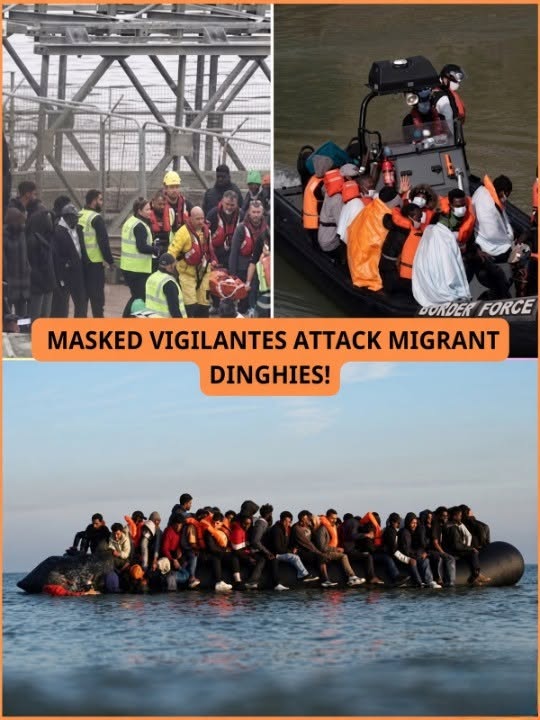
Images and videos appearing to show masked individuals confronting migrant boats in the English Channel have triggered a wave of public debate across Britain. The footage, shared widely online, has reignited arguments about illegal migration, border enforcement, public frustration, and the limits of civilian intervention.
Supporters of tougher migration controls have described the scenes as a sign of growing anger among communities who feel government policies have failed to address repeated Channel crossings. They argue that ordinary citizens are becoming increasingly frustrated by what they see as a lack of effective action against illegal migration.
However, critics have warned that vigilante activity at sea could create serious risks, potentially putting migrants, volunteers, and law enforcement personnel in dangerous situations. They argue that border management is the responsibility of government agencies and trained authorities, not private groups.
The events have therefore become part of a much larger national conversation: how should Britain respond to continued small boat crossings, and where should the line be drawn between public protest and direct action?
The Growing Tension Around Channel Crossings
For several years, small boat crossings across the English Channel have remained one of the most politically sensitive issues in the United Kingdom.
Thousands of people have attempted the dangerous journey from northern France to Britain, often travelling in overcrowded inflatable dinghies organised by people smugglers.
The journeys are extremely hazardous. The Channel is one of the busiest shipping routes in the world, with strong currents, unpredictable weather, and heavy commercial traffic.
British authorities, including the Border Force and emergency services, have repeatedly warned that the crossings put lives at risk.
Governments of different political parties have struggled to find a solution. Measures have included increased cooperation with France, stronger enforcement against criminal smuggling networks, changes to asylum procedures, and attempts to discourage people from making the journey.
Despite these efforts, the issue remains politically unresolved, creating frustration among many voters.
Who Are the Masked Individuals and What Happened?
The footage circulating online reportedly shows masked people approaching or confronting migrant boats in the Channel area. However, details surrounding the individuals involved, their intentions, and the exact circumstances of the incidents require careful verification.
Some online commentators have described them as “vigilantes” attempting to stop migrant crossings themselves. Others have portrayed them as activists responding to what they believe is a failure of government border policy.
The term “vigilante” itself is controversial.
Supporters of direct action argue that citizens have the right to express opposition when they believe official systems are failing.
Critics argue that individuals taking enforcement into their own hands can undermine the rule of law and create unpredictable consequences.
Authorities generally maintain that immigration enforcement must be carried out by legally authorised agencies with appropriate training and equipment.
Why Some People Support Hard-Line Action
Among those supporting tougher action, the issue is connected to concerns about border control, national sovereignty, and public resources.
Some residents in coastal areas have expressed frustration about the repeated arrival of migrant boats and the pressure placed on local communities, including accommodation services and public facilities.
They argue that governments have spent years promising solutions while crossings continue.
For some campaigners, the appearance of civilian groups confronting boats represents a visible expression of public anger.
They believe stronger measures are necessary to discourage illegal crossings and reduce the influence of smuggling gangs.
Some also argue that governments should listen more closely to citizens who feel ignored by political leaders.
Concerns About Vigilante Behaviour
Despite public frustration, legal experts and community leaders have warned about the dangers of unofficial intervention.
The English Channel is a complex environment where even trained professionals face challenges.
Attempting to intercept boats, approach migrants at sea, or interfere with rescue operations could create additional risks.
There are also legal questions surrounding private citizens attempting to enforce immigration rules.
Immigration control involves complex procedures, including asylum rights, international agreements, and humanitarian responsibilities.
Critics argue that individuals without official authority may not understand the legal situation of people arriving by boat.
They warn that emotionally charged situations could escalate quickly, particularly when large groups of people are involved.
The Humanitarian Dimension
Behind the political arguments are thousands of individual human stories.
Many people attempting Channel crossings say they are fleeing conflict, persecution, poverty, or instability in their home countries.
Human rights organisations argue that migrants and asylum seekers should be treated with dignity and that rescue responsibilities must remain a priority.
They emphasise that regardless of political views on immigration policy, people travelling in dangerous boats remain vulnerable human beings.
However, opponents argue that humanitarian concerns must be balanced with border security and the need for a controlled immigration system.
They claim that uncontrolled arrivals can create pressure on housing, public services, and social cohesion.
This tension between humanitarian responsibility and border enforcement is at the centre of the migration debate.
The Role of Social Media in Amplifying the Conflict
The controversy has also highlighted the powerful role of social media.
A short video clip can spread internationally within hours, often reaching millions of viewers before authorities provide official information.
Supporters and opponents of different political positions frequently use online platforms to present competing interpretations of the same event.
A video showing confrontation may be described by one side as “citizens defending the border” and by another as “dangerous vigilantism.”
The reality may involve more complicated circumstances that are not immediately visible in short clips.
Experts have repeatedly encouraged people to verify information before reaching conclusions, especially on issues involving migration, crime, and public safety.
Political Pressure on the Government
The Channel crossings have become one of the biggest political challenges facing successive British governments.
Voters across the political spectrum have demanded clearer answers about how illegal migration should be managed.
Some parties have called for tougher border controls, stricter asylum rules, and stronger action against people smugglers.
Others argue that the focus should be on improving legal migration routes, international cooperation, and humanitarian systems.
The issue has become especially significant because immigration is closely connected to public confidence in government.
When people believe borders are not being controlled effectively, trust in institutions can decline.
France and Britain’s Shared Challenge
The English Channel migration issue is not only a British problem.
France has also faced significant challenges managing migrants gathering along its northern coastline.
British and French authorities have worked together through agreements designed to reduce crossings and disrupt smuggling networks.
However, cooperation has faced political pressure and practical difficulties.
Smuggling organisations constantly adapt their methods, often changing routes and tactics.
Authorities on both sides argue that stopping the crossings requires international cooperation rather than isolated national action.
The Debate Over Responsibility
At the heart of the controversy is a fundamental question:
Who is responsible for solving the migration crisis?
Those frustrated with current policies argue that governments have failed and that communities are being left to deal with the consequences.
They believe stronger action is necessary.
Others argue that allowing private groups to intervene creates more problems than solutions.
They believe democratic governments, courts, and law enforcement agencies must remain responsible for immigration enforcement.
The disagreement reflects a wider debate about trust in institutions and the role of citizens in modern democracies.
A Divided Public Conversation
The reaction to the Channel confrontation reflects how deeply divided Britain has become over migration.
For some, the issue represents a failure to protect borders.
For others, it represents a humanitarian challenge requiring compassion and international cooperation.
Both sides often express genuine concerns, but the debate has become increasingly emotional.
The language used online can sometimes make compromise more difficult, with accusations of extremism, cruelty, or betrayal appearing on both sides.
Finding a balanced approach remains a major challenge for policymakers.
Conclusion: A Symbol of a Much Bigger Debate
The reported confrontations involving masked individuals and migrant boats have become more than a single incident.
They represent wider frustrations, fears, and disagreements about immigration, national identity, government responsibility, and public safety.
Supporters of stronger border controls see the events as evidence that many citizens have lost confidence in existing policies.
Critics see them as a warning about the dangers of individuals attempting to replace official authorities.
The facts surrounding individual incidents must continue to be examined carefully, but the broader debate is unlikely to disappear.
As Britain continues to search for answers on migration, the challenge will be finding a solution that addresses border security, respects the rule of law, and recognises the human realities behind every crossing.
The Channel remains not only a physical border between two countries, but also a symbol of one of the most difficult political questions facing modern Britain.
Masked Vigilantes and Migrant Boats: The Channel Confrontations Fueling Britain’s Border Debate
The English Channel has once again become a focal point in Britain’s increasingly heated debate over immigration, border security and the rule of law. Reports and claims involving masked vigilantes, migrant boats and confrontations along the coast have intensified public concern, raising difficult questions about how the country should respond to irregular migration without undermining the principles that underpin a democratic society.
For many people living in coastal communities, the issue is no longer an abstract political argument. It is connected to questions about public safety, the responsibilities of local authorities, pressure on public services and the government’s ability to manage the border effectively. At the same time, the appearance of unofficial groups seeking to intervene in migration-related incidents has introduced another source of tension into an already divisive situation.
The result is a growing confrontation between those demanding tougher action against irregular migration and those warning that vigilantism could make a difficult problem even more dangerous.
Rising Tensions Along the English Channel
The Channel has long been one of the most politically sensitive routes into the United Kingdom. Small boats carrying people across the narrow but dangerous stretch of water have become a defining image in the national immigration debate.
Successive governments have promised to reduce crossings, disrupt smuggling networks and strengthen the enforcement of immigration law. Yet the issue remains politically explosive because it brings together several concerns: border control, humanitarian protection, national sovereignty and the credibility of the state.
When boats approach British waters or people arrive on the coast, the immediate response can involve multiple agencies, including border officials, maritime authorities and emergency services. These operations are complicated by unpredictable weather, the condition of the vessels and the vulnerability of those aboard.
Against this background, reports of masked individuals seeking to confront or obstruct migrant boats have generated alarm. The involvement of people operating outside official channels raises questions about who has the authority to intervene, what risks such actions create and whether confrontations could escalate into violence.
Although anger over immigration policy is not new, the prospect of private individuals attempting to enforce their own interpretation of border rules represents a significant challenge to public order.
Why Vigilante Groups Are Attracting Attention
The emergence of vigilante-style activity reflects a deeper frustration among some members of the public. People who support tougher border controls often argue that repeated political promises have failed to produce sufficiently visible results. They may believe that official responses are too slow, that enforcement is inconsistent or that the government has lost control of the situation.
Social media can amplify these feelings. Dramatic footage, emotionally charged commentary and claims of government failure can spread quickly, sometimes before the underlying circumstances have been independently established.
For campaigners who believe Britain needs a fundamentally different immigration policy, confrontations near the coast can become symbols of a much wider political struggle. They may present their actions as attempts to draw attention to a problem they believe politicians have ignored.
However, there is an important distinction between peaceful protest and attempts to obstruct vessels, intimidate individuals or interfere with emergency operations.
Citizens have legitimate ways to express opposition to government policy, including demonstrations, petitions, public meetings and political campaigning. But private individuals do not acquire official enforcement powers simply because they believe the authorities are acting incorrectly.
If people use threats, violence or dangerous interference to impose their own decisions, the situation can move beyond protest and into conduct that may expose participants and others to serious legal consequences.
The challenge for the authorities is to respond proportionately, protecting lawful protest while preventing intimidation and dangerous confrontations.
The Human Risks of Channel Confrontations
The Channel is not an ordinary protest location. It is a busy and unpredictable maritime environment where even a seemingly minor confrontation can have serious consequences.
Small boats may be overcrowded, poorly equipped or unsuitable for the conditions. Passengers can include children and people who have already endured difficult journeys. Some may be frightened, exhausted or unable to understand what is happening around them.
Any attempt by unauthorised individuals to approach, obstruct or threaten such vessels could increase the danger. A sudden manoeuvre, a collision or panic among passengers could turn a political confrontation into a rescue emergency.
The risks also extend to people attempting to intervene. Those who enter the water or approach unstable vessels without appropriate training and equipment could endanger themselves and the emergency responders who may subsequently have to assist them.
This is why border enforcement at sea requires coordination, specialist training and clear lines of responsibility. Even those who strongly oppose irregular migration have reason to support a system in which dangerous incidents are handled by trained professionals rather than improvised groups.
Preventing deaths and maintaining public order are not competing objectives. Both depend on ensuring that the situation is managed safely and lawfully.
The Government Faces Pressure to Demonstrate Control
The political consequences of Channel confrontations can be substantial. Every widely circulated incident provides an opportunity for critics to question the government’s immigration strategy.
Supporters of stricter enforcement argue that the government must show that its rules have practical meaning. They want effective action against smuggling networks, quicker decisions on asylum claims and the removal of people who have no legal right to remain in the country once the relevant procedures have been completed.
They also argue that border management must be credible. If the public believes that official promises repeatedly fail to produce measurable results, trust in government institutions may deteriorate.
Critics of the government’s approach may therefore portray vigilante incidents as evidence of a wider breakdown in confidence. Their argument is that frustration grows when people feel that political leaders have failed to address a problem they consider urgent.
Yet the presence of vigilantes does not, by itself, establish that the state has lost control of its borders. It demonstrates that the issue has become deeply contentious and that some individuals may be willing to act outside established channels.
The government’s response must address both the underlying policy concerns and the immediate risks created by confrontational behaviour.
Simply condemning vigilantism without explaining how border enforcement will improve may leave public frustration unresolved. Conversely, encouraging or tolerating unofficial enforcement could undermine the very institutions responsible for maintaining order.
Immigration, Asylum and the Rule of Law
One of the most difficult aspects of the debate is the distinction between irregular entry and the right to seek asylum.
People arriving by small boat do not all have identical circumstances, and their legal positions cannot be determined solely by the method through which they reached the United Kingdom. Some may qualify for international protection, while others may not meet the relevant legal requirements.
That distinction matters because asylum decisions require individual assessments under applicable law. A person’s arrival by an irregular route does not automatically establish that their claim is genuine, but it also does not automatically prove that the person has no valid protection claim.
The government must therefore operate a system that can establish identity, assess claims efficiently, identify people who pose genuine security risks and enforce final decisions lawfully.
A credible process should be neither endlessly delayed nor carelessly rushed. Long waiting periods can create uncertainty for applicants and local communities, while inadequate assessment can lead to serious errors.
Those who demand stricter border controls often argue that faster decisions and effective returns would reduce the incentive to make dangerous journeys. Supporters of stronger asylum safeguards counter that enforcement must be accompanied by fair procedures and respect for legal obligations.
These positions are not necessarily incompatible. A system can pursue firm enforcement while maintaining the safeguards required to distinguish between different cases.
The central question is whether policymakers can build a process that is effective enough to command public confidence and fair enough to withstand legal scrutiny.
The Role of Smuggling Networks
The focus on migrants and vigilantes can obscure another major part of the problem: the criminal networks that facilitate dangerous crossings.
Smugglers may exploit people who have limited information about their destination, legal options or the risks of travelling by sea. They can charge substantial sums for journeys in unsafe vessels, leaving passengers exposed to weather, overcrowding and mechanical failure.
A serious border strategy must therefore address the organisations that profit from these journeys. That requires intelligence-sharing, criminal investigations, cooperation with international partners and action against the financial structures supporting smuggling operations.
Enforcement at the coast may be necessary, but it cannot solve the entire problem in isolation. Networks can adapt their routes and methods when pressure increases, meaning that long-term results depend on sustained cooperation and targeted investigations.
There is also a need for clear public communication about what the authorities are doing and what outcomes can realistically be expected. Dramatic promises may generate short-term political attention, but they risk deepening distrust if they cannot be delivered.
The public deserves measurable objectives and honest explanations of both progress and setbacks.
Coastal Communities Want Answers
For residents in coastal towns, the debate can feel particularly immediate. People may be concerned about the visibility of arrivals, the use of public resources, the responsibilities placed on local services and the potential impact on community relations.
These concerns should not be dismissed simply because immigration is politically divisive. Local communities have a legitimate interest in understanding how national policies affect their area and what support is available when pressures arise.
At the same time, entire groups of migrants should not be treated as responsible for every problem associated with the asylum system. Nor should allegations circulating online be accepted as established fact without evidence.
Local authorities need timely information, appropriate resources and clear communication from central government. Residents should be able to raise concerns through public meetings, elected representatives and lawful demonstrations without feeling that confrontation is the only way to be heard.
A lack of reliable information can create an environment in which rumours spread and isolated incidents become the basis for broader accusations. Transparency can help reduce that risk, although it cannot eliminate disagreements about policy.
Political Parties Face a Difficult Balancing Act
The Channel debate is likely to remain a major issue in British politics because it touches on national identity, public trust and the government’s ability to deliver on its promises.
Parties advocating tougher immigration measures may gain support by arguing that existing policies have failed. They can call for stronger enforcement, faster asylum decisions, action against smugglers and more effective returns for people without a legal basis to stay.
Parties defending a more protection-focused approach must also explain how the system can remain orderly and sustainable. They face questions about processing delays, accommodation costs, local authority responsibilities and the practical consequences of unsuccessful asylum claims.
For the government, the challenge is particularly demanding. It must demonstrate that it can manage the border, uphold the law, protect vulnerable people and respond to public concerns without allowing political pressure to dictate every operational decision.
The appearance of masked vigilantes adds another dimension. Authorities must avoid giving the impression that unlawful intimidation is an acceptable substitute for policy, while ensuring that peaceful criticism is not treated as a threat simply because it challenges the government.
The distinction between dissent and dangerous conduct is essential to maintaining democratic legitimacy.
A Test of Britain’s Institutions
The confrontation surrounding migrant boats is ultimately about more than the immediate events along the coast. It is a test of whether Britain can manage a highly emotional policy dispute through institutions that remain effective, accountable and trusted.
When people believe that official systems are failing, some may be tempted to take matters into their own hands. That reaction may attract attention, but it can also increase danger, deepen division and make practical solutions more difficult.
The government must show that immigration rules are enforced consistently and that decisions are made through a credible legal process. Police and maritime authorities must respond to dangerous incidents fairly and proportionately. Political leaders must distinguish between legitimate public concern and attempts to encourage intimidation.
At the same time, public debate needs to move beyond dramatic footage and competing accusations. The important questions are whether crossings are being managed safely, whether smuggling networks are being disrupted, whether asylum claims are processed promptly and whether final decisions are enforced lawfully.
Those are measurable issues that deserve scrutiny rather than slogans.
Conclusion: Firm Borders Without Vigilantism
The controversy surrounding masked vigilantes and migrant boats illustrates how deeply immigration has divided Britain. For some, the Channel has become a symbol of inadequate enforcement and political failure. For others, the most urgent concern is the danger posed when private groups attempt to intervene in situations requiring professional coordination and legal authority.
A sustainable response must recognise the legitimate public demand for effective border control while rejecting violence, intimidation and reckless interference.
Britain needs an immigration and asylum system that is efficient, transparent and enforceable. It needs a determined response to criminal smuggling networks, clear communication with coastal communities and consistent application of the law. It also needs political leadership capable of addressing public frustration without allowing confrontation to become the defining feature of the debate.
The Channel will remain a sensitive issue for as long as crossings continue and confidence in the system remains contested. Whether the current tensions lead to practical reform or further polarisation will depend on the decisions made by ministers, enforcement agencies, local communities and political campaigners.
The ultimate test is not which side can produce the most dramatic confrontation. It is whether Britain can restore confidence in its border arrangements while ensuring that the law—not fear, anger or unofficial force—determines what happens next.