

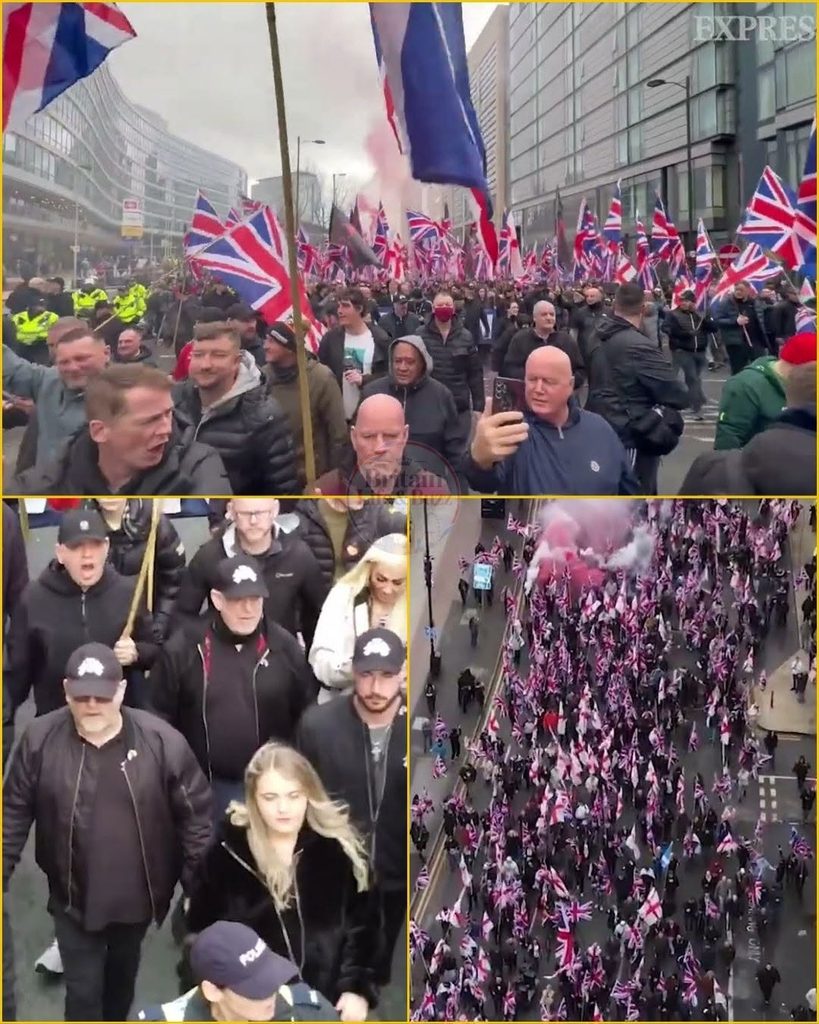
Tensions escalated dramatically in Manchester as an anti-migration march erupted into violence, with clashes between protesters and counter-protesters resulting in injuries and arrests.
Eyewitnesses reported chaotic scenes, as confrontations broke out and police struggled to maintain order amid the surging unrest.

The march, organized by anti-migration groups, attracted a significant turnout, reflecting growing sentiments surrounding immigration issues in the UK.
As the protesters made their way through the streets, they were met by a large counter-demonstration advocating for inclusivity and support for migrants.
Reports indicate that the situation intensified when protesters confronted counter-protesters, leading to physical altercations. Eyewitness accounts describe a chaotic atmosphere, with shouts and scuffles erupting as tensions boiled over.
Police were deployed in large numbers to separate the two groups and restore order.

Authorities reported several injuries, with some individuals requiring medical attention at the scene.
Law enforcement officials have confirmed that arrests were made, although the exact number remains unclear.
The police urged both sides to remain peaceful and warned against further escalation.
Local residents expressed their concern over the violence, highlighting the impact such events have on community cohesion.
Many voiced their desire for constructive dialogue rather than confrontational protests, emphasizing the need for understanding and empathy in discussions about migration.

As the situation unfolded, community leaders called for calm and urged participants to engage in peaceful discourse.
They emphasized the importance of addressing immigration issues through dialogue rather than violence, advocating for a more inclusive approach to the challenges faced by migrants.

The incident has reignited discussions about the rising tensions surrounding immigration in the UK, with many questioning the effectiveness of current policies and the societal divisions that have emerged.
As Manchester grapples with these issues, the need for constructive conversation and community unity has never been more pressing.
Authorities continue to monitor the situation closely, and further updates are expected as investigations into the violence proceed.
The events of the day serve as a stark reminder of the deep-rooted divisions that exist within society, underscoring the urgent need for dialogue and understanding in addressing complex issues like migration.
Manchester Tensions Flare as Anti-Migration Protesters and Counter-Demonstrators Face Off
Manchester has once again found itself at the centre of Britain’s heated debate over immigration after rival groups gathered in the city to demonstrate over migration, national identity and the future of community relations. Reports of confrontations between protesters and counter-protesters have renewed concerns about public order and the increasingly polarised atmosphere surrounding immigration in the United Kingdom.
The incident has drawn attention to the challenge facing police, local authorities and community leaders as they seek to protect the right to peaceful protest while preventing demonstrations from escalating into violence.
The controversy also raises broader questions about how Britain should discuss immigration at a time when public opinion remains divided over border controls, asylum accommodation and the responsibilities of government.
Rival Demonstrations Bring Tensions Into the Open
Anti-migration demonstrations and counter-protests have become an increasingly visible feature of political debate in Britain. Participants on one side often demand tougher border controls, stricter asylum rules and the removal of people who have no legal right to remain in the country. Counter-demonstrators frequently argue that such campaigns risk encouraging hostility towards migrants and minority communities.
Manchester has experienced several such demonstrations in 2026. On 21 February, supporters of Britain First gathered near Piccadilly station for a march calling for what the group described as “remigration” and mass deportations. Anti-racism organisations organised a counter-demonstration, and Greater Manchester Police introduced additional measures to manage the crowds. <Cite refs={[“turn879724search1”]}/>
A further Britain First march took place on 18 April. Hundreds of supporters and counter-protesters gathered in the city centre, with police reporting three arrests after confrontations involving some participants. Officers used pepper spray after counter-protesters allegedly attempted to break police lines and strike officers. Police said there were no reports of members of the public being injured during that operation. <Cite refs={[“turn879724search2″,”turn879724search3”]}/>
These earlier events provide context for the tensions described in reports about Manchester. However, the precise details of any separate confrontation must be established independently rather than assuming that every report describes the same incident.
Why Immigration Continues to Divide Britain
Immigration remains one of the most contested issues in British politics. Concerns include irregular Channel crossings, the cost of accommodating asylum seekers, pressure on housing and public services, and the speed at which asylum applications are processed.
People who support tougher restrictions argue that the government must demonstrate effective control of the country’s borders. They say public confidence suffers when asylum decisions take too long or when people whose claims have been rejected remain in Britain for extended periods.
For some protesters, demonstrations provide a way to express frustration with political leaders whom they believe have failed to deliver meaningful change. Their demands can include stronger enforcement, faster deportations and a reduction in irregular migration.
Others question whether confrontational street protests offer solutions to these problems. Anti-racism campaigners and migrant-support organisations argue that immigration debates should distinguish between people who have broken immigration rules, people seeking asylum and those who are legally resident or working in Britain.
They also warn that broad claims about migrants can encourage hostility towards entire communities, including people who have lived in the country for years and contributed to local economies.
The disagreement reflects different views about national identity, public responsibility and the limits of government policy. It also demonstrates why immigration debates can become particularly volatile when political arguments move from Parliament into public spaces.
The Police Face a Difficult Balancing Act
When rival demonstrations take place in the same city centre, police must balance several competing responsibilities. They must protect the right to lawful assembly, keep opposing groups apart when necessary, respond to violence and minimise disruption to residents, commuters and businesses.
Greater Manchester Police have previously deployed substantial numbers of officers to demonstrations involving Britain First and anti-racism groups. Dispersal orders and other legal powers have been used to manage crowds and address potential disorder.
Such measures can reduce the risk of direct confrontation, but they cannot eliminate every possibility of violence. Officers must make rapid decisions in crowded environments, where isolated incidents can quickly draw in other participants.
Arrests following a demonstration do not, by themselves, establish that an entire protest was violent. Equally, the fact that most participants remain peaceful does not remove the responsibility to investigate assaults, threats or other alleged offences.
Clear information from police is therefore essential. Confirmed details about injuries, arrests and criminal investigations help distinguish verified events from rumours and dramatic claims circulating on social media.
Local Communities Want Stability
For people who live and work in Manchester, the immediate concern is often the effect that demonstrations have on everyday life. Large crowds can cause road closures, public transport disruption and anxiety among residents and shopkeepers, particularly when opposing groups gather in close proximity.
Community leaders have repeatedly called for peaceful debate and respect between people with different views. Manchester City Council has also publicly criticised Britain First’s ideology, presenting the city as a place that values tolerance and community cohesion. <Cite refs={[“turn879724search1″,”turn879724search2”]}/>
Such appeals do not mean that concerns about immigration should be ignored. Questions about border security, asylum processing, housing and public expenditure are legitimate subjects for political debate. The challenge is to discuss them through evidence, policy proposals and democratic processes rather than intimidation or physical confrontation.
Community relations can suffer when people feel they are being treated as representatives of a group rather than as individuals. Preventing that division from deepening requires both effective public-order policing and a serious response to the practical issues behind public frustration.
Political Pressure on the Government
Demonstrations over immigration also place pressure on national politicians. Governments are expected to enforce immigration law, manage asylum claims efficiently and explain how public money is being spent. When the public believes these responsibilities are not being fulfilled, political dissatisfaction can spill into the streets.
Opposition parties have used immigration to challenge the government’s record, while ministers have faced demands to show that policies are delivering results. The debate is complicated by the fact that different concerns require different responses: preventing dangerous Channel crossings is not the same task as processing asylum claims, addressing labour shortages or expanding the supply of affordable housing.
A credible approach must therefore explain what the government intends to change, how the measures will operate and what evidence will be used to assess their effectiveness.
Street demonstrations can draw attention to public anger, but they cannot settle these questions on their own. The long-term response depends on political decisions, the implementation of policy and the ability of public institutions to maintain confidence.
A Wider Warning About Political Polarisation
The confrontations associated with rival demonstrations in Manchester illustrate the risks that arise when immigration becomes a symbol for broader anxieties about the direction of the country.
For anti-migration protesters, the issue may represent frustration with border controls and distrust of political leaders. For counter-protesters, the same demonstrations may raise concerns about racism, discrimination and the safety of migrants and minority communities.
Those perspectives can coexist within a democratic society, but violence and intimidation threaten the ability of people to express their views safely. The right to protest does not remove the obligation to obey the law, and disagreement with a political message does not justify attacking those who express it.
It is also important not to treat every gathering as evidence of a nationwide breakdown in public order. Individual incidents must be assessed using verified information about their scale, the conduct of participants and the response of the authorities.
What Happens Next?
The immediate priority after any confrontation is to establish what happened, identify any offences and ensure that those affected receive appropriate assistance. Police investigations and reliable reporting are essential to determining whether injuries occurred, how many people were arrested and whether charges follow.
Beyond the immediate incident, Manchester’s experience highlights the need for a more constructive national discussion about immigration. That discussion must address public concerns about border management and public spending while recognising the rights and dignity of people who live in Britain.
The city’s demonstrations do not provide a simple answer to the country’s immigration debate. Instead, they show how quickly disagreement can become confrontational when trust in political institutions is weak and rival groups believe their concerns are being ignored.
Ultimately, public safety will depend on effective policing, responsible conduct by demonstrators and political leadership capable of addressing difficult questions without encouraging hostility. Manchester’s challenge is not merely to prevent the next confrontation, but to ensure that the debate over immigration can take place without putting communities at risk.