

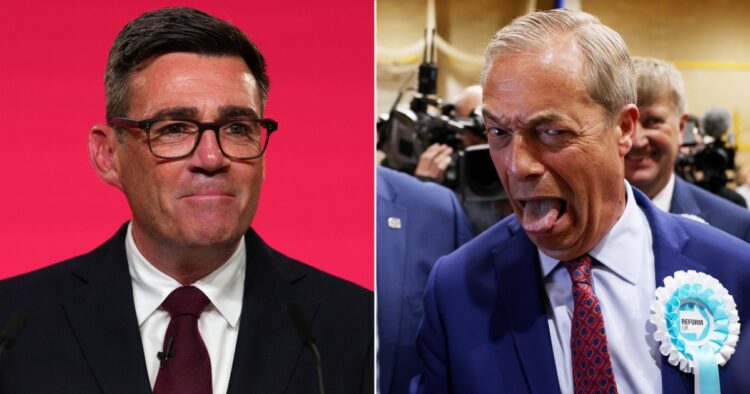
The contrasting polling fortunes of Labour and Reform show no signs of turning according to two major polls released this week.
For weeks now, Reform have been sliding in the polls as controversy and scandal swirls around the party. Meanwhile, Labour’s jump in support under Andy Burnham seems to be much more permanent than a bounce.
This has been reinforced by two surveys from major pollsters released on Wednesday.
The first came from Survation, who recorded a two point jump in support for Labour and a one point drop in support for Reform.
This have Burnham’s party a healthy six point lead over Reform, with the Tories further back on 19% after a two-point fall.
Further down, the Lib Dems and Greens were tied on 9% each.
This was followed by More In Common’s latest polling finding very similar results.
In this poll, Labour’s lead widened to five points thanks to a one point rise combined with one point drops for both the Tories and Reform.
With Reform in third place, this also left them six points adrift of Labour as they fell to their lowest level of support in 18 months.
The Lib Dems are in fourth with 11%, the Greens behind them on 9%, and Restore Britain on 6%.
The polls are the latest disappointing results for Reform over what has been a disastrous few months.
After making significant gains at the local elections in May, Reform and Farage seem to have been in self-destruct mode.
Controversies around undisclosed donations to Farage from crypto billionaires, Met Police investigations into party donations and undercover stings appearing to show Reform figures willing to bend the rules to get foreign money into the party have all hit the party’s popularity.
Meanwhile, Farage’s personal approval ratings are in free-fall, and the likes of Zia Yusuf seem more interested in defending far-right ringleader Danny Tommo than doing anything else.
If they keep this up, and the polls keep throwing up results like this, the possibility of Burnham calling an election before 2029 are only likely to increase.
Labour Polling Lead Grows as Reform UK Continues to Sink
The political landscape in the United Kingdom is undergoing a significant shift as the Labour Party strengthens its position in national opinion polls while Reform UK struggles to maintain its previous electoral momentum. After months of political uncertainty and growing dissatisfaction with the established parties, Labour appears to be recovering support, while Nigel Farage’s Reform UK is facing increasing pressure from its political opponents.
The latest polling figures suggest that Labour has established a substantial lead over Reform UK, raising questions about the future direction of British politics and whether Farage’s ambition to challenge the traditional two-party system is beginning to lose momentum. Although opinion polls do not necessarily predict the outcome of the next general election, the changing figures indicate that the political advantages Reform previously enjoyed may be weakening.


Labour’s Remarkable Political Recovery
According to the latest polling averages published on 7–8 November 2026, Labour is receiving approximately 28.6–29.2 per cent of voting intentions, compared with around 21.9–22 per cent for Reform UK. This gives Labour an advantage of approximately seven percentage points.
The PollCheck seven-poll average places Labour at 28.7 per cent, with Reform and the Conservatives both on 21.9 per cent. Meanwhile, the UK Fact Check tracker puts Labour at 29.2 per cent and Reform at 22 per cent.
These figures are particularly significant because Labour’s support was considerably weaker earlier in 2026. The party had struggled to maintain public confidence amid economic difficulties, political disagreements and dissatisfaction with government performance.
However, the recent recovery suggests that Labour may be benefiting from a combination of improved political leadership, a more coherent policy direction and growing doubts about the ability of Reform UK to govern effectively.
The emergence of Andy Burnham as Prime Minister on 20 July 2026 has also changed the political environment. His leadership appears to have provided Labour with an opportunity to reconnect with voters who had previously become frustrated with the party.
Burnham has attempted to present himself as a pragmatic leader who understands the economic and social difficulties facing ordinary households. His political approach has placed considerable emphasis on public services, economic growth, regional development and rebuilding confidence in government.
For Labour, the challenge is now to transform improved opinion-poll ratings into lasting public support.
Reform UK Faces Growing Political Difficulties
While Labour has strengthened its position, Reform UK appears to be struggling to reproduce the momentum that previously made it a major threat to Britain’s established political parties.
Nigel Farage’s party achieved considerable electoral success by attracting voters who were dissatisfied with the Conservative government and disappointed with Labour’s political direction. Its message focused on immigration, national sovereignty, economic frustration and opposition to what it described as an out-of-touch political establishment.
For a period, Reform successfully positioned itself as the principal alternative to the traditional political system.
However, the party has increasingly faced questions about its internal organisation, political experience and the behaviour of some of its representatives.
Several controversies involving Reform councillors and candidates have attracted national attention. Investigations into alleged racist and sexist remarks by party figures have raised concerns about candidate selection and the party’s internal culture.
Farage has repeatedly defended Reform’s political identity, but critics argue that the party must demonstrate that it can maintain appropriate standards among its elected representatives.
These controversies could damage its credibility among moderate voters who may agree with some of Reform’s immigration policies but remain uncomfortable with discriminatory language or political extremism.
The party also faces the difficult task of turning protest votes into a sustainable national political movement. Criticising the government is relatively straightforward, but convincing voters that Reform can manage the economy, improve public services and maintain international relationships requires a much broader political programme.
Nigel Farage’s Leadership Under Pressure

Nigel Farage remains one of Britain’s most recognisable political figures. His ability to attract media attention and communicate directly with voters has been central to Reform UK’s success.
Nevertheless, his leadership faces growing challenges.
One problem is the gap between Reform’s political ambitions and its organisational experience. Running a national political party requires more than attracting dissatisfied voters. It requires experienced candidates, effective local organisations, credible economic policies and the ability to manage complex government responsibilities.
Another challenge concerns the party’s relationship with the Conservative Party. Reform has attracted many former Conservative voters, but the Conservatives are beginning to recover some support.
The latest YouGov poll for The Times and Sky News, conducted on 1–2 November, placed Labour on 26 per cent, the Conservatives on 24 per cent and Reform on 21 per cent. This demonstrates that Reform is no longer comfortably ahead of its traditional Conservative rivals in every national survey.
If the Conservatives continue to recover, Reform could find itself squeezed between Labour’s improving position and a Conservative Party attempting to rebuild its electoral credibility.
The Conservatives Are Also Making a Comeback
Although Labour’s recovery is the main development, the Conservatives’ improving position should not be overlooked.
Under Kemi Badenoch, the party has attempted to rebuild its reputation following its defeat in the 2024 general election and subsequent political difficulties.
The Conservatives are seeking to persuade voters that they remain a credible alternative government, particularly on taxation, immigration, public spending and economic management.
Their recent polling improvements suggest that some voters who previously considered supporting Reform may be returning to the Conservative Party.
This creates a difficult situation for Farage because Reform’s political success has depended partly on convincing voters that the Conservatives can no longer represent their interests.
If Badenoch successfully restores confidence in her party, Reform could lose some of its electoral advantage.
However, the Conservatives still face considerable challenges. They must explain their previous record in government and convince voters that they have learned from their mistakes.
The competition between Reform and the Conservatives could therefore become one of the defining features of the next general election.
Andy Burnham’s Advantage

One of the most important developments in the current political situation is Andy Burnham’s personal popularity.
According to Opinium’s latest survey for The Observer, conducted between 4 and 6 November, Burnham has a positive net approval rating of approximately five points. By comparison, Nigel Farage remains deeply unpopular, with a net approval rating of minus 27.
These figures suggest that Burnham currently enjoys a significant personal advantage over his principal political opponents.
His political approach has focused on presenting Labour as a party capable of delivering practical improvements rather than simply making ambitious promises.
He has also attempted to address issues that resonate with voters across different regions, including the cost of living, healthcare, housing and economic inequality.
However, personal popularity does not automatically translate into electoral success. Burnham must demonstrate that his government can deliver measurable improvements in people’s everyday lives.
If economic growth remains weak, public services continue to struggle and living costs remain high, Labour’s current polling advantage could disappear.
Why the Latest Polls Matter
The recent polling results provide an important indication of how British politics may develop over the coming months.
|
Political party |
Latest polling average |
|---|---|
|
Labour |
28.7% |
|
Reform UK |
21.9% |
|
Conservatives |
21.9% |
|
Greens |
9.7% |
|
Liberal Democrats |
9.3% |
Source: PollCheck, seven-poll moving average, updated 7 November 2026.
| Voting intention | |
|---|---|
| Labour | 28,7% |
| Reform | 21,9% |
| Conservatives | 21,9% |
| Greens | 9,7% |
| Lib Dems | 9,3% |
The figures demonstrate that Labour has established a meaningful lead, although the Conservatives and Reform remain closely matched.
Importantly, the polling evidence does not show that Reform has completely collapsed. Its support remains around 22 per cent, substantially higher than the 14.3 per cent it achieved in the 2024 general election.
Nevertheless, its inability to establish a consistent lead over the Conservatives represents a political setback for Farage.
The Green Party’s growing support is another development worth watching. Its recent performance suggests that some voters dissatisfied with Labour may be moving towards a different progressive alternative rather than Reform.
This could complicate the electoral calculations of both major parties.
The Economic Challenge Remains Labour’s Biggest Test
Despite the encouraging polling figures, Labour cannot afford to become complacent.
British voters are primarily concerned with practical issues affecting their daily lives. The cost of living, housing affordability, NHS waiting times, wages and employment opportunities remain central to political decision-making.
If Burnham’s government fails to deliver improvements in these areas, voters may quickly reconsider their support.
The government’s economic strategy will therefore be particularly important. Labour must balance investment in public services with responsible public finances while encouraging businesses to invest and create employment.
Its relationship with the European Union could also become an important political issue. Burnham has indicated that closer European integration, potentially including eventual EU membership, should remain an option for Britain.
Such a position may appeal to pro-European voters and businesses seeking stronger trading relationships. However, it could also create opportunities for Reform UK to revive arguments about national sovereignty and the consequences of reversing Brexit.
The government will need to explain its European policy carefully if it wants to maintain support across different sections of the electorate.
Conclusion: Is Reform Losing Its Political Momentum?
The latest opinion polls suggest that British politics is entering a new phase. Labour has strengthened its position, while Reform UK is struggling to maintain the political momentum that previously made it one of the most powerful challengers to the established parties.
Andy Burnham’s leadership appears to have given Labour an opportunity to rebuild public confidence, while controversies surrounding Reform’s candidates and internal organisation have raised questions about Farage’s ability to turn electoral popularity into a credible governing alternative.
However, it would be premature to declare the end of Reform UK’s political influence. The party still commands the support of approximately one-fifth of British voters and retains a significant presence in national political debate.
The Conservatives are also recovering, making the competition for second place increasingly unpredictable.
Ultimately, the next general election will depend less on individual opinion polls and more on whether political parties can demonstrate that they have practical solutions to Britain’s economic and social problems.
For Labour, the priority is to maintain its recovery and prove that its government can deliver meaningful improvements. For Reform, the challenge is to restore public confidence, strengthen its organisation and convince voters that it is ready to govern.
One thing is increasingly clear: Nigel Farage can no longer assume that Reform UK will remain the unstoppable force in British politics. Labour’s recovery has changed the political conversation, and the battle for Britain’s political future is far from over.