
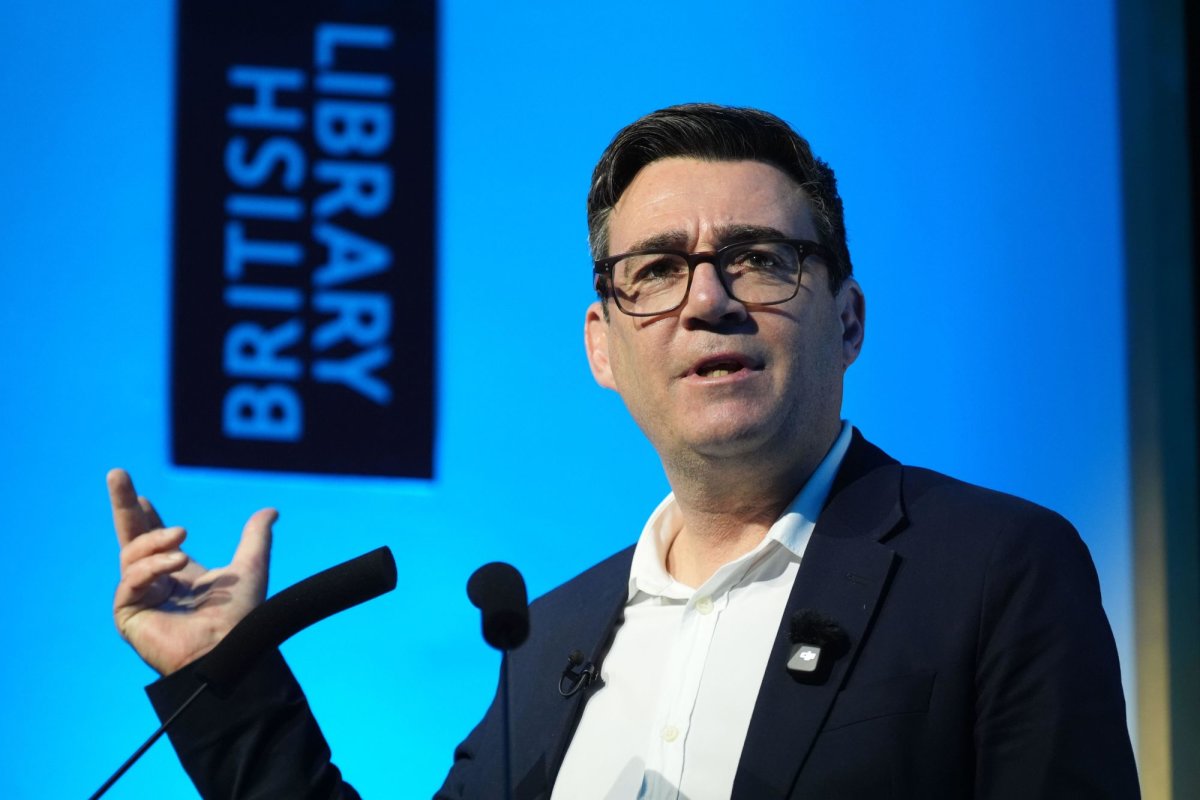
Labour Group Backed by Andy Burnham Condemns ‘Catastrophic Error’ After By-Election Defeat
The defeat suffered by Labour in the Gorton and Denton by-election represented a major political shock and exposed deep divisions within the party. Instead of retaining a seat that had traditionally been associated with Labour, the party was pushed into third place as the Green Party won the constituency. The result was particularly embarrassing because Gorton and Denton is located in Greater Manchester, an area strongly associated with Labour and with Andy Burnham, who had served as the region’s mayor. In response, Mainstream, a new centre-left Labour group backed by Burnham, described the result as an “absolute disaster” and argued that the party urgently needed a “fundamental reset”.

The controversy became even greater because Labour’s National Executive Committee had previously blocked Burnham from standing as the party’s candidate in the by-election. Mainstream argued that this decision had been a serious strategic mistake. In its statement following the defeat, the group claimed that the party leadership and sections of the NEC had prevented “the one candidate who could have won it for us”. It concluded that the decision now appeared to be a “catastrophic error”.
The outcome gave Burnham’s supporters an opportunity to argue that their original concerns had been justified. Before the election, there had been significant debate over whether Burnham should be allowed to return to Westminster. His supporters believed that his popularity and political experience could have protected Labour’s position. The NEC, however, had focused on the practical consequences of his candidacy, particularly the possibility of another mayoral election in Greater Manchester and the financial and organisational resources that this would require.
The result suggests that Labour’s calculation carried considerable political risk. The Green Party’s Hannah Spencer won the seat, while Reform UK also finished ahead of Labour. The Greens secured approximately 41 per cent of the vote and achieved a majority of 4,402 over Reform. Labour’s performance was therefore not simply a narrow defeat. It demonstrated that the party had lost substantial support to both the Greens and Reform, highlighting the difficult electoral position facing Keir Starmer’s leadership.
For Labour, the most worrying aspect was the direction of the protest vote. Reform UK has traditionally represented the greatest threat to Labour among voters who are concerned about immigration, living costs and dissatisfaction with the political establishment. However, the Gorton and Denton result showed that Labour was also losing support from voters who wanted a more progressive alternative. The Greens successfully appealed to people who believed Labour had moved too far towards the political centre and had abandoned important elements of traditional left-wing politics.
This creates a difficult strategic problem for Labour. If the party moves to the right in an attempt to compete with Reform, it risks losing progressive voters to the Greens. But if it moves substantially to the left, it may struggle to persuade voters who are primarily concerned about immigration, national identity and law and order. One Labour MP, Karl Turner, summarised this dilemma by arguing that Labour could not simply “out-rightwing Reform” on immigration or “out-leftwing the Greens” on progressive issues. His conclusion was that Labour needed to rediscover its own political identity.
The criticism from Mainstream is therefore significant because it comes from within the Labour movement rather than from an opposition party. The group’s intervention suggests that the debate about Labour’s future is no longer limited to traditional left-wing critics of Starmer. A broader section of the party is beginning to question whether the current political strategy is capable of maintaining Labour’s electoral coalition.
Mainstream’s call for a “fundamental reset” should be understood in this context. The group is not simply complaining about one unsuccessful election. Its argument is that the defeat reflects a deeper problem with Labour’s relationship with progressive voters. The statement warned that Labour risked no longer being regarded as the “natural home” for those voters.
That is a particularly serious warning for a centre-left political party. Labour has historically depended on a broad coalition of working-class voters, progressive professionals, trade union members and socially liberal voters. When those groups remain united, Labour can be electorally powerful. When they begin moving in different directions, the party becomes vulnerable to several competing parties at once.
Gorton and Denton demonstrated precisely this fragmentation. Reform appealed to voters dissatisfied with mainstream politics and concerned about issues such as immigration. The Greens attracted voters who wanted a more progressive economic and social programme. Labour was left squeezed between two very different forms of political opposition.
The defeat also intensified criticism of Keir Starmer personally. Several Labour MPs argued that the result could not simply be dismissed as a normal mid-term by-election defeat. Karl Turner described it as “catastrophic”, while other Labour figures called for Starmer to change direction. Unite general secretary Sharon Graham also urged the Prime Minister to stop listening to wealthy supporters and instead govern according to what she described as “real Labour” values.
Such criticism demonstrates that the party’s problems are both electoral and ideological. Labour is not merely losing votes; it is struggling to agree on what it should represent. Some MPs believe the government needs to become more radical on wealth, public services and economic investment. Others worry that moving too far left would make Labour less attractive to moderate voters.
The role of Andy Burnham in this debate is particularly important. Burnham has developed a distinctive political identity through his years as mayor of Greater Manchester. He has presented himself as a politician who understands the concerns of communities outside Westminster and who supports stronger regional government. His political style has allowed him to appeal to voters who may feel disconnected from the traditional Labour establishment.
That helps explain why his supporters believed he could have performed differently in Gorton and Denton. Even the Labour deputy leader later suggested that Burnham would probably have won the by-election. The argument is not necessarily that Burnham alone could have solved all of Labour’s problems, but that he might have been able to connect with voters in a way that the party’s eventual candidate could not.
However, it is important not to assume that Burnham’s presence would automatically have guaranteed victory. Green Party leader Zack Polanski argued after the election that even Burnham could have lost to the Greens. The political environment was already changing, and the Green campaign had succeeded in mobilising voters around issues including inequality, the cost of living and dissatisfaction with the government.
The result also contained an important geographical message. The Greens had previously been associated more strongly with particular areas of southern England, but their victory in Gorton and Denton demonstrated that they could make progress in a traditionally Labour part of Greater Manchester. Their victory therefore challenged the assumption that Labour could rely automatically on voters in its historic heartlands.
Hannah Spencer’s victory speech reinforced this message. She presented herself not as a conventional professional politician but as a plumber who understood the pressures faced by ordinary working people. Her campaign focused heavily on the idea that working hard no longer guaranteed the security and prosperity that previous generations had enjoyed. This message allowed the Greens to compete directly for voters who might once have regarded Labour as their natural political home.
Another important factor was the response of Muslim voters. Reports indicated that a significant shift among Muslim voters contributed to Labour’s defeat, with Gaza and Starmer’s approach to the conflict cited as important concerns. The Green campaign made considerable efforts to reach Muslim communities, including producing campaign material in Urdu.
This illustrates the complexity of Labour’s electoral challenge. The party cannot simply focus on traditional class politics. Modern Labour must also maintain support among diverse ethnic and religious communities, younger voters and socially progressive groups. A failure to maintain trust with any of these constituencies can have major electoral consequences.
The Gorton and Denton defeat therefore represents more than a single lost seat. It is a warning about what happens when a political party loses its ability to unite different groups behind a common programme. Labour won a large parliamentary majority at the 2024 general election, but by-elections can expose weaknesses that are hidden by the electoral system. The dramatic collapse in support in Gorton and Denton showed that a large national majority does not guarantee long-term political stability.
For Starmer, the challenge is how to respond without overreacting. Some Labour figures have warned against treating one by-election as a perfect reflection of national opinion. Heidi Alexander, for example, argued that by-elections have unique local dynamics and should not automatically be interpreted as evidence that voters across the country would choose the Greens or Reform at a general election.
That argument is reasonable. By-elections can be influenced by local candidates, turnout, specific community issues and protest voting. Nevertheless, the scale of Labour’s defeat means that the result cannot easily be ignored. The party needs to understand why voters who supported Labour previously felt sufficiently dissatisfied to choose other parties.
For Andy Burnham and Mainstream, the answer is clear: Labour needs to reconnect with its progressive identity while remaining electorally credible. The group’s criticism suggests that the party should become more ambitious on issues such as economic inequality, public investment and public services. At the same time, it must find practical solutions to concerns about immigration, housing and living costs.
The larger question is whether Labour can rebuild its position before the next general election. If it cannot, the political consequences could be significant. The rise of Reform means that Labour is vulnerable from the right, while the success of the Greens demonstrates that it is also vulnerable from the left. A party caught between two challengers risks losing voters in both directions.
In conclusion, the Labour-backed group supported by Andy Burnham was right to treat the Gorton and Denton defeat as a serious warning rather than an ordinary electoral setback. Its description of the decision to block Burnham as a “catastrophic error” reflects a much wider debate about Labour’s strategy and identity. The defeat showed that Labour can no longer assume that progressive voters will remain loyal simply because they traditionally supported the party.
For Burnham’s supporters, the result strengthens the argument that Labour needs a different political approach—one that is more connected to communities, more ambitious on social and economic issues and more capable of competing for voters who have lost faith in the party. Whether Starmer can deliver such a reset remains uncertain. What is clear is that Gorton and Denton has become a powerful symbol of Labour’s current difficulties. The party’s future may depend on whether it can learn from this defeat before its electoral problems become much harder to reverse.