
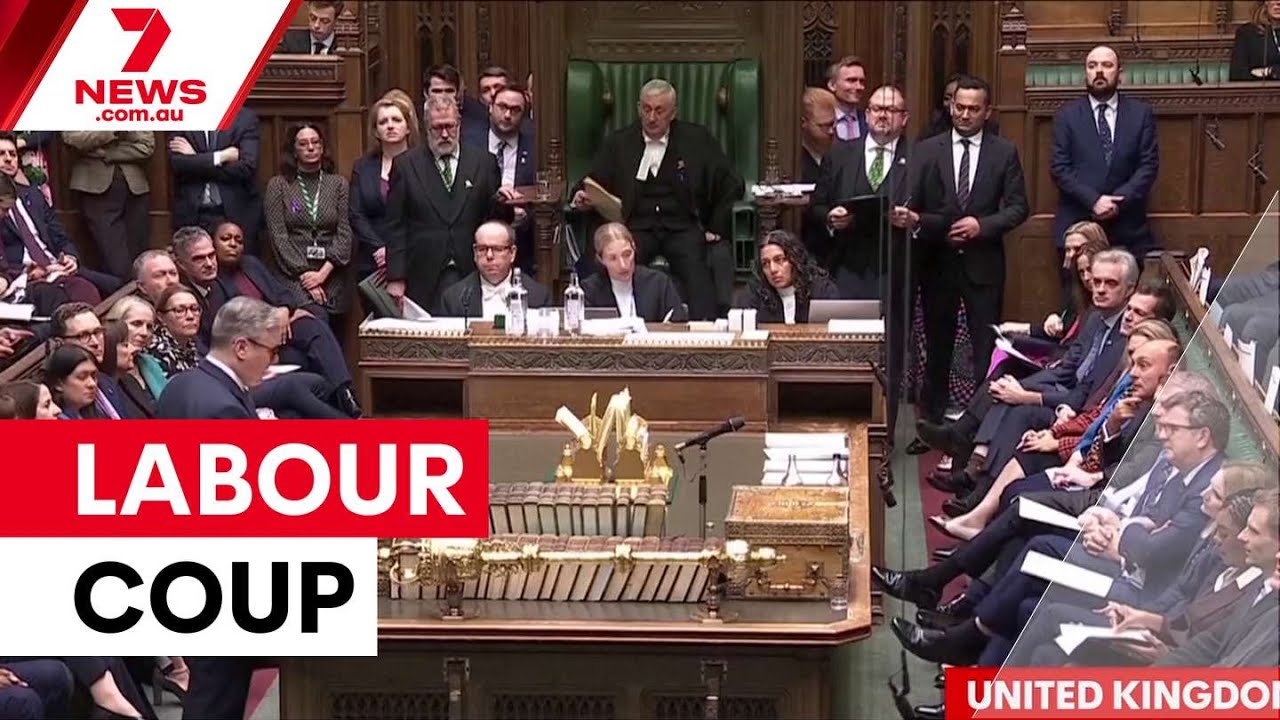
PM’s Labour Government Collapsing as Ministers Launch Brutal Coup
Keir Starmer’s premiership entered one of its most dangerous periods when senior Labour figures began openly questioning whether he could remain Prime Minister. What had previously been described as discontent among backbench MPs rapidly developed into a much more serious rebellion, with Cabinet ministers and junior members of the government reportedly pressing Starmer to consider his future.
The crisis followed Labour’s disastrous performance in the May 2026 local and devolved elections. The scale of the losses shocked the party. Labour lost control of more than 25 English councils and more than 1,000 council seats, while Reform UK made major gains across the Midlands and northern England. Labour also suffered a severe setback in Wales, while the Greens advanced in parts of London.
For a Prime Minister who had won a large parliamentary majority less than two years earlier, the results represented a dramatic collapse in political confidence.
Starmer attempted to fight back. He insisted that he would remain in office and argued that the government still had an important programme to deliver. In a speech intended to demonstrate strength, he declared that he would continue fighting for his political vision rather than surrender to internal pressure.
But his message failed to stop the rebellion.
By the following days, more than 80 Labour MPs had called for Starmer to resign or establish a timetable for his departure. The number was significant because Labour’s leadership rules mean that a formal challenge requires the support of 20 percent of Labour MPs. With 403 Labour MPs, that threshold was 81.
Suddenly, a leadership challenge was no longer a theoretical possibility. It had become a realistic political threat.
The most damaging development for Starmer was that criticism was no longer restricted to rebellious backbenchers. Ministers inside his own government were reportedly urging him to step aside. Among those named were Home Secretary Shabana Mahmood, Foreign Secretary Yvette Cooper, Defence Secretary John Healey, Energy Secretary Ed Miliband, Culture Secretary Lisa Nandy and Health Secretary Wes Streeting.
This was the moment when the crisis began to resemble a genuine coup.
A Prime Minister can survive criticism from opposition parties. A government can even survive unhappy backbenchers. What becomes extremely difficult to withstand is sustained opposition from senior ministers who are supposed to defend the Prime Minister publicly and implement his policies.
The situation was particularly reminiscent of previous British leadership crises, when ministers concluded that their Prime Minister had become an electoral liability.
The comparison with the final months of Tony Blair was especially striking. In 2006, Labour MPs and ministers began organising against Blair after years in government, eventually forcing him to announce that he would leave office. Some Labour figures in 2026 were already comparing the developing rebellion with that earlier episode.
However, there was an important difference. Starmer had been Prime Minister for only a relatively short period. His government had won office in 2024 promising stability, competent government and national renewal. The speed with which his authority appeared to collapse therefore made the crisis particularly remarkable.
One of the most important figures in the unfolding drama was Wes Streeting.
The Health Secretary was widely regarded as a potential successor and was reportedly preparing to meet Starmer amid speculation about a leadership bid. His position was particularly sensitive because he was both a senior member of the Cabinet and one of the politicians who could plausibly replace the Prime Minister.
Streeting’s possible involvement transformed the political calculations inside Labour.
If the rebellion had consisted only of left-wing MPs, Starmer might have portrayed it as an ideological dispute. But Streeting represented a different wing of the party. His potential candidacy suggested that dissatisfaction extended across Labour’s internal factions.
This was crucial.
Labour’s crisis was no longer simply about whether Starmer had moved too far to the right or too far to the left. Increasingly, MPs were asking whether he could win elections at all.
That question was reinforced by Reform UK’s extraordinary performance.
Nigel Farage’s party had made substantial gains in areas where Labour had traditionally been strong. Reform’s success demonstrated that the political map of Britain was changing rapidly. Working-class voters who had once regarded Labour as their natural political home were increasingly willing to support another party.
At the same time, the Greens were taking support from Labour on the progressive side of the political spectrum.
The result was a dangerous squeeze.
Labour was losing voters to Reform on one side and the Greens on the other. Starmer therefore faced an almost impossible political balancing act. Moving towards Reform could alienate progressive voters, while moving left could potentially weaken Labour’s appeal among moderate voters.
This helps explain why the leadership crisis became so intense.
The problem was not simply one unpopular policy. Labour MPs were beginning to fear that the party had lost its political direction.
Andy Burnham inevitably became central to this debate.
As Mayor of Greater Manchester, Burnham had developed a powerful political identity outside Westminster. He had already been discussed as a potential successor to Starmer, and his popularity among Labour members made him one of the most obvious alternatives.
His supporters argued that Labour needed a leader who could reconnect with working-class communities, strengthen public services and give greater political power to regions outside London.
Burnham’s political appeal therefore represented a completely different challenge to Starmer from that posed by Streeting.
Streeting could offer continuity with the modernising Labour tradition that had helped Starmer win the 2024 election. Burnham offered a more interventionist and regional approach.
For Labour MPs, the choice was consequently about much more than personalities.
It was about what kind of Labour Party could defeat Reform.
Burnham had repeatedly argued that Labour should not simply imitate Farage. Instead, he believed that the party needed to address the economic and social grievances behind Reform’s rise.
Better public services, more regional investment, stronger transport networks and greater economic security could, in his view, persuade voters that Labour still represented their interests.
This argument became increasingly powerful after the local election results.
The scale of Labour’s losses suggested that traditional campaign strategies were no longer sufficient. The party could not rely on the fact that it had won a large parliamentary majority in 2024. Voters had demonstrated that they were willing to change their allegiance remarkably quickly.
The crisis also exposed a deeper problem with Starmer’s political strategy.
When Labour entered government, Starmer promised stability and competence after years of Conservative turmoil. His approach was deliberately cautious. He wanted to reassure voters that Labour could be trusted with the economy and would not repeat the internal conflicts associated with previous Labour administrations.
But political caution has its own risks.
If voters believe that a government is not delivering meaningful change, stability can begin to look like stagnation. A Prime Minister who wins office by promising transformation must eventually demonstrate that transformation is actually happening.
Starmer’s defenders argued that his government needed time.
His critics believed that time was precisely what Labour could no longer afford.
The local elections had provided the critics with powerful evidence. Labour’s poor results were no longer theoretical polling concerns. They were actual votes cast by the public.
The rebellion consequently gained momentum.
Several ministerial aides resigned, and junior ministers also stepped down while criticising Starmer’s leadership. One resignation statement argued that the Prime Minister’s lack of values-driven leadership was damaging the government’s achievements and claimed that the public had irretrievably lost confidence in him.
Such resignations are especially dangerous because they create a domino effect.
When one minister resigns, others may conclude that they can do the same without being isolated. Once several ministers have gone, remaining ministers can begin to fear that staying loyal will damage their own political careers.
This is how leadership coups gather momentum.
The Prime Minister then faces a difficult choice. He can fight back and risk making the rebellion more bitter, or he can negotiate an orderly departure and attempt to preserve his political legacy.
Starmer chose confrontation.
At a Cabinet meeting, he insisted that he would remain Prime Minister. He argued that Britain expected the government to continue governing and that the formal mechanism for challenging Labour’s leader had not been triggered.
His message was unmistakable: he was not going quietly.
That decision created another dilemma for Labour.
If Starmer survived, the party could face months of instability as rivals continued to campaign against him. If he resigned immediately, Labour would enter a leadership contest that could consume the government at a time when the country was facing serious economic and international pressures.
Some ministers therefore warned rebellious MPs that attempting to remove Starmer could unleash chaos.
The warning was not without merit.
Leadership contests are unpredictable. They can expose ideological divisions, encourage personal attacks and distract governments from governing. A new Labour leader would also inherit the same economic and political problems that had damaged Starmer.
Replacing the Prime Minister would not automatically solve Labour’s electoral problems.
Nevertheless, the argument for change was becoming increasingly difficult to ignore.
The most powerful evidence came from Labour MPs themselves.
When dozens of MPs publicly question their leader, the Prime Minister can no longer rely solely on Cabinet authority. He must persuade colleagues that he remains capable of winning the next election.
That was becoming the central question of Starmer’s premiership.
Could he turn around Labour’s electoral fortunes?
Could he stop Reform UK?
Could he rebuild support in the North?
Could he persuade progressive voters not to defect to the Greens?
And, perhaps most importantly, could Labour MPs themselves believe that he could accomplish these things?
The answers were increasingly uncertain.
The presence of Andy Burnham made the uncertainty even greater.
Burnham represented a ready-made alternative for Labour members who believed the party needed a dramatic change. His popularity gave rebellious MPs somewhere to direct their hopes.
But he was not the only possible successor.
Wes Streeting had a powerful position within the Cabinet. Other senior Labour figures could potentially enter a leadership contest. This meant that the rebellion could eventually develop into a complicated struggle between competing factions.
For Starmer, that was potentially his strongest argument for survival.
If Labour MPs could not agree on a successor, they might conclude that keeping Starmer was safer than opening a destructive leadership contest.
This explains why some MPs who were deeply unhappy with Starmer nevertheless hesitated to demand his immediate resignation.
They wanted change—but they also feared what would happen afterwards.
British political history provides several examples of governments becoming consumed by leadership disputes. Once MPs begin focusing on succession, policy can become secondary. Ministers start thinking about their future positions rather than the government’s agenda.
The Labour Party therefore faced a paradox.
Starmer’s leadership was becoming a political weakness, but removing him could create an even greater period of instability.
This was the dilemma at the heart of the crisis.
The situation also demonstrated how quickly a government’s fortunes can change.
In July 2024, Starmer entered Downing Street with a huge Labour majority and an overwhelming sense that Britain had turned the page on Conservative rule.
Less than two years later, his own ministers were reportedly urging him to plan his departure.
That transformation is one of the most extraordinary aspects of the story.
It shows that parliamentary majorities do not necessarily translate into political security. A Prime Minister’s authority depends not only on the number of MPs behind them but also on their confidence that the government can deliver and win again.
Once that confidence disappears, a majority can become surprisingly fragile.
The developing coup also revealed the importance of electoral psychology.
The May 2026 elections were interpreted by many Labour MPs as evidence that the public had lost patience. Reform’s gains suggested that dissatisfaction was spreading, while Green advances indicated that Labour was failing to satisfy voters on its left.
The party therefore needed a new strategy.
Whether that strategy required Starmer to remain or leave was the question dividing Labour.
For Burnham’s supporters, the answer was increasingly obvious.
For Streeting’s supporters, the future could involve a different form of Labour modernisation.
For Starmer’s allies, however, the answer was that abandoning the Prime Minister would only create more chaos.
The battle was therefore not simply a coup against one man. It was a struggle over Labour’s future.
The phrase “government collapsing” captured the mood of the moment, but it is important to distinguish political crisis from actual governmental collapse. Starmer remained Prime Minister, and the government continued to function. The real issue was whether his political authority could survive.
That distinction matters.
A government can continue operating while its leader is fighting for political survival. Cabinet meetings can still take place, laws can still be proposed and ministers can still carry out their responsibilities.
But if ministers are simultaneously campaigning for a leadership change, the government’s ability to act decisively becomes severely weakened.
That was the danger facing Starmer.
Ultimately, the crisis demonstrated that the greatest threat to a Prime Minister does not always come from the opposition benches.
Nigel Farage could attack Labour from outside.
The Conservatives could criticise its policies.
The Greens could take progressive voters.
But the most immediate threat came from Labour politicians themselves.
When ministers begin asking a Prime Minister to leave, the political equation changes completely.
Keir Starmer’s challenge was therefore no longer simply to defeat Reform UK or improve Labour’s opinion-poll ratings. He had to persuade his own party that he remained the best person to lead it.
And that was becoming increasingly difficult.
The unfolding rebellion marked a decisive moment in Labour’s post-2024 story. A government elected with a huge majority had entered a period of extraordinary instability. Ministers were considering their positions, MPs were openly discussing succession and Andy Burnham was once again emerging as a central figure in Labour’s political future.
Whether Starmer could survive ultimately depended on one thing: confidence.
If Labour MPs regained confidence in his ability to govern and win, the coup could collapse.
If they concluded that his leadership had become an electoral liability, no number of speeches or Cabinet meetings would be enough.
The battle for Downing Street had therefore become a battle for Labour’s soul.
And as ministers turned against their own Prime Minister, the question was no longer whether Keir Starmer faced a crisis.
It was whether he could survive it.
Leave a Reply
You must be logged in to post a comment.