
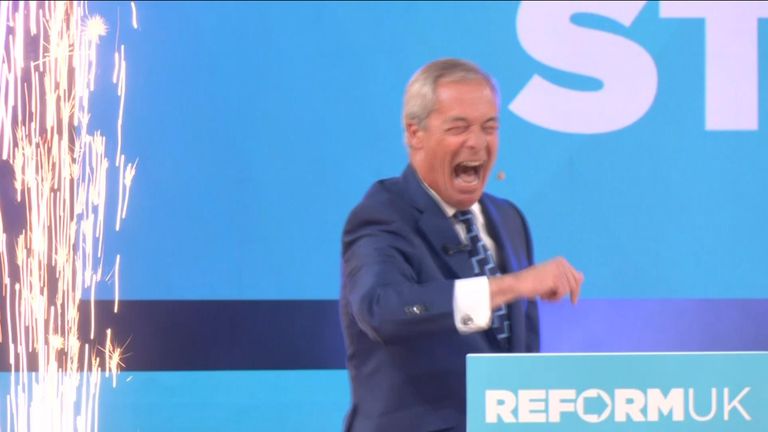
Nigel Farage insisted Reform UK “must be ready” for a general election in two years after Angela Rayner’s resignation. The Reform leader brought his keynote speech at the party conference in Birmingham forward three hours following the Deputy Prime Minister’s exit in a row over her tax affairs.
Mr Farage told supporters: “I think there is every chance now of a general election happening in 2027.”
He added: “We have topped over 100 of the last opinion polls, our lead is between 10 and 15% against any of the other parties. I tell you what, given the state of chaos they’re in, I think we can increase that lead further yet. Folks, it’s happening.”
Ms Rayner resigned from Government after Sir Keir Starmer‘s ethics adviser found she had breached the ministerial code over her underpayment of stamp duty on a seaside flat.
‘It’s happening!’ Nigel Farage makes huge Reform prediction after Angela Rayner quits
Nigel Farage has seized on Angela Rayner’s resignation to claim that a major political split is coming inside Labour, telling Reform UK supporters that the next general election could arrive much sooner than expected.
The Reform leader reacted quickly after Rayner resigned as deputy prime minister and housing secretary in September 2025. Rather than treating the departure simply as a ministerial resignation, Farage argued that it could trigger a much wider confrontation within Labour between its different political factions.
Speaking at Reform UK’s conference in Birmingham, Farage declared that the party was witnessing the beginning of a major Labour rift. He pointed to pressure from the political left, including the emergence of Jeremy Corbyn and Zarah Sultana’s political movement, and argued that Rayner’s departure would make Labour’s internal tensions more visible.
For Farage, the timing was particularly significant.
He had already been arguing that Britain could face an election in 2027. Rayner’s resignation, he suggested, provided another indication that Labour’s political difficulties were becoming increasingly difficult to contain.
Farage’s “big rift” prediction
Farage’s central argument was that Labour was entering a period of internal conflict.
For years, disagreements inside the Conservative Party had dominated Westminster politics. Brexit, Boris Johnson’s leadership, Theresa May’s premiership and subsequent Conservative leadership contests repeatedly exposed divisions within the party.
Farage now believes Labour could experience something similar.
“We’re about to witness a big rift in the Labour Party too,” he said after Rayner’s resignation.
His argument was that Rayner was not simply a cabinet minister. She was Labour’s elected deputy leader, meaning her departure had implications for the party organisation as well as the government.
That distinction mattered to Farage.
A ministerial resignation can sometimes be contained through a reshuffle. The resignation of a deputy party leader can have wider consequences, particularly when the party is already experiencing pressure from competing political movements.
Why Angela Rayner’s resignation mattered
Rayner resigned after admitting that she had not paid enough stamp duty when purchasing a property.
The issue had become increasingly controversial, and she ultimately announced that she would step down from both her government position and her role as Labour’s deputy leader.
Her departure removed one of Labour’s most recognisable figures from the centre of government.
Rayner had played an important role in Labour’s political identity, particularly in its relationship with working-class voters and trade union supporters.
Her political background was also different from that of Keir Starmer.
That made her position inside Labour particularly significant.
For Farage, the departure created an opportunity to argue that the Labour coalition was beginning to come apart.
The threat from Labour’s left
Farage specifically referred to Jeremy Corbyn and Zarah Sultana.
Both had been associated with attempts to establish a political alternative further to the left of Starmer’s Labour.
Corbyn, the former Labour leader, had been expelled from the parliamentary Labour Party and subsequently pursued an independent political project.
Sultana, meanwhile, had become one of the most prominent voices challenging the Labour leadership from the left.
Their political activity created another potential source of competition for Labour.
Farage argued that this could become particularly important if Labour voters became dissatisfied with the government’s policies.
The key question is whether voters who move away from Labour would transfer their support to a left-wing alternative, Reform, the Greens, Liberal Democrats or simply become less likely to vote.
That cannot be established from Rayner’s resignation alone.
Reform sees an opportunity
For Reform UK, however, the episode offered a chance to reinforce its broader political message.
Farage has sought to position Reform as an alternative to both Labour and the Conservatives.
His argument is that the traditional parties are struggling to maintain the support of voters who no longer feel represented by Westminster politics.
The party’s success in local elections has given that argument additional visibility.
In the May 2026 elections, Reform made substantial gains across England, while Labour suffered significant losses. Reuters reported that Reform had gained hundreds of council seats as counting continued, making it one of the principal beneficiaries of Labour’s losses.
Those results became an important part of Farage’s argument that the political landscape is changing.
However, local-election performance does not automatically translate into a general-election result.
Different electoral systems, turnout levels and local circumstances can produce very different outcomes.
The 2027 election argument
Farage’s prediction about a possible 2027 election is closely connected to his interpretation of Labour’s internal difficulties.
He has repeatedly argued that financial pressure could eventually force Labour to seek a fresh mandate.
At the 2026 Reform conference, Farage again said he believed there would be an election in spring 2027. He argued that the financial circumstances would force the government towards an earlier election and said Reform was preparing for it.
The prediction should be understood as Farage’s political assessment rather than a confirmed election timetable.
The current parliamentary term does not automatically end in 2027, and the timing of a future general election depends on political and constitutional developments.
Nevertheless, Reform has been behaving as though an early election is possible.
Farage said the party was restructuring, raising money and interviewing prospective general-election candidates several days a week.
Why Farage thinks Labour could fracture
Farage’s analysis rests on a simple political theory.
Labour contains several different traditions.
There is a centrist and centre-left group focused on economic management and electability. There are traditional Labour social democrats. There is a trade-union movement with its own priorities. And there remains a substantial left-wing constituency that has not necessarily accepted the direction taken by the party leadership.
A government can contain these differences while it is successful.
But when a government faces declining support, difficult policy decisions and internal disagreements, competing factions can become more visible.
That is the scenario Farage believes is developing.
Rayner’s resignation therefore becomes, in his interpretation, more than an isolated scandal.
It becomes a symbol of a broader disagreement over Labour’s direction.
The Conservative comparison
Farage’s comparison with the Conservatives is also significant.
He has spent years arguing that Conservative divisions over Brexit destroyed the party’s ability to govern effectively.
The Conservatives changed leaders repeatedly between 2016 and 2024, with internal disputes contributing to political instability.
Farage now believes Labour could experience a similar process.
The irony is that Reform’s rise has itself contributed to pressure on the Conservatives.
The party has attracted former Conservative politicians and voters, while Farage has repeatedly argued that the Conservatives failed to deliver on issues including immigration, taxation and public services.
The emergence of Reform therefore means that both major established parties face pressure from outside their traditional political structures.
The May 2026 results
The local elections provided Reform with further evidence for its argument.
Reuters reported that Reform gained 501 council seats in England during the May 2026 elections, while Labour had lost hundreds of seats during the count.
Those results were politically significant, but they should not be interpreted as a direct forecast of a future general election.
Local elections often involve different voting patterns and turnout.
Nevertheless, the scale of Reform’s gains allowed Farage to argue that his party’s organisational base was becoming considerably stronger.
It also gave Reform a larger number of councillors who could help build local campaigning networks.
Rayner’s departure and the Labour leadership question
Rayner’s resignation also contributed to wider speculation about Labour’s leadership.
Later developments showed that pressure on Keir Starmer became a major issue inside the party, with senior figures including Wes Streeting and others becoming part of a wider leadership debate.
That later context makes Farage’s original prediction particularly interesting.
At the time of Rayner’s resignation, however, it was still an interpretation of what might happen rather than proof that Labour was about to split.
Political parties frequently experience leadership disputes without collapsing.
The ability of Labour to manage internal disagreements would depend on parliamentary support, party organisation, policy decisions and the response of its members and voters.
What Reform is preparing for
Farage has made clear that Reform does not intend to wait until an election is formally called before preparing.
The party has been developing candidates, fundraising and discussing what it would do during the first 100 days of a potential government.
At its 2026 conference, Farage said Reform would seek to stop small-boat crossings within its first 100 days if it entered government. He also outlined proposals concerning taxation, parliamentary sitting hours and government spending.
Those plans form part of Reform’s attempt to present itself as a potential governing party.
That is a significant change from the party’s earlier identity as primarily a Brexit-focused or protest movement.
“It’s happening”
The significance of Farage’s reaction to Rayner’s resignation lies in the confidence of his interpretation.
For Reform supporters, the phrase “It’s happening!” captures the belief that the established political system is entering a period of rapid change.
But the facts are more measured.
Angela Rayner resigned from government and from Labour’s deputy leadership.
Reform has gained substantial numbers of council seats.
Labour has faced significant internal pressure.
And Farage believes those developments could contribute to a much earlier general election.
What remains uncertain is whether the political consequences will develop in the way he predicts.
A changing political landscape
The episode nevertheless illustrates how dramatically British politics has changed.
The traditional contest between Labour and the Conservatives has been challenged by Reform, the Greens and the Liberal Democrats.
At the same time, Labour has faced pressure from political movements to its left.
That creates a more fragmented political environment in which the future direction of voters is less predictable.
Farage’s response to Rayner’s resignation is therefore part of a much larger political argument.
He is telling Reform supporters that Labour’s internal difficulties could create an opportunity for his party.
His prediction is not a guarantee of what will happen.
But it demonstrates how Reform intends to approach the next stage of British politics: as a party that believes it must be ready for an election before its opponents are.
For now, Rayner’s resignation remains a documented political event, while Farage’s “big rift” prediction remains an interpretation of its potential consequences.
Whether Labour’s divisions deepen, whether Reform continues to gain support, and whether Britain actually faces an early general election are questions that will be answered by future political events and, ultimately, voters.