

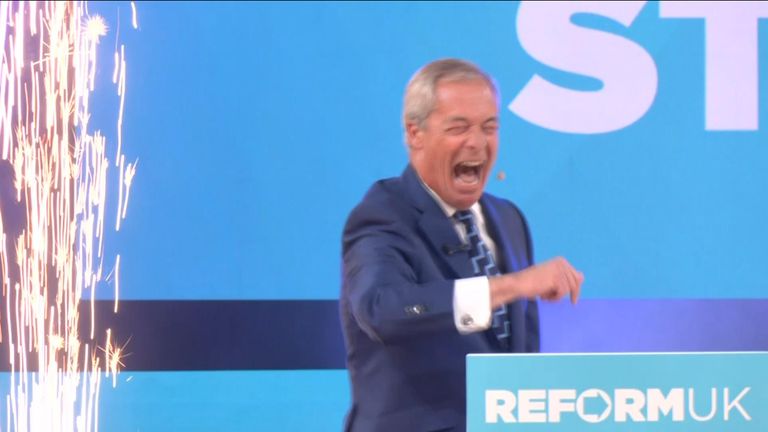
Nigel Farage insisted Reform UK “must be ready” for a general election in two years after Angela Rayner’s resignation. The Reform leader brought his keynote speech at the party conference in Birmingham forward three hours following the Deputy Prime Minister’s exit in a row over her tax affairs.
Mr Farage told supporters: “I think there is every chance now of a general election happening in 2027.”
He added: “We have topped over 100 of the last opinion polls, our lead is between 10 and 15% against any of the other parties. I tell you what, given the state of chaos they’re in, I think we can increase that lead further yet. Folks, it’s happening.”
‘It’s Happening!’ Nigel Farage Makes Huge Reform UK Prediction After Angela Rayner Quits
Nigel Farage has intensified speculation about the future of British politics after making a bold prediction about Reform UK, with Angela Rayner’s reported departure adding another dramatic twist to an already turbulent political landscape. The Reform UK leader has repeatedly argued that Britain is approaching a major political turning point, claiming that growing frustration with the established parties could create an unprecedented opportunity for his movement.
The phrase “It’s happening!” captures the confidence that Farage wants to project as Reform UK seeks to transform public dissatisfaction into electoral success. For the party, the central argument is that Labour and the Conservatives have lost the trust of significant numbers of voters who feel that successive governments have failed to address their concerns about immigration, taxation, living standards and public services.
Rayner’s reported resignation could add to the pressure facing Labour, particularly if it deepens questions about the party’s leadership, internal unity and ability to maintain its electoral coalition. However, the precise political consequences would depend on the circumstances of her departure and the wider developments within the government.
For Farage, such moments offer an opportunity to argue that the established political order is becoming increasingly fragile. Whether Reform UK can turn that argument into lasting electoral dominance remains one of the biggest questions facing British politics.
Angela Rayner’s Departure Creates an Opening
Angela Rayner’s resignation was a significant moment for Labour because she had occupied an important position within the party and the government. Her political background and public profile helped Labour connect with voters who might otherwise have felt distant from Westminster.
Her departure followed controversy surrounding the stamp duty paid on a property purchase. The issue raised questions about accountability and whether senior politicians should be held to the same standards they expect of others.
Farage seized on the situation to criticise Labour’s leadership and argue that the government had failed to deliver the change it promised. He portrayed Rayner’s departure as evidence of deeper weaknesses within the administration rather than an isolated political setback.
The Reform leader also suggested that Labour could face a growing internal struggle between its leadership and politicians further to the left. Figures such as Jeremy Corbyn and Zarah Sultana represented a different political direction, potentially attracting voters dissatisfied with Starmer’s approach.
The danger for Labour is that dissatisfaction could emerge from several directions simultaneously. Some traditional supporters may believe the government has not done enough to improve living standards, while others may object to its approach to public spending, immigration or economic reform.
However, there is no guarantee that these voters would move directly to Reform UK. Some could support the Green Party, the Liberal Democrats or independent candidates. Others might simply abstain.
Farage’s challenge is to turn Labour’s difficulties into a clear political advantage for his own party.
Reform UK’s Ambitions Extend Beyond Protest
One of the most important questions surrounding Reform UK is whether it can transform itself from a party of protest into a credible party of government.
Farage has spent years criticising the political establishment, arguing that the Conservatives and Labour have failed to address fundamental problems facing Britain. His return to frontline politics has given that message a new electoral platform.
The party has sought to attract voters concerned about immigration, the cost of living, taxation, energy prices and the performance of public services. It has also attempted to recruit politicians and candidates with experience in local government and national politics.
Yet winning public attention is different from demonstrating that a party can govern effectively.
Reform UK would need to present detailed policies, identify credible candidates and demonstrate that its proposals could be implemented within the constraints of public finances and existing institutions.
It would also need to prove that it could manage disagreements within its own ranks. A party that criticises established politicians for internal divisions would face scrutiny if similar disputes emerged among its own representatives.
Farage’s prediction that a major political transformation is under way therefore places considerable pressure on Reform itself. The party must convince voters that it has the people, policies and organisational capacity to deliver the changes it promises.
Could Britain Face an Early General Election?
Farage’s suggestion that Britain could face an early general election reflected his belief that Labour’s political difficulties might intensify.
An early election would create a major opportunity for Reform UK to test its growing support against the established parties. It would also force Labour and the Conservatives to defend their records while attempting to persuade voters that they remain capable of delivering economic stability.
However, political instability does not automatically lead to an early election. A government can survive ministerial resignations, internal disagreements and declining popularity if it retains sufficient parliamentary support.
The timing of an election also depends on decisions made by the prime minister and the wider political circumstances. Farage’s prediction should therefore be understood as an attempt to prepare his supporters for a possible scenario, rather than proof that an early election is inevitable.
Nevertheless, the prospect of an earlier contest can influence political behaviour. Parties may accelerate candidate selection, intensify fundraising and refine their campaign messages in anticipation of a sudden change in circumstances.
For Reform UK, preparation would be especially important because challenging the established parties across a national electoral map requires considerable organisation.
The party would need to identify constituencies where it has a realistic chance of winning, mobilise volunteers and persuade voters that its candidates can represent their local interests.
The Battle for Working-Class Voters
A central part of Farage’s strategy is his attempt to attract voters who once supported Labour but now feel disconnected from the party.
These voters do not necessarily share identical views. Some prioritise immigration and national sovereignty, while others are concerned about wages, housing, healthcare and the cost of raising a family.
Reform UK’s appeal depends on convincing them that these issues can be addressed through a different political approach.
Labour, meanwhile, faces the challenge of demonstrating that its policies are improving ordinary people’s lives. If voters continue to experience financial pressure while public services struggle, the government may find it increasingly difficult to defend its record.
Yet Reform must also answer questions about how its own proposals would affect workers, pensioners and families on lower incomes. Promises to reduce taxes or public expenditure can be attractive, but voters will want to understand the consequences for essential services and household finances.
Winning support requires more than criticising Labour. It requires offering a convincing alternative.
Farage appears confident that Britain is moving towards a political realignment in which voters increasingly reject the traditional party system. Whether that transformation becomes permanent will depend on the choices voters make and the performance of the parties seeking their support.
The Road Ahead for Nigel Farage
Farage’s declaration that “it’s happening” captures the optimism he wants to instil among Reform UK supporters. By connecting Rayner’s resignation to wider questions about Labour’s future, he has attempted to present a ministerial departure as part of a much larger political story.
For his supporters, the message is that Reform’s rise is no longer a distant possibility but a development that the established parties must take seriously.
For his opponents, the challenge is to show that political turbulence does not necessarily mean the collapse of the existing party system. Labour could recover support, the Conservatives could rebuild their position, and voters could ultimately reject Reform’s proposals.
The coming political battles will depend on economic performance, public confidence, party organisation and the ability of leaders to respond to voters’ concerns.
Farage has identified an opportunity and is determined to exploit it. His prediction of a major political shift could prove influential if Reform continues to build its support and demonstrates that it can compete beyond its strongest areas.
But electoral success is never guaranteed. Political momentum can change, campaign promises can face difficult scrutiny, and voters may reconsider their preferences when presented with a choice between competing programmes for government.
Ultimately, Angela Rayner’s departure offered Farage a moment to reinforce his argument that Britain’s political landscape is changing. Whether that moment becomes a turning point for Reform UK will depend on what happens next.
The party’s ambition is clear: to challenge Labour and the Conservatives for power and persuade voters that a new political direction is possible. The real test will be whether Farage can turn his confidence into a durable electoral coalition capable of winning a general election and governing the country effectively.