

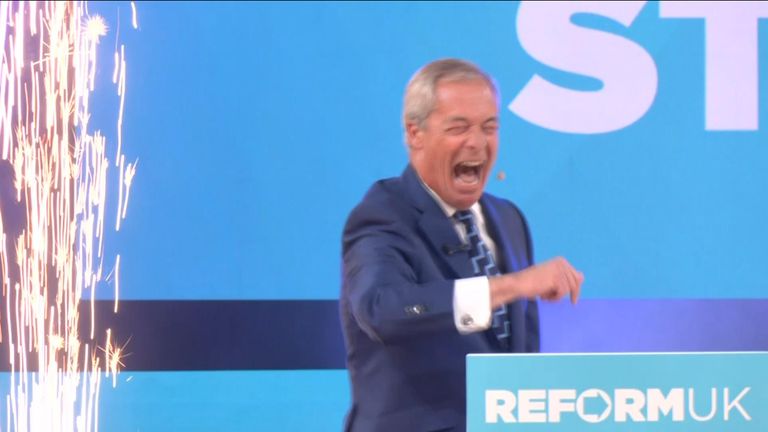
Nigel Farage insisted Reform UK “must be ready” for a general election in two years after Angela Rayner’s resignation. The Reform leader brought his keynote speech at the party conference in Birmingham forward three hours following the Deputy Prime Minister’s exit in a row over her tax affairs.
Mr Farage told supporters: “I think there is every chance now of a general election happening in 2027.”
‘It’s Happening!’ Nigel Farage Makes Huge Reform Prediction After Angela Rayner Quits as Labour Faces Political Turmoil
Nigel Farage has delivered a dramatic political prediction following Angela Rayner’s resignation from the Labour government, claiming that Britain could be heading towards a major political turning point and that Reform UK is closer than ever to taking power.
The Reform UK leader seized on the unexpected development to launch a fresh attack on Prime Minister Keir Starmer and his government, suggesting that Labour’s internal problems could soon become much more serious.
Speaking to enthusiastic supporters at the Reform UK conference in Birmingham in September 2025, Farage declared that the political situation was changing rapidly.
His message was unmistakable: Reform UK believes it has a genuine opportunity to replace the traditional political establishment.
“Folks, it’s happening!” he told the audience, as he predicted that another general election could take place as early as 2027.
For Farage, Rayner’s departure was not simply another ministerial resignation. He viewed it as a potentially significant moment that could expose deeper divisions within Labour and accelerate the party’s political difficulties.
The announcement immediately created a difficult situation for Starmer, whose government was already facing questions about its direction, public support and ability to deliver its promises.
And Farage wasted little time making political capital out of the situation.
Angela Rayner’s resignation creates a new headache for Labour
Rayner had been one of the most recognisable figures in the Labour government.
As deputy prime minister and deputy leader of the Labour Party, she occupied an important position within the political organisation that brought Starmer to power.
Her resignation followed controversy surrounding the amount of stamp duty paid on a property purchase.
An investigation by the government’s independent ethics adviser concluded that she had breached the ministerial code after failing to pay the correct amount of tax.
Rayner subsequently announced that she would leave her government position and resign as Labour’s deputy leader.
Her departure represented a significant political setback for a government that had already experienced difficult headlines.
Rayner had been particularly important because of her political background and ability to communicate with traditional Labour voters.
She had often presented herself as a representative of working-class communities and people who believed that Westminster politicians had become disconnected from ordinary life.
Her departure therefore created questions about Labour’s political identity.
Could Starmer maintain the support of different factions within his party?
Would other senior figures begin questioning his leadership?
And could the growing frustration among Labour supporters create opportunities for political opponents?
These were precisely the questions Farage wanted voters to consider.
Farage predicts a major Labour civil war
During his conference appearance, Farage argued that Labour could soon experience divisions similar to those that had previously damaged the Conservative Party.
For years, Conservative governments had been troubled by disagreements over Brexit, leadership and economic policy.
Those internal battles contributed to repeated changes of prime minister and eventually helped weaken the party’s electoral position.
Farage now believes Labour could face a comparable situation.
He suggested that disagreements between the party’s moderate wing and its more left-wing supporters could become increasingly difficult to manage.
He also pointed towards the emergence of a political alternative associated with former Labour leader Jeremy Corbyn and Zarah Sultana.
According to Farage, some Labour MPs could eventually conclude that their political future would be safer outside Starmer’s leadership.
He predicted that certain parliamentarians might believe they had a better chance of being re-elected under Corbyn’s political movement than under the existing Labour leadership.
Whether that prediction proves correct remains uncertain.
However, the possibility of Labour losing support from both the left and the right represents a serious political challenge.
If voters become dissatisfied with the government while different groups within Labour begin fighting over its direction, the party could find it increasingly difficult to present a united message.
Reform UK believes the political momentum is changing
Farage used the conference to underline what he described as Reform’s growing strength.
He claimed that the party had topped more than 100 opinion polls and enjoyed a lead of between 10 and 15 percentage points over its competitors.
Those were figures cited by Farage during his speech, rather than an independently verified measure of every available poll.
Nevertheless, his central argument was that Reform had moved beyond being a protest movement.
The party wanted to become a serious contender for government.
For years, Farage had campaigned against the political establishment, arguing that Labour and the Conservatives had repeatedly failed to address the concerns of ordinary British voters.
Immigration, taxation, public spending, economic growth and national sovereignty remained central to his political message.
Reform was attempting to attract people who felt that neither of the traditional governing parties represented their interests.
Rayner’s resignation gave Farage another opportunity to argue that the established political system was becoming increasingly unstable.
He told supporters that the party should prepare for a potentially earlier election rather than assume that the government would complete a full parliamentary term.
Could Britain really face an election in 2027?
One of the most significant parts of Farage’s speech was his prediction that Britain could return to the ballot box much sooner than expected.
He argued that Labour’s difficulties could create the conditions for an early general election.
Under normal circumstances, the government would expect to continue until the next scheduled election period.
However, political circumstances can change quickly.
A government facing declining public support, economic difficulties and internal disagreements may eventually decide that seeking a fresh mandate is preferable to continuing in a weakened position.
Farage suggested that 2027 could become a realistic possibility.
For Reform UK, preparing for such a scenario would be essential.
The party would need candidates, campaign organisations, funding and a detailed policy programme ready before an election was formally announced.
Farage was effectively telling his supporters that they should stop thinking of Reform as a party waiting for an opportunity.
Instead, he wanted them to behave like a party preparing to govern.
However, his prediction was not an official election announcement.
Only the political and constitutional process can determine when the next general election will take place.
The challenge from Jeremy Corbyn and the political left
Another important part of the situation concerns the possibility of Labour losing voters to parties and movements further to the left.
Starmer’s leadership has attempted to position Labour as a party capable of appealing to moderate voters and presenting itself as a credible alternative government.
But that approach has not satisfied everyone within the wider Labour movement.
Some traditional supporters believe the party has moved too far away from its historic principles.
Others are frustrated by decisions concerning public spending, taxation, welfare and foreign policy.
Corbyn and Sultana have sought to provide an alternative political direction for voters who believe Labour no longer represents their priorities.
This creates a complicated problem for Starmer.
If Labour moves further left, it could risk losing moderate voters.
If it maintains its current direction, it could face additional pressure from people who believe the government has abandoned its traditional supporters.
Farage believes these disagreements could become a major weakness.
For Reform, the opportunity would be to attract voters who are frustrated with Labour but do not necessarily want to support a new left-wing alternative.
The Conservatives are also facing pressure
While Farage concentrated much of his attention on Labour, the Conservatives were not spared.
Reform has consistently attempted to challenge the Conservatives for support among voters concerned about immigration, taxation and the size of government.
The party has also attracted several former Conservative politicians.
At the Birmingham conference, Farage welcomed former Conservative culture secretary Nadine Dorries, whose defection provided another headline-making moment.
Her arrival reinforced Reform’s argument that the traditional Conservative political coalition was weakening.
For the Conservatives, the problem is particularly serious.
They must persuade former supporters that the party has changed and can once again be trusted to deliver the policies it promises.
At the same time, Reform is attempting to convince those same voters that it represents a more decisive alternative.
This competition could become increasingly important if Labour’s popularity continues to weaken.
Farage’s promises will face closer scrutiny
Despite his confidence, becoming a governing party would present Reform with challenges that cannot be solved through political speeches alone.
Farage has made ambitious promises on immigration, energy and public spending.
He has previously promised that Reform would stop small-boat crossings within two weeks of taking office.
He has also argued for changes to energy policy, including increased domestic oil and gas production and an end to certain renewable energy subsidies.
Such proposals have attracted strong reactions.
Supporters believe they demonstrate a willingness to challenge policies that have failed to deliver the results they expected.
Critics question whether some of the promises could realistically be implemented within the proposed timescales.
This is an important distinction for Reform.
A party campaigning against the government can concentrate on highlighting problems.
A party seeking to govern must explain how it intends to solve them.
Voters will eventually want detailed answers about public finances, the NHS, housing, education, immigration and Britain’s economic future.
Farage will need to demonstrate that Reform has the experience and organisation required to manage those responsibilities.
The importance of the next elections
Farage also highlighted the importance of upcoming elections in Scotland and Wales.
He described these contests as essential building blocks towards Reform’s wider ambitions.
Success outside England could help the party demonstrate that its appeal extends beyond particular regions or communities.
It could also strengthen its political organisation and provide further opportunities to attract experienced candidates.
However, different parts of the United Kingdom have distinct political traditions.
Reform cannot assume that its performance in one area will automatically be repeated elsewhere.
The party will need to build local support and demonstrate that its policies address the specific concerns of voters across the country.
For Farage, these elections represent an important test of whether the momentum he describes can be sustained.
Starmer faces a difficult political calculation
For Keir Starmer, the challenge is not simply replacing a departing deputy prime minister.
He must maintain authority over his government while reassuring Labour MPs and supporters that the party remains united.
Every major political controversy creates an opportunity for opponents to question the government’s competence.
Farage understands this and has repeatedly attempted to turn Labour’s difficulties into arguments for a change of government.
But Starmer also has an opportunity to respond.
He can attempt to demonstrate that his government is capable of moving forward, addressing public concerns and delivering improvements in people’s everyday lives.
The success or failure of that approach will depend on economic conditions, public services and the government’s ability to maintain political confidence.
A leadership crisis is not inevitable simply because a senior minister resigns.
However, the way a party handles such a moment can influence how voters perceive its stability.
A political turning point for Reform UK?
Farage’s declaration that “it’s happening” captured the confidence of a party convinced that British politics is entering a new era.
The traditional dominance of Labour and the Conservatives is being challenged by a more fragmented political landscape.
Reform believes it can become the principal beneficiary of that change.
But the road to government remains difficult.
The party must expand its appeal, maintain its support, attract capable candidates and demonstrate that its promises can be delivered.
Meanwhile, Labour must prevent internal disagreements from becoming a wider crisis.
The Conservatives must find a way to recover voters who have moved towards Reform.
And smaller political movements will continue competing for support from people who feel dissatisfied with the established parties.
For now, Farage has made his prediction.
He believes Labour’s difficulties could intensify, that an early general election is possible and that Reform UK has a historic opportunity to take power.
Whether Britain really is approaching the political transformation he describes remains to be seen.
But one thing is clear: Angela Rayner’s resignation provided Farage with a powerful political moment, and he was determined to make the most of it.
For Reform supporters, the message was one of confidence and anticipation.
For Starmer and the Labour leadership, it was another reminder that their opponents are watching every mistake.
And for British voters, the possibility of a dramatically different political future has become an increasingly important part of the national debate.