
Inside Keir Starmer’s Desperate Address to Furious Labour MPs
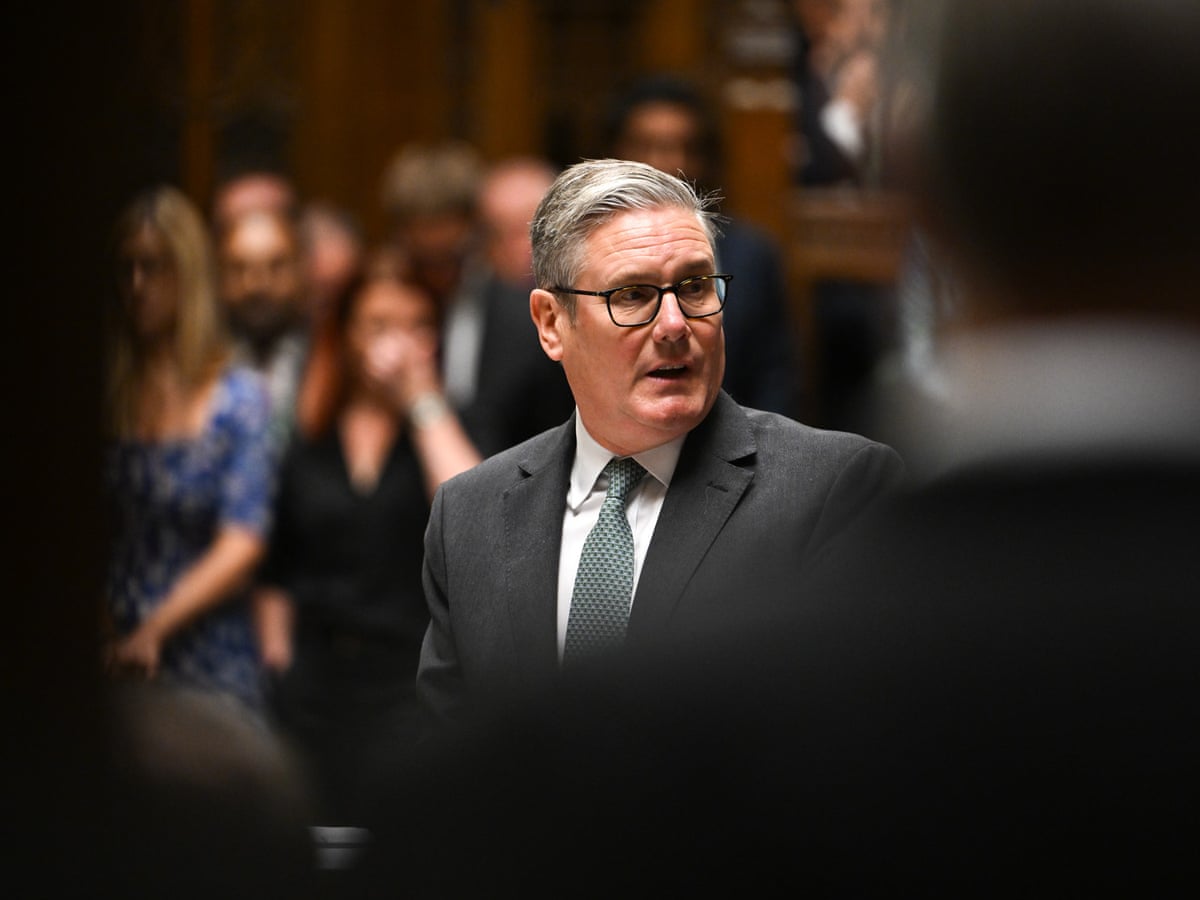
Keir Starmer walked into a room full of Labour MPs knowing that the biggest threat to his premiership was no longer coming from the Conservative opposition or Reform UK. It was coming from inside his own party.

The prime minister’s attempt to steady his leadership came after Labour suffered a deeply damaging set of local and devolved election results, prompting a growing number of MPs to question whether Starmer could lead the party into the next general election. By the time of his address, dozens of Labour MPs had publicly demanded that he resign or announce a timetable for his departure.
It was therefore less a routine political speech than an exercise in survival.
Starmer’s message was simple: he was not going anywhere.
“I know that people are frustrated by the state of Britain, frustrated by politics, and some people frustrated with me,” he told Labour MPs. He acknowledged that there were “doubters” within and beyond the party, but insisted that he would prove them wrong.
The words were deliberately defiant. But the atmosphere surrounding them was anything but confident.
A party losing patience
The scale of the rebellion was what made the moment so serious.
In the aftermath of Labour’s poor election performance, more than 70 MPs were reported to have called for Starmer to resign or set out a timetable for his departure. The number continued to rise, with some Labour MPs arguing that the prime minister had become a liability rather than an electoral asset.
For Starmer, the political problem was particularly uncomfortable because Labour had won a huge parliamentary majority under his leadership only a short time earlier.
Yet the mood inside Westminster had changed dramatically.
Backbenchers complained about the government’s lack of political direction, weak communication and inability to demonstrate tangible improvements in people’s everyday lives. Others were angry about decisions made in Downing Street and felt increasingly disconnected from the leadership.
One description circulating among Labour figures captured the emotional character of the crisis: an expression of “exasperation and frustration” and a “howl of pain”.
That was the challenge Starmer faced. He was not merely trying to defeat an organised leadership coup. He was trying to persuade a frustrated parliamentary party that its political future remained safer with him than without him.
The speech was designed to buy time
Starmer’s address was not an attempt to pretend that everything was going well.
Instead, he acknowledged the frustration and promised that the government would become better and bolder. The prime minister sought to frame the crisis as a moment of correction rather than a verdict on his leadership.
That distinction mattered.
Admitting failure without offering a convincing route forward could have accelerated calls for his resignation. Pretending that nothing was wrong would have insulted MPs who had spent days hearing from angry constituents.
So Starmer chose a middle course: accept responsibility for the political mood, promise change and challenge his critics to wait.
His central argument was that Labour had been elected to govern and that he still had a mandate to deliver its programme.
But there was an obvious weakness in that argument.
A parliamentary mandate is not necessarily the same thing as a political mandate within a party. Labour MPs who believed that Starmer had become incapable of winning the next election were unlikely to be reassured simply by being reminded of the last one.
The ghost of the next election
The greatest fear among many Labour MPs was not necessarily Starmer himself. It was what they believed his leadership might mean for their own seats.
The rise of Reform UK had transformed the political calculations facing MPs across the country. Labour representatives in traditionally safe constituencies could no longer assume that a large majority would protect them indefinitely.
The poor local election performance therefore became more than a disappointing result. It became a warning.
If Labour could lose support so quickly after winning a landslide, MPs had to ask whether the problem was temporary or structural.
Starmer’s opponents increasingly argued that a leadership change was necessary before the next general election. Some wanted an immediate transition, while others favoured an orderly process that would give the party time to decide on a successor.
That division was important.
It meant the rebellion was not yet a single, unified movement. Different groups wanted different successors and different timetables. Some MPs wanted a rapid change; others feared that removing Starmer without a credible replacement could plunge Labour into an even deeper crisis.
For Starmer, that lack of unity offered a political lifeline.
No obvious successor — yet
Leadership challenges become dangerous when an alternative candidate can unite the rebels.
At this stage, Labour had no universally accepted replacement.
Wes Streeting was widely discussed as a potential successor, while Andy Burnham was attracting significant support among MPs who wanted a more electorally resonant and politically confident Labour leadership. Angela Rayner remained an important figure, although her political position had also become complicated by controversies and internal party tensions.
Burnham’s position was particularly intriguing because his popularity extended beyond Westminster.
His eventual return to Parliament created the possibility of a much more direct challenge to Starmer. By June, after Burnham won the Makerfield by-election, pressure on Starmer had intensified dramatically, with Sky News reporting that 100 Labour MPs had publicly called for the prime minister to step down.
But during Starmer’s earlier fightback, that future challenge had not yet crystallised into a single parliamentary campaign.
The prime minister could therefore still argue that removing him would create uncertainty without guaranteeing Labour a better electoral future.
The problem was deeper than one speech
The most difficult question for Starmer was whether any speech could solve a crisis that had been building for months.
His political style had always been based on discipline, caution and control. Those qualities helped him take Labour from opposition to government. But inside a governing party, particularly one containing MPs with competing ideological traditions and electoral pressures, the same qualities could appear as distance and rigidity.
Former Labour figures later made precisely this criticism.
Yvette Cooper, reflecting on the Starmer years, argued that Labour had “not do[ne] government very well” and contrasted the former prime minister’s hierarchical style with Andy Burnham’s more collaborative approach.
That criticism goes to the heart of Starmer’s difficulty.
The problem was not simply that Labour MPs disliked individual policies. Many appeared to believe that the leadership had lost the ability to communicate a compelling political story.
A government can survive unpopular decisions if its supporters believe those decisions are part of a larger project.
What Labour MPs increasingly feared was that voters could see only the unpopular decisions.
A defiant ending
Starmer nevertheless refused to surrender.
His message was that he had fought too hard to win power and would not simply walk away because his political fortunes had deteriorated.
That defiance became one of the defining features of his response to the crisis. Even as MPs demanded a timetable for his departure, Starmer repeatedly insisted that he would fight any leadership challenge.
The immediate question was whether that determination represented strength or denial.
To supporters, it was the behaviour expected of a prime minister who had won a historic majority and still believed he could turn the situation around.
To opponents, it looked like a leader refusing to recognise that the political circumstances had changed.
The difference between those two interpretations ultimately depended on one thing: whether Starmer could produce results.
If living standards improved, public services recovered and Labour began winning back voters, his critics could eventually look like impatient rebels who had nearly destroyed their own government.
If the decline continued, the same speech could be remembered as the moment when Starmer was given one final opportunity to save his premiership — and failed.
The fight was only beginning
The most revealing aspect of Starmer’s address was therefore not what he said, but what it demonstrated about the Labour Party.
The party was no longer united simply by the desire to keep the Conservatives out of government. It was arguing about what Labour should become in power, how it should respond to Reform UK and whether Starmer was the person capable of delivering electoral success.
The prime minister entered the room hoping to stop the bleeding.
He left with his leadership intact — but profoundly weakened.
In the weeks and months that followed, the pressure only intensified. The number of Labour MPs publicly calling for his departure eventually reached around 100, while Burnham’s return to Westminster transformed the succession question from speculation into a credible political threat.
Starmer’s desperate address therefore bought him time, but time was never going to be enough on its own.
He needed a political recovery.
He needed frightened MPs to believe their seats were safer with him.
And above all, he needed voters to believe that Labour still had a reason to govern.
That was the real message behind the angry meeting. Starmer might have been able to survive a rebellion inside Westminster. What he could not survive indefinitely was the belief, shared by MPs and voters alike, that his government had run out of answers.
For the moment, he chose to fight.
But in a party increasingly impatient for change, the question was no longer simply whether Keir Starmer could survive the crisis.
It was whether Labour still believed he was the person who could lead it out of one.