
December 27th, 1966. Christmas had just passed. A fire base in Vietnam’s Kiman Valley was about to become a killing ground. The American gun crews leveled their howitzers, not up at distant targets. Straight ahead, point blank, into a human wave assault. What came out of those tubes wasn’t an explosive.
It was 8,000 steel darts traveling at supersonic speed. Each dart was 1 in long with four stabilizing fins. Tiny metal arrows designed for one purpose. The sound it made gave it a name. And the carnage it caused made it legendary. This is the story of the Beehive round. Let’s go back to where this nightmare started. Korea 1950. American artillery crews faced a problem that terrified them.
Chinese forces would attack in waves. Hundreds, sometimes thousands of soldiers charging positions at close range. Standard high explosive shells have minimum safe distances. Fire too close to your own position and you kill your own men. That gap became a killing zone where the enemy could overwhelm you. In April 1957, the US Army gave a contract to an unlikely partner.
Pikatini Arsenal in New Jersey teamed up with the Whirlpool Corporation. Yes, the appliance company. They were tasked with re-imagining an ancient concept for the modern battlefield. Canister Shot, the giant shotgun shell of the cannon era. Pack a metal can with hundreds of musk balls. Fire point blank. turn your artillery piece into a devastating anti-personnel weapon. But this was 1957.
They couldn’t use musk balls. They used something far worse. Steel fleshes. Tiny arrows 1 in long with four stabilizing fins. Each one weighing half a gram. 8,000 of them stacked inside a single artillery shell. The name beehive came from how they were arranged inside. Stacked in concentric tiers like a traditional Skep beehive.
The 8,000 fleshes together weighed just over 9 lbs of payload. But when veterans heard that name, they didn’t think about the engineering. They thought about the sound. Landing zone bird, a dirt clearing in the Kimson Valley barely big enough for three batteries of artillery and one company of infantry. 199 American soldiers.
Christmas had just passed. The rain was constant. At midnight they came. Three battalions of the North Vietnamese 22nd Regiment, the elite Saang Division, Gold Star. Over a thousand men filtering through the darkness. The perimeter was breached almost immediately. The 155 millimeter guns were overrun.
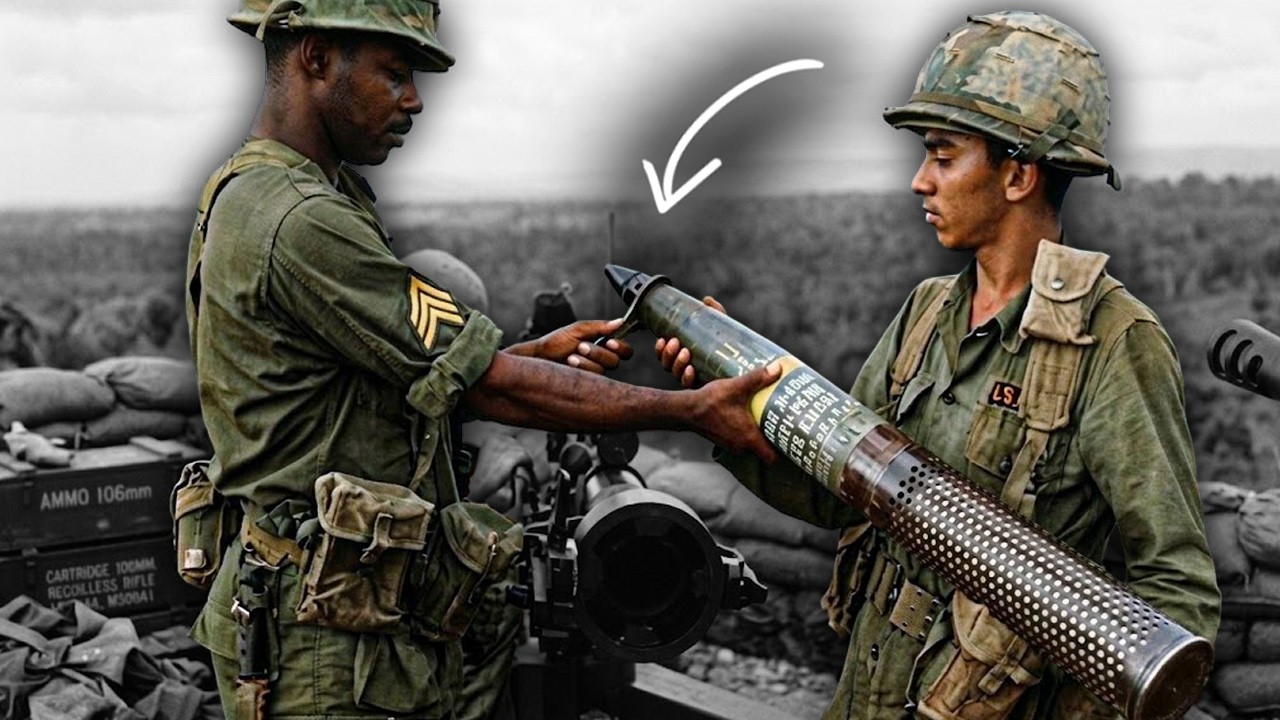
Enemy soldiers were inside the firebase. That’s when the surviving 105 mm crews did something that wasn’t in any manual. First Lieutenant John Piper and Staff Sergeant Robert Underwood grabbed their gun crews. They didn’t elevate their tubes for distant fire. They leveled them horizontal, point blank into the attacking force less than 50 m away.
The shells were marked with white diamonds so crews could grab them in the dark. Green star cluster flares went up first. A warning to friendly troops. Get down. Cover your heads. Then they fired. Specialist Fourth Class Clint Houston was there that night with Battery, Second Battalion, 19th Artillery. What he described was unforgettable.
It screeched like a million bees. 8,000 steel darts, each one spinning through the air at supersonic speed. The sound wasn’t just loud. It was psychologically devastating. A high-pitched shriek that seemed to come from everywhere at once. The darts spread in a forward expanding cone.
At 50 m, that cone was wide enough to cut down an entire assault wave. Houston saw a big hole in their ranks. And then he heard screaming. Those bodies were ripped to shreds. Then they fired again with the same results. The assault was stopped dead in its tracks. When the sun came up at El Zird, the firebase was still in American hands. 28 Americans killed, 67 wounded.
The North Vietnamese left behind 266 dead. Sergeant Delbert Jennings received the Medal of Honor for his actions that night. Lieutenant Piper got the Distinguished Service Cross. But the real story was what happened in those few minutes when the Beehive rounds were fired. The assault stopped, not retreated, stopped dead.
Because the men who had been leading it were no longer physically capable of moving forward across the right across the river from me. And when I fired it, they fired at my muzzle blast. When it hit the shield, it blew me off the piece. It also hit Sergeant Gant right in the chest. And the last thing I can remember was Sergeant Gant just disappearing into the darkness.
Well, the enemy started turning my howitzer around supposedly to fire turn it and fired at our guys. If I’d been awake, I would have known that our next gun back was going to fire beehive round. Standing rule is you never let the enemy take control of the weapon. You know, common sense. But I was not. I was unconscious.
>> If LZBird was the beehive’s combat debut, then Soy Trey was its validation as doctrine. War Zone C T Nin Province. 3 months after Bird, the 272nd Vietkong regiment hit fire support base gold with everything they had. 2500 men in a coordinated assault against a fourth infantry division position. The artillery battalion commander was Lieutenant Colonel John Vessie Jr.
He had about 40 experimental beehive rounds allocated to his unit. When the perimeter was penetrated at 0752 hours, he used every single one. His gun crews depressed their tubes to near zero elevation and fired those 40 beehive rounds in a sustained barrage. When the special ammunition ran out, they switched to pointblank high explosive.
The afteraction report is clinical. The reality was carnage. Walt Shugert was an infantryman with Bravo Company, Third Battalion, 22nd Infantry. He was there. His account is the single most cited description of what Beehive did to human beings. With rank upon rank of enemy infantry still advancing, the artillery lowered its tubes for direct fire and unleashed successive volleys of beehive rounds.
Each shot sounded like a massive swarm of bees had been unleashed. The advancing troops were mowed down like a reaper harvesting wheat. Enemy dead were found with arms pinned to their chests by a multitude of fleshettes. The final count was 31 Americans killed and 187 wounded. 647 Vietkong and North Vietnamese dead were recovered from the battlefield.
The unit received a presidential unit citation. Vessie got the distinguished service cross. Years later, John Vessie would become chairman of the joint chiefs of staff, the highest ranking officer in the US military. But in March 1967, he was a battalion commander who had just proven something terrifying. The Beehive round worked exactly as designed.
10 months later, it happened again. Fire support base. Four enemy battalions attacked a 25th Infantry Division position. The declassified afteraction report reads like a case study. Captain Jerry Brown of the Third Battalion, 22nd Infantry, wrote in his report, “Between 0 to 0230 hours, 105 mm Beehive direct fire was requested and fired along Company C perimeter.
Beehive rounds eliminated penetration except for four Vietkong four. Out of hundreds attacking that sector, Beehive left four men standing. fire support base. Bert’s final losses were 23 Americans killed and 153 wounded, 401 enemy dead were confirmed. This battle became the basis for the climactic firebase fight in Oliver Stone’s platoon.
Stone served with Bravo Company, Third Battalion, 22nd Infantry. He was there that night. By early 1968, the pattern was established. When beehive rounds were available and conditions were right, they could stop a mass assault in its tracks. But there was already something replacing it. Killer Jr., a technique developed by Lieutenant Colonel Robert Dean of the First Battalion, Eighth Field Artillery.
Standard high explosive shells with timed fuses set to detonate 30 ft above ground. It had one crucial advantage. Enemy soldiers lying prone to avoid Beehive’s horizontal pattern couldn’t hide from fragments raining down from above. The army’s official verdict was clear. Killer Jr. was more effective in many instances than direct fire with beehive ammunition because the enemy could avoid Beehive by lying prone or crawling.
By 1969, Beehive was already being held in reserve, a last resort weapon for when the enemy got inside minimum air burst range. Now, let’s talk about what those steel darts actually did when they hit a human body. The peer-reviewed medical literature on flesh wounds is surprisingly thin, but what exists is specific and disturbing. Cardiac surgeons working in Vietnam evacuation hospitals published several case studies in the journal Surgery in 1971.
Doctors Shector and Gilbert established a clinical signature that battlefield medics learned to recognize. The entry wound was so small it could be missed during initial examination. under 3 mm, smaller than a pencil eraser. But that dart could penetrate deeply, traveling in a straight line through soft tissue until it hit bone or dense organ tissue.
When it struck dense tissue, the slender body would bend. The fins would sometimes shear off, creating what surgeons called the bent needle pattern on X-rays. This wasn’t like a bullet wound. Bullets tumble, create massive temporary cavitation, transfer energy explosively. Fletchettes stayed point forward, creating narrow permanent cavities unless they hit bone.
Then all that kinetic energy got transferred into fragmentation. The Vietnamese have a name for it. Jan to literally beehive round. Individual darts are called muen theep steel arrows or fio darts. In 2022, a team that included Vietnamese architect Schwan Thang and American veteran Bob March excavated a mass grave at Schwanson Hill near Lzed Bird.
They recovered approximately 60 North Vietnamese soldiers killed in that Christmas battle. The Vietnamese press described Beehive as a secret weapon of enormous lethality being field tested for the first time. One American veteran who participated in the recovery testified that Vietnamese soldiers were killed mainly by being hit by the newly trial beehive round.
The US Army selected some bodies for autopsy to evaluate the weapon’s effectiveness. Let that implication of field testing settle for a moment. Vietnamese television did a documentary in 2023 called Mani U, which means fragments of memory. It covered the recovery operation and included survivor testimonies. But here’s what’s important.
The Vietnamese official military history titled Victory in Vietnam doesn’t treat Beehive as a discrete topic. It’s mentioned as one weapon among many. Not singled out as the war’s signature atrocity. The Vietnamese Artillery Museum in Hanoi has no dedicated beehive exhibit. The captured document archives at Texas Tech University’s Vietnam Center hold 200,000 Pav and Vietkong documents.
None specifically analyzing fchet tactics have surfaced in public indexing. The Vietnamese voice on beehive that exists in the public record is real, but it’s recent. Reconciliation framed, not the contemporaneous war crimes accusation you might expect. Here’s a claim you’ll see repeated constantly.
Facchet weapons are banned by the Geneva Convention. That claim is false. Multiple legal databases, the International Committee of the Red Cross, and a definitive 2003 Israeli Supreme Court ruling all confirm the same thing. Fleshet munitions are not specifically prohibited under any treaty.
No treaty bans them, not Geneva, not the HEG, not anywhere. The Russell Tribunal, Bertrren Russell’s International War Crimes Tribunal met in Stockholm and Copenhagen in 1967. They unanimously condemned US use of weapons prohibited by the laws of war. Napal, white phosphorus, cluster bombs, CS gas, defoliants. Beehive isn’t mentioned by name in the published proceedings.
Not once. The closest the international community came to banning fchettes was at the international committee of the Red Cross convened Lousern conference in September 1974. This conference would eventually produce the 1980 convention on certain conventional weapons. The treaty that restricts non-detectable fragments, mines, incendiaries, and blinding lasers.
According to weapons research organizations, the proposal to ban fchet weapons attracted little comment and was dropped for lack of support. The most rigorous legal analysis comes from scholars like Eric Proush and Eton Barack. Their verdict is nuanced. Fchett munitions aren’t inherently indiscriminate by design, but their use in populated areas raises serious concerns about the principle of distinction between combatants and civilians.
Legal scholars describe them as occupying a gray zone in international humanitarian law. Barack notes that fleshes were not used to any major degree in any subsequent armed conflict that attracted much international attention until Israeli use in Lebanon and Gaza after 2001. The US Army Field Artillery Museum at Fort Sil displays an M546 cutaway in its Vietnam era gallery.
That’s roughly the totality of Beehive’s official commemoration. The battalion commander from Soy Trey became chairman of the Joint Chiefs of Staff. There’s no Field Artillery Hall of Fame entry for the round itself. No monument, no ban, just a quiet exit from the arsenal. By the late 1960s, Beehive was already being displaced by better tactics.
By the 1970s, it was obsolete. Improved DPICM cluster munitions were eight times more efficient per casualty. In the precisiong guided era of copperhead and Excalibur rounds, the idea of turning a howitzer into a giant shotgun seems almost quaint. But beehive’s real significance isn’t technical.
It’s psychological and doctrinal. Doctrinally, it represented the industrial era return of the canister round, a Civil War concept briefly revived and then discarded as tactics evolved. Psychologically, it broke the distance buffer that normally separated artillerymen from the consequences of their fire. Gun crews who fired Beehive saw, smelled, and walked among the results in the morning.
Most of the field artillery branch was spared that. Beehive gunners weren’t. The honest frame for understanding beehive is neither demonization nor celebration. A specific tactical problem generated a specific weapon which worked exactly as designed within a very narrow envelope and then faded as better solutions emerged.
It left behind a small body of medical literature, a smaller body of legal debate, and a vivid place in the memories of men on both sides who encountered it. 8,000 steel darts in a cone pattern, the sound of a million bees, arms pinned to chests. That’s the beehive’s legacy. Not banned, not celebrated, just remembered by those who heard it.
The Vietnam War produced dozens of weapons that changed modern combat. Some became icons. Some became scandals. Most just faded away when something better came along. If you want to understand what actually happened in that war beyond the mythology and the politics, this channel covers it. Next week, we’re looking at the Phoenix program.
Click subscribe, hit the bell, and leave a comment with what weapon or tactic you want covered next.
The True HORRORS Of The Beehive Round In Vietnam (Its Worse Than You Think)
December 27th, 1966. Christmas had just passed. A fire base in Vietnam’s Kiman Valley was about to become a killing ground. The American gun crews leveled their howitzers, not up at distant targets. Straight ahead, point blank, into a human wave assault. What came out of those tubes wasn’t an explosive.
It was 8,000 steel darts traveling at supersonic speed. Each dart was 1 in long with four stabilizing fins. Tiny metal arrows designed for one purpose. The sound it made gave it a name. And the carnage it caused made it legendary. This is the story of the Beehive round. Let’s go back to where this nightmare started. Korea 1950. American artillery crews faced a problem that terrified them.
Chinese forces would attack in waves. Hundreds, sometimes thousands of soldiers charging positions at close range. Standard high explosive shells have minimum safe distances. Fire too close to your own position and you kill your own men. That gap became a killing zone where the enemy could overwhelm you. In April 1957, the US Army gave a contract to an unlikely partner.
Pikatini Arsenal in New Jersey teamed up with the Whirlpool Corporation. Yes, the appliance company. They were tasked with re-imagining an ancient concept for the modern battlefield. Canister Shot, the giant shotgun shell of the cannon era. Pack a metal can with hundreds of musk balls. Fire point blank. turn your artillery piece into a devastating anti-personnel weapon. But this was 1957.
They couldn’t use musk balls. They used something far worse. Steel fleshes. Tiny arrows 1 in long with four stabilizing fins. Each one weighing half a gram. 8,000 of them stacked inside a single artillery shell. The name beehive came from how they were arranged inside. Stacked in concentric tiers like a traditional Skep beehive.
The 8,000 fleshes together weighed just over 9 lbs of payload. But when veterans heard that name, they didn’t think about the engineering. They thought about the sound. Landing zone bird, a dirt clearing in the Kimson Valley barely big enough for three batteries of artillery and one company of infantry. 199 American soldiers.
Christmas had just passed. The rain was constant. At midnight they came. Three battalions of the North Vietnamese 22nd Regiment, the elite Saang Division, Gold Star. Over a thousand men filtering through the darkness. The perimeter was breached almost immediately. The 155 millimeter guns were overrun.
Enemy soldiers were inside the firebase. That’s when the surviving 105 mm crews did something that wasn’t in any manual. First Lieutenant John Piper and Staff Sergeant Robert Underwood grabbed their gun crews. They didn’t elevate their tubes for distant fire. They leveled them horizontal, point blank into the attacking force less than 50 m away.
The shells were marked with white diamonds so crews could grab them in the dark. Green star cluster flares went up first. A warning to friendly troops. Get down. Cover your heads. Then they fired. Specialist Fourth Class Clint Houston was there that night with Battery, Second Battalion, 19th Artillery. What he described was unforgettable.
It screeched like a million bees. 8,000 steel darts, each one spinning through the air at supersonic speed. The sound wasn’t just loud. It was psychologically devastating. A high-pitched shriek that seemed to come from everywhere at once. The darts spread in a forward expanding cone.
At 50 m, that cone was wide enough to cut down an entire assault wave. Houston saw a big hole in their ranks. And then he heard screaming. Those bodies were ripped to shreds. Then they fired again with the same results. The assault was stopped dead in its tracks. When the sun came up at El Zird, the firebase was still in American hands. 28 Americans killed, 67 wounded.
The North Vietnamese left behind 266 dead. Sergeant Delbert Jennings received the Medal of Honor for his actions that night. Lieutenant Piper got the Distinguished Service Cross. But the real story was what happened in those few minutes when the Beehive rounds were fired. The assault stopped, not retreated, stopped dead.
Because the men who had been leading it were no longer physically capable of moving forward across the right across the river from me. And when I fired it, they fired at my muzzle blast. When it hit the shield, it blew me off the piece. It also hit Sergeant Gant right in the chest. And the last thing I can remember was Sergeant Gant just disappearing into the darkness.
Well, the enemy started turning my howitzer around supposedly to fire turn it and fired at our guys. If I’d been awake, I would have known that our next gun back was going to fire beehive round. Standing rule is you never let the enemy take control of the weapon. You know, common sense. But I was not. I was unconscious.
>> If LZBird was the beehive’s combat debut, then Soy Trey was its validation as doctrine. War Zone C T Nin Province. 3 months after Bird, the 272nd Vietkong regiment hit fire support base gold with everything they had. 2500 men in a coordinated assault against a fourth infantry division position. The artillery battalion commander was Lieutenant Colonel John Vessie Jr.
He had about 40 experimental beehive rounds allocated to his unit. When the perimeter was penetrated at 0752 hours, he used every single one. His gun crews depressed their tubes to near zero elevation and fired those 40 beehive rounds in a sustained barrage. When the special ammunition ran out, they switched to pointblank high explosive.
The afteraction report is clinical. The reality was carnage. Walt Shugert was an infantryman with Bravo Company, Third Battalion, 22nd Infantry. He was there. His account is the single most cited description of what Beehive did to human beings. With rank upon rank of enemy infantry still advancing, the artillery lowered its tubes for direct fire and unleashed successive volleys of beehive rounds.
Each shot sounded like a massive swarm of bees had been unleashed. The advancing troops were mowed down like a reaper harvesting wheat. Enemy dead were found with arms pinned to their chests by a multitude of fleshettes. The final count was 31 Americans killed and 187 wounded. 647 Vietkong and North Vietnamese dead were recovered from the battlefield.
The unit received a presidential unit citation. Vessie got the distinguished service cross. Years later, John Vessie would become chairman of the joint chiefs of staff, the highest ranking officer in the US military. But in March 1967, he was a battalion commander who had just proven something terrifying. The Beehive round worked exactly as designed.
10 months later, it happened again. Fire support base. Four enemy battalions attacked a 25th Infantry Division position. The declassified afteraction report reads like a case study. Captain Jerry Brown of the Third Battalion, 22nd Infantry, wrote in his report, “Between 0 to 0230 hours, 105 mm Beehive direct fire was requested and fired along Company C perimeter.
Beehive rounds eliminated penetration except for four Vietkong four. Out of hundreds attacking that sector, Beehive left four men standing. fire support base. Bert’s final losses were 23 Americans killed and 153 wounded, 401 enemy dead were confirmed. This battle became the basis for the climactic firebase fight in Oliver Stone’s platoon.
Stone served with Bravo Company, Third Battalion, 22nd Infantry. He was there that night. By early 1968, the pattern was established. When beehive rounds were available and conditions were right, they could stop a mass assault in its tracks. But there was already something replacing it. Killer Jr., a technique developed by Lieutenant Colonel Robert Dean of the First Battalion, Eighth Field Artillery.
Standard high explosive shells with timed fuses set to detonate 30 ft above ground. It had one crucial advantage. Enemy soldiers lying prone to avoid Beehive’s horizontal pattern couldn’t hide from fragments raining down from above. The army’s official verdict was clear. Killer Jr. was more effective in many instances than direct fire with beehive ammunition because the enemy could avoid Beehive by lying prone or crawling.
By 1969, Beehive was already being held in reserve, a last resort weapon for when the enemy got inside minimum air burst range. Now, let’s talk about what those steel darts actually did when they hit a human body. The peer-reviewed medical literature on flesh wounds is surprisingly thin, but what exists is specific and disturbing. Cardiac surgeons working in Vietnam evacuation hospitals published several case studies in the journal Surgery in 1971.
Doctors Shector and Gilbert established a clinical signature that battlefield medics learned to recognize. The entry wound was so small it could be missed during initial examination. under 3 mm, smaller than a pencil eraser. But that dart could penetrate deeply, traveling in a straight line through soft tissue until it hit bone or dense organ tissue.
When it struck dense tissue, the slender body would bend. The fins would sometimes shear off, creating what surgeons called the bent needle pattern on X-rays. This wasn’t like a bullet wound. Bullets tumble, create massive temporary cavitation, transfer energy explosively. Fletchettes stayed point forward, creating narrow permanent cavities unless they hit bone.
Then all that kinetic energy got transferred into fragmentation. The Vietnamese have a name for it. Jan to literally beehive round. Individual darts are called muen theep steel arrows or fio darts. In 2022, a team that included Vietnamese architect Schwan Thang and American veteran Bob March excavated a mass grave at Schwanson Hill near Lzed Bird.
They recovered approximately 60 North Vietnamese soldiers killed in that Christmas battle. The Vietnamese press described Beehive as a secret weapon of enormous lethality being field tested for the first time. One American veteran who participated in the recovery testified that Vietnamese soldiers were killed mainly by being hit by the newly trial beehive round.
The US Army selected some bodies for autopsy to evaluate the weapon’s effectiveness. Let that implication of field testing settle for a moment. Vietnamese television did a documentary in 2023 called Mani U, which means fragments of memory. It covered the recovery operation and included survivor testimonies. But here’s what’s important.
The Vietnamese official military history titled Victory in Vietnam doesn’t treat Beehive as a discrete topic. It’s mentioned as one weapon among many. Not singled out as the war’s signature atrocity. The Vietnamese Artillery Museum in Hanoi has no dedicated beehive exhibit. The captured document archives at Texas Tech University’s Vietnam Center hold 200,000 Pav and Vietkong documents.
None specifically analyzing fchet tactics have surfaced in public indexing. The Vietnamese voice on beehive that exists in the public record is real, but it’s recent. Reconciliation framed, not the contemporaneous war crimes accusation you might expect. Here’s a claim you’ll see repeated constantly.
Facchet weapons are banned by the Geneva Convention. That claim is false. Multiple legal databases, the International Committee of the Red Cross, and a definitive 2003 Israeli Supreme Court ruling all confirm the same thing. Fleshet munitions are not specifically prohibited under any treaty.
No treaty bans them, not Geneva, not the HEG, not anywhere. The Russell Tribunal, Bertrren Russell’s International War Crimes Tribunal met in Stockholm and Copenhagen in 1967. They unanimously condemned US use of weapons prohibited by the laws of war. Napal, white phosphorus, cluster bombs, CS gas, defoliants. Beehive isn’t mentioned by name in the published proceedings.
Not once. The closest the international community came to banning fchettes was at the international committee of the Red Cross convened Lousern conference in September 1974. This conference would eventually produce the 1980 convention on certain conventional weapons. The treaty that restricts non-detectable fragments, mines, incendiaries, and blinding lasers.
According to weapons research organizations, the proposal to ban fchet weapons attracted little comment and was dropped for lack of support. The most rigorous legal analysis comes from scholars like Eric Proush and Eton Barack. Their verdict is nuanced. Fchett munitions aren’t inherently indiscriminate by design, but their use in populated areas raises serious concerns about the principle of distinction between combatants and civilians.
Legal scholars describe them as occupying a gray zone in international humanitarian law. Barack notes that fleshes were not used to any major degree in any subsequent armed conflict that attracted much international attention until Israeli use in Lebanon and Gaza after 2001. The US Army Field Artillery Museum at Fort Sil displays an M546 cutaway in its Vietnam era gallery.
That’s roughly the totality of Beehive’s official commemoration. The battalion commander from Soy Trey became chairman of the Joint Chiefs of Staff. There’s no Field Artillery Hall of Fame entry for the round itself. No monument, no ban, just a quiet exit from the arsenal. By the late 1960s, Beehive was already being displaced by better tactics.
By the 1970s, it was obsolete. Improved DPICM cluster munitions were eight times more efficient per casualty. In the precisiong guided era of copperhead and Excalibur rounds, the idea of turning a howitzer into a giant shotgun seems almost quaint. But beehive’s real significance isn’t technical.
It’s psychological and doctrinal. Doctrinally, it represented the industrial era return of the canister round, a Civil War concept briefly revived and then discarded as tactics evolved. Psychologically, it broke the distance buffer that normally separated artillerymen from the consequences of their fire. Gun crews who fired Beehive saw, smelled, and walked among the results in the morning.
Most of the field artillery branch was spared that. Beehive gunners weren’t. The honest frame for understanding beehive is neither demonization nor celebration. A specific tactical problem generated a specific weapon which worked exactly as designed within a very narrow envelope and then faded as better solutions emerged.
It left behind a small body of medical literature, a smaller body of legal debate, and a vivid place in the memories of men on both sides who encountered it. 8,000 steel darts in a cone pattern, the sound of a million bees, arms pinned to chests. That’s the beehive’s legacy. Not banned, not celebrated, just remembered by those who heard it.
The Vietnam War produced dozens of weapons that changed modern combat. Some became icons. Some became scandals. Most just faded away when something better came along. If you want to understand what actually happened in that war beyond the mythology and the politics, this channel covers it. Next week, we’re looking at the Phoenix program.
Click subscribe, hit the bell, and leave a comment with what weapon or tactic you want covered next.