

I Revealed What Smugglers Were Plotting – and the Mega Dinghy Shows the Worst Is Yet to Come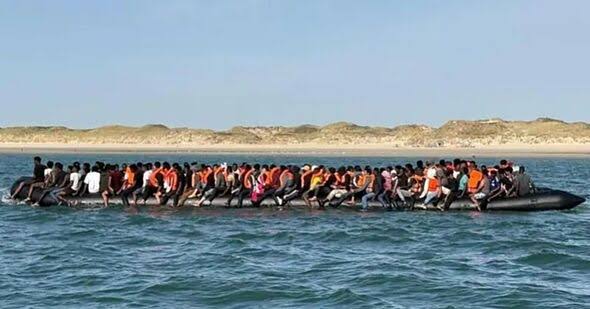
The English Channel has become the scene of one of Britain’s most persistent and politically explosive challenges: the continuing arrival of migrants in small boats operated by people smugglers.
For years, the public has been shown images of overcrowded dinghies attempting the dangerous crossing from France. Yet the latest developments suggest that the criminal networks behind the journeys may be adapting faster than governments can respond.
And one particularly striking vessel has offered a glimpse of what could be coming next.
The appearance of a huge, purpose-built inflatable boat has raised fresh questions about how sophisticated the smuggling gangs have become and whether Britain is prepared for the next phase of the Channel crisis.
This is no longer simply a story about desperate people climbing into whatever boat they can find.
It is increasingly a story about organised criminal enterprises, commercial logistics and a market that appears capable of adapting whenever authorities change their tactics.
The smugglers are adapting
People smugglers have one overriding objective: get as many paying customers across the Channel as possible while minimising their own risks.
That incentive has produced an increasingly sophisticated business model.
Boats can be sourced, modified and prepared specifically for crossings. Engines are selected for particular journeys. Passengers can be gathered through online networks. Payments can be arranged remotely.
The people organising these operations do not necessarily need to board the boats themselves.
That distinction is crucial.
The person taking a migrant across the Channel may be expendable. The organisers operating behind the scenes can remain safely outside Britain while their customers undertake one of the world’s busiest and most dangerous maritime journeys.
The result is a criminal business in which the risks are often transferred to the migrants themselves.
And as enforcement methods evolve, smugglers have an incentive to evolve with them.
Why the “mega dinghy” matters
The enormous inflatable vessel is significant because of what its size suggests.
A conventional small dinghy has obvious limitations. It can carry only a certain number of passengers, has limited fuel capacity and is vulnerable to weather and waves.
A much larger craft potentially changes the economics.
If smugglers can transport substantially more people in a single crossing, they may be able to increase their revenues while reducing the number of individual journeys required.
That could have profound consequences.
One successful crossing involving a large number of passengers could generate a considerable amount of money for the criminal network behind it.
The bigger the operation becomes, the more attractive the market can become to organised crime.
This is why focusing exclusively on the boats themselves risks missing the wider picture.
The real target should be the infrastructure behind them.
A dangerous business model
There is an uncomfortable contradiction at the heart of the Channel crisis.
For migrants, the journey can be terrifying.
For smugglers, however, it can be extraordinarily lucrative.
A single passenger may pay thousands of pounds for the journey. Multiply that by dozens of passengers and the financial incentive becomes obvious.
This helps explain why criminal groups continue to operate despite repeated attempts by governments to disrupt them.
When one route becomes more difficult, another can be developed.
When one type of vessel attracts attention, a different design can be introduced.
When communications are disrupted, smugglers can move to alternative platforms.
The basic business model remains remarkably resilient.
That is why simply increasing patrols or intercepting individual boats cannot, by itself, solve the problem.
The Channel is becoming a technological contest
There is a growing sense that the battle between authorities and smuggling gangs is becoming a technological contest.
Governments increasingly use surveillance, intelligence-sharing, drones, maritime patrols and sophisticated databases to identify suspicious activity.
Smuggling networks respond by changing their methods.
They can exploit encrypted communications, social-media advertising, disposable phones and rapidly changing logistical arrangements.
This creates an endless cycle.
Authorities identify a method.
Smugglers adapt.
Authorities respond again.
The criminal networks adapt again.
The danger is that the public sees only the final stage: the boat arriving on the British coast.
What remains largely invisible is the complex organisation that made the crossing possible.
The people paying the price
Whatever one’s views on immigration, there is one point on which there should be broad agreement: Channel crossings in overloaded or unsuitable boats are dangerous.
Passengers can be exposed to cold water, powerful currents, poor weather and mechanical failure.
If a boat becomes unstable, the consequences can be catastrophic.
That makes the activities of people smugglers particularly disturbing.
They are not simply providing transportation.
They are selling a dangerous journey in circumstances where passengers may have little understanding of the risks.
The bigger the boats become, the greater the potential consequences if something goes wrong.
A vessel carrying a handful of people presents one set of challenges.
A giant inflatable packed with passengers presents another entirely.
The political consequences
The Channel crisis has become one of the defining issues of British politics because it combines immigration, border control, national sovereignty and public confidence in government.
Successive governments have promised to reduce crossings.
Yet the political pressure has continued.
For voters, the issue is often about something much bigger than individual boats.
It is about whether the state can control its own borders.
That is why every new record, every new vessel and every new smuggling tactic generates such intense political reaction.
For opposition parties, the boats are evidence that the government has lost control.
For the government, each successful interception can be presented as proof that enforcement is working.
But neither argument completely addresses the underlying problem.
As long as people are willing to pay large sums to reach Britain and smugglers can make money by providing the journey, the market will remain.
The “worst is yet to come” argument
The most worrying possibility is that today’s boats may not represent the peak of the problem.
Criminal organisations are constantly looking for ways to improve their margins.
If larger vessels prove effective, they could become more common.
If smugglers discover that particular launch locations reduce the risk of interception, those locations may become more important.
If a particular type of engine or boat performs better in difficult conditions, it could be adopted more widely.
That does not mean that a future explosion in crossings is inevitable.
But it does mean that policymakers should not assume that the current pattern is fixed.
The smugglers have every reason to innovate.
Breaking the business model
The most effective response therefore needs to go beyond the boats.
The priority should be identifying and dismantling the criminal organisations that finance, advertise and coordinate the crossings.
That means intelligence work.
It means international cooperation.
It means tracing money.
It means identifying recruiters and organisers rather than concentrating solely on the people physically operating boats.
And it means working with French and European authorities to disrupt operations before boats reach the water.
The people making money from these crossings should be the primary target.
Otherwise, the system risks becoming a revolving door.
One boat is stopped.
Another replaces it.
One smuggler is arrested.
Another takes his place.
One route is closed.
A different route opens.
Britain also faces a wider dilemma
There is another part of the debate that cannot be ignored.
As long as there are people who believe that reaching Britain through irregular routes offers a realistic opportunity to remain in the country, demand will continue.
That means enforcement must be accompanied by a credible asylum and immigration system.
Cases need to be processed efficiently.
Those who qualify for protection need to receive it.
Those who do not have a legal basis to remain need to be removed where legally possible.
And safe, legal routes need to be designed carefully enough to ensure that they do not simply create new incentives for exploitation.
None of these measures is easy.
But without a comprehensive approach, the government risks treating symptoms rather than causes.
The real warning
The giant dinghy should therefore be seen as more than a striking image.
It is a warning about the adaptability of the criminal market.
The smugglers are not standing still.
They are watching government policy, calculating risks and looking for opportunities.
Every time authorities close one avenue, they have an incentive to search for another.
That means Britain cannot afford to become complacent when crossings temporarily fall.
The numbers can change quickly.
The criminal infrastructure can change even faster.
And if larger boats become part of the smugglers’ toolkit, the potential consequences could be considerably more serious.
The Channel is not simply a migration route.
It is a battleground between governments attempting to enforce borders and criminal organisations attempting to profit from people who want to cross them.
The smugglers have already demonstrated their willingness to innovate.
The question now is whether governments can innovate faster.
Because the most dangerous mistake would be to look at today’s boats and assume that tomorrow’s problem will look the same.
The mega dinghy may be just one vessel.
But it could also be a glimpse of what the smuggling industry is preparing next.
And if that is the case, Britain needs to act before the next wave arrives — rather than waiting until it is already in the water.