

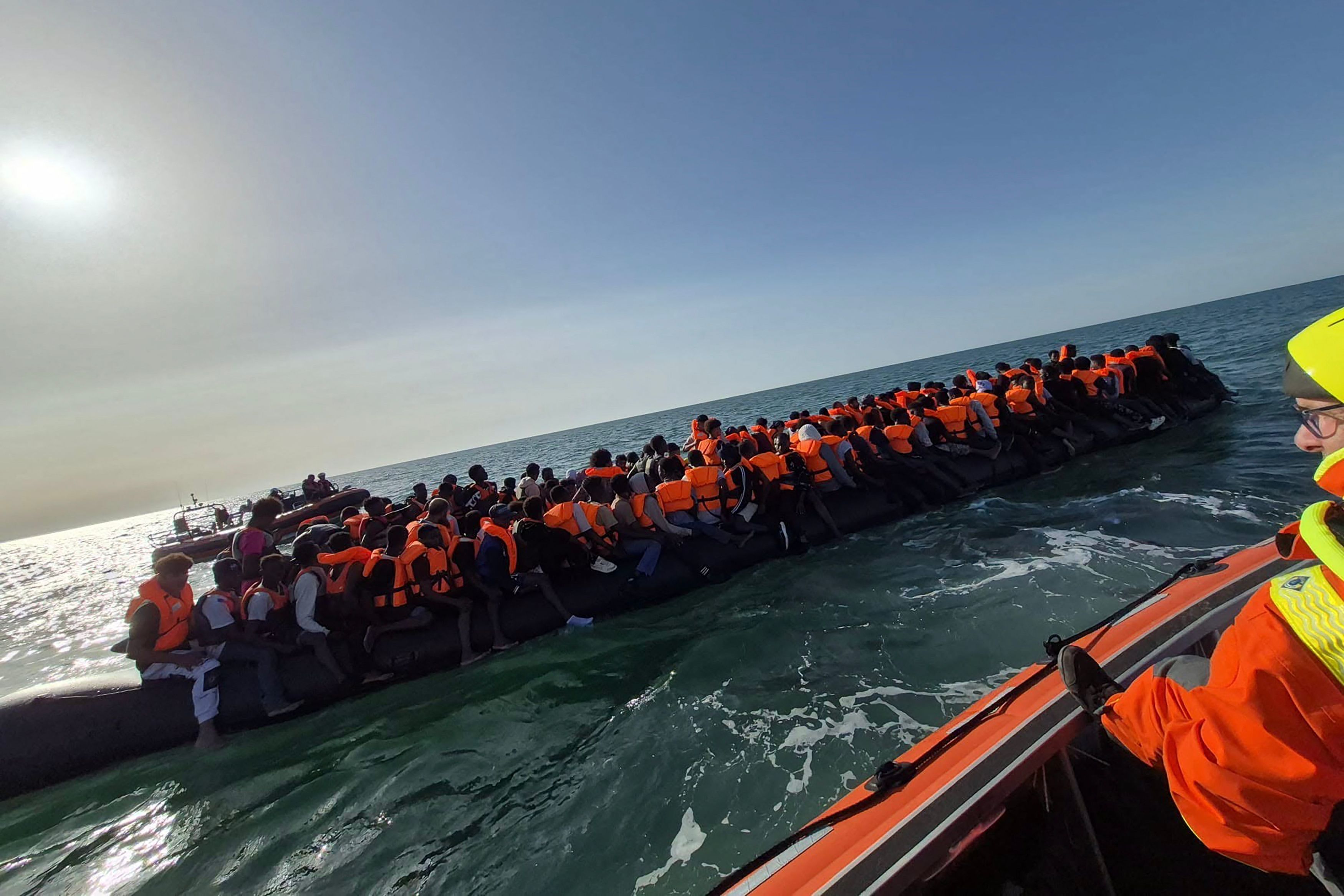
Huge Migrant Dinghy Carrying 230 People Pictured as French Face Questions Over Channel Crossings
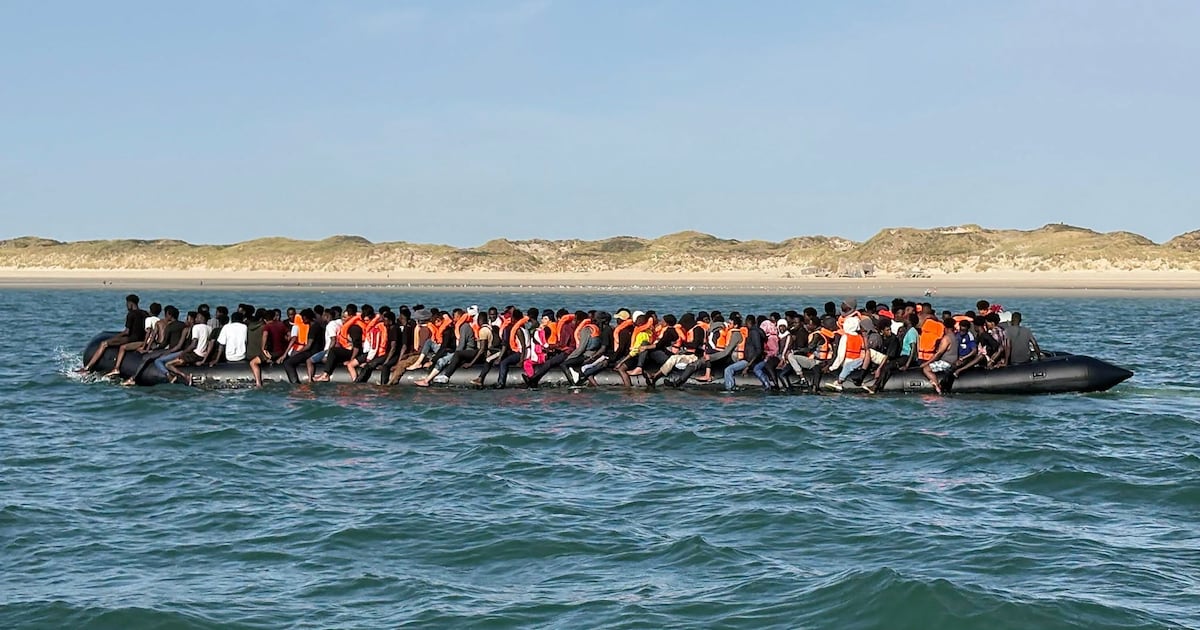
A huge inflatable dinghy carrying a record 230 people has crossed the English Channel from France to Britain, providing a dramatic illustration of how people-smuggling gangs are changing their tactics as authorities attempt to disrupt small-boat crossings.
The extraordinary vessel arrived in the UK in the early hours of August 10, carrying more people than any previous single boat recorded during the Channel crisis. The crossing has intensified political pressure on the government and raised fresh questions about whether tougher enforcement on French beaches is actually forcing smugglers to find new ways around the authorities.
The image of such a vast number of people packed onto one inflatable boat is particularly striking because the policy response on both sides of the Channel has increasingly focused on preventing boats from launching in the first place.
Yet the latest crossing suggests that the criminal gangs organising the journeys are adapting rapidly.
A new era of “mega-dinghies”
For years, Channel crossings were associated with relatively small inflatable boats carrying dozens of passengers.
That model appears to be changing.
The latest vessel carried 230 people — dramatically exceeding the previous record of 165 people set in July. Another boat carrying 128 people had crossed earlier in the summer, while a separate vessel carrying 173 people caught fire and capsized in the Channel on August 4.
The emergence of these so-called “mega-dinghies” is one of the most significant developments in the Channel migration crisis.
According to analysis reported by the Financial Times, the average number of people travelling on each small boat has increased enormously since the crisis began. In 2018, the average was only around seven people per boat. By the year ending March 2026, that figure had risen to approximately 63.
The reasons are relatively straightforward.
If French authorities make it harder for smugglers to launch multiple smaller boats, criminal networks have an incentive to put more people on each vessel that successfully gets away.
That may reduce the number of individual launches.
But it creates an even greater danger for the people onboard.
Why the boats are becoming larger
French authorities have increased efforts to prevent crossings from northern France.
The UK has also been working with European partners to disrupt the supply of boats and engines before they reach the coast.
These measures appear to have had an impact.
Overall Channel arrivals in 2026 are substantially lower than during the equivalent period last year. The Home Office says crossings have fallen by more than 40 per cent, while July reportedly recorded the lowest number of arrivals for that month since 2020.
But lower overall numbers do not necessarily mean that the underlying problem has been solved.
Instead, smugglers appear to be adapting.
Rather than launching large numbers of small boats, some criminal groups are using fewer but much larger vessels.
This has created what officials describe as a new “taxi boat” model.
Under this system, boats can be launched and moved away from the immediate shoreline before being used to collect groups of migrants waiting elsewhere.
That makes traditional beach patrols more difficult because authorities are no longer simply looking for large groups of people attempting to launch boats directly from the French coast.
A dangerous development
The most worrying aspect of the new strategy is the danger to human life.
A small inflatable boat carrying dozens of people is already vulnerable to rough seas, mechanical failure and overcrowding.
Putting more than 200 people onto the same vessel magnifies those risks.
The danger was demonstrated just days before the record crossing, when a mega-dinghy carrying 173 people caught fire after its engine failed.
Those onboard had to be rescued, with several people suffering injuries. The incident highlighted the potentially catastrophic consequences if one of these huge inflatables encounters serious trouble in the middle of the Channel.
A boat carrying 230 people creates a particularly difficult rescue scenario.
If the vessel sinks or capsizes, emergency services could suddenly be dealing with hundreds of people in the water.
The Channel is one of the world’s busiest shipping routes, and its currents, temperatures and weather conditions make rescue operations extremely challenging.
French officials have warned that the growing size of the boats presents serious difficulties for rescue services as well as migrants themselves.
Is France doing enough?
The record crossing has inevitably produced criticism of French enforcement.
Critics argue that Britain cannot stop the Channel crisis alone because the journeys begin on French territory.
They want French authorities to prevent boats from entering the water and to dismantle smuggling networks before migrants reach the coastline.
The British government has therefore invested heavily in French enforcement.
A new payment-by-results arrangement is intended to increase the number of French officers operating on beaches in northern France, with the UK funding additional personnel and surveillance equipment, including drones.
The Home Office says this approach is already delivering results.
But the arrival of a 230-person boat creates an awkward political counterpoint.
If the government says French enforcement is working, opponents can point to the enormous vessel that apparently managed to leave the French coast and cross the Channel successfully.
The reality is more complicated.
A fall in overall crossings can coexist with individual spectacular failures.
One record-breaking boat does not necessarily prove that French enforcement has completely failed.
Equally, the record crossing demonstrates that smugglers are finding ways around the measures that have been introduced.
The smugglers are changing the business model
The latest development illustrates an important feature of the crisis: people-smuggling networks are businesses capable of adapting to government pressure.
When authorities disrupt one method, smugglers look for another.
When boats are seized, they seek new suppliers.
When beaches are heavily patrolled, they alter launch points or use different methods.
And when smaller boats become harder to operate, larger vessels can become more attractive.
Recent reporting has also highlighted the international supply chain behind the inflatable boats, with manufacturers in China producing large vessels that can subsequently reach European markets. Some of these boats are advertised for legitimate commercial purposes, although authorities are concerned that criminal networks are exploiting them for migrant crossings.
That means Britain’s problem is not simply located on the beaches of northern France.
It stretches across several countries and involves manufacturing, transportation, organised crime, finance and recruitment.
Stopping the boats therefore requires international cooperation.
Political pressure on Andy Burnham
The record crossing is particularly uncomfortable for Prime Minister Andy Burnham.
He has promised to be “relentless” in tackling small-boat crossings and has pledged to “eradicate” the problem.
His government argues that the overall reduction in arrivals demonstrates that its strategy is beginning to work.
But the 230-person crossing gives opposition politicians an opportunity to argue that the government’s strategy is failing to keep pace with the smugglers.
The timing is also significant.
Immigration has become one of the most important political issues in Britain, with Reform UK leader Nigel Farage repeatedly using Channel crossings as evidence that successive governments have failed to secure the country’s borders.
Farage described the record crossing as evidence of what he called a national security emergency.
That language is likely to resonate with voters who are already concerned about illegal migration.
Reform UK sees an opportunity
For Reform UK, the latest incident provides another opportunity to attack the government from the right.
The party can argue that promises of stronger enforcement mean little if smugglers can still transport more than 200 people across the Channel in a single inflatable boat.
Farage has long argued that Britain needs a much tougher approach to illegal migration.
The record crossing gives him a powerful visual symbol for that argument.
However, the government has an important counterargument.
If total crossings are genuinely down by more than 40 per cent, then the overall picture is not one of unlimited growth.
Instead, it is a picture of a system in transition.
Authorities may be stopping more traditional boats while smugglers compensate by increasing the number of people on each vessel.
That distinction will become increasingly important in the political debate.
The “one in, one out” agreement
Another element of the government’s strategy is the UK-France “one in, one out” arrangement.
The policy allows certain people who arrive in Britain from France by small boat to be returned, while another person can enter Britain legally through an approved asylum route.
The government believes the arrangement can create a deterrent by making irregular crossings less attractive.
Critics argue that deterrence measures can have the opposite effect by encouraging smugglers to make crossings more dangerous.
The emergence of mega-dinghies has therefore become part of a much larger argument over whether enforcement is reducing demand or simply changing the way journeys are organised.
Why 230 people on one boat matters
The record is significant not simply because it is a large number.
It changes the mathematics of the crisis.
If smugglers can transport 230 people on one vessel, they potentially need fewer successful launches to move the same number of people.
That can make conventional interception strategies more difficult.
It also means that each successful crossing can have a much greater political impact.
One photograph of a massive inflatable packed with people can dominate headlines and create the impression of an escalating crisis even when overall arrival numbers are falling.
That is precisely why the government will be keen to emphasise the broader statistics.
The 230-person crossing is extraordinary.
But it is only one part of the wider picture.
A record that nobody wanted
There is also a human dimension that should not be forgotten.
Whatever political position someone takes on immigration, putting 230 people onto an inflatable vessel for a Channel crossing represents an extremely dangerous undertaking.
The people onboard are exposed to drowning, hypothermia, mechanical failure and exploitation by criminal gangs.
The people-smuggling organisations profiting from these journeys have a financial incentive to maximise the number of passengers.
That is why officials on both sides of the Channel have condemned the use of increasingly overcrowded boats.
The Home Office described the tactics as “reckless and dangerous”, accusing criminal gangs of putting lives at risk by cramming increasing numbers of people onto vessels that are not designed for such journeys.
What happens next?
The biggest question is whether the 230-person crossing represents an isolated record or the beginning of a new phase in the crisis.
If smugglers continue using mega-dinghies, authorities may need to change their tactics again.
That could mean greater surveillance offshore, stronger intelligence operations against smuggling networks, increased seizures of boats and engines, and closer cooperation between Britain, France and other European countries.
It could also mean more attention on the international supply chain producing the vessels themselves.
The government will want to demonstrate that its strategy can adapt just as quickly as the smugglers.
France, meanwhile, will face increasing pressure to prove that its strengthened beach patrols are capable of preventing large vessels from launching.
And the political opposition will continue asking why a record-breaking boat was able to cross in the first place.
A warning written across the Channel
The image of a giant inflatable carrying 230 people is therefore much more than another shocking photograph.
It is evidence of a rapidly evolving problem.
Overall Channel crossings may be falling significantly, but the smugglers have not disappeared.
They are adapting their methods, increasing the capacity of individual vessels and creating new dangers for the people they transport.
For Andy Burnham, the challenge is now to show that the government’s strategy can stay ahead of those changes.
For French authorities, the challenge is to demonstrate that additional patrols and surveillance can actually prevent increasingly sophisticated operations.
And for Nigel Farage and other opponents of the government, the record crossing provides fresh ammunition for the argument that Britain still does not have control of its borders.
The 230 people who made the journey have become the largest group ever recorded on a single Channel crossing.
But the bigger story is what their vessel represents: when governments close one route, criminal networks look for another.
The battle to stop the boats is therefore becoming a race between enforcement and adaptation.
And after this record-breaking crossing, it is clear that the smugglers are changing tactics faster than many politicians expected.
Leave a Reply
You must be logged in to post a comment.