
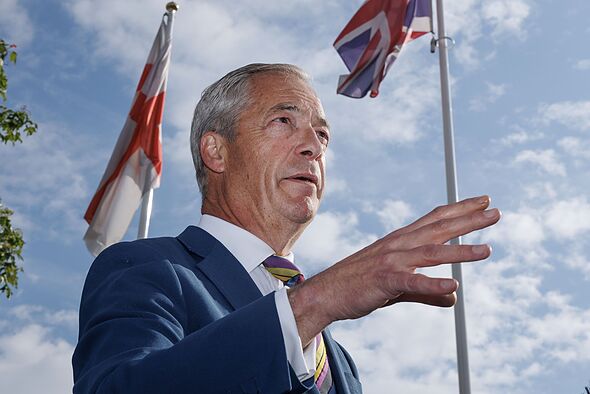
Huge Boost for Nigel Farage as Reform Overtakes Labour in Bombshell Poll
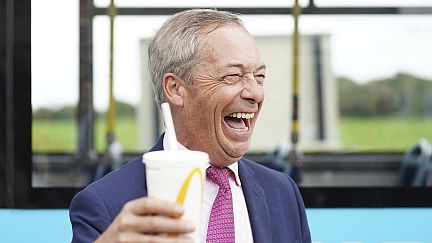
Nigel Farage has been handed another major political boost after a new poll put Reform UK ahead of Labour, providing fresh evidence that Britain’s political landscape remains exceptionally volatile.
The result will be particularly significant for Farage because Reform’s recent momentum had appeared to weaken following the arrival of Andy Burnham as Prime Minister.
However, it is important to note that polling is currently producing mixed signals. A recent Ipsos poll actually put Labour three points ahead of Reform, at 28% to 25%, while another recent survey by Lord Ashcroft placed Labour on 27% and Reform on 18%.
That makes any individual poll less important than the broader trend.
Nevertheless, whenever Reform moves ahead of Labour, the political implications are enormous.
For Farage, it reinforces his central argument that Reform is not merely a protest movement.
It is a potential governing party.
Farage’s political gamble
Farage has spent years attempting to transform his political movement from an insurgent force into a serious alternative to the traditional parties.
That journey has never been straightforward.
Reform’s breakthrough at the 2024 general election gave the party a significant presence in Parliament, but winning Westminster seats is very different from building a nationwide electoral coalition.
The party subsequently made major gains in local elections, demonstrating that its support extends well beyond Farage’s personal following.
Now the battle is for the political centre of gravity.
If Reform can consistently remain ahead of Labour in national polling, Farage can make a much more powerful argument to voters:
Why vote for an established party that is struggling when Reform could actually form the next government?
That psychological shift could be decisive.
Political parties often become more attractive when voters believe they can win.
A protest vote is one thing.
A potential government is another.
Labour’s challenge under Burnham
Andy Burnham’s arrival in Downing Street initially created a significant political opportunity for Labour.
The new Prime Minister presented himself as a change from the previous administration and promised to restore optimism and confidence.
Some polling suggested that Labour benefited from an early “Burnham bounce”.
More in Common, for example, recorded Labour on 28% against Reform on 24% at the end of July.
But maintaining momentum is considerably harder than generating it.
Burnham now has to govern.
That means making unpopular decisions.
It means dealing with taxation, public spending, immigration, housing and the NHS.
It also means managing Labour’s internal divisions.
The honeymoon period will eventually end.
When it does, voters will judge Burnham on results rather than rhetoric.
That could create another opening for Farage.
Why Reform’s support matters
Reform’s strength comes partly from the fact that it has managed to combine several different sources of dissatisfaction.
Immigration is obviously central.
But Reform’s appeal also extends to voters who feel ignored by Westminster, frustrated with the cost of living, angry about public services and increasingly sceptical about the traditional political establishment.
Farage has been particularly successful at presenting these issues as connected.
His argument is that Britain has experienced years of weak government, high immigration, inadequate housing, declining public services and rising taxation.
Whether voters agree with every part of that diagnosis is another question.
But politically, the message is simple.
Britain needs a different direction.
That is why a poll putting Reform ahead of Labour would be so valuable to Farage.
It gives him evidence that his message is reaching beyond his traditional base.
The danger of reading too much into one poll
There is, however, an obvious warning.
The latest polling landscape is not uniform.
Ipsos’s August polling actually found Labour ahead of Reform by three points, while Lord Ashcroft’s latest survey put Reform significantly behind both Labour and the Conservatives.
This is a reminder that opinion polls are snapshots, not election results.
Different polling companies use different methodologies.
Samples differ.
Question wording can differ.
And political events can produce rapid changes in voter sentiment.
Farage therefore cannot afford to assume that one favourable poll means Reform has permanently overtaken Labour.
The opposite is also true.
A single poll showing Labour ahead does not mean Reform’s challenge has disappeared.
The underlying volatility is itself politically significant.
The Clacton test
Farage is currently facing another important political test in Clacton.
A special election is taking place there today after Farage resigned his parliamentary seat to trigger the contest. Polling stations opened on Thursday morning, with the result expected early Friday.
The contest is highly unusual.
The major parties have chosen not to contest it, leaving Farage facing a field of fringe and novelty candidates, including Count Binface.
There are 34 candidates — reportedly the largest ballot in British electoral history.
Farage is widely expected to win.
But the real political significance is not simply whether he gets back into Parliament.
It is what the result says about his personal brand.
Farage is attempting to present the election as a confrontation between himself and the political establishment.
His opponents have dismissed it as a vanity project.
Either way, it gives Farage a huge national platform.
Reform’s biggest problem
The party’s biggest challenge is no longer attracting attention.
It has plenty of attention.
The question is whether it can convert attention into sustained support.
That requires much more than immigration rhetoric.
Reform needs credible policies on the economy.
It needs answers on healthcare.
It needs a workable approach to housing.
It needs to explain how public spending would be financed.
And it needs to convince voters that its candidates can actually govern.
That is the difficult transition from protest politics to government.
Farage is an experienced campaigner.
But running Britain would require an entirely different skill set.
A government cannot simply identify problems.
It has to solve them.
The Conservative opportunity
Another complicating factor is the Conservative Party.
Recent polling has shown the Conservatives capable of recovering some support while Reform fluctuates.
Lord Ashcroft’s latest poll, for example, put the Conservatives on 23%, Labour on 27% and Reform on only 18%.
That creates a potentially dangerous three-way battle for the British right.
Farage wants Reform to become the dominant alternative to Labour.
But the Conservatives still have a substantial electoral base and an established national organisation.
If Conservative support recovers significantly, Reform could find itself squeezed.
On the other hand, if Reform overtakes the Conservatives and begins consistently challenging Labour for first place, Conservative voters may face an uncomfortable choice.
Do they return to the traditional Conservative Party?
Or do they conclude that Farage’s party has become the more credible vehicle for changing government?
That question could define the next election.
The immigration factor
Immigration remains one of Reform’s strongest issues.
Farage has repeatedly argued that Britain needs much tighter control over immigration and the asylum system.
The Channel crossings have provided a particularly powerful symbol for the party.
But immigration alone cannot explain Reform’s support.
The party’s broader argument is about sovereignty and trust.
Farage tells voters that governments have repeatedly promised change and failed to deliver it.
That message has considerable political power.
Every new policy failure gives Reform another opportunity.
Every broken promise becomes campaign material.
Every unpopular government decision can be presented as evidence that the establishment has learned nothing.
Burnham therefore faces a difficult task.
He cannot simply attack Reform.
He has to make Reform less necessary.
Can Burnham stop Farage?
The answer will depend largely on whether the new Prime Minister can deliver visible improvements.
If housing becomes more affordable, Labour gains.
If NHS waiting times fall, Labour gains.
If living standards improve, Labour gains.
If illegal migration falls significantly, Labour gains.
If public services become more reliable, Labour gains.
But if voters continue to experience high costs, poor services and political uncertainty, Farage will have an enormous opportunity.
This is why the latest polling should be viewed as a warning rather than a victory declaration.
Reform does not need to win every poll.
It simply needs to remain competitive.
If Farage can keep Reform within striking distance of Labour, the political narrative changes.
Voters begin asking whether Reform could actually win.
Media coverage changes.
Donors become more interested.
Potential candidates become more willing to join.
And tactical voting calculations become increasingly important.
That can create a feedback loop.
A battle for the future of Britain
Britain’s political system is already undergoing a profound transformation.
The traditional Labour-Conservative contest has weakened.
Reform has established itself as a major force.
The Greens and Liberal Democrats retain important support.
And voters appear increasingly willing to change parties between elections.
That makes the next general election extraordinarily difficult to predict.
Farage will undoubtedly use every favourable poll to argue that the old political order is collapsing.
Burnham will point to polls showing Labour ahead and argue that Reform’s support is less durable than it appears.
Both will have evidence to support their claims.
But ultimately, neither polls nor political speeches will determine the outcome.
Voters will.
And they will judge the parties on the problems they face in their everyday lives.
The economy.
Immigration.
Housing.
Crime.
The NHS.
Taxes.
Public services.
Trust.
Those issues will determine whether Reform’s rise becomes a permanent realignment or another temporary political surge.
For Farage, however, the message from any poll putting Reform ahead of Labour is clear.
The road to Downing Street is no longer an absurd ambition.
It is a possibility that Labour must take seriously.
The latest polling is not proof that Farage will become Prime Minister.
Indeed, other recent surveys point in the opposite direction.
But the fact that Britain’s political landscape can swing so dramatically in such a short period is itself remarkable.
And that may be the biggest boost Farage has received.
Reform no longer needs to convince voters that it exists.
It needs to convince them that it can govern.
If Farage succeeds in making that leap, the next general election could become one of the most unpredictable contests in modern British political history.
Leave a Reply
You must be logged in to post a comment.