

Home Office Translates Guidance Telling Asylum Seekers Not to Rape Into Multiple Languages
The British government has sparked a fierce political debate after the Home Office issued new guidance for asylum seekers explaining basic laws and social expectations in the United Kingdom, including the fact that sex without consent is rape and that sexual harassment, domestic abuse and sexual contact with children are serious offences.
The guidance has attracted widespread attention because of the bluntness of some of its messages. It tells newcomers that men and women have equal rights, that women are entitled to make their own decisions about their lives, and that unwanted sexual comments, following someone in the street, blocking their path and making kissing sounds at people are unacceptable. Reports say the material is being made available in multiple languages so that people with limited English can understand it.
For supporters of the policy, the principle is straightforward: if people are expected to obey British law, the government should make sure they understand what that law requires.
For critics, however, the very existence of such a leaflet raises uncomfortable questions. Why should anyone need to be told that rape is illegal? Why does the government believe it is necessary to explain basic standards of behaviour to adults arriving in Britain? And does producing such guidance represent sensible integration policy, or does it reveal deeper failures in the asylum and immigration system?
Those questions have quickly turned the booklet into a political flashpoint.
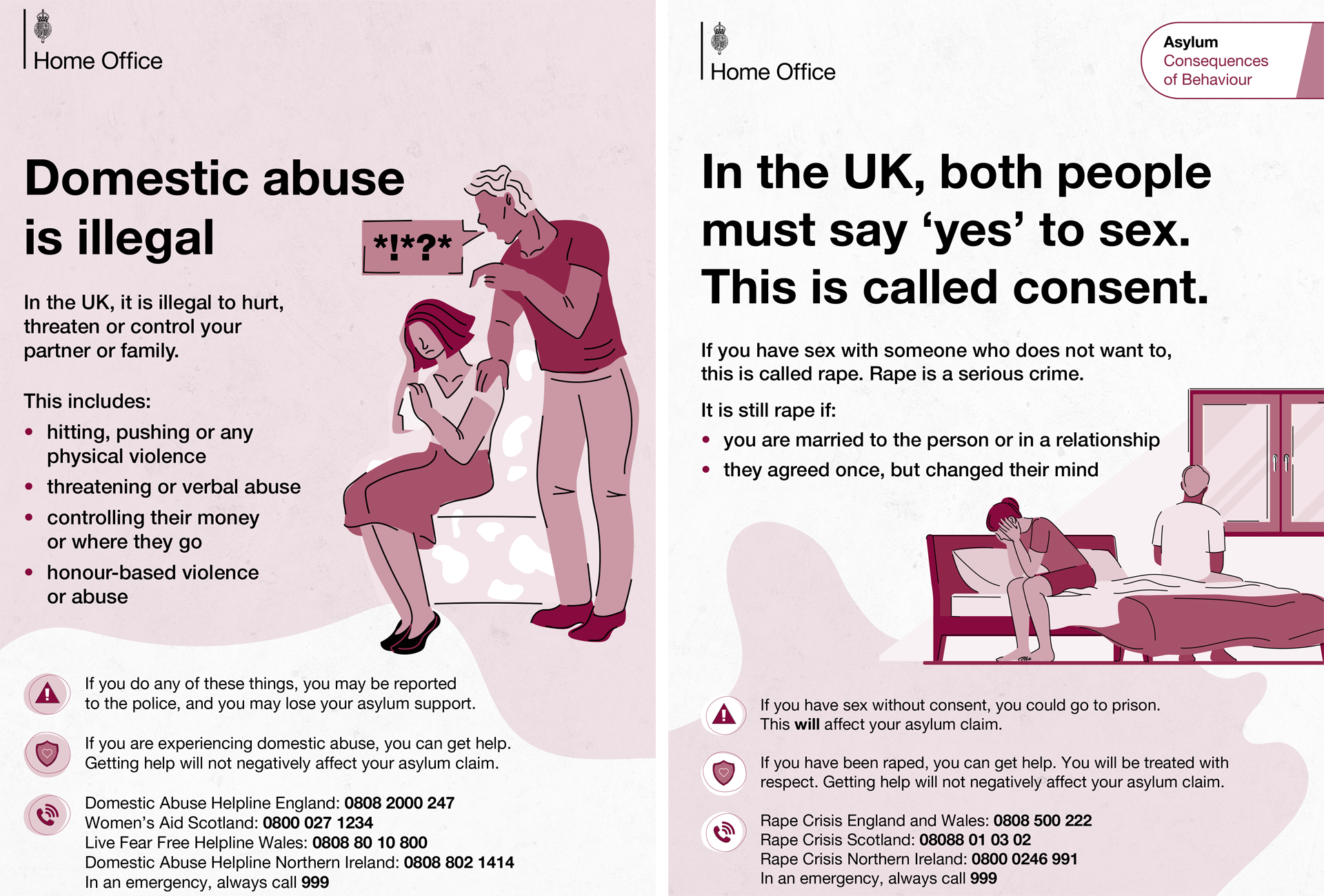
The Home Office’s defence is that clarity is essential. Britain receives asylum seekers from a wide variety of countries and cultural backgrounds, and not everyone arriving in the country will have the same understanding of British laws, social expectations or gender relations. The government therefore argues that it is better to make the rules explicit rather than assume that every newcomer automatically understands them.
That argument is not without logic.
The Home Office already recognises the importance of communicating effectively with people who have limited English. Its own guidance on designing information for people using Home Office services states that important information can be difficult to understand for those who are not fluent in English and recommends clear language, translation and testing with users.
In that context, translating information about British law is hardly an extraordinary concept.
The controversy arises because of the subject matter.
The new guidance does not merely explain how to apply for services or how the asylum process works. It directly addresses sexual behaviour, consent, domestic abuse and interactions between men and women. It reportedly states that sexual activity must involve mutual consent and makes clear that sex without consent constitutes rape. It also explains that sex with children is illegal and warns that criminal behaviour can have consequences for a person’s asylum claim and support.
For many British voters, the wording may seem astonishingly basic.
Yet the government’s position is that the purpose is prevention. A rule that is clearly communicated cannot later be misunderstood as easily as one that is assumed.
This distinction matters. The leaflet does not change British law. It does not create new criminal offences. It simply communicates existing rules and expectations.
Indeed, Britain has a long tradition of providing information to visitors, migrants and residents about legal responsibilities. People are routinely told about driving laws, employment rights, taxation requirements and public-service rules. From that perspective, explaining consent and gender equality is another form of public information.
But there is a legitimate political question about where education ends and enforcement begins.
British law is already clear: rape, sexual assault and domestic abuse are crimes. The criminal justice system does not generally excuse unlawful behaviour because someone did not understand the rules. Cultural background cannot be used as a blanket justification for committing a serious offence.
Consequently, critics argue that the government’s priority should not simply be explaining the rules but enforcing them.
That criticism has particular force when the debate concerns serious sexual offences. A leaflet cannot protect victims if authorities fail to investigate crimes, prosecute offenders or remove foreign nationals who have no legal right to remain in the country.
At the same time, it would be wrong to conclude that the existence of the guidance proves that asylum seekers as a group are more likely to commit sexual offences. Such a claim would go far beyond the evidence. The booklet is directed at a diverse population, and the overwhelming majority of people seeking protection cannot fairly be characterised by the crimes of individuals.
This distinction is important because immigration debates can easily become emotionally charged.
The British public has every right to demand that people living in the country obey its laws. Women and girls have the right to feel safe. Victims of sexual violence deserve justice regardless of the nationality of the perpetrator. But those principles do not require treating every asylum seeker as a potential criminal.
The stronger argument is that one standard of law should apply to everyone.
That means asylum seekers should understand British law, British citizens should obey it, and foreign nationals convicted of serious offences should face the legal consequences applicable to their circumstances.
The political controversy surrounding the Home Office leaflet also reflects a much wider argument about integration.
Integration is not simply about speaking English or finding employment. It also involves understanding the legal and social framework of the country in which someone lives. Equality between men and women, consent in sexual relationships, freedom of religion and freedom from violence are fundamental principles of British society.
A government that communicates those principles clearly can reasonably argue that it is helping newcomers understand the society they have entered.
The more difficult question is whether information alone is sufficient.
It is not.
A successful integration policy requires education, employment opportunities, language learning and contact with wider society. It also requires a credible immigration system. If people believe that the asylum system is poorly controlled, even a sensible piece of educational material can become a symbol of broader frustration.
That appears to be what has happened here.
Instead of being viewed simply as a practical information leaflet, the document has become a proxy for the much larger debate over Britain’s borders, asylum accommodation, illegal migration and public safety.
Critics have portrayed it as evidence that the government is trying to “teach” adults basic morality instead of controlling immigration. Supporters have argued that explaining British law is simply common sense. Labour figures have defended the approach as necessary clarity, while Conservative and Reform politicians have called for a stronger emphasis on enforcement and deportation of foreign offenders.
Both sides are tapping into genuine public concerns.
There is nothing unreasonable about demanding that newcomers respect the law.
But there is also nothing inherently wrong with ensuring that people understand the law.
The real test should therefore be what happens after the guidance is distributed.
If an asylum seeker commits a serious offence, the authorities must respond firmly and fairly. If someone is convicted of a crime and immigration law permits removal, that process should be carried out efficiently. If someone has a legitimate asylum claim, however, criminal justice and immigration decisions must still follow the law and appropriate due process.
The government should also be transparent about the purpose and effectiveness of the programme. How many people receive the guidance? In which languages? Is it actually understood? Are there measurable improvements in awareness of British law? And does the policy form part of a wider integration strategy?
Those are much more useful questions than simply arguing over the headline.
Ultimately, the Home Office has chosen to make one message unmistakably clear: British laws apply to everyone.
That should not be controversial.
Rape is a crime. Sexual assault is a crime. Domestic abuse is a crime. Sex without consent is a crime. Women and men have equal legal rights. Children must be protected. These principles are not optional cultural preferences; they are part of the legal framework of the United Kingdom.
Translating those principles into multiple languages may therefore be seen as a practical attempt to ensure that the message reaches people who need to understand it.
The controversy tells us something important about modern Britain. The public wants stronger control of immigration, but it also expects the government to maintain basic standards of safety, equality and justice. Those objectives should not be treated as mutually exclusive.
The Home Office booklet will not solve Britain’s immigration problems. Nor will it prevent sexual violence on its own.
But it does establish a principle that should be beyond dispute: anyone living in Britain is expected to respect British law.
The real measure of the government’s seriousness will not be how many languages the leaflet is translated into.
It will be whether the same government has the determination to enforce the rules it has so carefully explained.
Home Office Translates Guidance Telling Asylum Seekers Not to Rape Into Multiple Languages
The British government has sparked a fierce political debate after the Home Office issued new guidance for asylum seekers explaining basic laws and social expectations in the United Kingdom, including the fact that sex without consent is rape and that sexual harassment, domestic abuse and sexual contact with children are serious offences.
The guidance has attracted widespread attention because of the bluntness of some of its messages. It tells newcomers that men and women have equal rights, that women are entitled to make their own decisions about their lives, and that unwanted sexual comments, following someone in the street, blocking their path and making kissing sounds at people are unacceptable. Reports say the material is being made available in multiple languages so that people with limited English can understand it.
For supporters of the policy, the principle is straightforward: if people are expected to obey British law, the government should make sure they understand what that law requires.
For critics, however, the very existence of such a leaflet raises uncomfortable questions. Why should anyone need to be told that rape is illegal? Why does the government believe it is necessary to explain basic standards of behaviour to adults arriving in Britain? And does producing such guidance represent sensible integration policy, or does it reveal deeper failures in the asylum and immigration system?
Those questions have quickly turned the booklet into a political flashpoint.
The Home Office’s defence is that clarity is essential. Britain receives asylum seekers from a wide variety of countries and cultural backgrounds, and not everyone arriving in the country will have the same understanding of British laws, social expectations or gender relations. The government therefore argues that it is better to make the rules explicit rather than assume that every newcomer automatically understands them.
That argument is not without logic.
The Home Office already recognises the importance of communicating effectively with people who have limited English. Its own guidance on designing information for people using Home Office services states that important information can be difficult to understand for those who are not fluent in English and recommends clear language, translation and testing with users.
In that context, translating information about British law is hardly an extraordinary concept.
The controversy arises because of the subject matter.
The new guidance does not merely explain how to apply for services or how the asylum process works. It directly addresses sexual behaviour, consent, domestic abuse and interactions between men and women. It reportedly states that sexual activity must involve mutual consent and makes clear that sex without consent constitutes rape. It also explains that sex with children is illegal and warns that criminal behaviour can have consequences for a person’s asylum claim and support.
For many British voters, the wording may seem astonishingly basic.
Yet the government’s position is that the purpose is prevention. A rule that is clearly communicated cannot later be misunderstood as easily as one that is assumed.
This distinction matters. The leaflet does not change British law. It does not create new criminal offences. It simply communicates existing rules and expectations.
Indeed, Britain has a long tradition of providing information to visitors, migrants and residents about legal responsibilities. People are routinely told about driving laws, employment rights, taxation requirements and public-service rules. From that perspective, explaining consent and gender equality is another form of public information.
But there is a legitimate political question about where education ends and enforcement begins.
British law is already clear: rape, sexual assault and domestic abuse are crimes. The criminal justice system does not generally excuse unlawful behaviour because someone did not understand the rules. Cultural background cannot be used as a blanket justification for committing a serious offence.
Consequently, critics argue that the government’s priority should not simply be explaining the rules but enforcing them.
That criticism has particular force when the debate concerns serious sexual offences. A leaflet cannot protect victims if authorities fail to investigate crimes, prosecute offenders or remove foreign nationals who have no legal right to remain in the country.
At the same time, it would be wrong to conclude that the existence of the guidance proves that asylum seekers as a group are more likely to commit sexual offences. Such a claim would go far beyond the evidence. The booklet is directed at a diverse population, and the overwhelming majority of people seeking protection cannot fairly be characterised by the crimes of individuals.
This distinction is important because immigration debates can easily become emotionally charged.
The British public has every right to demand that people living in the country obey its laws. Women and girls have the right to feel safe. Victims of sexual violence deserve justice regardless of the nationality of the perpetrator. But those principles do not require treating every asylum seeker as a potential criminal.
The stronger argument is that one standard of law should apply to everyone.
That means asylum seekers should understand British law, British citizens should obey it, and foreign nationals convicted of serious offences should face the legal consequences applicable to their circumstances.
The political controversy surrounding the Home Office leaflet also reflects a much wider argument about integration.
Integration is not simply about speaking English or finding employment. It also involves understanding the legal and social framework of the country in which someone lives. Equality between men and women, consent in sexual relationships, freedom of religion and freedom from violence are fundamental principles of British society.
A government that communicates those principles clearly can reasonably argue that it is helping newcomers understand the society they have entered.
The more difficult question is whether information alone is sufficient.
It is not.
A successful integration policy requires education, employment opportunities, language learning and contact with wider society. It also requires a credible immigration system. If people believe that the asylum system is poorly controlled, even a sensible piece of educational material can become a symbol of broader frustration.
That appears to be what has happened here.
Instead of being viewed simply as a practical information leaflet, the document has become a proxy for the much larger debate over Britain’s borders, asylum accommodation, illegal migration and public safety.
Critics have portrayed it as evidence that the government is trying to “teach” adults basic morality instead of controlling immigration. Supporters have argued that explaining British law is simply common sense. Labour figures have defended the approach as necessary clarity, while Conservative and Reform politicians have called for a stronger emphasis on enforcement and deportation of foreign offenders.
Both sides are tapping into genuine public concerns.
There is nothing unreasonable about demanding that newcomers respect the law.
But there is also nothing inherently wrong with ensuring that people understand the law.
The real test should therefore be what happens after the guidance is distributed.
If an asylum seeker commits a serious offence, the authorities must respond firmly and fairly. If someone is convicted of a crime and immigration law permits removal, that process should be carried out efficiently. If someone has a legitimate asylum claim, however, criminal justice and immigration decisions must still follow the law and appropriate due process.
The government should also be transparent about the purpose and effectiveness of the programme. How many people receive the guidance? In which languages? Is it actually understood? Are there measurable improvements in awareness of British law? And does the policy form part of a wider integration strategy?
Those are much more useful questions than simply arguing over the headline.
Ultimately, the Home Office has chosen to make one message unmistakably clear: British laws apply to everyone.
That should not be controversial.
Rape is a crime. Sexual assault is a crime. Domestic abuse is a crime. Sex without consent is a crime. Women and men have equal legal rights. Children must be protected. These principles are not optional cultural preferences; they are part of the legal framework of the United Kingdom.
Translating those principles into multiple languages may therefore be seen as a practical attempt to ensure that the message reaches people who need to understand it.
The controversy tells us something important about modern Britain. The public wants stronger control of immigration, but it also expects the government to maintain basic standards of safety, equality and justice. Those objectives should not be treated as mutually exclusive.
The Home Office booklet will not solve Britain’s immigration problems. Nor will it prevent sexual violence on its own.
But it does establish a principle that should be beyond dispute: anyone living in Britain is expected to respect British law.
The real measure of the government’s seriousness will not be how many languages the leaflet is translated into.
It will be whether the same government has the determination to enforce the rules it has so carefully explained.