
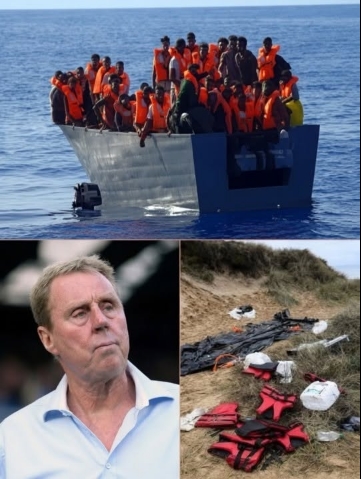
Harry Redknapp Says Britain Has Been “Overrun”—and Reopens the Country’s Most Explosive Debate
Harry Redknapp spent decades making difficult decisions under pressure. From touchline battles in the Premier League to dressing rooms filled with enormous personalities, the former Tottenham Hotspur, West Ham United and Portsmouth manager built a public reputation around instinct, bluntness and an unmistakably direct style of speaking.
Now, long after leaving football management, Redknapp has stepped into a far more dangerous arena.
His declaration that Britain has become “completely overrun” by migrants has ignited an intense national argument over immigration, borders and the language public figures use when discussing people arriving in the country.
Appearing on TalkTV alongside presenter Jeremy Kyle, Redknapp was reacting to dramatic footage involving migrants attempting to enter Ceuta, Spain’s North African enclave. He turned the conversation toward Britain, arguing that the country had lost control of the situation and claiming that his adopted hometown of Bournemouth had deteriorated so severely that parts of it resembled a “third-world country.”
The comments were classic Redknapp: spontaneous, emotional and delivered without the cautious qualifications expected from a professional politician.
That may be precisely why they resonated.
To supporters, Redknapp said aloud what millions of frustrated voters privately believe. They see overcrowded housing, lengthy waits for public services, asylum hotels, small boats arriving across the English Channel and governments repeatedly promising control without appearing capable of delivering it.
They hear official assurances that the system is being repaired, but they look at their communities and feel that change has happened faster than politicians are willing to acknowledge.
Redknapp’s words, from this perspective, were not an attack on every migrant. They were an expression of anger at political leaders who allowed migration policy to become disconnected from housing capacity, border enforcement and public confidence.
His critics heard something very different.
They argue that describing Britain as “overrun” turns human beings into an invading force and encourages the public to view migrants as a single threatening mass. The word does not distinguish between refugees, overseas workers, international students, legal immigrants, visa overstayers and people entering without authorization.
It collapses every category into one emotionally charged image.
That matters because Britain’s migration system is far more complicated than television arguments often suggest.
The number of detected arrivals through illegal routes remains substantial. In the year ending March 2026, the Home Office recorded 43,806 arrivals through unauthorized routes, with small boats accounting for approximately 90 percent of them. Those numbers provide legitimate grounds for concern about border control, criminal smuggling networks and the government’s ability to process or remove people efficiently.
Yet irregular arrivals are not the same thing as total immigration.
Millions of people discussed under the broad label of “migrants” may have entered legally to work, study, join family members or fill vacancies in healthcare and other industries. Some later leave Britain, meaning immigration totals alone do not show the long-term addition to the population.
The Office for National Statistics reported that long-term net migration continued to decline through the year ending December 2025, returning to levels not seen since around 2021. That fall was driven by lower immigration and increased emigration after the unusually high levels recorded in previous years.
Those figures do not eliminate public concern. A falling number can still be viewed as too high, particularly when housing construction, schools, healthcare and local infrastructure have failed to keep pace.
But they do challenge the idea that Britain is experiencing one simple, endlessly accelerating migration surge.
The political power of Redknapp’s comments lies not in statistical precision but in the gap between national data and local experience.
A government may announce that net migration has fallen, yet a particular town can still experience rapid population change. A council may be asked to accommodate asylum seekers without enough advance notice. Residents can encounter rising rents, crowded surgeries and shortages of school places even when migration is only one of several contributing factors.
The Local Government Association has repeatedly called for better coordination and funding when asylum accommodation is opened or closed, warning that poorly managed transitions can create homelessness and pressure on councils.
That is where the migration debate frequently becomes distorted.
Supporters of tighter controls sometimes blame migrants for every failing in Britain’s public realm. Critics of restrictive policies sometimes dismiss all local anxiety as ignorance or prejudice.
Neither approach is adequate.
Britain’s housing crisis, for example, cannot be explained by immigration alone. It also reflects decades of insufficient construction, planning restrictions, high land prices, limited social housing and regional economic concentration.
Pressure on the National Health Service is affected by population growth, but also by workforce shortages, aging demographics, management decisions and years of uneven investment. Migrants themselves work throughout the NHS, social care, construction, hospitality and agriculture.
At the same time, it is unrealistic to claim that rapid population growth has no consequences. Every new resident needs somewhere to live. Families require schools, transport and medical care. When migration rises faster than infrastructure, pressure is inevitable—even when those arriving contribute economically.
A serious country should be capable of acknowledging both realities at once.
Redknapp’s choice of words remains important because language shapes the atmosphere in which policy is debated.
Calling a country “overrun” may communicate urgency, but it can also encourage collective blame. An asylum seeker fleeing persecution, a nurse recruited from overseas and a criminal smuggler are not morally or legally equivalent. Treating them as one group makes effective policy harder, not easier.
The same problem occurs when critics respond to every border concern by accusing speakers of hostility toward foreigners. Voters who want lower immigration are not automatically motivated by hatred. Many are worried about governmental competence, community cohesion or the sustainability of public services.
Silencing those concerns does not make them disappear. It often drives people toward political movements promising simple answers.
Redknapp has spoken positively about similarly hard-line migration discussions before. In April 2025, he praised a GB News panel for raising concerns about asylum seekers and said more people should speak openly in that way. His latest intervention therefore appears to reflect an established view rather than an isolated outburst.
His status also makes the remarks politically valuable.
Redknapp is not a Westminster strategist or professional activist. To many Britons, he remains a familiar football personality associated with working-class culture, humor and plain speaking. When someone with that image says the country has changed beyond recognition, the statement can carry more emotional weight than a formal party speech.
But celebrity experience is not policy expertise.
Redknapp can describe what he believes he sees in Bournemouth. He cannot establish someone’s immigration status merely by appearance, nor can personal observation substitute for nationwide evidence.
That does not mean his feelings are irrelevant. It means they should begin a conversation rather than end one.
Britain needs clearer distinctions between legal migration, asylum and unlawful entry. It needs faster decisions so that legitimate refugees are protected and unsuccessful applicants are not left in indefinite limbo. It needs stronger action against smuggling gangs and more transparent information about the costs and outcomes of accommodation policies.
It also needs a realistic assessment of how many people the economy and public infrastructure can absorb without damaging social confidence.
The government’s challenge is not simply to reduce a headline number. It is to demonstrate that rules exist, decisions are enforced and local communities are not expected to carry national responsibilities without resources or consultation.
Meanwhile, those demanding stricter borders have a responsibility not to turn immigration policy into hostility toward entire ethnic or religious populations.
Harry Redknapp’s intervention has become powerful because it captures the anger of a nation that often feels politicians speak in statistics while citizens experience change in streets, schools and waiting rooms.
But anger alone cannot produce a workable migration system.
Was Redknapp simply speaking his mind? Almost certainly.
Did he cross a line? For many people, describing Britain as “overrun” and comparing a diverse coastal town to the developing world did exactly that.
Yet the fiercest argument should not be about whether one retired football manager chose the perfect words.
It should be about why Britain’s political institutions have allowed the migration debate to become so mistrusted, polarized and emotionally combustible.
Redknapp did not create that division. He exposed it.
The task now facing Britain is to move beyond slogans—to secure its borders, treat people lawfully and humanely, invest in communities and tell the public the truth about both the benefits and costs of migration.
Until that happens, the country will continue hearing two competing stories.
In one, Britain is being overwhelmed.
In the other, legitimate anxiety is being weaponized against migrants.
The reality is more complicated than either—and far too important to be settled by outrage alone.