

Farage Warns France Exactly What He Plans to Do on Migrants: “You Will Have to Lump It!”
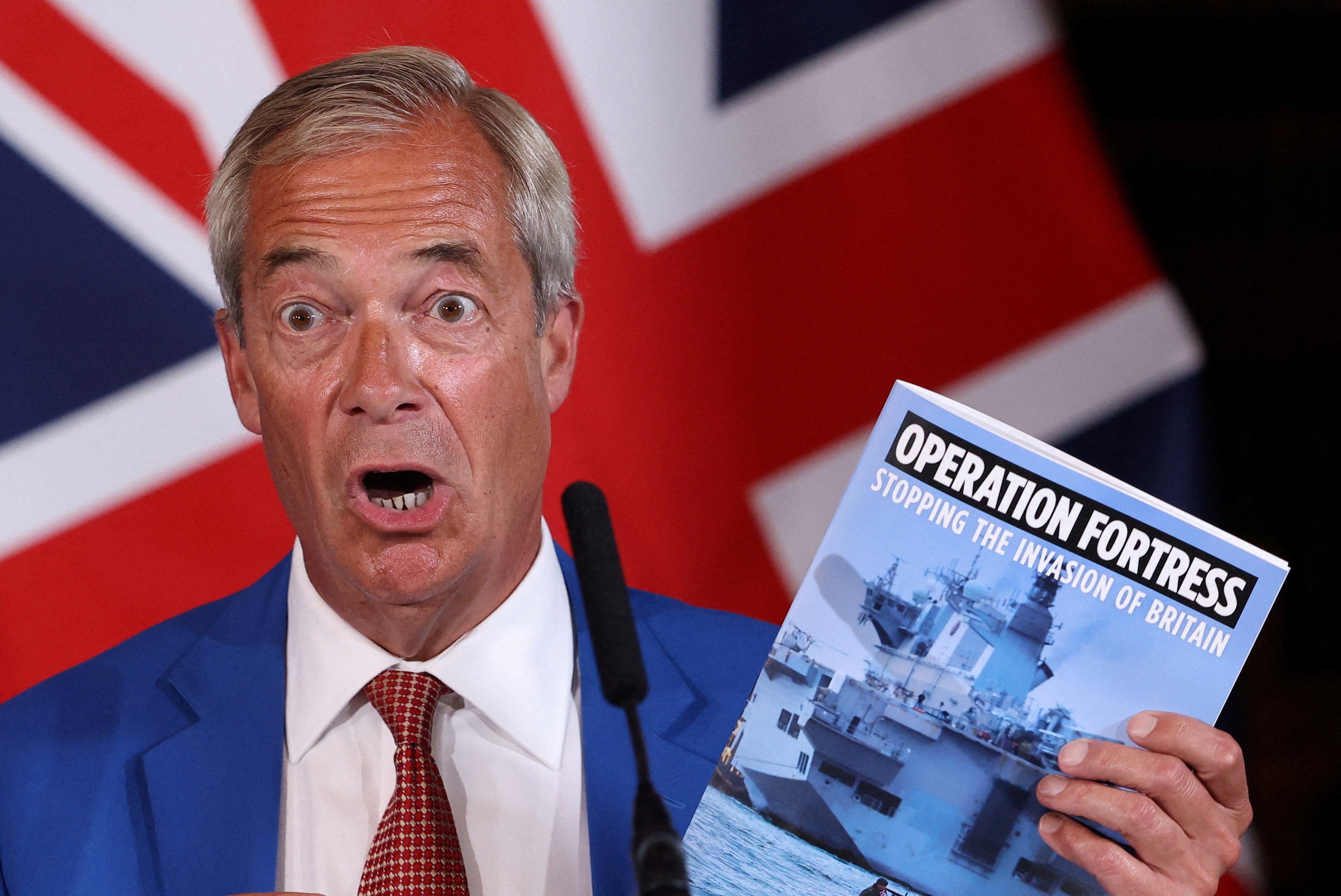
Nigel Farage has delivered a blunt warning to France over the growing crisis in the English Channel, saying that if Reform UK comes to power, Britain could take a dramatically tougher approach to migrant crossings — even if the French government strongly objects.
The Reform UK leader has argued that Britain should intercept small boats crossing the Channel and return their passengers to France, describing the policy as a necessary step to deter dangerous journeys and disrupt the business model of people-smuggling gangs.
His message to Paris was uncompromising: France may not like the policy, but, in his words, it would “have to lump it.”
The proposal would represent a major escalation in Britain’s approach to Channel migration. It would also create a potentially serious diplomatic and legal confrontation between Britain and France.
The question is no longer simply whether Britain should attempt to stop the boats.
It is whether a future British government could actually implement Farage’s proposed strategy while maintaining cooperation with one of its closest European neighbours.
Farage wants to change the entire Channel strategy
For years, successive British governments have struggled to reduce the number of people crossing the Channel in small boats.
The crossings have become one of the defining political issues of British immigration policy.
Governments have introduced new legislation, agreements with France, increased enforcement and various schemes intended to deter people from making the journey.
Yet the political argument has continued.
Farage believes the fundamental problem is that migrants and smuggling gangs currently have reason to believe that reaching British waters can ultimately result in being brought ashore in the United Kingdom.
His proposed solution is designed to change that calculation.
Under Reform’s proposed approach, the Royal Navy would be involved in intercepting unauthorised boats, dealing with immediate safety or medical concerns and transferring passengers onto naval vessels.
Those people would then, under the proposal, be taken back toward France or Belgium.
The theory is straightforward.
If migrants know that crossing the Channel will not result in arrival in Britain, the incentive to pay criminal gangs thousands of pounds for the journey could diminish.
“They will have to lump it”
Farage has been particularly direct about the possibility that France might reject the proposal.
He has acknowledged that the French authorities may oppose Britain’s approach but argued that this should not prevent a Reform government from pursuing it.
His “have to lump it” warning is deliberately confrontational.
It is intended to demonstrate that Reform would be prepared to prioritise Britain’s border policy even at the risk of diplomatic friction.
That marks a significant difference in tone from the approach taken by previous governments, which have emphasised cooperation with French authorities.
Britain and France have already worked together extensively on Channel security.
The UK has provided substantial funding to France for efforts aimed at preventing crossings, and Farage has questioned whether that arrangement is delivering the results British taxpayers should expect.
His argument is essentially that Britain cannot continue paying France to help stop the boats while migrants continue reaching British territory.
The argument over British funding
One of Farage’s strongest criticisms concerns the money Britain has provided to France.
He has referred to roughly £1 billion in British funding for efforts to combat Channel crossings and questioned what British taxpayers are receiving in return.
In his view, if France receives significant financial assistance but boats are still reaching Britain, the current arrangement needs to be reconsidered.
The French government, however, has its own perspective.
France has repeatedly argued that it is already carrying a significant responsibility for preventing crossings and that the issue cannot be solved simply by Britain demanding that France accept people intercepted at sea.
This is where the political disagreement becomes much more complicated.
Britain sees the Channel as a border-security issue.
France sees it as a broader European migration problem.
Smuggling networks operate across multiple countries.
Migrants often travel through several European states before reaching northern France.
Neither country can completely control the entire route on its own.
The legal question could be enormous
Perhaps the biggest obstacle facing Farage’s proposal is not political opposition.
It is the law.
Britain cannot simply assume that France will accept people returned from British-controlled vessels.
The legal circumstances surrounding maritime interceptions and asylum claims are complex.
Farage has argued that international maritime principles allow Britain to take people rescued from dangerous boats to the nearest safe place — which he identifies as France.
He has also argued that migrants crossing from France should be returned to France because it is a safe country from which they departed.
But the practical legal position would depend on the circumstances of each operation.
There is an important difference between rescuing people from a vessel in distress and intercepting a vessel specifically for the purpose of returning its passengers.
Any government attempting to implement such a policy would therefore need to ensure that its actions complied with domestic law, international obligations and relevant asylum protections.
That is likely to become one of the biggest areas of dispute.
France could strongly resist
If a British government began returning boats or passengers without French agreement, relations between London and Paris could deteriorate rapidly.
France could argue that Britain was attempting to impose its migration policy on French territory.
British officials, meanwhile, could argue that France has a responsibility to prevent people from leaving its coastline in the first place.
This creates a potentially difficult diplomatic confrontation.
The two countries need one another on a wide range of issues, including trade, defence, intelligence, counter-terrorism and border security.
A dispute over Channel migration could therefore have consequences well beyond immigration.
Farage appears willing to accept that risk.
His argument is that stopping the crossings is sufficiently important that Britain should be prepared to take a tougher position.
The human cost is central to Farage’s argument
Farage has also presented his policy as a humanitarian measure.
He has repeatedly argued that people should not be making dangerous Channel crossings in overcrowded and unsuitable boats.
In recent comments, he said that people were dying and argued that Britain should be ashamed that the journeys continue.
This is an important part of the political argument.
The debate is often framed as one between border control and humanitarianism.
But Farage argues that stronger border enforcement can itself be humanitarian if it prevents people from entering the hands of criminal smuggling gangs and undertaking dangerous sea journeys.
The opposing view is that simply refusing entry does not necessarily eliminate the reasons people migrate.
If people continue to believe they have no other option, they may attempt alternative routes.
That could potentially make the journeys even more dangerous.
What would happen to the smuggling gangs?
Farage believes the biggest effect of his policy would be economic.
People-smuggling is a business.
Criminal gangs charge migrants large sums to organise journeys across the Channel.
The more successful those journeys are, the more attractive the business becomes.
If boats are consistently intercepted and passengers returned, Farage argues that the gangs would lose their customers.
The calculation would change.
Instead of thinking, “If I reach Britain, I can stay while my asylum claim is processed,” potential migrants might think, “I will simply be returned.”
That could reduce demand.
But critics argue that criminal networks are adaptable.
If one route becomes more difficult, smugglers may develop another.
They may use different boats, launch from different locations or exploit weaknesses elsewhere in the border system.
This is why the success of any deterrence policy would ultimately have to be measured by long-term changes in crossing numbers rather than by political rhetoric.
The impact on the Royal Navy
Farage’s proposal would also place additional responsibilities on the British military.
The Royal Navy is primarily a defence organisation, not an immigration agency.
Deploying naval vessels to intercept migrant boats would therefore raise questions about resources, personnel and operational priorities.
There would also be difficult decisions about what happens when a boat is genuinely in distress.
If people are at immediate risk of drowning, British personnel would have a humanitarian duty to assist them.
The challenge would then be deciding what happens after the rescue.
That is precisely where the legal and diplomatic questions become most complicated.
What if France refuses?
This is perhaps the biggest unanswered question.
Farage’s “lump it” message assumes that Britain can ultimately force the issue.
But France has its own sovereignty.
Britain cannot simply order another country to accept people.
If France refuses to take passengers returned from British vessels, what would happen next?
Would Britain hold them on naval vessels?
Would they be brought to British territory?
Would another European country agree to receive them?
Would new diplomatic negotiations be required?
A credible policy would need answers to these questions before it could be implemented.
Without them, the proposal risks becoming easier to announce than to operate.
The political stakes for Andy Burnham
The issue represents an important challenge for Prime Minister Andy Burnham.
Farage wants to portray the government as unwilling to take sufficiently strong action.
He has accused Burnham of lacking the political courage necessary to stop the crossings and has compared the current government’s approach unfavourably with his own proposed strategy.
For Burnham, simply adopting stronger rhetoric may not be enough.
The government needs to demonstrate measurable results.
If crossings remain high, Reform will argue that Labour has failed.
If crossings fall significantly, Burnham will be able to claim that cooperation and enforcement are working.
Migration is therefore becoming an increasingly important test of the government’s competence.
The wider European dimension
The Channel crisis cannot be separated entirely from Europe’s wider migration problem.
Migrants reaching northern France may have travelled through several European countries.
Some may have previously applied for protection elsewhere.
Others may have spent months or years moving through different countries.
That makes bilateral UK-France solutions difficult.
Britain is outside the European Union’s current migration arrangements, but it remains geographically connected to the continent.
The Channel is not an isolated border.
It is part of a wider European migration route.
Any long-term solution will therefore probably require cooperation, even if Farage’s political message is based on confrontation.
Could the policy actually stop the boats?
That is the crucial question.
The answer is currently impossible to know with certainty.
The policy could potentially have a significant deterrent effect if migrants and smuggling gangs become convinced that reaching Britain is no longer possible.
But its effectiveness would depend on several factors.
Would France cooperate?
Would the policy be legally sustainable?
Could the Royal Navy intercept enough boats?
Would smugglers develop alternative methods?
Would migrants attempt more dangerous routes?
And would other European countries cooperate?
Those questions would determine whether the strategy succeeded.
Why Farage is willing to take the risk
Farage’s political calculation is relatively clear.
Migration has been one of the most powerful issues for Reform UK.
A strong position on Channel crossings allows the party to distinguish itself from Labour and the Conservatives.
It also allows Farage to argue that established parties have spent years discussing the problem without solving it.
His message is deliberately simple:
Stop the boats.
Return those who arrive.
Break the smugglers’ business model.
And prioritise Britain’s borders.
The difficulty is turning that simple political message into a policy that works within the complicated reality of international law and diplomacy.
The danger of a political showdown
If Reform eventually forms a government and attempts to implement the plan, the confrontation with France could become one of the most significant early tests of its foreign and domestic policy.
Britain would have to negotiate with Paris while simultaneously demonstrating that it was prepared to act.
France would have to decide whether to cooperate or resist.
European governments would watch closely.
The courts could become involved.
And humanitarian organisations would likely scrutinise every interception.
A policy that appears straightforward during an election campaign could become extremely complicated once real people, real boats and real international borders are involved.
Conclusion
Nigel Farage’s warning to France represents one of the toughest positions yet put forward in Britain’s Channel migration debate.
His proposal is based on a simple principle: if migrants cannot successfully reach Britain by small boat, the economic incentive for criminal gangs to organise the crossings should collapse.
He wants the Royal Navy to play a direct role in intercepting boats and returning passengers toward France or Belgium, even if Paris strongly objects.
Farage has made clear that he is prepared to accept diplomatic confrontation, telling France that it would effectively “have to lump it.”
But the difficult questions begin after the headline.
Can France legally and politically be compelled to accept returned passengers?
Would the policy comply with Britain’s international obligations?
What would happen to people rescued from genuinely dangerous situations?
Could the Royal Navy handle the operational demands?
And would smugglers simply find another route?
Those questions will determine whether Farage’s plan becomes a genuine alternative to Britain’s current migration policy or remains primarily a powerful political pledge.
What is clear is that the Channel will remain one of the biggest tests of Britain’s immigration strategy.
And if Farage ever gets the opportunity to put his plan into practice, Britain and France could be heading for a very different kind of Channel confrontation.