
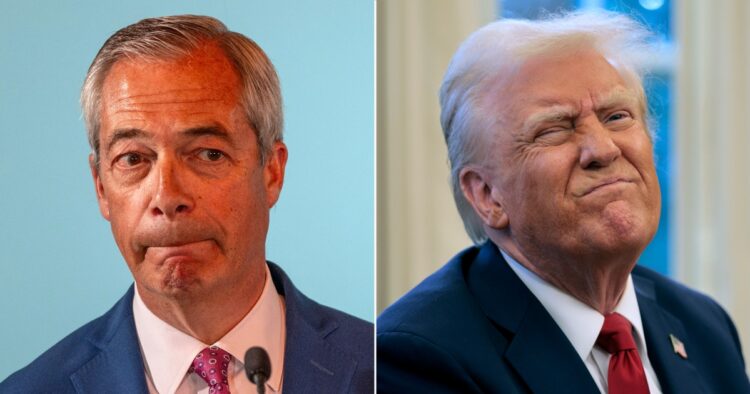
Nigel Farage has started trying to distance himself from Donald Trump in the wake of the Republican Party’s midterm humiliation.
As recently as Tuesday, Farage was predicting that the Republicans would do surprisingly well at the crucial elections, maintaining his support for Trump.
But what a difference a few days make.
After a blue tsunami swept over the US and the Democrats gained control of the House and Senate, it hasn’t taken long for previously staunch Trump supporters to start criticising him.
In the US, the likes of JD Vance and Ted Cruz have already taken aim at Trump for his war in Iran, widely accepted to be the main reason voters turned against Republicans after the economic chaos caused by the conflict.
Now, Farage has become Captain Hindsight as well, hitting out at Trump for breaking a key promised he had made to US voters.
Speaking to reporters on Thursday, Farage said: “One thing about Trump, he always kept his promises.
“But in this case, he said, no more foreign wars and here we are in month eight of a war with no sign of ending. And that, and the resulting fuel prices, in the end has done the damage.”
After voicing his concern that Trump would “continue aggressively attacking Iran” now the midterms are over, Farage stood by his belief that the UK should have supported the Americans “on day one.”
He continued: “I think the Iranian regime is dreadful. I think doing strikes to slow down their development of nuclear weapons was right. But I’ve never supported endless war.
“I was against Libya. I was against Iraq. I was sceptical about Afghanistan and so was Trump. And that’s the irony of where we are.”
Farage’s comments come after Robert Jenrick appeared to criticise the Clacton MP and others who had supported Trump’s military action in Iran.
THE MOMENT FARAGE REALISED TRUMP’S POLITICAL FORTUNES HAD CHANGED
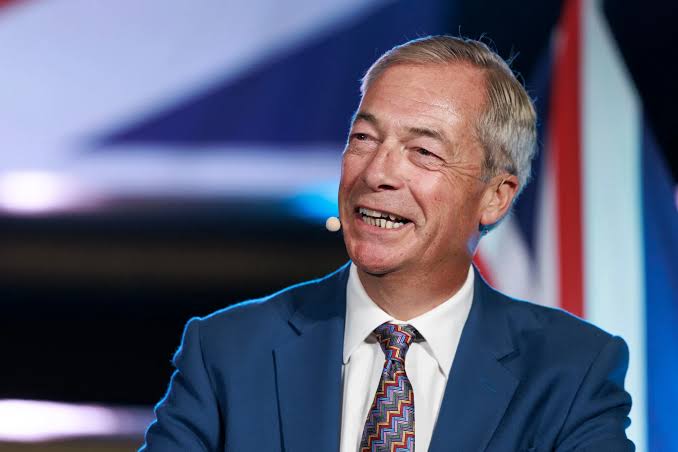
The political shift became particularly noticeable in the days surrounding the American midterm elections.
Before the results were announced, Farage appeared on GB News and dismissed predictions that Trump’s Republicans were heading towards a major defeat.
He suggested that Republican support remained stronger than many commentators believed and expressed confidence that the party’s campaigning operation, financial resources and political influence could limit Democratic gains.
However, the results told a very different story.
The Democrats secured control of both the House of Representatives and the Senate, delivering a major setback to Trump’s administration.
Speaking to broadcasters on 5 November, Farage openly admitted that his prediction had been wrong.
He described the Republican result as a complete wipeout and an absolute disaster.
His admission was significant because Farage has built much of his political reputation around predicting electoral developments that established political commentators sometimes underestimate.
This time, however, he acknowledged that he had misjudged the American political mood.
According to Sky News, he explained that he had expected Elon Musk’s financial support and technological campaigning operation to limit Republican losses.
That expectation did not materialise.
The result forced Farage to reconsider his assessment of Trump’s political position and the consequences of his administration’s decisions.
<Cite refs={[“turn204059search3″,”turn204059search10”]}/>
THE IRAN WAR: THE BIGGEST PROBLEM FOR TRUMP
One of the most important reasons behind Farage’s changing tone concerns the prolonged American military conflict with Iran.
Trump originally attracted substantial support by promising to avoid becoming involved in endless foreign wars.
His supporters viewed this position as a major departure from previous American administrations, which had become deeply involved in conflicts across the Middle East and elsewhere.
However, the eight-month conflict with Iran has created serious political and economic consequences.
Higher fuel prices have placed additional pressure on American households, while uncertainty surrounding international energy supplies has affected markets across the world.
Farage directly addressed this issue during his press conference on Thursday, 5 November.
He argued that Trump had broken an important promise to American voters.
The Reform UK leader explained that Trump had previously been effective at keeping his promises but had failed to honour his commitment to avoid new foreign wars.
Farage also acknowledged that the resulting increases in fuel prices had contributed to the Republican defeat.
His comments represented a significant departure from the more supportive tone he had previously adopted towards the American president.
He was particularly concerned about the possibility that Trump could intensify military operations following the election defeat.
Farage warned that further attacks on Iran could push oil prices higher, increase inflation and create additional economic problems throughout the Western world.
<Cite refs={[“turn204059search0″,”turn204059search2″,”turn204059search3”]}/>
FARAGE STILL DEFENDS SOME OF TRUMP’S MILITARY DECISIONS
Despite his criticism, Farage has not completely abandoned his previous position on American policy towards Iran.
He has continued to argue that preventing the Iranian regime from developing nuclear weapons is an important objective.
He also maintained that military strikes intended to slow down Iran’s nuclear programme were justified.
However, he distinguished between limited military action and becoming involved in an extended conflict.
Farage explained that he had never supported endless wars and compared the situation with previous Western military interventions in Libya, Iraq and Afghanistan.
This distinction is important because it demonstrates that his disagreement with Trump is primarily focused on the duration and consequences of the Iran conflict rather than a complete rejection of American military objectives.
Nevertheless, the criticism creates an uncomfortable political situation for Farage.
He previously presented Trump as an example of a leader who understood the frustrations of ordinary voters and was prepared to challenge established political thinking.
Now he is highlighting the very economic and foreign-policy consequences that critics of Trump have repeatedly warned about.
A FRIENDSHIP THAT IS BECOMING POLITICALLY COMPLICATED
Farage’s relationship with Trump has been one of the most recognisable political alliances between Britain and the United States.
The Reform UK leader has repeatedly spoken about his friendship with the American president and has appeared at several political events associated with the MAGA movement.
Their relationship has also provided Farage with valuable international visibility.
Trump’s political success helped strengthen the argument that populist movements could challenge traditional political establishments and achieve significant electoral victories.
For Farage, the American president became an important example of how political outsiders could build large movements around immigration, national sovereignty and opposition to established institutions.
However, political friendships can become complicated when circumstances change.
The Republican defeat has weakened Trump’s position in Washington, while Farage now faces questions about whether his close association with the American president remains politically advantageous.
When asked about their relationship, Farage indicated that he still considered Trump a friend.
He also made clear that friendship did not mean agreeing with every decision.
He acknowledged that he had not spoken to Trump for some time.
This is an important qualification. Farage has criticised specific decisions without announcing a complete break with the American president.
<Cite refs={[“turn204059search3″,”turn204059search0”]}/>
THE REPUBLICAN DEFEAT CREATES A NEW POLITICAL REALITY
The American midterm results have consequences extending far beyond Trump’s personal reputation.
Losing control of both chambers of Congress creates a substantially more difficult political environment for the administration.
The Democrats will have greater influence over legislation, congressional investigations and oversight of the executive branch.
Republican politicians will also face difficult questions about their support for Trump’s policies, particularly the economic consequences of the conflict with Iran.
Vice President JD Vance has already addressed the defeat, with attention focusing on the administration’s foreign-policy decisions and their impact on American households.
Other Republican figures have also begun examining whether the administration’s approach has damaged the party’s electoral prospects.
For Farage, the result creates an additional complication.
His political strategy has frequently drawn inspiration from Trump’s communication style and campaign methods.
The American defeat therefore raises questions about whether the same political approach can maintain its appeal in Britain.
The two countries have different electoral systems, political cultures and economic circumstances. Nevertheless, developments in American politics can influence British political discussions, particularly when political leaders openly identify themselves with the MAGA movement.
WHY FARAGE’S POSITION MATTERS FOR REFORM UK
The consequences of Trump’s defeat could also affect Reform UK’s domestic political strategy.
Farage has frequently presented Reform as a movement challenging the established political parties.
His approach has included strong criticism of immigration policy, opposition to aspects of the political establishment and calls for significant changes to Britain’s economic and institutional arrangements.
Trump’s electoral success provided an international example of a similar political movement achieving power.
However, the American experience also demonstrates the risks associated with controversial policies.
Rising living costs, fuel prices and concerns about foreign military involvement can quickly become major electoral issues.
For British voters, the most important consideration is often whether political decisions improve everyday life.
A party that campaigns on economic security must be prepared to explain how its policies will affect household bills, employment, taxation and public services.
Farage’s criticism of Trump’s handling of the Iran conflict suggests that he recognises the political importance of these issues.
It also raises a question about how closely Reform UK wants to associate itself with American political developments.
The party may continue sharing certain ideological positions with Trump while seeking to establish a more independent identity in British politics.
IS FARAGE REALLY ABANDONING TRUMP?
The headline that Farage is desperately distancing himself from Trump captures the drama of the moment, but the actual position is more complicated.
There is clear evidence that Farage has changed his public tone.
Before the elections, he predicted that Republicans would avoid the overwhelming defeat many commentators expected.
After the results, he admitted he was wrong and described the outcome as a disaster.
He also criticised Trump’s failure to avoid foreign wars and identified the Iran conflict and higher fuel prices as important factors behind the Republican defeat.
However, Farage has not completely rejected Trump.
He continues to describe him as a friend and has maintained support for certain American objectives concerning Iran.
The more accurate interpretation is that Farage is attempting to separate his support for particular political principles from his criticism of Trump’s recent decisions.
Whether that distinction will satisfy voters remains an open question.
<Cite refs={[“turn204059search0″,”turn204059search2″,”turn204059search3”]}/>
FINAL VERDICT: A TURNING POINT FOR FARAGE AND THE MAGA CONNECTION?
The Republican midterm defeat has created a difficult moment for Nigel Farage.
For years, his relationship with Donald Trump represented a powerful international connection between two political movements that shared important themes of nationalism, immigration control and opposition to established political institutions.
Now, following the Democrats’ victories, Farage has been forced to acknowledge that Trump’s political strategy has suffered a serious setback.
His admission that he was wrong about the election results, combined with his criticism of the Iran war, marks a noticeable change in his public position.
Yet it would be premature to describe the relationship as completely over.
Farage continues to defend aspects of Trump’s foreign-policy objectives and has not withdrawn his description of the American president as a friend.
The bigger issue is whether Reform UK can maintain its political identity without becoming too closely associated with the successes and failures of the Trump administration.
For Britain, the American elections also provide a wider lesson about the importance of economic security, foreign-policy decisions and public confidence in political leadership.
Ultimately, Farage now faces an uncomfortable balancing act: maintaining his relationship with an international political ally while demonstrating that he can independently judge policies that affect ordinary people.
Trump’s Republican defeat has changed the political conversation. Whether it permanently changes Farage’s relationship with MAGA remains to be seen.