
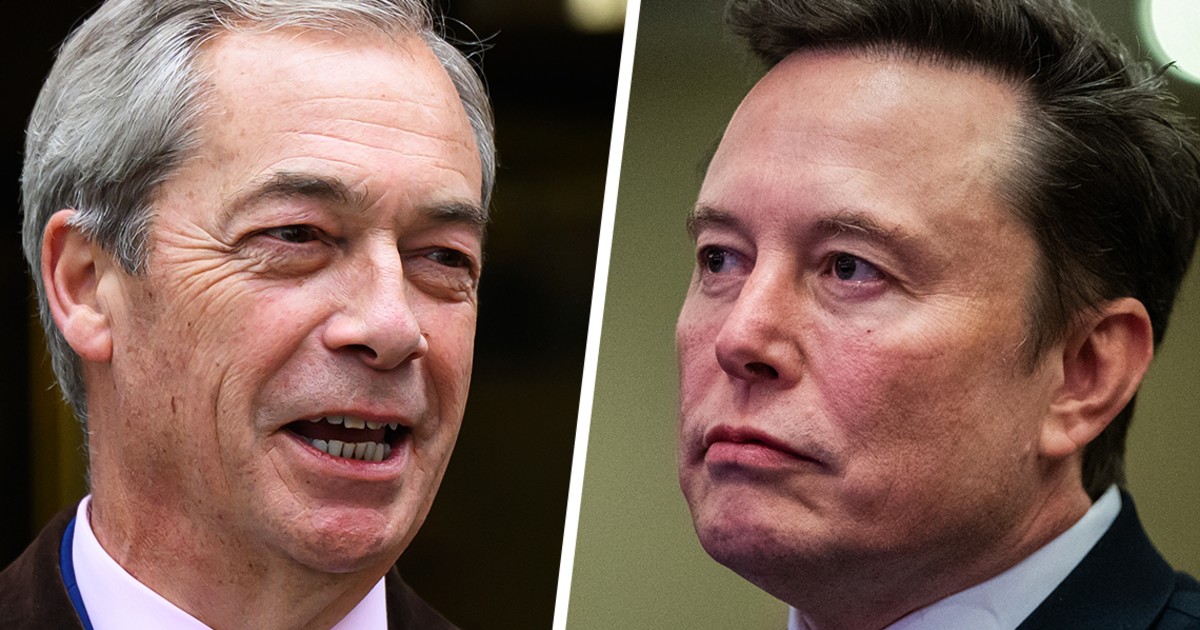
Elon Musk and Nigel Farage in Bitter Row as Billionaire Backs Rival Restore Britain Party
A growing political rift on Britain’s populist right has placed Elon Musk and Nigel Farage on opposite sides of an increasingly bitter struggle for influence, after the billionaire appeared to throw his support behind Rupert Lowe’s rival political movement, Restore Britain.

The intervention has potentially significant consequences for Reform UK.
Farage has spent years building himself into one of Britain’s most recognisable political figures. Reform’s rise has transformed the electoral landscape, particularly among voters who are frustrated with the Conservatives and increasingly sceptical of Labour.
But the emergence of Restore Britain creates a direct challenge from the right.
And Musk’s apparent support for Lowe makes the situation considerably more uncomfortable.
Musk backs Farage’s rival
The row intensified during the Makerfield by-election campaign, when Musk appeared to endorse Restore Britain by reposting a message from Rupert Lowe on X with the words “Restore Britain.”
The intervention was brief, but its political significance was anything but small.
Musk is one of the world’s most influential technology billionaires and has developed increasingly strong political interests on both sides of the Atlantic.
His intervention meant that Britain’s emerging battle between Reform UK and Restore Britain was suddenly attracting international attention.
For Farage, the message represented an obvious challenge.
He had hoped Reform would become the dominant political force on Britain’s right.
Instead, a hugely influential billionaire was publicly giving oxygen to a rival movement.
Rupert Lowe’s challenge to Farage
Restore Britain was created by Rupert Lowe, a former Reform MP whose relationship with Farage dramatically deteriorated.
Lowe eventually left Reform and established his own political vehicle.
The result is a rare situation in British politics: two parties are now competing for broadly overlapping groups of voters while both claiming to represent a fundamental change in the direction of the country.
Lowe’s movement positions itself to the right of the political establishment and has adopted hardline positions on immigration, crime, welfare and national identity.
That creates a particularly difficult problem for Farage.
If Reform moves further right to compete with Restore Britain, it risks alienating moderate voters.
If it remains where it is, Lowe can argue that Reform is no longer radical enough.
Makerfield exposed the danger
The dispute became particularly visible during the Makerfield by-election.
Musk’s intervention came at a moment when the right-wing vote was already showing signs of fragmentation.
A Survation poll put Labour’s Andy Burnham ahead on 43%, with Reform on 40% and Restore Britain on 7%. Farage responded by insisting that Reform was the only realistic challenger capable of defeating Burnham.
The arithmetic illustrated the problem.
Reform could potentially challenge Labour.
Restore Britain could attract voters who otherwise might have supported Reform.
And if those voters were divided, Labour could win even without commanding majority support among the electorate.
That is precisely what worried Farage.
Farage’s “two-horse race” argument
Farage’s response was straightforward.
He argued that Makerfield was effectively a contest between Labour and Reform.
His message to right-wing voters was essentially:
If you want to defeat Labour, vote Reform.
That is a classic first-past-the-post strategy.
Under Britain’s electoral system, voters do not simply choose their favourite party.
They also have to consider which candidate has the best chance of winning.
Farage therefore had an incentive to portray Restore Britain as a wasted vote.
Lowe had an equally strong incentive to reject that argument.
Lowe refuses to disappear
For Lowe, the existence of Restore Britain is about more than one by-election.
He is attempting to establish an independent political force that can eventually compete nationally.
His argument is that Reform does not go far enough.
That is an uncomfortable message for Farage because it comes from someone who knows Reform from the inside.
Lowe is not an outsider critic who has never worked with Farage.
He was part of Reform’s parliamentary operation.
He understands its strengths and weaknesses.
And he knows precisely which voters Reform is trying to attract.
Musk’s support changes the equation
Lowe’s biggest potential advantage is visibility.
A new political party normally struggles to attract national attention.
Musk can change that almost instantly.
A single post from one of the world’s most prominent social-media personalities can reach millions of people.
That gives Restore Britain something most new British parties do not have: international amplification.
It does not guarantee votes.
But it can make it much harder for Farage to ignore the rival.
Why would Musk support Restore Britain?
Musk has not simply entered British politics because of a personal disagreement with Farage.
His political interventions increasingly reflect a broader ideological agenda.
He has become an outspoken critic of what he regards as excessive government regulation, uncontrolled migration, establishment politics and restrictions on free speech.
Restore Britain’s political message overlaps with some of those concerns.
That creates a natural ideological connection.
But political alignment does not necessarily mean Musk and Lowe agree on every policy.
The billionaire’s support appears to be focused on the broader direction of the movement.
The Farage-Musk relationship
The situation is particularly interesting because Musk has previously been friendly towards Farage and Reform.
Farage has developed strong links with prominent figures in the American conservative movement and has presented himself as part of a broader international populist revolt.
Musk’s decision to promote Lowe therefore represents something of a strategic complication.
The question is no longer simply whether Farage can defeat Labour.
It is whether he can maintain control of the political movement he helped create.
The battle for the “anti-establishment” vote
At its heart, this is a battle over identity.
Who represents the genuine political outsider?
Farage has an obvious claim.
He spent decades campaigning against Britain’s membership of the European Union and eventually helped lead the Brexit movement.
He founded and transformed political parties.
He has repeatedly disrupted the traditional Conservative-Labour system.
But Lowe can make a different argument.
He can say that Farage has become part of the political establishment himself.
After years at Westminster, media appearances and international political connections, Lowe can portray himself as the newer challenger.
That argument will resonate with some voters.
Reform’s biggest strategic problem
The fundamental difficulty for Reform is that its success has created competition.
When Reform was challenging the Conservatives, its message was relatively straightforward.
Vote Reform if you want something different.
Now there is another party telling voters:
Vote Restore Britain if you want something even more radical.
That forces Reform to defend its right flank.
The problem is that Reform cannot necessarily move endlessly in that direction.
At some point, policies become too extreme for the broader electorate.
Farage therefore faces a balancing act.
He needs to keep Reform’s core supporters without frightening voters who might otherwise consider voting for the party.
Restore Britain has a different calculation
Lowe does not necessarily need to defeat Reform immediately.
For a new party, establishing a durable electoral base can itself be considered a success.
If Restore Britain wins several hundred thousand votes nationally, it becomes difficult for Reform and the Conservatives to ignore.
If it starts winning parliamentary seats, the political landscape changes dramatically.
And if it can force Reform to negotiate, Lowe gains leverage.
That may be the long-term strategy.
Farage’s response: cooperation or confrontation?
Farage has already faced calls from Lowe to cooperate.
Lowe publicly invited Farage to work with Restore Britain and suggested that the two movements should set aside their differences to challenge the left.
But cooperation is easier to propose than to implement.
Which party would stand candidates where?
Who would control the alliance?
Which policies would appear in a joint manifesto?
Who would lead?
And perhaps most importantly:
Who gets to claim victory?
For Farage, agreeing to an alliance could give Lowe legitimacy.
For Lowe, accepting a subordinate role could undermine the reason Restore Britain exists.
That makes a formal deal extremely difficult.
First-past-the-post makes the rivalry dangerous
The British electoral system gives this dispute particular importance.
Suppose Labour wins a constituency with 38% of the vote.
Reform receives 35%.
Restore Britain receives 15%.
Conservatives receive 10%.
The anti-Labour vote would be much larger than Labour’s vote.
Yet Labour would still win.
This is why Farage is so concerned about Restore Britain.
The rival does not necessarily need to defeat Reform.
It simply needs to win enough Reform-leaning voters to prevent Reform from finishing first.
Musk may unintentionally help Labour
There is an ironic possibility.
If Musk’s support helps Restore Britain grow rapidly, the ultimate beneficiary could be neither Musk nor Lowe.
It could be Labour.
A divided right makes it harder for Reform to win marginal constituencies.
Recent analysis has explicitly warned that the division between Reform and Restore could benefit Andy Burnham and Labour.
That would be an extraordinary outcome.
A billionaire attempting to strengthen Britain’s populist right could inadvertently make it harder for the right to win parliamentary seats.
The Conservatives are also watching
The Conservative Party has another reason to welcome the split.
Reform’s rise has threatened Conservative support across parts of England.
If Restore Britain begins taking votes from Reform, the Conservatives could potentially recover some voters.
This would create a three-way battle on the right.
In some constituencies, Conservatives could defeat Reform.
In others, Reform could defeat the Conservatives.
And in still others, Restore Britain could become competitive.
The result would be an increasingly unpredictable electoral map.
Restore Britain’s hardline agenda
Lowe’s political platform is deliberately uncompromising.
He has called for tougher immigration policies and other measures designed to appeal to voters who believe Britain’s political establishment has been too cautious.
He has also proposed cooperation with Reform under demanding conditions.
Those positions give Restore Britain a clear identity.
But they also create a ceiling.
A party can attract a passionate core of supporters with very strong policies.
The difficulty is expanding beyond that core.
Farage has a different advantage
Farage has something Lowe cannot easily replicate: decades of public recognition.
His name is known throughout Britain.
He has contested numerous elections.
He led the Brexit campaign.
He has spent years developing media relationships.
He has also built a national political organisation.
That gives Reform a substantial head start.
A social-media endorsement from Musk can generate attention.
It cannot instantly create hundreds of local political organisations.
But Musk brings something Farage cannot
The reverse is also true.
Musk possesses enormous financial and technological influence.
He owns X, one of the world’s most important social-media platforms.
He has a global audience.
And he can put a relatively unknown political figure in front of millions of people almost instantly.
For Lowe, that is an extraordinary asset.
It means Restore Britain can potentially bypass traditional media structures.
That is particularly relevant for a movement built around the idea that established institutions cannot be trusted.
The danger of personality politics
There is also a broader question about the role of billionaires in democratic politics.
Musk’s intervention illustrates how individual wealthy figures can influence political conversations far beyond their home countries.
A single endorsement can generate headlines, shape online debates and provide legitimacy to a new political movement.
Supporters would argue that Musk is simply exercising his freedom of speech.
Critics would argue that billionaires possess disproportionate influence.
The disagreement reflects a wider global debate about the relationship between wealth, technology and democracy.
Farage has learned that popularity can be fragile
The latest developments come at a difficult time for Farage.
He has just regained his parliamentary seat in Clacton, winning 22,239 votes.
But the by-election was unusual.
The major parties boycotted the contest, leaving Farage to face a field of fringe candidates, with Count Binface finishing second on 9,455 votes.
Farage won decisively, but the result did not entirely settle questions about his national political future.
Reform has also faced financial scrutiny, while Restore Britain continues to compete for support on its right flank.
That makes Musk’s support for Lowe particularly uncomfortable.
The Farage-Lowe feud could become personal
Political competition is rarely purely ideological.
The history between Farage and Lowe makes this rivalry particularly intense.
Lowe’s departure from Reform followed a serious breakdown in relations.
Now the former colleague has created a party capable of competing directly against Farage.
That means every Reform setback can become an opportunity for Restore Britain.
And every Restore Britain gain can be portrayed by Farage’s supporters as evidence that Lowe is damaging the wider movement.
Could the two parties eventually unite?
It remains possible.
Lowe has already made overtures.
He has argued that cooperation could prevent the left from dominating British politics.
But any alliance would probably require major compromises.
Farage would have to accept Lowe as a legitimate partner.
Lowe would have to accept that Farage remains the better-known political leader.
Both would have to agree on candidate selection.
And they would need to resolve the fundamental question of leadership.
That is a formidable list of obstacles.
The Elon Musk factor
Musk’s intervention makes compromise harder in one respect.
If Restore Britain believes it has access to Musk’s support and a rapidly growing online audience, it may feel less pressure to compromise with Reform.
Why surrender independence if the party can build its own political brand?
That could encourage Lowe to continue challenging Farage.
For Reform, the logical response would be to strengthen its own organisation and demonstrate that it can win elections rather than merely dominate opinion polls.
The bigger question: who owns Britain’s right?
This is ultimately the battle.
For years, the Conservative Party assumed that it owned the political right.
Farage challenged that assumption.
Now Lowe is challenging Farage.
The British right is consequently undergoing a process of fragmentation and realignment.
The question is no longer simply whether Reform can defeat the Conservatives.
It is whether Reform can prevent a new generation of challengers from taking its voters.
What happens next?
The next major test will be parliamentary elections.
By-elections will offer clues, but national elections are where the rivalry becomes truly consequential.
If Reform remains substantially ahead of Restore Britain, Farage will have little incentive to compromise.
If Restore begins winning significant support, the pressure for cooperation will increase.
If the two parties remain close, the rivalry could become one of the defining features of Britain’s next election.
Final verdict
Elon Musk’s apparent support for Rupert Lowe’s Restore Britain has transformed what might otherwise have been a relatively obscure political rivalry into a much bigger battle for Britain’s right.
For Nigel Farage, the danger is obvious.
He has spent years building Reform into a major political force.
Now a former colleague is attempting to take voters from him — with one of the world’s most influential billionaires providing public amplification.
For Lowe, the opportunity is equally clear.
Restore Britain does not need to defeat Reform overnight.
It needs to establish itself as a credible alternative.
The Makerfield campaign demonstrated just how powerful the rivalry can become. Musk’s endorsement of Restore Britain came as polling suggested Reform was already competing closely with Labour, raising fears that a divided right could help Andy Burnham.
Yet Farage retains major advantages: national recognition, an established party organisation and a substantial core vote.
The battle is therefore far from decided.
The real danger is that Farage and Lowe could spend so much time fighting each other that Labour becomes the ultimate winner.
Britain’s first-past-the-post system rewards unity among parties that share voters.
It punishes fragmentation.
And that leaves both Reform and Restore Britain facing the same uncomfortable choice.
They can compete for control of Britain’s populist right — or they can find a way to work together before their rivalry costs them the very voters they need to defeat Labour.
For now, however, Elon Musk’s intervention suggests that the battle is moving in the opposite direction.
The war for Britain’s right is becoming more personal, more international and potentially much more consequential.